
Last Updated on April 4, 2026 by Craig Allen Keefner
Why is Europe different — and what does that mean for operators globally?
Because Europe is:
- More regulated (EAA, EN 301 549)
- More cash-diverse
- More unattended-dense
- More fragmented geographically
- Often ahead in compliance, behind in standardization
## Executive Overview
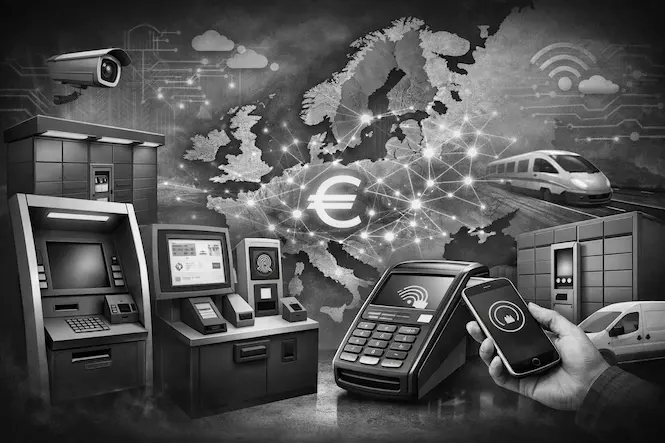
Europe is one of the most advanced — and complex — self-service markets in the world. Adoption is driven not just by labor economics, but by regulatory mandates, payment diversity, and dense urban infrastructure.
Compared to the U.S., Europe often deploys more kiosks per location, particularly in QSR, ticketing, and transportation environments. At the same time, compliance requirements such as the European Accessibility Act (EAA) and EN 301 549 are reshaping how kiosks are designed, specified, and deployed.
McDonalds, Burger King, Popeyes are all examples of restaurants that are often totally self-service with 20 kiosks versus 3 in the US version. Outdoor is tougher too which makes drive-thrus more problematic.
This guide provides a complete view of the European self-service landscape, including market structure, standards, payments, vendors, and deployment considerations.
## Why Europe Is Different
Regulatory-first market
- Accessibility is not optional
- EAA enforcement deadlines (2025–2026)
- EN 301 549 as baseline
Europe = compliance-led design
Fragmented but mature
- 27+ markets
- Different languages, currencies, regulations
- Local integrators matter more
- Think of the US with all its separate regions.
No “one-size deployment”
Personal Anecdote — Craig grew up in Oklahoma but ended up moving to Minnesota. Went to work Target Club Wedd bridal registry. Became project manager. At one meeting the idea of a tailored UX came up. The reason? Because our next units were going to Oklahoma and “we all know” what those people are like (compared to Boston). Took me a minute to compose myself….
Higher unattended density
- QSR: often 5–10 kiosks vs 2–4 in U.S.
- Transit & ticketing deeply embedded
- Parcel lockers mainstream
Europe = operational scale leader
## Standards and Compliance
This should link HARD into your standards pillar.
Key frameworks:
- EAA (European Accessibility Act)
- EN 301 549
- GDPR (data/privacy)
- PCI DSS (payments)
What it means for kiosks:
- Screen reader compatibility
- Reach and height compliance
- Audio + tactile interfaces
- Multilingual support
This is where Europe leads globally
## Payments in Europe
Key realities:
- Contactless dominant
- Cash still relevant (Southern/Eastern Europe)
- Local schemes (not just Visa/Mastercard)
Implications:
- Multi-payment support required
- Terminal certification complexity
- Cash + card hybrid still common
Europe = payment diversity complexity
## Hardware and Deployment Models
Typical configurations:
- Wall-mounted (space constrained)
- Outdoor hardened units (transit)
- Multi-unit clusters (QSR)
Key differences vs U.S.:
- Smaller footprint
- More modular
- Often longer lifecycle expectations
## Software and Integration
- Multilingual UI is mandatory
- Country-specific integrations
- VAT/tax handling differences
- Payment orchestration varies by region
## Key European Companies
(Internal links + soft directory pull from kioskeurope)
Examples to include:
- Pyramid Computer
- imageHOLDERS
- ACRELEC Europe
- Storm Interface
- PARTTEAM
- Prestop
- Wavetec
- See kioskeurope.org for full list
Keep this curated, not exhaustive
## Market Data and Trends
Pull your strongest insights here:
- UK = leader
- France = scale
- Italy = fast growth
- Eastern Europe = leapfrog adoption
“Europe often deploys 2–3× more kiosks per site than U.S.”
## Vertical Use Cases
QSR
- Self-order dominant
- High density deployments
Transportation
- Ticketing + wayfinding
- Outdoor reliability critical
Retail
- Self-checkout + endless aisle
Government / Public
- Identity + service access
## Edge AI in Europe
- Privacy-first → favors edge inference
- Multilingual AI interfaces
- Regulation impacting cloud usage
- See our AI hub
## Deployment Checklist
- Compliance first (EAA / EN 301 549)
- Multi-language UI
- Multi-payment support
- Service coverage across countries
- Hardware serviceability
- Remote management
- Lifecycle planning (5–7 years)
## Common Mistakes
- Assuming U.S. model translates directly
- Ignoring compliance early
- Underestimating payments complexity
- Not planning for localization
- Weak service network
## Internal Links
- https://kioskindustry.org/standards/
- https://kioskindustry.org/kiosk-services/
- https://kioskindustry.org/kiosk-hardware/
- https://kioskindustry.org/kiosk-software/
- https://kioskindustry.org/restaurant-self-service-technology/
- https://kioskindustry.org/faq/
- https://kioskeurope.org