Last Updated on February 3, 2026 by Craig Allen Keefner
The Cost of Poor Service for Kiosks
In 2025, a long-standing in-person service option for U.S. taxpayers quietly came to an end — the Internal Revenue Service’s self-service Taxpayer Assistance Center (TAC) kiosks. After years of mixed performance and declining usage, the IRS has officially discontinued its kiosk program at physical offices nationwide.
Insights — classic reverse case study on kiosk maintenance and the cost for not executing ($500K federal contract). Nice to see my Stubby kiosks from KIS lasting as long as they did but not surprised the trackballs and keyboard gave out. Probably one of the original Dell optiplex PCs in it running XP.
📉 Outdated Technology and Operational Challenges
Originally deployed more than a decade ago, the Taxpayer Assistance Center kiosks were designed to give walk-in taxpayers a self-help alternative to staffed service counter interactions — including:
-
Access to Free File and other online IRS services
-
Retrieval of prior year tax transcripts
-
Employer Identification Number (EIN) applications
-
Other digital IRS tools
However, a Treasury Inspector General for Tax Administration (TIGTA) review found major issues with the program. As of April 2024, only about half of the 100 kiosks located across 37 TACs were operational — with roughly 40 completely inoperable and 5 whose status was unknown.
The contractor responsible for maintenance was slow to respond to breakdowns, leaving many machines unusable for extended periods — in some cases over a year. This poor performance ultimately led the IRS not to renew the approximately $500,000 annual kiosk support contract for 2025.
✂️ Program Discontinued, But IRS Eyes Modern Alternatives
By mid-August 2025, the IRS confirmed it had begun scrapping the kiosk program altogether. Officials cited:
-
A sharp decline in kiosk usage (from tens of thousands of users in earlier years to only a few thousand annually)
-
Equipment that had become outdated and unreliable
-
A strategic shift toward online and mobile self-service tools that taxpayers are increasingly accustomed to using
While the physical kiosks are being phased out, TIGTA and other oversight bodies have recommended that the IRS consider modernized self-service options, such as updated hardware or laptop-based digital access at certain locations — particularly to support users without reliable home internet access.
📲 What This Means for Taxpayers
With the kiosk program shuttered:
-
Walk-in taxpayers will no longer find standalone terminals at TACs.
-
The IRS is emphasizing digital service channels and remote self-service tools.
-
For taxpayers without internet access, traditional in-person assistance and staffed help remain available through TAC appointments.
The end of the kiosk experiment reflects broader trends at the IRS: modernizing taxpayer services while retiring legacy systems that fail to keep pace with user expectations and technology evolution.
📌 IRS Kiosk Maintenance Contract — What’s Publicly Known
-
The IRS awarded a firm fixed-price contract in June 2021 to a vendor for monitoring and maintaining its self-service kiosks at Taxpayer Assistance Centers (TACs).
-
The contract was worth about $500,000 per year and included responsibilities such as hardware support, network connectivity, printer support, live helpdesk, on-site services, cabling, and reporting to the IRS program manager.
-
The IRS was in Option Year 3 of the contract during the 2023–2024 review period, and it ultimately did not exercise the 2025 option year, effectively ending the program.
-
Public news and watchdog reporting all refer to “the contractor” or “a vendor” without publicly disclosing the company name.
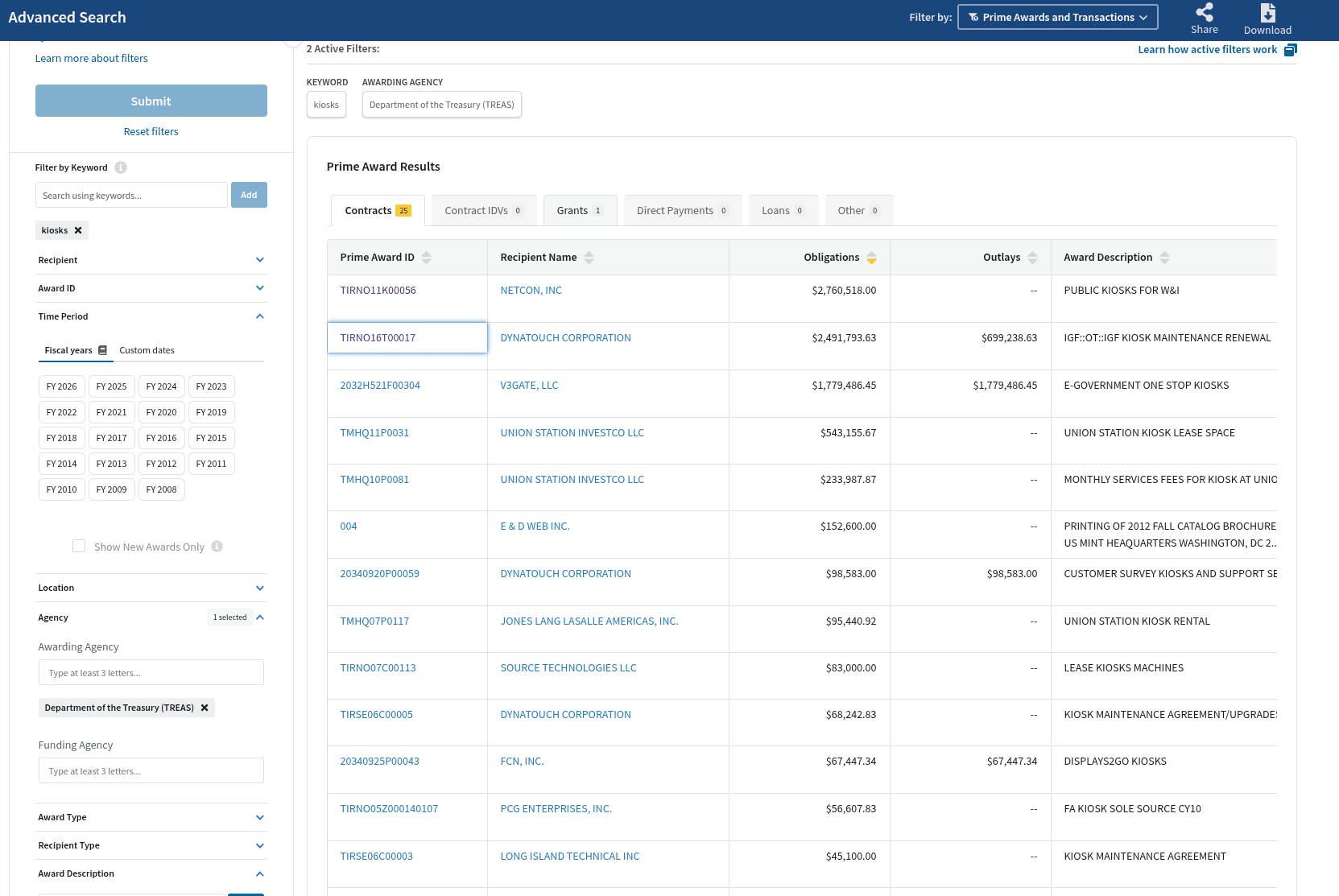
- USA Spending Search brings up Netcon and Dynatouch — that makes some sense as the kiosks are definitely Kiosk Information Systems kiosks (Stubby) and Dynatouch was purchasing kiosks from KIS back in the early 2000s.
IRS Tax Kiosk KIS