Last Updated on March 20, 2026 by Craig Allen Keefner
How Vending is Driving Electronic Payments
The unattended retail sector—spanning vending machines, micro markets, and smart stores—has rapidly evolved into a sophisticated, high-value retail channel powered by digital payments and automation. In vending automation, the big majority of cash payments are for small dollar items. And that is where the change is coming.
Cashless payments removed the industry’s biggest barrier: dependence on cash. Today’s advanced terminals support contactless cards, mobile wallets, and tap-to-pay, which now account for 77% of cashless transactions in North America and 94% in the U.K. Importantly, cashless transactions generate 26% higher average ticket values, directly increasing revenue.
Consumer adoption is driven by:
-
Speed and convenience (49% cite speed as the primary benefit)
-
Reduced human interaction (33% value low-contact transactions)
Operationally, integrating payment systems with telemetry and inventory platforms enables:
-
Real-time sales and stock visibility
-
Predictive analytics and demand forecasting
-
Dynamic pricing strategies
-
Over 20% reduction in operating costs
Micro markets and smart stores significantly outperform traditional vending:
-
150–400 SKUs vs. ~40 in vending
-
~4× higher sales volume per location
-
Smart store average ticket: $4.25 vs. $2.11 for traditional vending
AI, computer vision, RFID, and embedded scales further enhance automation by:
-
Automatically identifying products
-
Eliminating checkout lines
-
Reducing shrink
-
Improving user experience
The sector’s electronic payment volume is projected to reach $118 billion by 2029, growing at a 21% CAGR, fueled by higher-ticket sales, expanded product categories (fresh food, pharma, electronics), and deployments in high-traffic environments.
Bottom Line:
Unattended retail is no longer just vending—it is becoming a scalable, data-driven, AI-enabled retail infrastructure platform and a major growth engine for electronic payments and automated commerce.
Blair released nice WilliamBlair_Unattended-Retail-Driving-Incremental-Growth-of-Electronic-Payments in late 2025. Here is a summary
Executive Brief
Unattended Retail: A Structural Growth Engine for Electronic Payments
(Source: William Blair Industry Report, August 2025
Strategic Thesis
Unattended retail—vending, micro markets, and smart stores—is transitioning from a low-ticket convenience channel into a high-growth, technology-driven retail infrastructure platform.
This shift is materially accelerating cashless adoption, payment volume growth, and average ticket expansion, creating long-term upside for payments providers, operators, and automation vendors.
Market Snapshot
-
~14.8M vending machines globally
-
Only 44% connected (2023) → 71% expected by 2028
-
Cashless vending payment volume projected to reach $118B by 2029
-
~21% CAGR expected in cashless vending volume
Significant white space remains in small-ticket digital conversion.
Key Growth Drivers
1. Cash-to-Card Conversion
-
43% of U.S. transactions ≤ $5 still use cash
-
Tap-to-pay dominates cashless adoption:
-
77% of U.S./Canada unattended cashless transactions
-
94% in U.K. markets
-
-
Cashless transactions generate +26% higher ticket sizes
Implication: Strong tailwind for card networks, acquirers, and processors.
2. Higher-Ticket Mix Shift
-
Vending high-ticket mix: 9% (2017) → 16% (2024)
-
Fresh food, robotics-prepared meals, OTC/pharma, electronics expanding category reach
-
Examples: Farmer’s Fridge, robotics food automation, specialty retail vending
Implication: Ticket size expansion drives revenue without requiring location growth.
3. Micro Markets: Step-Change Economics
-
150–400 SKUs vs ~40 in vending
-
~10x sales per device uplift
-
~3.6x–3.9x sales per location uplift
-
+27% higher average ticket
Shift from workplace-only deployments toward hospitals, residential, transit, and public venues.
Implication: Structural margin and revenue expansion for operators.
4. Smart Stores (AI + Computer Vision)
Smart stores combine:
-
Pre-authenticated entry
-
Computer vision + sensors
-
Automated checkout
Average ticket:
-
$4.25 vs $2.11 vending (+100%)
Enables deployment in:
-
Airports
-
Hospitality
-
Healthcare
-
Sports & entertainment
-
High-traffic public locations
Implication: Smart stores reduce shrink while scaling unattended retail into mainstream retail footprints.
Industry Consolidation
-
Ongoing M&A among payments, telemetry, and software providers
-
Large operators now control ~65% of industry sales
Consolidation improves:
-
Economies of scale
-
Data leverage
-
Integrated platform offerings
Financial Impact (Pure-Play Leaders)
Nayax
-
$4.9B payment volume (2024)
-
Targeting 35% revenue growth, 30% EBITDA margin
Cantaloupe
-
$3.3B payment volume
-
Acquired at ~13.8x EBITDA
Executive Takeaways
-
Unattended retail is no longer just vending—it is automated retail infrastructure.
-
Cashless conversion remains materially underpenetrated in small-ticket environments.
-
Micro markets and smart stores fundamentally change per-location economics.
-
AI, telemetry, and payment integration drive margin expansion and shrink reduction.
-
Electronic payments ecosystem participants (Visa, Mastercard, Fiserv, Adyen, Shift4, etc.) are structural beneficiaries.
Bottom Line
Unattended retail represents a durable, technology-enabled growth channel for electronic payments and automated commerce.
As higher-ticket mix, smart-store deployment, and connected device penetration expand, the sector is positioned to move from incremental growth driver to strategic pillar within the broader retail and payments ecosystem
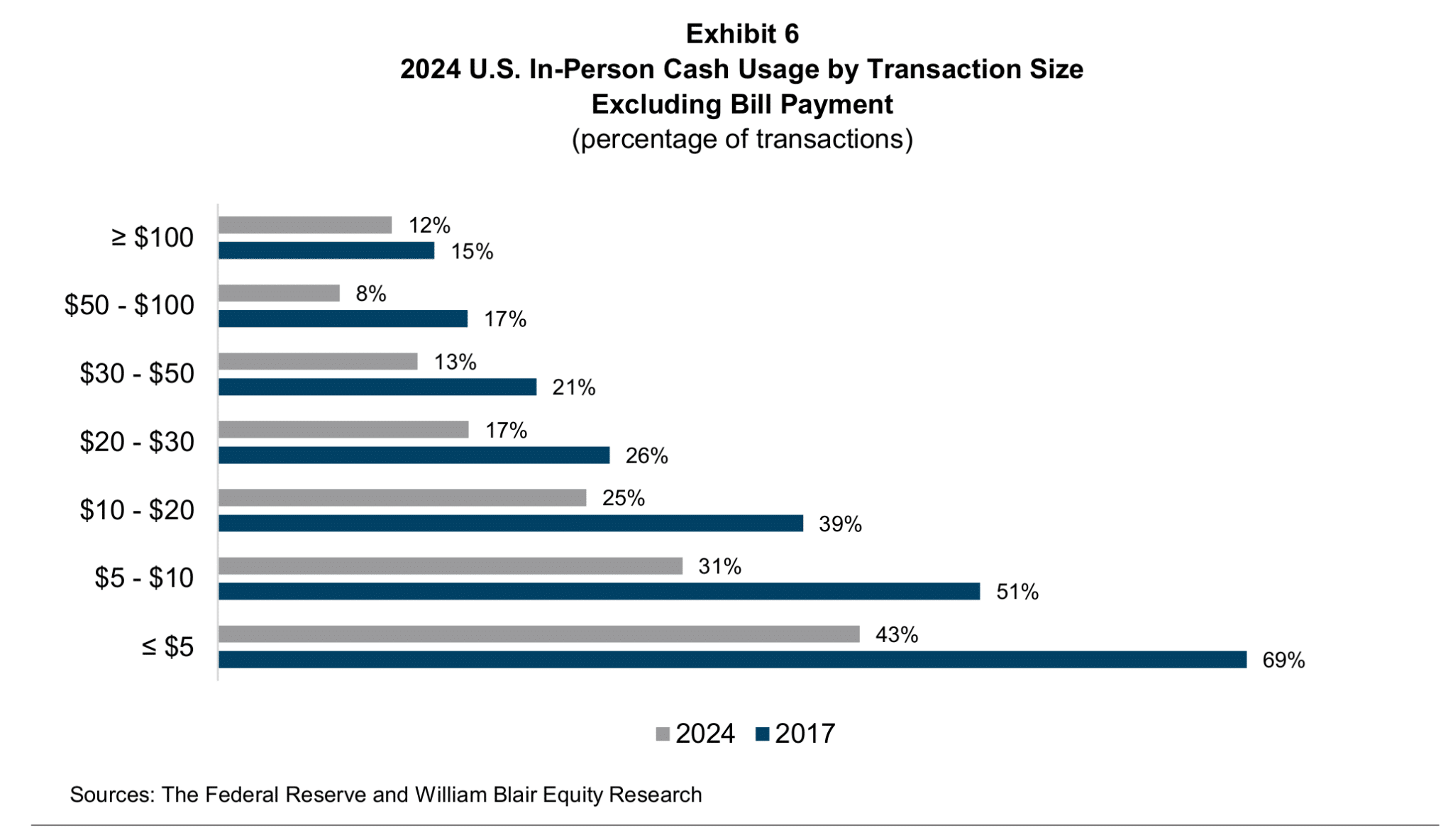
The use of cash for low-ticket transactions follows similar trends in Europe