Last Updated on March 25, 2026 by Craig Allen Keefner
Your Mobile Phone As your SCO
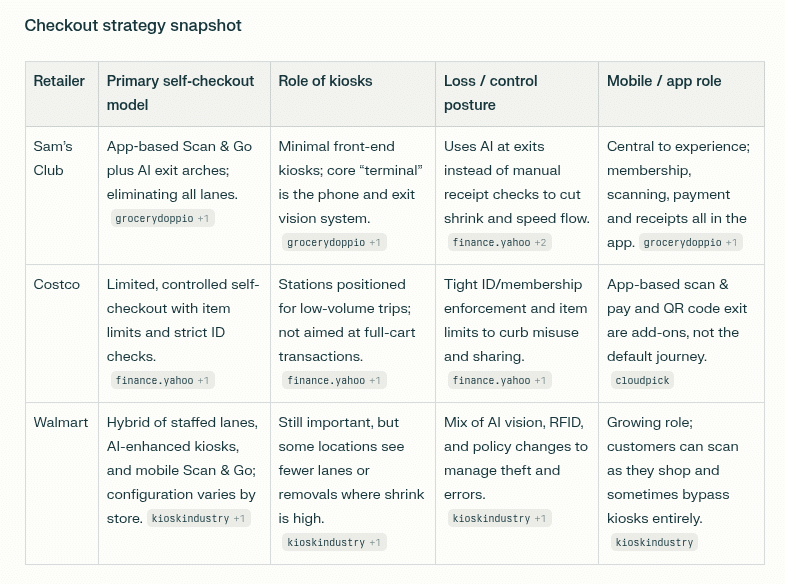
Self-checkout is no longer just a row of terminals at the front of the store. Sam’s Club is in the middle of a radical experiment: remove traditional lanes altogether and replace them with mobile Scan & Go plus AI-powered exit verification. Costco and Walmart are moving in almost opposite directions, revealing three very different answers to the same question: what does “self-service” look like in a world of vision AI, edge computing, and rising shrink?
Sam’s Club: when the phone becomes the kiosk
Sam’s Club is betting the future of its checkout on a simple idea: the member’s smartphone is the primary self-service device. Traditional staffed and self-checkout lanes are being phased out in favor of Scan & Go in the app and computer-vision “exit arches” that verify the basket in seconds as shoppers leave.
From a kiosk and self-service perspective, the architecture matters more than the app branding.
-
The fixed POS and self-checkout terminals at the front end shrink dramatically; the “front end” effectively moves into the aisle and into the shopper’s hand.
-
AI-powered gates at the exit become the critical control point, comparing the digital receipt to what is actually in the cart without a human manually scanning items or checking paper receipts.
Sam’s has publicly tied Scan & Go usage to higher visit frequency, higher spending, and stronger renewal rates among engaged members. That makes this more than a cost-cutting exercise: frictionless self-service plus strong membership data is being treated as a growth engine.
Costco: controlled self-checkout and human-first front ends
If Sam’s is deleting the front end, Costco is tightening it. Costco has dialed back and re‑shaped its self-checkout footprint, using item limits, stricter ID checks, and closer supervision to manage fraud, membership sharing, and user frustration. Self-checkout is positioned as a “quick trip” convenience — not as the default for full-cart warehouse shopping.
Costco is experimenting with app-based scan and pay and digital verification, but it is doing so within a model that still prioritizes staffed checkout as the backbone for big transactions. For kiosk stakeholders, Costco’s strategy emphasizes:
-
Self-service as a supplement to, not replacement for, high-touch lanes staffed by trained cashiers.
-
Risk control first, automation second: technology is deployed to reinforce the existing operating model rather than rewrite it.
In this framework, kiosks and terminals are still the primary points of interaction at the front end, and the store remains a classic hardware-centric self-service environment with guardrails.
Walmart: hybrid and hyper-local self-checkout strategy
sams self-checkout comparison
Walmart lands between Sam’s Club’s aggressive mobile-first play and Costco’s guarded approach. Across the fleet, Walmart continues to invest in self-checkout, but it is selectively reducing or even removing self-checkout in some stores while expanding staffed lanes where shrink and congestion are problematic.
At the same time, Walmart is one of the most active experimenters with AI-enhanced kiosks, computer vision, and mobile Scan & Go, including pilots that blend traditional barcode scanning with cameras and sensors for real-time validation. For the kiosk industry, Walmart’s model highlights:
-
A hybrid front end where self-checkout kiosks, staffed lanes, and mobile self-scanning coexist, tuned store-by-store to risk and demographics.
-
Increasing use of AI at the terminal (and behind it) to detect anomalies, reduce mis-scans, and guide associates to intervene when needed, rather than removing hardware outright.
This “configuration as a variable” strategy keeps kiosks central to the experience while quietly shifting more intelligence and decision-making into the software layer.
What it means for kiosk and self-service providers
The contrast between Sam’s Club, Costco, and Walmart is not just about brand philosophy; it marks a structural change in how self-service gets delivered. Sam’s Club treats the fixed terminal as optional, relying on mobile, edge AI, and computer vision at the exit to harden an almost invisible checkout experience. Costco doubles down on staffed lanes and constrained self-checkout, prioritizing human control and membership integrity over maximum automation. Walmart, meanwhile, keeps kiosks in the mix but uses AI and configuration flexibility to find the right balance between automation, labor, and loss prevention store by store.
For kiosk and self-service suppliers, a few implications stand out.
-
The value is shifting from the box to the stack: computer vision, edge AI, fraud controls, and tight integration with mobile and loyalty are becoming as important as the physical terminal itself.
-
“Self-checkout” now spans fixed kiosks, phones, sensors, and gates, which opens room for new devices but also pressures traditional front-end hardware to evolve or risk being bypassed entirely.
For us, Sam’s Club offers a clear look at a post-lane front end, while Costco and Walmart show why many retailers will keep living in a hybrid world for years: hardware is still crucial, but the winning play marries it to AI, mobile, and being smarter at the edge.
What About…?
Relying on a phone-centric model absolutely raises inclusion and accessibility questions, even if the SKU count and store format make Sam’s easier to automate than a full-line Walmart. The design risk is shifting from “can you reach the kiosk” to “do you have, understand, and trust the app,” which is a different kind of barrier.
Mobile-only and who gets left out
Sam’s is signaling a future where Scan & Go is the primary, and in many clubs the only, way to check out, with AI verification at the exit. Even with very high smartphone penetration among 50+ adults, there is still a meaningful minority who either don’t own a modern device, don’t install retail apps, or are not comfortable managing payments on a phone.
Groups at risk of being excluded or frustrated include:
-
Shoppers without smartphones, low-income members on limited data plans, or people with older devices that struggle with new apps.
-
Customers with lower digital literacy or “app fatigue” who resist yet another login, password, and payment set-up for routine shopping.
Accessibility and ADA implications
Accessibility law and litigation around self-service have focused so far on kiosk reach, tactile controls, and non-visual access, but the same principles apply to mobile-first journeys. If a retailer effectively makes app use a condition of service, that app and the surrounding flow have to work with screen readers, voice control, and assistive tech, and there must be reasonable alternatives when they don’t.
Key angles:
-
Visual and motor impairments: small tap targets, complex navigation, and fast time-outs can make app-based checkout unusable for some, just as inaccessible touchscreens did in earlier kiosk lawsuits.
-
Cognitive load: forcing customers to juggle membership, scanning, coupons, and payment in an app can overwhelm some users, especially under time pressure in a busy club.
How Sam’s is trying to backstop it
Sam’s has indicated that associates with mobile devices can scan and check out members who don’t or won’t use Scan & Go, effectively turning staff tablets into roving POS for edge cases. That mitigates some exclusion, but it’s operationally fragile: if staffing is tight, the “fallback path” becomes slow or invisible, and those customers feel second-class compared to app users.
From an accessibility and customer-experience standpoint, best practice would be:
-
Clear, in-store signage that non-app options exist and where to get help, rather than quietly assuming everyone will install the app.
-
Ensuring the mobile app itself meets WCAG/ADA expectations (screen reader support, high contrast, alternative input), plus training associates to proactively assist members who appear stuck.
Takeaway
Sam’s is showing what happens when SKU simplicity meets aggressive digital transformation, but also that mobile-only pushes the accessibility surface area off the kiosk and onto the phone. Self-service providers and retailers will have to design for:
-
“No-lane” environments and “no-phone” customers at the same time, using staff-held devices, secondary kiosks, or assisted-service flows as a safety net.
-
An expanded view of ADA and inclusive design that covers both physical kiosks and required mobile apps as a single, end-to-end experience.
Privacy?
Sam’s Club’s new model is very camera‑heavy, but the company says it is not using biometrics like facial recognition on members in the exit flow today. The privacy issues are still real, though, because you have persistent cameras tied to an account-based, app-driven journey.
What tech Sam’s is using
Sam’s AI “arches” at the exit use multiple 4K cameras and computer vision running on edge GPU servers to capture images of the entire cart and match them to a recent receipt in real time. The system focuses on identifying items and associating them with a transaction, whether paid via Scan & Go or a register, and has been rolled out to roughly all 600 clubs.
Sam’s CTO has explicitly said that the exit system does not use facial recognition or biometrics and does not look at “human characteristics” to identify members; the stated purpose is item recognition only. Some deployments also add RFID in the exit truss to assist the AI in validating what’s in the cart.
Privacy and data concerns
Even without biometrics, this is still a dense data environment: the app ties purchases, visit patterns, and in‑club behavior to a named membership account, and the computer‑vision system records carts and movement through the exit. Privacy advocates have already flagged concerns about how long video and sensor data are retained, how they are linked to profiles, and whether they might later be repurposed for more intrusive uses like behavioral scoring or face recognition.
Sam’s Club’s privacy notice allows for biometric data in specific use cases (for example, virtual try‑on features that scan a customer’s face for eyewear fitting in the app), which shows the company is at least open to biometric processing in some contexts, even if the exit arches are currently item‑only. That makes transparency and clear limits on use and retention essential if they want to maintain trust while pushing a no‑lane, camera‑rich model.
Reference Links
- https://corporate.walmart.com/about/samsclub/sams-club-privacy-notice
- https://www.latimes.com/california/story/2025-05-02/sams-club-is-adding-ai-to-the-shopping-experience-why-are-private-advocate-groups-worried
- https://www.modernretail.co/technology/sams-club-sees-success-in-removing-checkout-lanes-at-one-store-but-its-still-just-a-test/