

Last Updated on September 19, 2026 by Craig Allen Keefner
Accessibility is probably the most misunderstood—and most frequently talked-about—risk in kiosk deployment.
Everybody says they are “compliant,” but that word is fuzzy. Compliant with what? Which standard? And, more importantly, to what degree? A kiosk can have a few accessible features and still fail badly for a blind user, a wheelchair user, someone with limited reach, or a user who cannot use a touchscreen.
In the U.S., enforcement has been spotty at best. Regulations keep getting delayed, watered down, or simply left sitting on the shelf. The U.S. Access Board has moved slowly, and now ADA Title II deadlines have been delayed as well. Technical guidelines are useful, but without enforcement, procurement requirements, or litigation pressure, they are often just that: guidelines.
Europe looks different. The European Accessibility Act, or EAA, has real teeth. For companies selling into Europe, accessibility is increasingly a market-access issue, not a nice-to-have feature that can be added later.
Insight by Intel
We generally recommend talking with organizations and suppliers that actually understand the subject—not just companies that say “ADA compliant” on a spec sheet. Vispero, Tech for All, Dot Inc., and Storm Interface are all worth knowing.
There is also what might be called the “accessibility paint job.” You see it often, particularly with ATMs and other financial terminals. The hardware looks accessible: maybe it has a headphone jack, raised markings, a lower screen, or an ADA symbol. But when you actually try to use it, the experience is incomplete. Audio guidance may not work through the whole transaction. Touch targets may be poorly designed. The card reader, cash dispenser, receipt printer, or keypad may still be out of reach. The software may be the real problem.
That is why accessibility has to be evaluated as an end-to-end user journey—not as a checklist of hardware parts.
Where Things Stand
As of April 18, 2026, kiosk and self-service accessibility is being shaped by updated digital-accessibility rules in the United States, existing ADA obligations, and much more specific requirements under the EU’s EAA.
U.S. ADA Title II: Delayed One Year
State and local governments must meet WCAG 2.1 AA requirements for web and mobile content, with deadlines now falling in 2026–2027 depending on the size of the entity. Those requirements are already influencing public-sector kiosk software, digital-service contracts, and procurement specifications.
The problem is familiar: having a technical standard is not the same as having enforcement. If there is no meaningful enforcement mechanism, accessibility often becomes a box to check during procurement and then gets forgotten during design, testing, deployment, and support.
We are watching the EAA more closely.
HHS Section 504: Healthcare Is a Major Area
Healthcare organizations and entities receiving HHS funding must also meet WCAG 2.1 AA digital-accessibility requirements by 2026–2027. That can include patient-facing kiosk experiences such as check-in, registration, appointment workflows, portals, payments, and wayfinding.
For healthcare kiosks, the key point is that accessibility cannot stop at the screen. The complete experience matters: physical access, audio output, privacy, workflow timing, readable content, payment, receipt delivery, and staff assistance when technology fails.
U.S. ADA Title III: Still No Kiosk-Specific Rule
There is still no broad new ADA Title III rule written specifically for kiosks. Private-sector kiosks remain subject to general ADA obligations, including effective communication and barrier removal, along with the 2010 ADA Standards covering items such as reach ranges and operable parts.
That leaves plenty of gray area. Private industry in the U.S. can often choose to be a follower until a customer demands accessibility, a contract requires it, or a lawsuit arrives. That is not a very good strategy, but it remains common.
EU EAA: More Specific and More Enforceable
The EU’s European Accessibility Act has been in force since mid-2025 and explicitly covers self-service terminals. New kiosks placed on the European market need to meet accessibility requirements. Existing fleets have transition time, but that transition is not unlimited: the useful-life allowance is capped at 20 years.
That changes the conversation. In Europe, accessibility is not just a possible legal exposure or a procurement preference. It can determine whether a product can be sold, deployed, or retained in the market.
The Practical Difference
The EU approach has more direct market-access consequences and can include significant penalties, potentially tied to revenue. In the U.S., pressure is more fragmented:
-
Federal deadlines and funding conditions, especially in government and healthcare
-
Procurement specifications requiring WCAG or accessibility conformance reports
-
State and local government requirements
-
Civil litigation and settlement risk
-
Customer and brand pressure
The private sector in the U.S. still has room to wait and follow. In Europe, that room is narrowing quickly.
The bottom line: do not accept “accessible” or “compliant” as an answer. Ask which requirements apply, what was tested, who tested it, whether real users participated, and whether the entire transaction can be completed independently.
Global View
For kiosks and self-service, we will organize these into three different layers:
- Policy / Legal Authority
- Technical Standards Body
- Implementation Guidelines
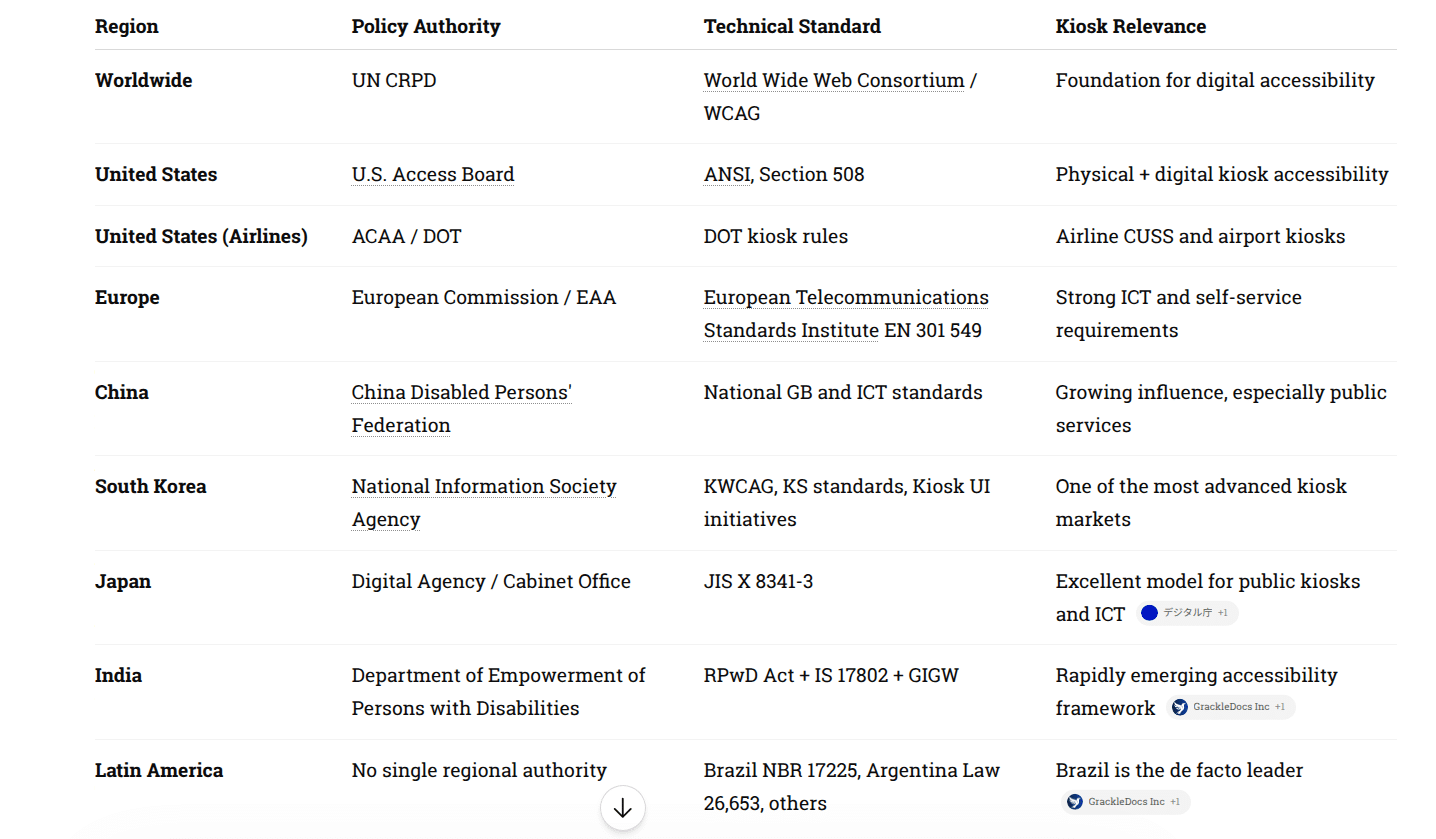
Global Regulatory
Global
-
WCAG (Web Content Accessibility Guidelines) / W3C — The de facto international benchmark for digital accessibility; WCAG 2.2 is referenced by virtually every national law and standard on this list, making it the foundational technical reference for accessibility conformance worldwide.
-
UN Convention on the Rights of Persons with Disabilities (CRPD) — The international human-rights treaty (Article 9) that obligates signatory states to ensure access to information and communications technologies, which is the legal root from which most national digital accessibility mandates grow.
-
ISO 9001-2026 — This is a quality-management standard, not an accessibility standard. Related to accessibility are ISO 30071-1 (ICT accessibility) or ISO 9241-171 (software accessibility), which are the relevant ISO accessibility references.
North America
-
U.S. Access Board — The federal agency that writes the accessibility standards (Section 508, ADA guidance) binding U.S. government agencies and heavily influencing private-sector litigation benchmarks.
-
ANSI — The U.S. standards coordinator whose member-developed standards (e.g., via RESNA) underpin assistive technology and accessible design requirements.
-
U.S. DOT / Air Carrier Access Act (ACAA) — The regulation requiring U.S. airlines and airport kiosks ( ticketing/check-in machines) to be accessible, making it directly relevant to kiosk and self-service terminal deployments.
-
UL Solutions — The safety-certification body that has expanded into accessibility certification for kiosks and self-service products, giving manufacturers a third-party verification route beyond legal minimums.
-
VPAT (Voluntary Product Accessibility Template) — The standardized reporting template (maintained by the Information Technology Industry Council, ITI) that vendors use to document how their products conform to accessibility standards — covering WCAG, Section 508, and EN 301 549; it has become the de facto procurement document that buyers worldwide request as proof of accessibility conformance.
-
Section 508 — Revised Standards (including Mobile) — The 2017 refresh of the U.S. federal accessibility standards incorporates WCAG 2.0 by reference and explicitly applies to all information and communications technology, including mobile apps and native mobile applications used by federal agencies, making it a binding legal requirement for any vendor selling into the U.S. federal market.
-
Section508.gov — Mobile Accessibility Guidance — Practical federal guidance for designing, developing, and testing accessible mobile apps.
-
GSA’s Accessibility Requirements Tool (ART) — Helps agencies generate Section 508 requirements (and VPAT/ACR expectations) for procurement solicitations, including mobile software acquisitions.
HHS Section 504 Final Rule (45 CFR Part 84) — “Web, Mobile, and Kiosk Accessibility” — HHS’s May 9, 2024 rule (effective July 8, 2024) is the first federal regulation to explicitly require WCAG 2.1 Level AA conformance for web content and mobile apps across all HHS-funded health and human service programs, extending far beyond federal agencies to hospitals, clinics, and FQHCs receiving federal funds.
- Kiosk provision — 45 CFR § 84.83 (eCFR) / § 84.83 (Cornell LII): States a general nondiscrimination mandate — no qualified individual with a disability may be excluded from or denied the benefits of any recipient program provided through kiosks. Notably, no specific technical standard is prescribed for kiosks (unlike the WCAG 2.1 AA standard for web/mobile); HHS deliberately left the technical requirements open, pointing to the U.S. Access Board’s ongoing self-service transaction machine rulemaking as the future source of kiosk-specific standards. Workarounds (e.g., staff-assisted alternatives) are permitted only if they offer equal access, convenience, and confidentiality.
- The document is an interim final rule from DOJ extending Title II compliance from April 24, 2026 to April 26, 2027 for large entities and from April 26, 2027 to April 26, 2028 for smaller entities and special districts.
- DOJ justifies the delay based on underestimated costs, staffing/resource limits, slow accessibility tech progress, and litigation risk, especially for small governments and education.
- The preamble says DOJ still “fully anticipates implementing the regulation at the new deadline” unless further circumstances arise, and it plans a separate future rulemaking on substance—but again, this is only for Title II.
- HHS’s Section 504 digital rule (with May 2026/May 2027 dates) is a different statute, different agency; nothing in this DOJ action suggests HHS is reconsidering or is required to reconsider its own compliance dates.
Status as of September 2026
- Litigation: Nine states (Texas v. Kennedy, N.D. Tex.) are challenging the rule, including its kiosk, web, and medical equipment provisions; after a long pause, the case is proceeding toward summary judgment, with state briefs filed May–July 2026. The rule remains in effect while the case is pending.
- Deadline extension: On May 7, 2026, HHS OCR issued an Interim Final Rule extending the WCAG 2.1 AA compliance deadlines by one year — recipients with 15+ employees now have until May 11, 2027; smaller recipients until May 10, 2028. The § 84.83 kiosk nondiscrimination obligation itself is already operative, since it has no technical-standard grace period.
Europe
-
ETSI — The standards body producing EN 301 549, the harmonized European standard for ICT accessibility that is the technical backbone of the EAA and public procurement rules.
-
European Accessibility Act (EAA) — Landmark EU directive (in force since June 2025) mandating accessibility for products and services — including kiosks, ATMs, e-commerce, and banking — sold in the EU market, with enforcement by member states.
China
-
China Disabled Persons’ Federation (CDPF) — The state-recognized organization representing people with disabilities that drives China’s web accessibility standards (e.g., YD/T standards for accessible websites) and compliance advocacy.
South Korea
-
National Information Society Agency (NIA) — The government agency that administers Korea’s Web Accessibility Quality Certification (WA mark) program and the Web Accessibility Hub, including the national kiosk accessibility guidelines.
-
Korea Kiosk UI Association — Korea’s kiosk accessibility work runs largely through NIA’s Kiosk UI Platform (wah.or.kr), which provides standardized accessible kiosk interface templates reflecting Korea’s strict kiosk accessibility enforcement.
Japan
-
Digital Agency (デジタル庁) — The government body driving Japan’s “no one left behind” digital transformation, including JIS X 8341-3 conformance requirements for government web services.
-
JIS X 8341 Committee (JISC) — The Japanese Industrial Standards committee whose JIS X 8341-3 standard mirrors WCAG and is legally referenced by Japan’s Act on Elimination of Discrimination against Persons with Disabilities.
India
-
Department of Empowerment of Persons with Disabilities (DEPwD) — The ministry implementing the Rights of Persons with Disabilities Act 2016, whose rules (Gazette 2022) mandate government ICT accessibility.
-
Bureau of Indian Standards (BIS) — India’s national standards body, which published IS 17802 — a WCAG-aligned web accessibility standard.
-
Guidelines for Indian Government Websites (GIGW) — The mandatory compliance framework for all Indian government websites, embedding WCAG 2.0 Level AA as a binding requirement.
Latin America
-
Brazil — Brazilian Inclusion Law (Lei 13.146/2015) + ABNT NBR 17225 — The LBI makes digital accessibility a civil right (Art. 63 mandates accessible websites for companies and government), and NBR 17225 (published March 2025) gives Brazil a national, WCAG 2.2-aligned technical standard with 146 testable items, removing ambiguity about what compliance means.
-
Argentina — Law 26,653 on Accessibility of Information on Web Pages — Argentina’s pioneering 2010 law requiring WCAG conformance for all national public-sector websites, making it one of the earliest digital accessibility mandates in Latin America.
For enterprise kiosk manufacturers, the practical compliance hierarchy is usually:
WCAG → ETSI EN 301 549 → U.S. Access Board → Regional standards (JIS X 8341, IS 17802, KWCAG, GB standards)
That is the stack most multinational self-service vendors end up designing against. It also maps well to healthcare, retail, transportation, and government kiosks.
Recent Delay
The Interim Final Rule 2026-07663 only delays DOJ’s ADA Title II web/mobile compliance dates by one year; it does not touch HHS’s Section 504 digital accessibility rule, and there is no indication that HHS will mirror DOJ’s delay at this time.
Executive Reality
- ADA = legal risk (U.S.)
- EN 301 549 = functional accessibility (EU)
- EAA = market access (Europe)
- WCAG = interface behavior
None of these tell you how to build a kiosk.
All of them determine if you can deploy one.
There is no single global standard, no universal certification, and no simple checklist you can follow to guarantee compliance. Instead, accessibility is defined across multiple frameworks—physical, digital, and legal—that vary by region and often overlap in confusing ways.
In the United States, requirements are driven by prescriptive regulations like ADA and Section 508. In Europe, accessibility is defined through EN 301 549 and enforced through the European Accessibility Act (EAA). Across Asia-Pacific, standards exist but are fragmented and inconsistently applied.
The result is a reality most operators discover too late: a kiosk can be compliant in one region and unusable—or even illegal—in another.
This page breaks down how these standards actually work, how they differ, and what it takes to design and deploy kiosks that are truly accessible in real-world environments.
- CUSS Kiosk and CUTE Standards for Airports
- UL Kiosk Standards
- PCI Compliance Kiosk EMV – PCI Unattended Self-Service
- ANSI’s U.S. Standards Strategy 2026 – Kiosk Industry
- AV Standards – Kiosk Manufacturer Association
- EV Charging Standards – KMA.global
- ANSI Standards Readiness Checklist – 2026 | Kiosk Industry
The 4-Layer Model
The 4-Layer Accessibility Model for Kiosks
| Layer | Role | What It Covers | Risk if Ignored |
|---|---|---|---|
| ADA (U.S.) | Physical compliance | Reach, operability, tactile controls | Lawsuits |
| EN 301 549 (EU) | Functional ICT accessibility | Non-visual, cognitive, audio interaction | Product rejection |
| EAA (EU) | Legal enforcement | Market access requirements | Cannot deploy |
| WCAG (Global) | Digital UX | Screen flow, contrast, navigation | Usability failure |
Insight – Accessibility is not a feature. It is a system.
ADA (U.S.)
Key Points:
- Prescriptive, measurable requirements
- Examples:
- Reach ranges (15”–48”)
- Force limits (≤ 3.0N)
- Tactile controls required
- Audio output for ATMs
Insight – If you fail one number, you are non-compliant.
EN 301 549 (Europe Technical Standard)
EN 301 549 — Europe’s Accessibility Standard for ICT
Key Points:
- Procurement-driven standard
- Based on WCAG + functional requirements
- Focus areas:
- Usage without vision
- Usage without hearing
- Cognitive accessibility
- Assistive tech compatibility
Insight: EN 301 549 tells you what the outcome must be — not how to build it.
EAA (The Game Changer)
European Accessibility Act (EAA)
2025 changed everything.
- EAA enforces accessibility across:
- ATMs
- Ticketing machines
- Banking
- Transport
- E-commerce
- See our EAA Checklist
Insight: EAA does not define requirements — it enforces EN 301 549.
Insight: No compliance = no market access.
APAC Accessibility Landscape
- 🇯🇵 Japan — JIS X 8341 (structured, procurement-driven)
- 🇰🇷 Korea — most enforced in practice
- 🇨🇳 China — massive scale, inconsistent enforcement
Insight: APAC has no unified kiosk accessibility standard — which creates both risk and opportunity.
Real-World Kiosk Design Reality
What “Accessible” Actually Means for Kiosks
- Multimodal interaction (touch + audio + visual)
- No-vision workflows
- No-hearing workflows
- Cognitive simplicity
- Real-world testing (not lab-only)
Insight: Passing WCAG does not mean your kiosk is usable.
Documentation & Compliance
How Compliance Is Proven
- VPAT (Voluntary Product Accessibility Template)
- Self-declaration model (EU)
- Procurement validation
- Increasing legal exposure
- UL Listings
- Examples
Insight: There is no global “certification.” You own the claim.
Next Steps for Operators
- FAQ – What is a kiosk? Comprehensive, experience-driven knowledge base that answers practical questions on planning, deploying, securing, and optimizing self-service kiosks across industries like retail, QSR, and healthcare.
- Kiosk Hardware – Directory of kiosk manufacturers, software vendors, AI voice providers, payment devices, printers, and consulting firms across retail, healthcare, QSR, and more.
- Kiosk Software – an overview of the software layer that powers self-service—covering kiosk lockdown, device management, content delivery, remote monitoring, and application development across platforms like Windows, Android, and Linux.
- Edge AI – Curated hub that explores how edge AI, computer vision, and conversational interfaces are transforming self-service kiosks by improving performance, privacy, and real-time user interaction across industries.
What To Do
Where to Start
- Audit current deployments
- Map ADA + EN 301 549
- Build internal checklist
- Test with real users
Insight: The biggest accessibility risk is assuming you are compliant when you are not.
Frequently Asked Questions
- Does a kiosk that passes WCAG count as accessible?
- Not by itself. WCAG governs digital interface behavior — screen flow, contrast, navigation — but an accessible kiosk also needs multimodal interaction (touch + audio + visual), no-vision and no-hearing workflows, cognitive simplicity, and testing with real users in real environments. Passing WCAG is necessary; it is not sufficient.
- What does the HHS Section 504 rule require for kiosks specifically?
- Section 84.83 prohibits excluding people with disabilities from programs delivered through kiosks, but unlike the rule’s WCAG 2.1 AA mandate for web and mobile content, it prescribes no technical standard for kiosks. HHS deliberately left that open, pointing to the U.S. Access Board’s ongoing self-service transaction machine rulemaking. Staff-assisted workarounds are allowed only if they provide equal access, convenience, and confidentiality.
- Does the DOJ Title II delay change anything for kiosks?
- Not directly. The one-year delay (to April 2027/2028) applies to state and local government web/mobile content under Title II — a different statute and agency from HHS’s Section 504 rule, whose deadlines stand. However, Title II’s WCAG 2.1 AA requirements are flowing into kiosk software and service procurements, so government-facing kiosk vendors should still plan around the new dates.
- Which standard should a multinational kiosk manufacturer design against?
- The practical stack most vendors converge on: WCAG → ETSI EN 301 549 → U.S. Access Board (ADA/508) → regional standards (JIS X 8341, IS 17802, KWCAG, GB standards). Design to the top of the stack and most regional requirements fall out naturally.
Standards Library
- General Standards
- ADA
- ABA – very important adjunct
- PCI DSS EMV
- UL
- HIPAA
- Section 508
- AntiBacterial FDA
- Gaming (GLI)
- Cuss and Cute Airlines
- VPAT — Consistent with the original VPAT, version 2.4 provides a column for recording conformance to each provision of a standard or guideline relevant to a product or service. Manufacturers or venders declare the degree of conformance using one of four conformance levels: supports; partially supports; does not support; or not applicable.