olea self-service kiosk

Olea Kiosks Review & Company Profile (2026)

Last Updated on June 2, 2026 by Craig Allen Keefner

Olea Kiosks Enterprise Self-Service Platform Profile

Executive Overview
Olea Kiosks is a California-based kiosk manufacturer specializing in healthcare, government, retail, QSR, and financial-services self-service deployments. Known for U.S.-based manufacturing, industrial design, accessibility-conscious engineering, and long lifecycle planning, Olea serves organizations requiring enterprise-grade kiosk infrastructure rather than commodity hardware solutions.
Key Terms


Quick Facts

Category Details
Founded 1975
Headquarters Cerritos, California, USA
Manufacturing U.S.-based in-house manufacturing
Primary Markets Healthcare, Retail, QSR, Government, Hospitality, Financial Services
Core Strengths Industrial design, enterprise deployments, lifecycle, customization
Deployment Types Indoor kiosks, outdoor, self-checkout, patient check-in, ticketing
Manufacturing Philosophy In-house engineering and fabrication
Typical Production Standard models: 4–8 weeks
Deployment Scale Enterprise multi-location deployments
Primary OS Support Windows, enterprise compute platforms, Client preference
Compliance Orientation ADA-conscious, government-ready, healthcare-oriented
Notable Focus Areas Modular self-service, lifecycle stability, serviceability

Sources:


Company Positioning

Olea operates in the enterprise self-service infrastructure tier of the kiosk market.

Unlike low-cost OEM-focused manufacturers, Olea positions itself around:

  • industrial design
  • enterprise deployment readiness
  • lifecycle planning
  • accessibility-aware engineering
  • in-house U.S. manufacturing
  • long-term operational support

The company emphasizes:

“better kiosks through intelligent design”

Olea is not primarily competing on lowest hardware cost. Instead, it competes on:

  • deployment durability
  • integrated engineering
  • field serviceability
  • design customization
  • enterprise risk reduction

Competitive Context

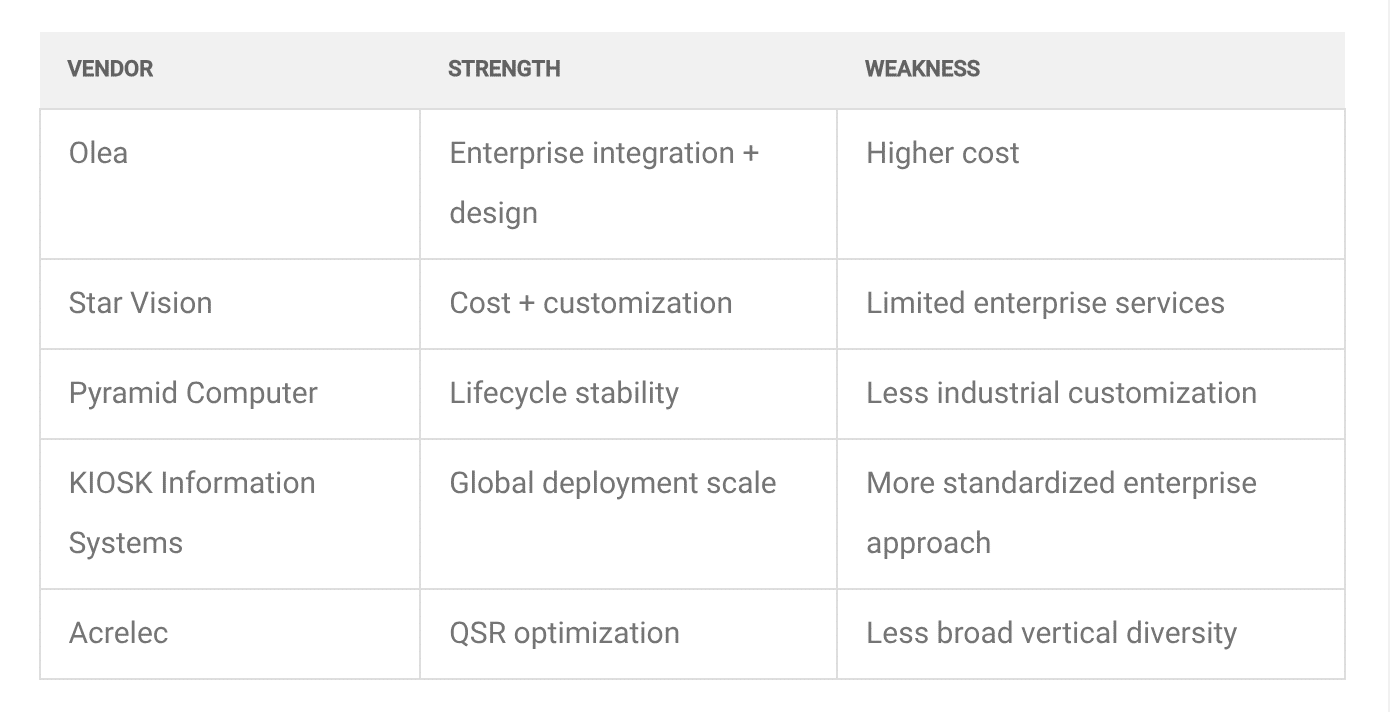
Compared to OEM/ODM Manufacturers

Compared to lower-cost Asian OEM/ODM providers such as:

  • Star Vision
  • generic Shenzhen OEM factories
  • commodity kiosk integrators

Olea is:

  • more vertically integrated
  • more service-oriented
  • more lifecycle-focused
  • more compliance-aware
  • more enterprise-oriented

Compared to enterprise competitors such as:

Olea differentiates through:

  • industrial design
  • custom fabrication
  • U.S. manufacturing
  • healthcare and government positioning
  • highly customized deployment capability

How Olea Compares


Core Product Portfolio

Self-Service Kiosks

Olea develops:

  • self-order kiosks
  • patient check-in kiosks
  • ticketing kiosks
  • self-checkout systems
  • financial service kiosks
  • government kiosks
  • outdoor kiosks

Olea Kiosks designs in modularity which is very important for lifecycle. Here is video.

The company offers both:


Healthcare Kiosks

Healthcare is one of Olea’s strongest verticals.

Capabilities include:

Healthcare deployments emphasize:

  • ADA accessibility
  • patient experience
  • operational efficiency
  • integration readiness

Outdoor Kiosks

Olea has strong positioning in outdoor deployments:

  • weather-resistant enclosures
  • ruggedized deployments
  • drive-thru environments
  • unattended outdoor commerce
  • Videos

Financial Services Kiosks

Use cases include:

  • bill payment
  • cash acceptance
  • cash-to-card
  • cryptocurrency systems
  • transaction automation

Platform Profile

Hardware Layer

  • Custom fabricated enclosures
  • Industrial-grade construction
  • Indoor and outdoor variants
  • Enterprise peripherals
  • Serviceable component access

Compute Layer

Olea increasingly positions around:

  • enterprise compute
  • lifecycle stability
  • edge computing
  • operational durability

The company explicitly discusses:

  • long hardware lifecycle requirements
  • operational risk reduction
  • remote management
  • scalable deployments

Peripherals

Supported peripherals include:

  • printers
  • scanners
  • payment terminals
  • ID readers
  • cameras
  • NFC/contactless systems
  • accessibility hardware

Typical Olea Deployment Stack

Layer Typical Partner
Kiosk Hardware Olea
Compute Intel / enterprise OEM
OS Windows
Accessibility JAWS / ADA integrations
Payments Ingenico / Verifone
Kiosk Software SiteKiosk / custom
CMS Third-party enterprise platforms
Remote Management Enterprise IT tooling

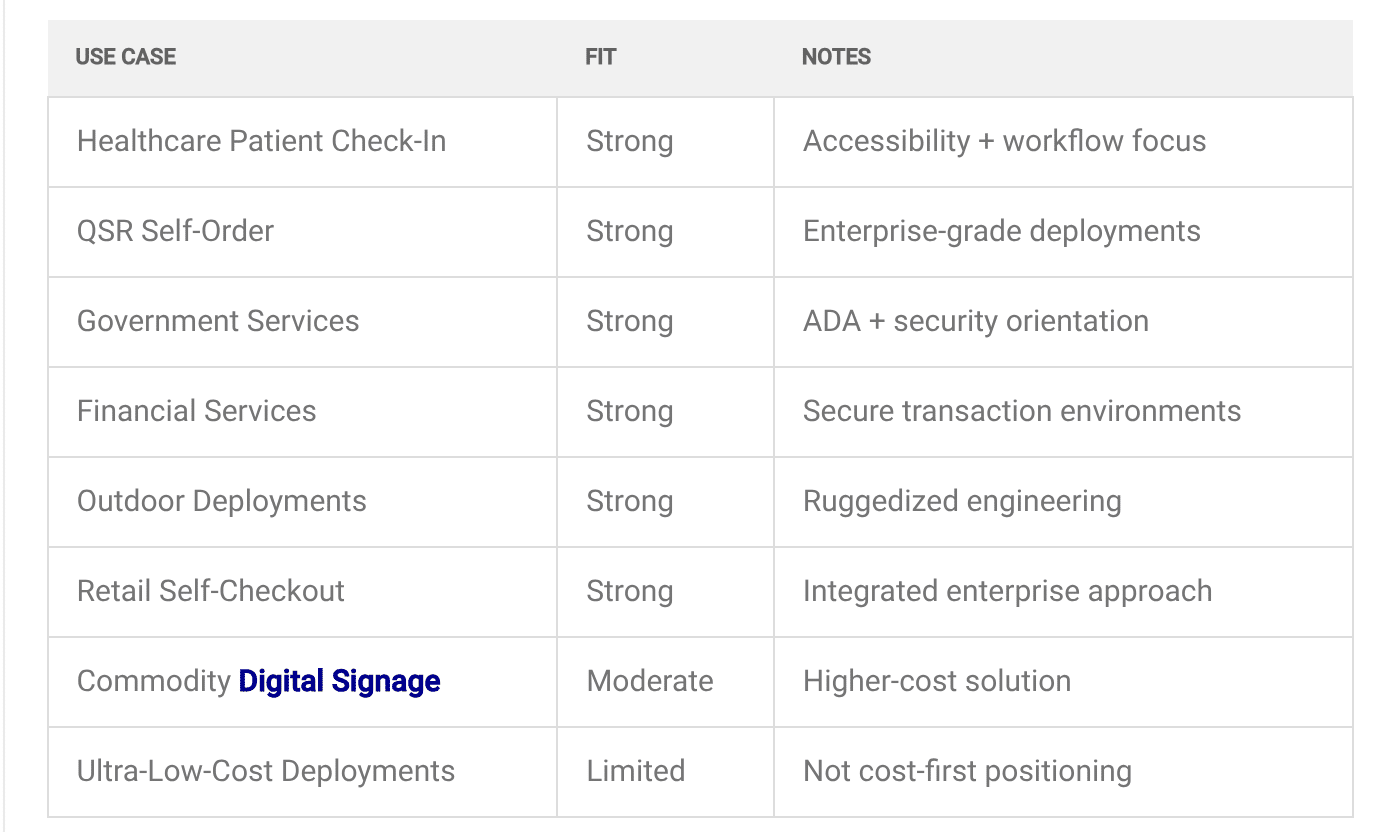
Deployment Fit Analysis (TIG)

deployment fit

deployment fit


Lifecycle & Enterprise Readiness

This is one of Olea’s strongest differentiators.

The company repeatedly emphasizes:

  • lifecycle stability
  • operational durability
  • serviceability
  • long-term deployments
  • enterprise compute planning

Olea explicitly discusses:

  • 5–7 year deployment expectations
  • SKU stability
  • field replacement
  • compliance
  • remote management
  • operational scalability

Regulatory & Accessibility

Olea appears substantially more mature in accessibility and regulated deployment positioning than many OEM-focused manufacturers.

Key strengths:

  • healthcare deployments
  • government deployments
  • ADA-conscious positioning
  • enterprise operational planning

Compliance-relevant areas include:

  • ADA
  • Section 508
  • PCI
  • healthcare workflow integration
  • government deployment requirements

Where Olea Wins

  • Enterprise deployment readiness
  • U.S.-based manufacturing
  • Custom industrial design
  • Accessibility-conscious engineering
  • Long lifecycle orientation
  • Healthcare and government expertise
  • Outdoor kiosk capability
  • Integrated engineering support

Where Olea Does Not Compete

  • Lowest-cost commodity hardware
  • Ultra-fast OEM-only manufacturing
  • Alibaba-style white-label deployments
  • Minimal-service kiosk sourcing

Decision Framework

Choose Olea If:

  • You require enterprise-grade deployments
  • You need ADA-conscious design
  • You need lifecycle stability
  • You require custom industrial design
  • You operate in healthcare or government
  • You need integrated engineering support
  • You want U.S.-based manufacturing

Avoid or Supplement If:

  • Lowest upfront hardware cost is primary
  • You only need commodity OEM hardware
  • You already control all integration internally
  • You prioritize ultra-fast offshore manufacturing cycles

Strategic Take

Olea represents the higher-engineering, lifecycle-focused tier of the self-service kiosk market.

The company is particularly well-positioned for:

  • healthcare
  • government
  • regulated deployments
  • enterprise retail
  • long-lifecycle self-service infrastructure

Unlike lower-cost OEM manufacturers focused primarily on fabrication and customization, Olea emphasizes operational durability, accessibility-aware engineering, integrated deployment support, and enterprise risk reduction.

As self-service deployments increasingly move toward edge AI, lifecycle management, accessibility compliance, and operational resiliency, Olea’s positioning aligns well with long-term enterprise deployment trends.


FAQ Frequently Asked Questions

Is Olea a kiosk OEM manufacturer?

Yes. Olea provides OEM manufacturing capabilities, but unlike commodity OEM providers, it also offers integrated engineering, industrial design, deployment consulting, and enterprise deployment support.


Where are Olea kiosks manufactured?

Olea manufactures kiosks in California using in-house fabrication and engineering operations.


What industries does Olea serve?

Key industries include:

  • healthcare
  • retail
  • QSR
  • government
  • hospitality
  • financial services
  • gaming
  • ticketing

Does Olea support outdoor kiosk deployments?

Yes. Outdoor kiosk systems are one of Olea’s established deployment categories.


Is Olea focused on accessibility and compliance?

Olea appears significantly more accessibility-aware than many low-cost kiosk OEM providers, especially in healthcare and government deployments.


What differentiates Olea from low-cost kiosk OEM providers?

Primary differentiators include:

  • U.S. manufacturing
  • industrial design
  • lifecycle planning
  • integrated engineering
  • accessibility-conscious deployments
  • enterprise deployment readiness
  • operational durability

How much do Olea kiosks cost?

Olea positions typical self‑service kiosk hardware in a broad range starting around a few thousand dollars per unit, with more fully configured systems often running between roughly 2,500 and 13,000 dollars depending on peripherals and options. Final pricing is driven by factors such as enclosure type, display size, payment hardware, scanners, printers, and any custom engineering or branding.

Does Olea manufacture kiosks in the United States?

Yes, Olea designs, engineers, and manufactures its kiosks in‑house at its campus in Cerritos, California, part of the greater Los Angeles area. U.S. manufacturing gives Olea direct control over quality, lead times, and design changes throughout the kiosk lifecycle.

Does Olea support Epic Welcome integration?

Olea actively targets healthcare as a core vertical and supports hardware platforms used for Epic Welcome patient check‑in workflows, including ID capture and payment. Epic Welcome itself is an Epic software module, so Olea typically works with Epic‑certified integrators and health system IT teams to validate and deploy the combined solution.

Does Olea offer outdoor self-service kiosks?

Yes, outdoor kiosks are a well‑established part of Olea’s portfolio, covering use cases such as QSR drive‑thru, ticketing, transportation, and government services. Platforms like the Boulder outdoor kiosk are engineered for sunlight readability, weather protection, and modular integration of payment, printing, scanning, and camera components.

What payment systems work with Olea kiosks?

Olea integrates with a wide range of EMV, NFC/contactless, and magstripe payment devices and typically pairs with the customer’s existing payment processor and POS ecosystem through software partners. Supported configurations include card-present EMV, contactless wallets, and bill‑payment solutions, with PCI‑conscious designs for unattended environments.

Does Olea support ADA-compliant kiosk design?

Olea has long experience engineering ADA‑conscious kiosks, and many of its standard and custom models are designed to meet applicable reach, approach, and operability guidelines for users with disabilities. Offerings include ADA‑compliant patient check‑in kiosks and government systems, with options like tactile input, audio support, and height‑adjustable bases for full hardware accessibility.

Can Olea kiosks use AI applications?

Olea’s hardware platforms support Windows, Android, and Linux applications and are deployed with software partners who provide AI‑driven capabilities such as personalization, intelligent upsell, and predictive menus. The company also integrates with AI‑powered systems like HID’s facial recognition for secure authentication, enabling advanced check‑in and identity workflows across sectors.


Professional Summary Table

Category Specifications / Details
Headquarters Cerritos, California
Founded 1975
Manufacturing In-house U.S. manufacturing
Core Markets Healthcare, Retail, Government, QSR
Deployment Focus Enterprise self-service
Outdoor Capability Yes
Accessibility Orientation Strong
Lifecycle Positioning Strong
Best Fit Enterprise deployments
Primary Differentiator Intelligent enterprise kiosk engineering

Sources referenced throughout profile: https://www.olea.com

Common Technology Partners

  • Intel Corporation
  • Ingenico
  • Verifone
  • Vispero
  • Epic Systems
  • SiteKiosk

Olea vs Other Kiosk Manufacturers

Company Best For
Olea Healthcare, Government, Custom Design
Pyramid Computer QSR, Retail
KIOSK Information Systems Enterprise Scale
ACRELEC Restaurant Self-Ordering
REDYREF Public Sector
Frank Mayer Retail & Healthcare

Why Enterprises Choose Olea

Organizations investing in self-service technology increasingly recognize that a kiosk is not a short-term hardware purchase—it is a long-term operational platform. Olea has built its reputation around enterprise-grade deployments that prioritize lifecycle stability, accessibility, customization, and operational reliability. For healthcare providers, government agencies, retailers, financial institutions, and hospitality operators, Olea offers a combination of engineering expertise and manufacturing capabilities that extend far beyond commodity kiosk hardware.

5–7 Year Lifecycle Planning

Many self-service deployments are expected to remain in service for five to seven years or longer. Olea designs its platforms with lifecycle management in mind, emphasizing component availability, serviceability, upgrade paths, and long-term operational support. This approach helps organizations reduce total cost of ownership while minimizing the risks associated with hardware obsolescence, peripheral changes, and evolving software requirements.

U.S.-Based Manufacturing

Unlike many kiosk suppliers that rely primarily on offshore production, Olea maintains in-house manufacturing operations in California. This provides customers with greater control over quality, engineering changes, production schedules, and deployment consistency. U.S.-based manufacturing can also simplify procurement requirements for government agencies, healthcare organizations, and enterprises seeking domestic sourcing options.

ADA and Accessibility Readiness

Accessibility is becoming a critical requirement rather than an optional feature. Olea’s experience supporting healthcare, government, and public-facing deployments has resulted in a strong focus on ADA-conscious design principles. From kiosk placement and reach ranges to audio support, assistive technologies, and accessible user interface integration, Olea helps organizations address accessibility requirements while improving the user experience for all customers.

Healthcare Industry Expertise

Healthcare remains one of Olea’s strongest vertical markets. The company has extensive experience supporting patient check-in, registration, wayfinding, payment processing, and digital front-door initiatives. Healthcare deployments often require integration with electronic health records, identity verification systems, payment technologies, and accessibility solutions—all areas where Olea has established expertise.

Proven Outdoor Deployment Capability

Outdoor self-service environments introduce unique challenges related to weather exposure, temperature management, vandal resistance, and long-term reliability. Olea offers ruggedized outdoor kiosk solutions designed for demanding environments such as ticketing, parking, government services, retail pickup, transportation, and unattended commerce applications. These deployments benefit from industrial-grade construction and environmental design considerations that support around-the-clock operation.

Custom Engineering and Industrial Design

Not every self-service project fits into a standard enclosure. Olea’s engineering and industrial design capabilities allow organizations to develop highly customized solutions tailored to their workflows, branding requirements, physical environments, and customer experience objectives. Whether modifying an existing platform or developing a completely custom design, Olea provides integrated engineering support throughout the project lifecycle.

Enterprise Deployment Support

Successful kiosk deployments require more than hardware procurement. Olea works with organizations to support deployment planning, hardware integration, peripheral selection, manufacturing, testing, logistics, and ongoing operational requirements. This enterprise-focused approach helps reduce deployment risk while supporting scalable rollouts across multiple locations and business units.

The Bottom Line

Enterprises choose Olea because the company focuses on long-term deployment success rather than simply manufacturing kiosk hardware. Its combination of U.S. manufacturing, accessibility awareness, healthcare expertise, outdoor deployment experience, custom engineering capabilities, and lifecycle planning makes Olea particularly well-suited for organizations seeking durable, scalable self-service infrastructure that can support operational requirements for years to come.

Useful Links

  • Kiosk Manufacturers – Explore leading kiosk manufacturers worldwide, including enterprise providers specializing in self-service, retail, healthcare, government, and outdoor kiosk deployments.
  • Healthcare Kiosks – Learn how patient check-in, registration, wayfinding, and payment kiosks are transforming healthcare access and operational efficiency.
  • Outdoor Kiosks – Discover weather-resistant outdoor kiosk solutions designed for unattended transactions, ticketing, drive-thru, and public access environments.
  • ADA Kiosk Standards – Review accessibility requirements and best practices for designing self-service kiosks that comply with ADA, Section 508, and related regulations.
  • Self-Service Technology – Explore the technologies, trends, and business drivers shaping modern self-service solutions across multiple industries.
  • Kiosk Hardware – Understand the key components, peripherals, displays, computing platforms, and lifecycle considerations behind successful kiosk deployments.
  • Edge AI – Learn how edge AI enables real-time intelligence, privacy protection, and operational efficiency for self-service and interactive kiosk applications.
  • SiteKiosk – Discover SiteKiosk software for kiosk lockdown, remote management, digital signage, and secure self-service deployments.
  • JAWS for Kiosk – Learn how JAWS screen reader technology helps make self-service kiosks accessible for blind and low-vision users.
  • Intel Computing – Explore Intel-powered computing platforms that provide the performance, reliability, and lifecycle stability required for enterprise kiosk deployments.