Last Updated on February 5, 2026 by Craig Allen Keefner
Why It Matters for Kiosks, AI, Payments, and Self-Service in 2026
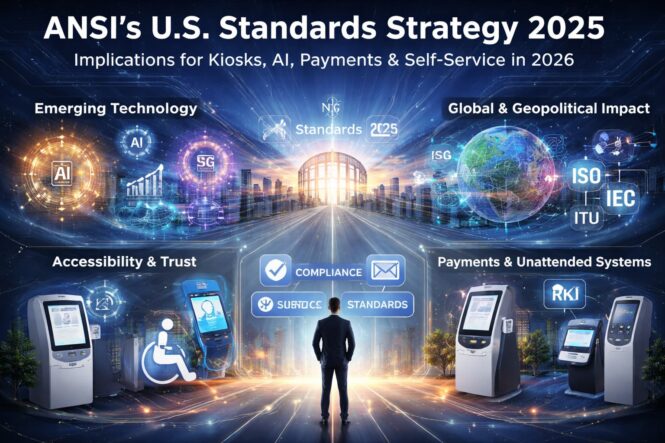
American National Standards Institute (ANSI) quietly set the tone for the next decade of technology competition with the release of the U.S. Standards Strategy 2025 (USSS). While framed as a
ANSI Standards
policy document, the implications are immediate and operational—especially for companies working in kiosks, unattended retail, payments, AI, accessibility, and digital services.
This is not an abstract standards update. It is a strategic declaration that standards are now instruments of economic power, market access, and national security.
Standards Are No Longer Passive
ANSI’s message is clear: standards are no longer background compliance artifacts. They are now competitive infrastructure. Technologies that fail to align with recognized standards risk being excluded from global markets, public-sector deployments, and regulated industries.
For kiosk and self-service ecosystems—where payments, accessibility, AI, hardware, and software converge—this raises the stakes dramatically.
Private Sector Leadership Is Reaffirmed (But Conditional)
The USSS explicitly doubles down on private-sector-led, market-driven standards, pushing back against government-mandated or geopolitically driven frameworks.
However, there is a catch:
Private leadership only matters if industry participates.
Companies that actively engage in standards bodies will shape outcomes. Those that don’t will inherit them.
Emerging Technology Collision Zone
ANSI highlights AI, biotechnology, and quantum computing, but the downstream effects spill directly into:
-
Conversational AI interfaces
-
Voice-enabled self-service
-
Biometric authentication
-
Unattended and frictionless payments
-
Accessibility and inclusive design
-
Edge computing and IoT-driven kiosks
In 2026, standards will increasingly define how these technologies are allowed to interoperate, not just how they perform.
Accessibility and Trust Move Center Stage
Accessibility, usability, and transparency are no longer “nice to have.” They are becoming core acceptance criteria—especially for public-facing systems.
Expect:
-
Tighter alignment between accessibility and AI interaction standards
-
Increased scrutiny of voice AI, multimodal UX, and inclusive design
-
More linkage between accessibility compliance and procurement eligibility
For self-service systems, accessibility compliance is becoming a market entry requirement, not a retrofit.
Global Competition Is Explicit
ANSI openly references geopolitical manipulation of standards. Translation: the U.S. intends to actively contest international standards bodies, not merely observe them.
This affects exporters, multinational deployments, and vendors relying on global certification pathways. The companies best positioned for 2026 will be those aligned with internationally recognized, ANSI-influenced standards frameworks.
What This Means for the Industry
-
Standards strategy is now a business strategy
-
Compliance teams become strategic assets
-
Industry groups and alliances gain influence
-
Early alignment beats late remediation
For kiosks and self-service, the era of “build first, certify later” is ending.
Final Takeaway
ANSI’s U.S. Standards Strategy 2025 signals a shift from compliance as cost to standards as competitive leverage.
For kiosk, self-service, AI, and payments companies, the question in 2026 is no longer “Are you compliant?”
It is “Are you shaping the standards—or reacting to them?”
Standards Readiness Checklist
For Kiosk, AI, Payments & Self-Service Vendors (2026)
Use this checklist to assess whether your organization is positioned for ANSI-aligned standards leadership—or exposed to future risk.
ANSI_Standards_Readiness_Checklist_2026 PDF
1. Governance & Strategy
-
☐ Standards ownership is assigned internally (not ad-hoc)
-
☐ Standards are reviewed at product roadmap level
-
☐ Executive leadership understands standards as market enablers
-
☐ Standards participation is budgeted, not optional
2. Standards Participation
-
☐ Active participation in ANSI-accredited or ANSI-aligned bodies
-
☐ Monitoring ISO / IEC / W3C / accessibility working groups
-
☐ Input provided—not just adoption after publication
-
☐ Industry alliances used to amplify influence
3. AI & Emerging Technology
-
☐ AI systems mapped to transparency and trust standards
-
☐ Voice and conversational AI evaluated for accessibility
-
☐ Edge AI and data privacy requirements documented
-
☐ Clear audit trail for AI decision logic where applicable
4. Payments & Unattended Systems
-
☐ EMV and PCI alignment validated for unattended use cases
-
☐ Remote key injection (RKI) standards supported
-
☐ Terminal management standards documented
-
☐ Security certifications kept current across deployments
5. Accessibility & Usability
-
☐ WCAG and ADA standards integrated into design process
-
☐ Accessibility tested across hardware, software, and UX
-
☐ Multimodal interaction (touch, voice, audio, vision) validated
-
☐ Accessibility compliance documented for procurement use
6. Global Market Readiness
-
☐ Products aligned with internationally recognized standards
-
☐ Regional deviations documented and managed
-
☐ Certification pathways mapped by geography
-
☐ Standards risks included in market expansion planning
7. Documentation & Proof
-
☐ Standards compliance documented and customer-ready
-
☐ Certifications and conformance statements up to date
-
☐ Standards alignment used in sales and RFP responses
-
☐ Internal teams trained on relevant standards impacts
Risk Self Assessment
Here’s a Standards Risk Score you can drop into the post as a self-assessment (and later convert into a PDF/Google Form).
Standards Risk Score (0–100)
Score each item 0 / 2 / 5:
-
0 = Not in place / unknown
-
2 = Partially in place / informal
-
5 = Documented, repeatable, owned, and current
Add them up. Max = 100.
A) Governance & Ownership (0–20)
-
Standards owner assigned (name + role) (0/2/5)
-
Standards tracked in a register (what, version, who owns, status) (0/2/5)
-
Standards reviewed in roadmap / release planning (0/2/5)
-
Budget/time allocated for compliance + participation (0/2/5)
B) Participation & Monitoring (0–15)
-
Active participation in at least 1 relevant body/working group (0/2/5)
-
Systematic monitoring of changes (quarterly or better) (0/2/5)
-
You can map “standards changes → product impact” within 30 days (0/2/5)
C) AI, Data, Privacy, Trust (0–15)
-
AI feature inventory + where it runs (edge/cloud) + data flows documented (0/2/5)
-
Accessibility + usability testing includes conversational/voice if used (0/2/5)
-
Auditability: logs/traceability for AI outputs where required (0/2/5)
D) Payments & Unattended Security (0–20)
-
EMV/PCI scope defined for unattended deployments (0/2/5)
-
Key management/RKI approach documented and validated (0/2/5)
-
Terminal/device management process is secure + repeatable (0/2/5)
-
Patch cadence & vulnerability response SLA exists (0/2/5)
E) Accessibility & Inclusive Design (0–15)
-
WCAG/ADA requirements defined for your product class (0/2/5)
-
Testing includes real assistive-tech workflows (not only checklists) (0/2/5)
-
You maintain procurement-ready evidence (VPAT-style or equivalent) (0/2/5)
F) Documentation & Proof (0–15)
-
Current certifications/conformance statements are maintained and accessible (0/2/5)
-
RFP language + “proof pack” (policies, test results, diagrams) exists (0/2/5)
-
Field deployment configuration control documented (baseline + drift mgmt) (0/2/5)
Risk Bands (Interpretation)
-
0–24 = High Risk
You’re exposed to procurement delays, certification surprises, and global market friction. -
25–49 = Elevated Risk
You can ship, but standards changes or audits will create rework and slow deals. -
50–74 = Managed Risk
Generally solid. Tighten participation and evidence packs to win RFPs faster. -
75–100 = Standards-Ready
You’re positioned to lead (and influence) rather than react.
If you scored under 50: prioritize (1) ownership + standards register, (2) unattended payments security scope, (3) accessibility evidence pack, (4) change-monitoring cadence.
More Resources
- Self-Service Awards 2026 The Industry Group (TIG)
- The Industry Group Participation Guidelines
- Why “Faster Kiosk Delivery” Doesn’t Mean Faster Deployment
End of Page