Partnership with Uber and Ayden
Right now we are looking at one Uber kiosk in LaGuardia. Buthe expanded partnership between Adyen and Uber, announced in February 2026, represents a significant evolution in their 14-year relationship. This deal ensures Uber can scale rapidly in emerging markets by instantly adopting local payment habits while simultaneously solving a major “pain point” for travelers through new, physical booking hardware.The impact of this deal can be summarized across three key areas:
The partnership focuses on removing friction as Uber scales into diverse global markets.
-
New Geographic Footprint: Uber is using Adyen for payments in the UAE, Hong Kong, and the Caribbean.
-
Local Acquiring: They are expanding local processing in Japan, Mexico, New Zealand, and Australia to improve authorization rates and reduce transaction costs.
-
Alternative Payment Methods (APMs): By integrating local favorites like Pix (Brazil), Afterpay (Australia), and WeChat Pay (Global), Uber can better serve local users and international travelers who may not use traditional credit cards.
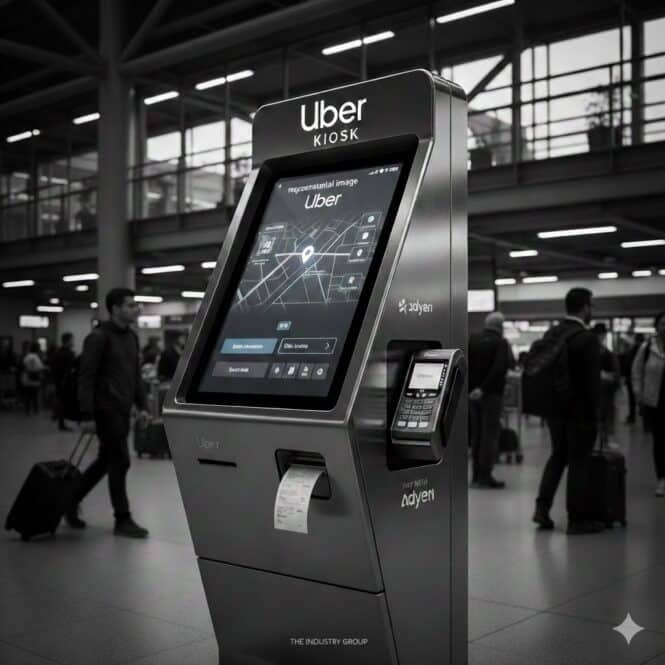
A major highlight of this announcement is the launch of physical Uber Kiosks, powered by Adyen’s point-of-sale terminals.
-
Target Audience: Designed specifically for travelers who lack a local data plan, have a dead phone battery, or do not have the Uber app installed.
-
User Experience: Users enter their destination on the kiosk, choose a ride type, and receive a printed paper receipt with trip details.
-
Strategic Rollout: The first kiosk is live at LaGuardia Airport (LGA) Terminal C, with plans to expand to international airports, hotels, and ports globally.
Much wider support
-
Consolidated Platform: Uber is moving more of its global volume onto Adyen’s single “Checkout API,” simplifying its financial backend across 70 countries.
-
Omnichannel : This marks a transition for Uber from being a purely “in-app” digital company to a “unified commerce” player, bridging the gap between digital bookings and physical airport/venue infrastructure.
-
Growth Momentum: Adyen reported supporting “strong volume acceleration” for Uber in the US, UK, and Brazil over the past year, signaling that Adyen is capturing a larger share of Uber’s massive transaction volume.
How the real kiosks work
The image we provide is purely speculation. Uber has only shown the screen in pictures.
How they work | The real-world Uber kiosks are designed to be “phone-free” hubs. Here is the actual workflow they use:
-
Interface: A large touch screen where you enter your destination.
-
Payment: Integrated Adyen card readers (like the one shown in the image) to handle physical card or mobile wallet payments on the spot.
-
The Receipt: A critical feature for travelers without data plans; it prints a physical slip with the driver’s name, license plate, and car model so you can find your ride without needing to check an app.
Resource links
- https://www.prnewswire.com/news-releases/adyen-and-uber-expand-global-partnership-to-power-new-markets-launch-uber-kiosks-302681864.html
- Uber has launched kiosks, powered by Adyen terminals
- Uber Offers Breathalyzer Kiosk On Thanksgiving Eve
- UBER Kiosks at Pearson International
- Tesla Kiosk Centralized in Trials – EV Charging