

Last Updated on August 25, 2026 by Craig Allen Keefner
Introduction: What this list covers
Looking for a custom kiosk manufacturer? This guide ranks leading kiosk manufacturers based on recent custom designs, engineering capability, manufacturing experience, deployment history and demonstrated projects. Our 2026 selections include Olea Kiosks, KIOSK Information Systems, Kiosk Innovations, Advanced Kiosks, REDYREF, ImageHolders and Alveni, along with several leading manufacturers of configurable standard kiosks. 
Custom kiosks are an art that few companies demonstrate recurring excellence. A truly custom kiosk may also be an exclusive design. That can be a little spendy but just like TIO for banking payment kiosks, it happens. Advantage these days is with China as they will tolerate low quantity jobs. [Feature Image is a telehealth unit from RedyRef].
To the right — jobpoint kiosk — “custom kiosk” that NeoProducts did for UK Postal Job Centre in 2001. 9,000 units. Might be the first large-scale production kiosk?
How we evaluate custom kiosk manufacturers
Methodology — How companies were evaluated: Recent demonstrable custom deployments; in-house industrial, mechanical, and electrical engineering; manufacturing and integration capability; serviceability and deployment experience; range of verticals; and publicly verifiable project history. This is an editorial assessment, not a paid ranking or exhaustive market census.

custom kiosk outdoor bill payment kiosk innovations 2025
Custom kiosks always have unique requirements, either functionally or aesthetically. Extra design and engineering implies NRE or non-recurring engineering and that can exceed a million by itself. Mercedes-Benz likes stainless steel for example. It fits their brand—big budget. A good place to see custom kiosks is our Best of 2024 Awards. I love the Empire State Building unit and also the Santa Monica outdoor smart city. One and only one place to get those units…
One big problem is Non-Disclosure Agreements. The kiosk companies did it but often they are not allowed to broadcast it. But then you will note that some deployers actually celebrate their units. NASA wanted to tell the world about their units and so did Empire State Building. Especially after they won a big award for it. Extra points for that.

Custom kiosk outdoor kiosk innovations – interior 2025
Let’s do the numbers and see the region breakdown. The European kiosk manufacturers almost always complain about being neglected and marginalized. Some don’t though and sell a ton in the US (e.g. Pyramid and Acrelec).
Leading custom kiosk manufacturers
- Olea Kiosks – Olea Kiosks is a U.S. kiosk manufacturer specializing in highly customized self-service kiosk design and fabrication. Recent examples include kiosks for the Empire State Building, NASA ticketing and Universal Parks.
- KIOSK Information Systems –KIOSK Information Systems is among the largest and most established kiosk manufacturers globally, with deployments across virtually every major vertical. The company offers both highly customized systems and a broad range of proven standard kiosk platforms.
- Kiosk Innovations – Kiosk Innovations specializes in custom self-service kiosk design and production. Neil brings more than two decades of kiosk engineering experience, including prior leadership as chief engineer at KIOSK Information Systems in Colorado.
- Advanced Kiosks – Advanced Kiosks is especially strong in government, courts, public agencies, healthcare, and education, combining hardware with its own kiosk-management and workflow software. Its projects commonly address secure self-service, payments, document handling, visitor management, and citizen services.
- BestKiosk – Shenzhen-based BestKiosk is an OEM/ODM manufacturer focused on custom kiosk hardware for worldwide deployment. It supports custom designs, private-label programs, and varied formats for self-ordering, ticketing, check-in, information, printing, and related applications.
- KT Group – KT Group is a European kiosk supplier best known for custom sports-betting and bill-payment terminals. The company’s made-to-order designs span payment, information, digital-signage, and betting applications, with market reach in Europe and Asia.
- REDYREF – REDYREF is a U.S. full-service custom kiosk manufacturer providing design, engineering, and production. Its portfolio ranges from telecom and bill-payment kiosks to cash-to-card systems, self-ordering, check-in, ticketing, and its notable Smart Fresh Food Fridge vending kiosk. I like the AT&T bill pay and the Fridge
- ImageHolders – imageHOLDERS specializes in tablet enclosures and compact interactive kiosks, including floor-standing, countertop, wall-mounted, and portable formats. With operations serving the UK, U.S., and Canada, it offers both configured standard products and bespoke designs, including accessible ADA/DDA-oriented installations.
- Alveni – Alveni provides custom interactive kiosks, POS stands, customer-feedback systems, and digital-signage solutions, with U.S. operations and nearshore manufacturing in Mexico. The company combines design and manufacturing with deployment, monitoring, and after-sales support, serving Mexico and the broader Latin American market.
-
Meridian and Frank Mayer — custom kiosks is a segment of both their companies.
Comparison of Top Custom Kiosk Manufacturers

Top Custom Kiosk Manufacturers
The following companies stand out for recent, publicly demonstrated custom kiosk work (pictures and case studies, not renderings), engineering depth, and deployment experience. Olea and KIS are equally capable but Olea/Frank always end up doing more customs (though he has a new modular line which is custom in its way). Alpine Kiosk is super modular.
Custom vs. configured standard kiosks

custom kiosks
Excellent Standard Kiosks
- Pyramid Technology — visit McDonalds. Seems like Diebold but actually Pyramid
- ACRELEC – McDonald’s, Popeyes, Burger King come to mind
- KT Group – Sports Betting and Bill Payment galore
- EasyPay Systems – Sports Betting and Bill Payment galore
- M4B in Poland
- Peerless-AV – tend to be large touchscreen OTS
- Alpine Kiosk is super modular but allows “custom kiosk” as an outcome. Based in Austria with production in Vietnam.
Questions to Ask Every Custom Kiosk Supplier
- Is it really just a modified standard kiosk? Those are cheaper.
- Have you visited the main office?
- Have them pull their mobile out and give you a virtual tour of their plant and offices.
- I’ve done that several times with China.
- Where is the design and engineering done?
- Where is manufacturing?
- Where is the assembly, for that matter?
- How often and how recent, or is it just a “we’ve done that before” verbal.
- Typically, a custom unit is a smaller production run (20?)
- Much heavier design and engineering cost factor.
- Custom kiosks are higher profit margin for manufacturers. Sometimes profit margin is restricted by deployer. McDonald’s buys millions of Epson printers at an agreed margin which is very low (nearing single digit?)
- Are they an actual kiosk manufacturer?
- Or do they just sell or serve as a provider of kiosks (eg Diebold, Grubbrr, etc).
- Some “standard kiosks” are extremely customized
- Custom kiosks usually implies NRE or non-recurring engineering. Can be over a million dollars and that is just hardware (AT&T and Verizon good examples)

Custom kiosk for ticketing kiosk innovations circa 2025 production floor
Examples of Custom Kiosks
People will tell you they do custom kiosks, but what have they done? More typically we do those but we can’t show you due to NDA.
Here is a list of RECENT projects. I did custom kiosks in 2006 but those don’t count.
- Olea Kiosks – US
- KIOSK Information Systems – US, Europe and Taiwan
- Amazon Whole Foods Return Locker —
- Bcycle – Bike Rental
- Kiosk Innovations – US
- Advanced Kiosks
- REDYREF – standard and custom kiosks
- ImageHolders – tablet kiosks of all types
- Alveni – custom kiosks and software
Advertising But Not Providing
Companies like I&E and Elotouch advertise quite a bit, but, they don’t do custom kiosks.
Pictures of Kiosk Design
Here is our collection of kiosk designs — https://www.pinterest.com/kioskindustry/kiosk-designs/
Comments and Criticism
- List that excludes rest of world beyond North American shores, few notable exclusions KT, Evoke Creative, OEM kiosks, E-kiosk are just few that pop as well known within custom kiosk fabrication. [nice cheat on North American especially from European in the list…]
- Kenneth Larsen thanks for speaking in behalf of so many other interesting and amazing custom manufacturers of selfservice kiosks like PARTTEAM & OEMKIOSKS® . Kudos to your comment. [I am familiar with CityLink but that was one project and done back in 2019.]
Custom Kiosk Resources
- Custom Kiosk Manufacturers
- Custom Kiosks Self Service & Self Order – Kiosk Industry
- Olea Kiosks Kiosk Manufacturer
- Custom Kiosks – Cash-To-Card and Drive-Thru Kiosks
- Custom Kiosk Software Development
Certifications
- UL evaluation or listing is commonly requested, depending on the deployment and customer requirements.
- FCC, CE, and other applicable conformity requirements should be verified for the intended market and integrated components.
- PCI DSS for payment devices.
- There is no such thing as ADA-certified, there is only degree of compliance.
- You can do VPAT which is often required for government
Custom Kiosk FAQ
What does “custom” actually mean?
A custom kiosk can range from a standard enclosure with custom paint, graphics, peripherals, and branding to a completely new industrial design engineered around a unique workflow, footprint, payment system, accessibility requirement, or environmental condition. The distinction matters: a configured standard product can move quickly, while a ground-up enclosure generally requires concept work, CAD engineering, prototype validation, and production tooling.
What is NRE, and what does it typically cost?
NRE means non-recurring engineering: the one-time cost to convert a concept into a manufacturable kiosk. It may include requirements analysis, industrial design, mechanical and electrical engineering, 3D CAD, drawings, bills of material, component sourcing, prototype work, testing fixtures, production documentation, and sometimes tooling or compliance testing.
As a practical planning range, modest customization of an existing kiosk may require little or no separate NRE, or roughly $2,500 to $10,000. A genuinely custom enclosure and integrated prototype commonly falls in the $15,000 to $75,000 range, while unusually complex projects—cash automation, refrigeration, outdoor hardening, regulated payments, unusual mechanisms, or formal safety/compliance work—can exceed $100,000. These are budgeting ranges, not universal price lists; final NRE depends heavily on complexity, documentation, prototype quantity, component integration, and validation requirements.\
NRE has been known to exceed a million dollars…
NRE should be quoted separately from per-unit hardware pricing. It may be amortized into the first production run, credited back after a volume threshold, or retained as an upfront development cost. Buyers should clarify exactly what deliverables they receive: CAD files, drawings, prototype ownership, tooling ownership, source code, test plans, and rights to manufacture elsewhere.
How long is the design cycle?
A simple branding or peripheral modification to a standard kiosk may take one to three weeks of design work. A new custom enclosure normally takes about six to 12 weeks from requirements sign-off through design, engineering, and prototype construction, assuming timely customer feedback and component availability. Custom designs can add roughly six to eight weeks compared with a standard kiosk program.
A realistic end-to-end schedule often looks like this:
Production lead times usually begin around eight to 10 weeks after a project is ready for production, but certification, supply-chain constraints, international freight, and custom components can extend the schedule. A prototype or controlled pilot is strongly recommended before committing to volume production; it gives users and operators an opportunity to test serviceability, workflow, reliability, and accessibility in the real environment.
Will my kiosk design be exclusive?
Not automatically. A buyer should assume that standard cabinets, standard subassemblies, generic mechanical approaches, and a manufacturer’s pre-existing intellectual property remain available to the manufacturer unless the contract says otherwise.
If you commit to thousands of units then it is more likely that the kiosk provider will agree to exclusivity.
Exclusivity can be structured in several ways:
-
Cosmetic exclusivity: The supplier will not sell the same colors, graphics, logo treatment, or branded configuration to another customer.
-
Configuration exclusivity: The supplier will not sell the same combination of enclosure, peripherals, and workflow into a defined market or territory.
-
Design exclusivity: The supplier agrees not to reuse the customer-funded industrial design or enclosure architecture for competitors.
-
Tooling ownership: The customer owns dedicated dies, molds, fixtures, or other paid-for production tooling, subject to storage and maintenance terms.
-
Field-of-use exclusivity: The manufacturer may reuse the design outside a specifically defined vertical, geography, or named-account list.
The agreement should define the product precisely, specify the exclusive market and geography, state the term, establish minimum purchase commitments if applicable, and address what happens if annual volumes are not met. “Exclusive” without these details is generally too vague to protect either party.
Who owns the design files and prototype?
This is negotiable and should be addressed before NRE is approved. In many projects, the manufacturer retains ownership of its underlying design methods, CAD libraries, fabrication know-how, and reusable modules, while the customer owns its brand assets, application requirements, and any specifically purchased tooling. Full transfer of native CAD files, fabrication drawings, firmware, electronics designs, or manufacturing rights often costs more and may not be available from every supplier.
Ask for a written statement covering:
-
Ownership and delivery format for CAD models, drawings, BOMs, and documentation.
-
Ownership, location, maintenance, and release conditions for tooling.
-
Whether the supplier can reuse the design, and in which markets.
-
Whether the customer can move production to another manufacturer.
-
Prototype ownership, acceptance criteria, and responsibility for redesigns.
-
Ownership and license terms for kiosk software, remote management, and source code.
How can buyers control custom-project cost and risk?
Start with a well-defined requirements package: transaction flow, display size and orientation, payment devices, printers/scanners, accessibility targets, connectivity, maintenance access, security, installation environment, expected volume, and target price. Then use a staged process—concept approval, engineered design review, prototype acceptance, pilot, and production release—rather than authorizing full volume from a rendering alone.
For Verizon and new model we had multiple video walkthrus to “see the unit” as built. Renderings never do justice.
Where possible, reuse proven displays, computers, payment devices, locks, printers, and enclosure elements. Manufacturers note that standard or configurable kiosk platforms can avoid much of the engineering and prototype time, whereas a fully ground-up kiosk requires more iteration and customer review. For larger orders, sheet-metal production becomes more economical after the prototype stage; Olea identifies 20 or more units as a useful level at which CNC setup costs begin to benefit from scale.
TCO
Evaluate lifecycle cost, not purchase price
Kiosk economics should be measured across the expected operating life of the deployment—not at the point of purchase. Consumer-grade displays, tablets, PCs, and peripherals can lower initial capital cost, but shorter product lifecycles, limited repair paths, higher replacement frequency, inconsistent availability, and field downtime can quickly eliminate the apparent savings.
For unattended deployments, buyers should evaluate total cost of ownership: hardware price, spare inventory, warranty terms, RMA turnaround, labor for field replacement, software requalification, lost transactions, and the ability to source compatible replacements for the full deployment term. Commercial-grade components generally cost more because they are designed to reduce those operational risks.
See Consumer Grade example below.
Related Resources
Consumer Grade
The introduction of consumer-grade components is one of the usual battles a kiosk manufacturer has to contend with. The client has a preferred device which isn’t truly industrial quality. Maybe it is an inexpensive tablet they saw on Amazon? Kiosk companies have to think in terms of lifecycle and support. Long-term cost and support. Biggest problem with iPads is this years model goes away in a year and replaced with a new model.
For kiosk fleets, a consumer device’s production location, ODM, component mix, model revision, and repair policy can change without warning during a five-year deployment. Those changes can turn an apparently low-cost device into an inventory, service, and compatibility problem.
Kiosk economics are measured over the full operating life, not at purchase. Consumer-grade hardware may appear less expensive upfront, but its shorter lifespan, higher failure rate, limited serviceability, replacement cycles, and downtime costs quickly erode that initial savings. Over time, the total cost of ownership catches up—and often exceeds—the cost of purpose-built commercial equipment designed for continuous public use.
From Frank Olea — This stack of boxes represents 80+ Microsoft Surface tablets that failed final testing and burn-in on an order of just over 1,000 kiosks.
The bigger issue? Getting them repaired.
Unlike many industrial computing brands, consumer products don’t always have the RMA and service infrastructure needed for large deployments. We’ve played hell getting these units back to Microsoft, and every delay impacts our ability to fulfill the larger order.
Then consider that OLEA and our client need to keep these kiosks running for the next 5 years.
Consumer hardware can absolutely make sense in a kiosk. Just understand the support limitations.

Surface Pros destined to be returned as RMA
Side view of Surface Pro
Rising materials costs and changing tariff structures have added another layer of risk to consumer-device sourcing. Microsoft’s Surface line has historically relied heavily on Pegatron manufacturing in China, while Pegatron has expanded production capacity in Vietnam as electronics suppliers diversify beyond China.
For kiosk deployers, the lesson is not simply where a device is assembled. It is whether the supplier can provide a stable, serviceable product platform over the expected life of the deployment. A consumer tablet may be redesigned, discontinued, or shifted to a new manufacturing source within a year or two—potentially changing availability, repair paths, accessories, certifications, and the cost of maintaining a compatible spare inventory.
The failed incoming-QA batch Olea experienced raises a supply-chain question worth investigating: whether the units came from a new factory, production line, component source, or manufacturing transition. Pegatron’s expansion in Vietnam illustrates the broader trend of electronics production diversifying beyond China, but the available evidence does not establish that a Vietnam assembly change caused these particular failures.
Kiosk Design Backstory Solohealth
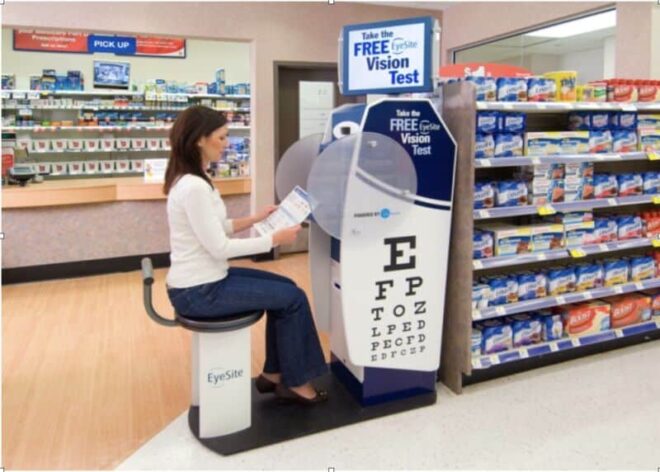
vision screening kiosks Solohealth
While at Kiosk Information Systems we won a Best of Show at KioskCom in 2008 with the custom Solohealth vision testing unit. One of our competitors kept hanging around and later when we/KIS had some problems, they adeptly stepped in and took the production cycle away. We overestimated ourselves and we paid dearly for it. We did all the work and they got the build. The actual mechanical design of the kiosk was handled by Neil Nguyen who just happens to be the CEO of Kiosk Innovations now. That unit actually has two displays. One of them is inside the kiosk, actually. I had to steal an ELO 22 off the show floor to replace ours that failed hours before the judging.
The software initially was done by Netkey. Shortly after the award, Netkey was able to point to this project and sell itself for a pretty penny to NCR (Dusty Lutz managed) before eventually vanishing.
Here is a recent wrap on “Solohealth” look-back in 2023 we did.


