Insight: NCR Isn’t Leaving Hardware — It’s Leaving the Factory
When NCR Voyix announced it was transitioning its self-checkout and POS hardware operations to Ennoconn (aka Hon Hai), some industry observers rushed to frame the move as “NCR exiting hardware.”
That’s the wrong conclusion.
What NCR is really doing is exiting manufacturing ownership — a very different thing — while doubling down on hardware as a delivery mechanism for software, services, and long-term customer lock-in.
This Is an ODM Strategy, Not a Retreat
Under the new structure, Ennoconn assumes responsibility for:
- Hardware design and engineering
- Manufacturing and supply chain
- Repair, logistics, and fulfillment
NCR keeps:
- Sales and customer relationships
- Product roadmap control
- Branding and market positioning
Customers still buy NCR systems. The badge doesn’t change. What changes is who bends the metal behind the scenes.
This mirrors the ODM-first playbooks used for years in computing, networking, and consumer electronics. NCR isn’t abandoning hardware — it’s industrializing it.
Why This Actually Improves Agility
Large legacy firms rarely excel at rapid hardware iteration. Long approval cycles, internal tooling constraints, and capital-heavy factories slow down enclosure refreshes, component swaps, and regional variants. NCR is a classic case of change taking 2 years.
Ennoconn specializes in high-mix, global manufacturing. That means:
- Faster response to silicon and component changes
- Easier cost-down iterations
- More flexibility across markets and verticals
Ironically, NCR hardware may now evolve faster than it did when NCR owned the factories.
Follow the Margins, Not the Headlines
The more important shift is financial.
By moving hardware manufacturing off its books, NCR:
- Reduces exposure to thin hardware margins
- Improves gross margin optics
- Pushes value into software, services, and lifecycle support
This isn’t about “stopping hardware.” It’s about where profits are recognized — and Wall Street understands that distinction.
The Walmart Signal Matters
Retail giants like Walmart designing their own self-checkout hardware aren’t edge cases anymore — they’re signals.
Large buyers increasingly expect:
- Custom form factors
- Faster refresh cycles
- OEMs to integrate, not invent
NCR’s shift positions it to stay relevant in an environment where owning factories is less valuable than orchestrating ecosystems.
Branding Is Now the Moat
Customers don’t buy NCR because of sheet metal. They buy:
- Global support
- Proven deployments
- Platform continuity
- Integration depth
The NCR logo still matters — even if the unit rolls off an Ennoconn line. Trust, not tooling, is the differentiator.
The Trade-Off NCR Is Accepting
There is a risk.
As more vendors rely on shared ODMs:
- Physical differentiation narrows
- Hardware becomes increasingly commoditized
- Software execution carries more weight than ever
NCR is making a deliberate bet that its platforms, services, and installed base are strong enough to carry that weight.
Bottom Line
- NCR didn’t stop selling hardware.
- It stopped being a factory.
The company is repositioning itself as a platform-led solutions provider where hardware exists to enable software, data, and recurring revenue — not to define the business.
In today’s self-service and POS market, that’s not retreat.
It’s survival by design.
Comparison Box: How Major POS & Self-Checkout Vendors Approach Hardware
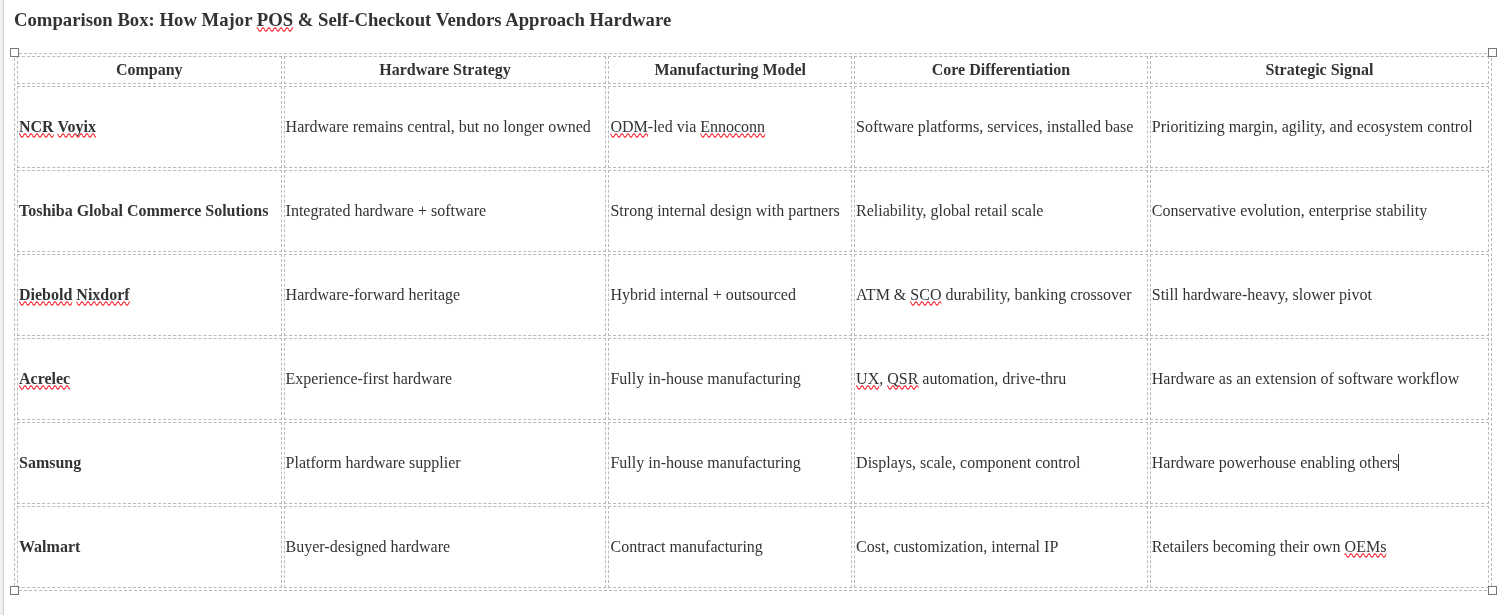
NCR comparison
What This Comparison Shows
-
NCR is moving toward the Acrelec model, not abandoning hardware but reframing it as a software delivery vehicle
-
Toshiba and Diebold Nixdorf still lean on hardware heritage, appealing to conservative enterprise buyers
-
Samsung remains a hardware enabler rather than a solution owner
-
Walmart signals the future buyer mindset: OEMs must adapt to customer-defined hardware, not the reverse
Related “offload”
-
Sony and TCL have signed an MoU to form a joint venture that will assume Sony’s entire home entertainment business (TVs and home audio), with TCL owning 51% and Sony 49%, giving TCL operational control.
-
By contrast, Hon Hai’s key U.S. deal in this space is the acquisition of Foxconn Assembly LLC via its subsidiary Cloud Network Technology USA, giving Hon Hai 100% ownership of that entity rather than sharing control with NCR; NCR shows up as a customer/partner in typical EMS/ODM relationships, not as a co-owner of a JV.
Comments
-
In 2026, ROI is the first metric that matters in the QSR space. Adoption of technology, both for front-of-house and back-of-house, is essential for success. The trick, however, is marrying technology with the customer experience, as consumers continue to look for the human touch from their favorite brands.
An increased use of biometric technology plays a role, as facial and automated voice ordering allow brands to utilize data and previous orders to provide personalized recommendations and faster ordering. QSRs that successfully implement technology that enhances the customer journey, rather than focusing only on a long-term revenue goal will be more successful in the long run.” – Chloe Bisiaux, Director of Products & Marketing, Acrelec
-
Additionally, as a final point of official clarification by Acrelec, Acrelec owns its hardware and manufactures it in its owned production and assembly factories in France. They also own and operate an assembly factory in China, where additional manufacturing occurs. Most of the solutions come from the French factory.
The industry isn’t choosing between hardware or software — it’s choosing who carries the manufacturing risk and who owns the customer relationship.
Irony
Ennoconn Corporation is a subsidiary of Foxconn Technology Group (Hon Hai Precision Industry Co., Ltd.). Foxconn became the majority shareholder of Ennoconn in 2007 and it operates under the broader Foxconn IPC (Industrial PC) business group. Foxconn (officially Hon Hai Precision Industry Co., Ltd.) is a Taiwanese multinational electronics manufacturer headquartered in New Taipei City, Taiwan
This isn’t NCR abandoning manufacturing—it’s NCR admitting where manufacturing excellence now lives, and where enterprise value no longer does. NCR is effectively saying: “We want to be Apple, not GE Appliances.
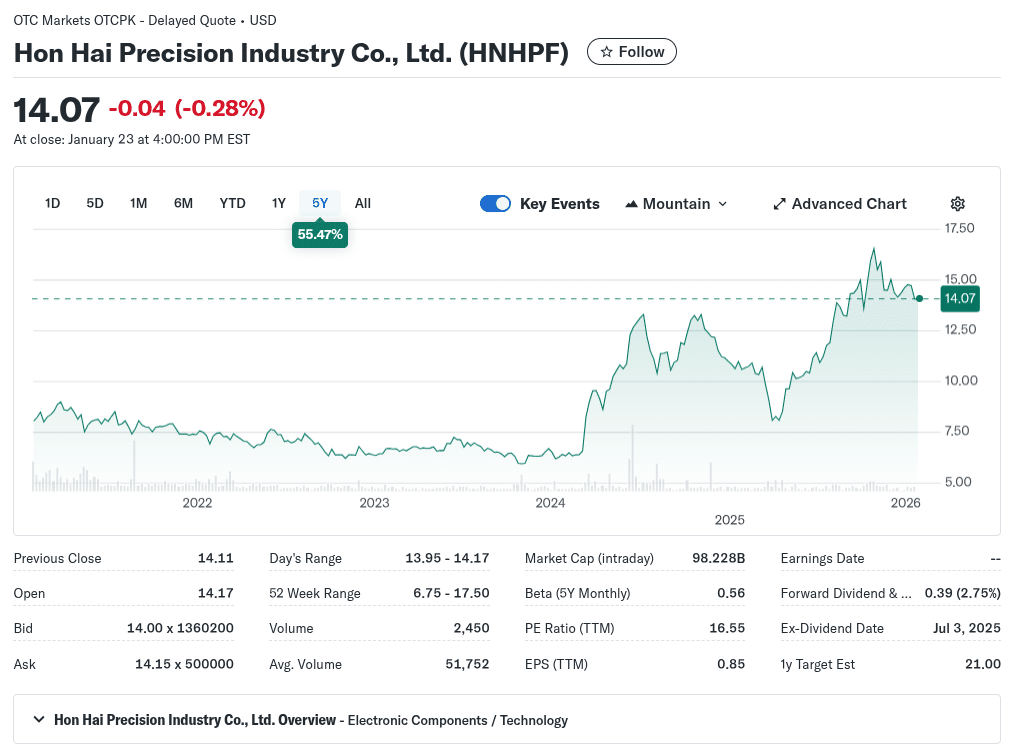
click for full size – Hon Hai Financials
More NCR Voyix Ennocon
- Walmart Self Checkout NCR – The Numbers – Kiosk Industry
- Walmart Self Checkout Being Replaced? Is NCR Toast?
- Aloha and NCR Merchant Fees Just Increased – Retail Systems
- NCR Kiosks, Grubbrr and Toast POS — Analyst Review