Last Updated on March 28, 2026 by Craig Allen Keefner
The New Intelligence Behind Self-Service: How AI Is Transforming Kiosks
By Mike Jarmus, Founder & Market Research Strategist, Maverick Market Research, LLC
I. The New Intelligence Behind Self-Service
Kiosks have long delivered speed, consistency and convenience. Today, they’re evolving again infused with artificial intelligence that listens, learns and adapts. Voice recognition, computer vision and data-driven personalization are redefining what “self-service” means, blurring the line between machine and human-assisted interaction.
But with each leap in capability comes a paradox. Innovation that promises simplicity often introduces new layers of complexity, cost and reliability risk.
In this article, AI kiosk refers to any self-service terminal enhanced by voice, vision or analytics that enable context-aware, adaptive engagement whether at a restaurant, store or transit hub.
A 2025 survey found users cite speed, convenience, accuracy, customization and accessibility as the top benefits of kiosk use (Source: Kiosk Industry). In fact, a recent survey found that 72% of consumers in 2025 said they are comfortable using in-store kiosks up from 59% the previous year, reflecting how quickly self-service technology is becoming mainstream (Source: Tillster 2025 Phygital Index)2025 Tillster Phygital
This article explores how voice, accessibility, edge intelligence and autonomous retail are converging to define the next era of self-service and the operational realities that come with it.
II. 🎙️Voice at the Forefront – SoundHound & Acrelec Lead the Way
How is voice AI changing ordering and what barriers remain?
Voice AI has become one of the most visible forms of intelligence in kiosks and drive-thrus. SoundHound AI recently launched its next-generation restaurant platform supporting omnichannel ordering across phone, text, car and kiosk interfaces (Source: SoundHound). The company reports more than 10,000 active restaurant deployments and a 10% improvement in drive-thru speed of service (Source: SoundHound Blog).

Meanwhile, Acrelec (A subsidiary of GLORY LTD) is best known for its enterprise kiosk and drive-thru systems partnered with SoundHound to embed conversational ordering directly into its digital signage ecosystem (Source: AVIXA Xchange). Acrelec positions its kiosks as “AI-ready,” built to personalize menus and recommendations dynamically (Source: Acrelec).
Even so, the field isn’t without setbacks. McDonald’s ended its IBM voice-AI trial in 2024 after inconsistent accuracy and user-experience results (Source: AP News).
Reader Takeaway: Voice kiosks are shifting from pilots to real scale, but success requires robust UX design, noise handling and seamless POS integration.
III. ♿ Accessibility & Multimodal Design – LG and Intel Push the Standard
Why inclusive AI design is fast becoming a strategic advantage.
As voice interfaces become mainstream, accessibility ensures that intelligent interaction extends to every customer. While voice technology expands convenience, the next evolution ensures that the same intelligence serves everyone through inclusive, multimodal design.
LG Business Solutions recently introduced self-ordering kiosks co-designed with accessibility experts, featuring tactile keypads, JAWS® screen-reader support and integrated voice access via SoundHound AI (Source: LG Newsroom). The company co-chairs the Kiosk Manufacturers Association Accessibility Committee, signaling that inclusive design is becoming a competitive differentiator.
On the technology backbone side, Intel’s OpenVINO and edge-AI platform enables local model inference reducing latency while enhancing privacy (Source: Intel Edge AI).
Reader Takeaway: Accessibility and edge intelligence aren’t just compliance. They expand market reach and improve uptime for all users.
IV. ⚙️ Edge Intelligence, Data Loops & Ecosystem Synergy
How data turns kiosks into self-optimizing systems.
Modern kiosks are no longer static terminals; they’re nodes in an intelligent, connected network. According to Intel and IDC research, a growing majority of new retail AI workloads are now being deployed at the edge enabling faster, more secure processing within modern kiosk networks (Source: Intel).
Operators now use real-time analytics to personalize menus, monitor hardware health and optimize operations. One recent IDC study projects that 78% of retailers will adopt edge-AI systems by 2026, delivering average operational savings of about US $3.6 million per store each year (Source: IDC).
A recent Deloitte-linked analysis found AI-driven kiosks can dynamically adjust content based on inventory, weather and purchase history to lift average transaction values (Source: Retail Systems).
Hardware leaders such as NCR Voyix, Olea Kiosks and Diebold Nixdorf are emphasizing modularity and remote-device management to minimize downtime.
Reader Takeaway: Edge analytics close the loop between user data and operational improvement, but privacy and governance must evolve alongside capability.
V. Beyond the Kiosk – From Screens to Autonomous Retail
Where kiosk principles meet sensor-driven ecosystems.
The next frontier isn’t just smarter kiosks. It’s autonomous self-service environments.
Yum! Brands is partnering with NVIDIA to deploy vision and voice AI across its restaurants (Source: NVIDIA).
PopID, backed by Visa Ventures and Verifone, is expanding facial-recognition payments (Source: Verifone).
Amazon continues to evolve its “Just Walk Out” and smart-cart systems (Source: GlobalData).
Globally, similar AI-enhanced kiosks are emerging in transportation and healthcare from biometric airport check-ins in Asia to hospital self-registration in Europe signaling that kiosk intelligence is crossing industries and borders.
Reader Takeaway: Kiosks are merging with IoT and autonomous-retail concepts, demanding cross-platform design thinking from manufacturers and operators alike.
VI. The Road Ahead – Responsible AI and ROI Reality
How to turn AI ambition into operational return.
The AI moment is here but its risks are real. McDonald’s decision to end its IBM trial underscored how accuracy and guest trust must come first (Source: AP News).
Before deploying AI at scale, brands should follow the 4 Rs of AI Kiosk Readiness:
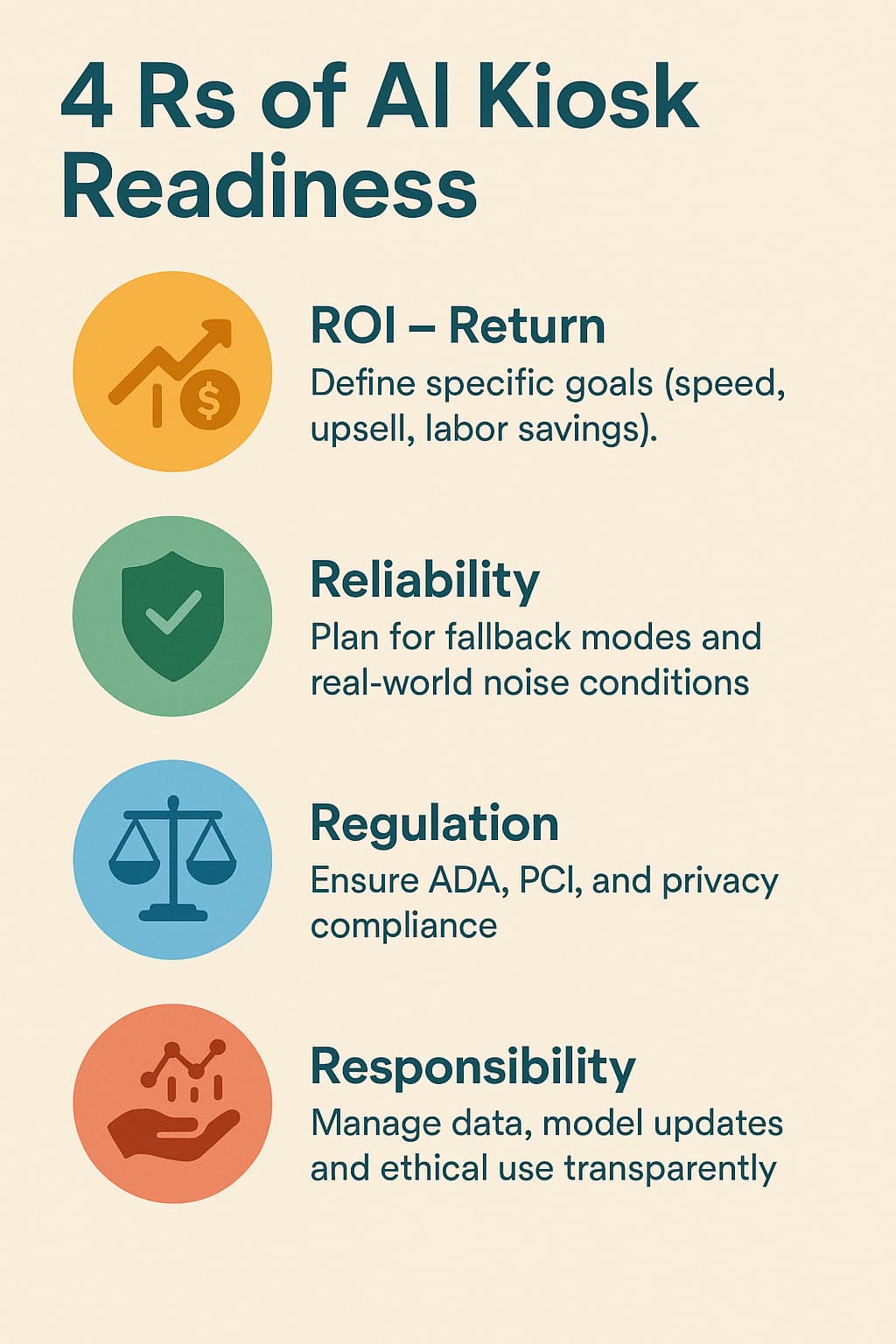
AI Kiosk Four Rs Infographic
Reader Takeaway: AI will augment not replace human service. Success comes from balancing innovation with reliability, inclusivity and measurable ROI.
VII Key Questions for Vendors/Operators
-
“Does your kiosk software support local model inference or just cloud?”
-
“Can your voice UX handle ambient cafeteria noise at >80 dB?”
-
“What fallback modes exist if vision/voice fails (touch only, manual)?”
-
“How will personalization data be governed to satisfy privacy and PCI/ADA/compliance?”
About the Author
Mike Jarmus is the Founder and Market Research Strategist at Maverick Market Research, LLC , a consultancy specializing in market intelligence and growth strategy for technology driven industries. He has led global research and strategy teams in the self-service, payments and retail technology sectors for companies including Crane Payment Innovations (CPI), CoinFlip and Glory Global Solutions. Through MMR, Mike now partners with kiosk and automation innovators to translate data into actionable growth strategies and smarter customer experiences.
More Resource Links Recommended
News We Liked!
- Clover Kiosk POS – Restaurant ROI – 3 Examples – Kiosk Industry
- AI Connect Bar – Conversational AI Audio Gets a Leg Up
- AI Drive Thru Menu Boards – Samsung White Castle – Soundhound
- SoundHound AI and Acrelec Partner – Kiosk Industry
- KFC Drive Thru Conversational AI Voice Audio – YouTube
Posts (Last Modified 7)
- Digital Signage AI Analytics – meldCX + ASUS
Digital Signage Analytics and AI Analytics Nice case study by ASUS. …
- Build Kiosk Demo Online with AI
SiteKiosk Online introduces AI Advisor Kiosk Mode The utilization of artificial …
- AI Kiosk Shopping Malls – Skechers in Singapore
Skechers and We Are Social Singapore Launched the Luna Kiosk Nice …
- Conversational AI Kiosk – Valyant AI & KIOSK Information Systems
Conversational AI Kiosk KIOSK and Valyant AI announce a partnership …
- NRA Chicago Kiosk – 2023 Conversational AI
NRA Restaurant Kiosks 2024 In 2024 You can find us in …
- AI Artificial Intelligence Conversational Chatbot Avatars by SapientX
AI Conversational Chatbot Avatars New member SapientX provides A.I. Software That …
- Self-Ordering Kiosk LG Announcement – Hands Free too
Accessibility From The Start – Designed, Configured and Tested This is …
Our Major Vertical Markets
We have a couple of “primary” areas as well as supplemental properties.
- Primary
- Kiosks — https://kioskindustry.org is primary
- Digital Signage — digital-signage.blog + AVIXA xchange
- Payment & POS — kioskindustry.org
- Retail automation and Vending – retailsystems.org
- Edge computing like thin client, miniPC and media players (hardware as rule)
- Patient Kiosk Healthcare — patientkiosk.io
- New AI focus portals
- Supplemental
- Menu Boards — menu-board.net
- EV Charging — ev-charging-stations.org
- Asia Group — kioskasia.org
- Europe Group — kioskeurope.org
- Smart Cities — designsmartcity.com
- Telehealth and Telemedicine — i-telehealth.com