

Last Updated on August 21, 2026 by Craig Allen Keefner
A Look at the Past and Into The Future with Digital Signage or Better Digital Screenage
Digital signage has come a long way—from flickering neon and bulky CRT displays to today’s ultra-thin, AI-enhanced, cloud-managed systems. Yet, despite the explosive growth and visibility of digital signage in every sector—from retail to airports—its history has remained surprisingly under-documented.
This post aims to fix that.
As longtime curators of kiosk and self-service history, we’ve put together a detailed timeline tracing the evolution of digital signage over the past century. From early video walls to modern “smart displays,” we look at the technologies, formats, and use cases that shaped what we now see in airports, restaurants, hospitals, and city streets.
And yes—we’re coining a new phrase along the way: “Digital Screenage.” It captures this moment in time when signage isn’t just signage anymore—it’s interactive, personalized, AI-driven, and embedded into our daily lives.
Below, we break it all down: key innovations, market shifts, the rise of interactivity, and the tech trends (like COB LEDs, PoE, and contextual AI) redefining the future of out-of-home displays.
Let’s explore how we got here—and where we’re headed. I’ll try to behave 🙂
About the Editor
Written with the bias of someone who’s seen the rise (and stall) of more than one “next big thing,” this post is infused with a mix of industry realism, historical curiosity, and just enough digital skepticism to keep things honest. When I say “Digital Screenage,” I mean the era we’re in — where signs became screens, and screens started talking back. Whether that’s progress or poetic overkill, I’ll let you decide. I should also thank one of the gurus and role models in history, Dave Haynes, inventor of “Digital Signage Snark”.
— Craig, Managing Editor
Kiosks are also somewhat of an archaic niche, much like the word signage. We’ve added digital signage into our history since attractors and more were always a big part, if usually supplemental. I also want to personally thank ICON (Intelligent Commerce Outreach Navigator). aka Chatgpt. See below and also [Kiosk History — For more history and historical content, see the Kiosk Archives here on Kiosk Industry.] We also have new digital-screenage.com site — Welcome to the Interactive Digital Screen Age!
Precursors and Early Electronic Displays – 1950s – 1970s
Signs have been part of human communication for thousands of years, but the foundation for digital signage began in the 20th century with technologies like neon signs in the 1910s and illuminated

Split Flip
billboards that increased visibility and attraction for businesses. Advances in the 1960s saw Hewlett-Packard introduce the first LED displays, and by the 1970s and 1980s, VHS and LaserDisc technologies enabled video playback that would later fuel point-of-sale advertising.
Split-flap displays, sometimes called Solari boards, were first developed in the early 20th century but saw their main period of widespread use from the 1950s and 1960s through the 1990s, especially in airports, train stations, and as public timetable or information displays. Although digital alternatives began taking over in the 1980s, these displays continued to be used in some locations, and manufacturing persists for niche applications, art, or design. [credit: Murray McDonald]
Flip-dot (also known as flip-disc) displays were invented in the early 1960s, with the first major use case in 1961 at the Montreal Stock Exchange. They gained popularity through the 1970s and 1980s for stock ticker displays, public transport signs, and highway information boards due to their high visibility outdoors. Flip-dot displays have largely been replaced by modern LED and LCD technology, but some are still used in specialized applications and remain of interest to technology hobbyists and in art installations.
The Times Square ticker sign in the 1960s, known as the “Zipper” or Motograph News Bulletin, used electromechanical technology based on incandescent light bulbs. Headlines were created by manually setting metal-plated letters into frames, which then passed over electrical brushes, lighting up bulbs to spell out text and giving the illusion of moving letters across the building facade. This was not a flip-dot or split-flap system, but an early form of large-scale electronic signage using thousands of incandescent bulbs controlled by electromechanical means.
Starting in the late 1990s, these displays were upgraded to modern LED technology, but the classic Zipper display from the 1960s relied on thousands of bulbs and mechanical contacts, not the flip-dot or split-flap mechanisms seen elsewhere
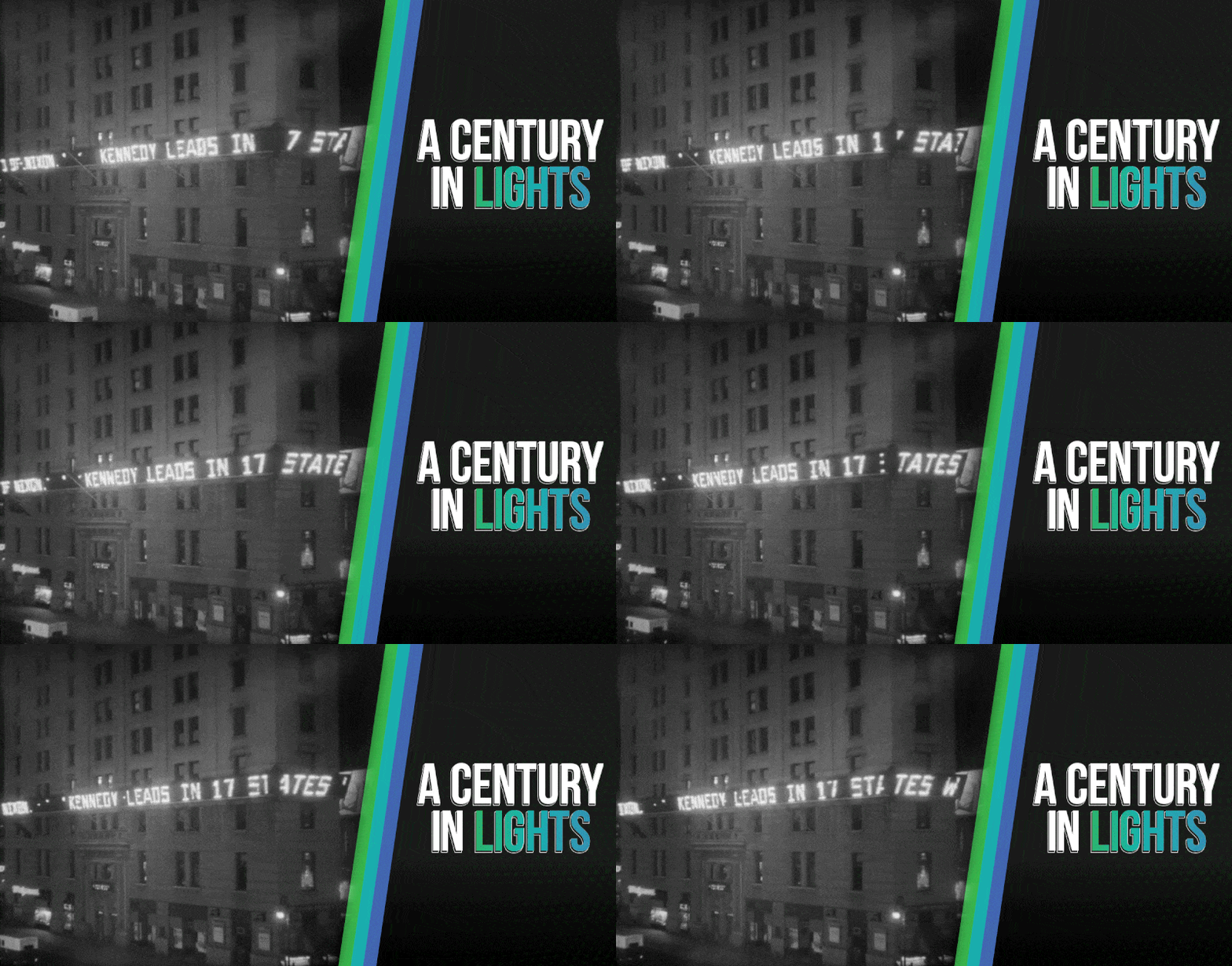
nyc digital signage 1960
The Birth of Digital Signage (1980s–1990s)
Early examples of digital signage included grids of CRT televisions playing marketing videos in stores, airports, and public spaces. Retailers began looping commercials via VCRs, and casinos, stadiums, and airports mounted screens to showcase ads and news. The term “digital signage” gained traction in the 1990s as computer technology and flat screen displays became more affordable and practical, allowing dynamic information and video to be played beyond traditional broadcast channels.
Technology Progress and Industry Expansion (1990s–2000s)
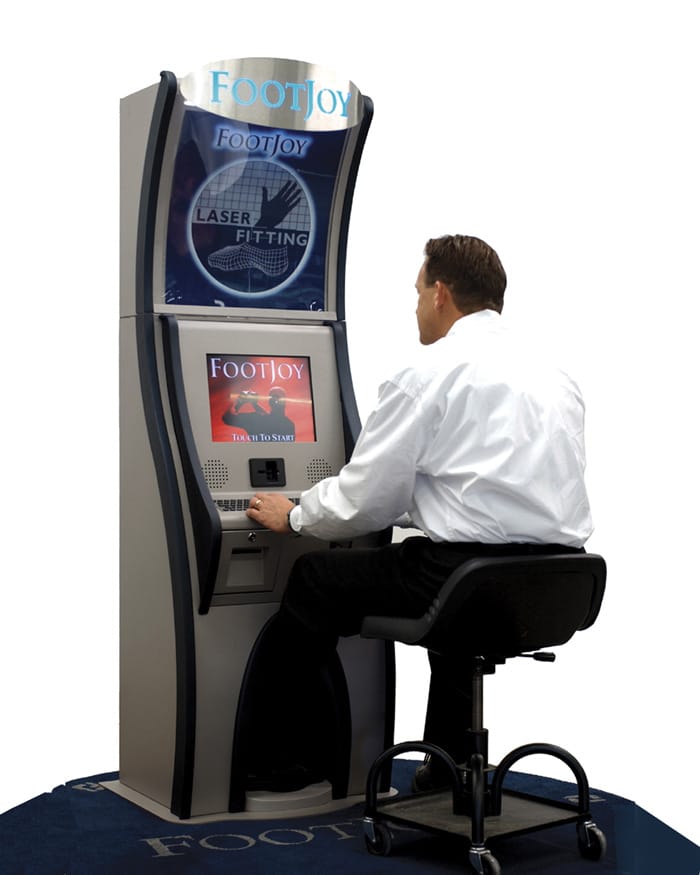
Footjoy custom kiosk used laserdisc for custom fiiting in 2002. Won award with St. Clair Interactive
Technological improvements, such as the introduction of plasma and LED displays, made digital signage visually stunning compared to static posters and neon signs. Major adoption occurred in retail, hospitality, and large venues, where digital signs replaced print to reduce costs and environmental impact. Companies began selling ad space on displays, turning digital signage into both an information channel and a revenue stream. Some of us remember “narrow casting in 90s” (thanks Ed Crowley)
Digital Signage Becomes Mainstream (2010s)
The development and adoption of cloud-based content management systems in the 2010s made digital signage easier to manage from anywhere, ushering in an era of remote updating and flexible scheduling. Applications expanded from advertising to internal communications, entertainment, wayfinding, and brand storytelling. Smart TVs and affordable displays leveled the playing field for small businesses to use digital signage alongside retail giants.
Modern Innovations (2020s and Beyond)
Recent years mark explosive growth driven by interactive technologies—touchscreens, sensors, RFID, and context-aware systems that tailor messages based on audience behaviors and environmental factors. Digital signage now spans healthcare, education, manufacturing, hospitality, and transportation, providing tailored experiences and analytics for operators.
As of 2025, the global digital signage market is estimated to reach $54.69 billion by 2034 due to a 7.41% compound annual growth rate (CAGR), underscoring the industry’s importance in marketing, information sharing, and customer engagement.
Summary Table of Major Milestones
| Decade | Milestone | Source |
|---|---|---|
| 1910s–1960s | Neon signs, illuminated displays | source |
| 1960s–1980s | LED displays, VCRs, video walls, LaserDisc | source |
| 1980s–1990s | CRT grids, term “digital signage” emerges | source |
| 1990s | Flat screens, computer integration, retail adoption | source |
| 2000s | Plasma/LED tech, large venue and retail expansion | source |
| 2010s | Cloud CMS, smart TVs, internal corporate communications | source |
| 2020s | Interactive, context-aware systems, massive global expansion | source |
The history of the digital signage industry is a story of innovation, adaptability, and transformation—propelled by technology and driven by businesses’ need to engage and inform diverse audiences more effectively.
Here is a detailed timeline of key technological milestones in the digital signage industry, tracing its evolution from the earliest electronic displays to today’s advanced systems.
Timeline of Key Technological Milestones
-
1960s–1970s: CRT Displays
-
Cathode Ray Tube (CRT) displays are used in televisions. Early digital display experiments begin, paving the way for large-screen electronic signage.
-
-
1968: First LED Display
-
Hewlett-Packard introduces the first LED display, setting a new precedent for electronic visual communication.
-
-
1972: Consumer VCR Launch
-
Philips releases the Video Cassette Recorder (VCR), enabling video loops on screens for advertising in public spaces.
-
-
1980s: LED Technology Expansion
-
LED signs and displays provide brighter, more reliable, and dynamic advertising tools, particularly for outdoors and large venues.
-
-
Late 1980s–1990s: Digital Signage Gains Identity
-
Term “digital signage” coined in 1992 after video walls become common in retail and malls.
-
Early adoption of plasma and LCD screens in commercial settings replaces neon and static billboards.
- Large-format venue video walls: 1980 (Dodger Stadium, Diamond Vision), the watershed moment for big public video displays later dominated by LED. [source]
-
-
1990s: Media Players and Retail Adoption
-
Dedicated digital media players emerge, enabling retailers and venues to update content electronically without VHS or DVDs.
-
-
Early 2000s: Broadband & Content Management
-
Broadband internet and networked signage arrives, allowing central content scheduling and remote updates.
-
First commercial touchscreen displays and kiosks enter the market, enhancing interactivity.
-
Proliferation of outdoor and free-standing screen enclosures for versatile deployment.
-
-
Mid–2000s: LED Video Walls
-
Thin LCD and LED screens support modular video walls and immersive, large-scale digital displays.
-
-
2010s: Cloud-Based Platforms & Ultra-Narrow Bezels
-
Cloud content management systems (CMS) take off, making dynamic, real-time, multi-site content distribution seamless.
-
Ultra-narrow bezel displays introduced, allowing nearly seamless multi-screen video walls.
-
Smart TVs reduce hardware costs, promoting broader adoption in business settings.
- Early 2010s: COB as a packaging approach begins to be applied to direct‑view LED display modules; industry accounts cite 2012 as an inception point for COB’s rise in dvLED. [BOE]
-
-
2010s–2020s: Interactivity and Context Awareness
-
Widespread use of touchscreens, sensors, and interactive kiosks transforms customer engagement.
-
Ultra-high-definition (4K, 8K) displays and energy-efficient e-paper signage expand possibilities and eco-friendliness.
-
Digital signage used for wayfinding, internal communications, and data-driven, targeted advertising.
-
Smart shelf labels and solar-powered digital signage are commercially deployed.
- Multiple vendors claim early “firsts,” but credible industry records indicate that COB-packaged direct‑view LED display modules were first commercialized in the early 2010s by Chinese LED display makers, with 2012 often cited as the inception period; by the mid‑to‑late 2010s several suppliers had shipping COB fine‑pitch walls, and in 2024 Daktronics launched a major flip‑chip COB line signaling mainstream adoption in the U.S. market [source]
-
-
Present and Future
-
AI-Driven Content & Personalization: Digital displays increasingly use artificial intelligence for data-driven, real-time content adaptation, audience engagement, and predictive content scheduling based on demographics and behavior.
- MicroLED Displays: Deliver extremely high brightness, true blacks, and ultra-fine pixel pitches for giant video walls, retail, and premium installations. MicroLEDs are moving from prototype to broad commercialization, sometimes even replacing OLED in flagship roles.
-
Digital signage now serves diverse roles in transportation, healthcare, education, hospitality, and retail, delivering tailor-made and interactive content in real time.
- Flexible & Transparent Displays: OLED and LED technologies now allow for rollable, bendable, and transparent screens for unique design, retail, automotive, and architectural applications
- E-Paper & Energy-Efficient Screens: Growing adoption in shelf tags and battery-powered outdoor displays due to their power saving and readability in sunlight.
-
-
Star Wars Next Generation —
Dynamically generating display content based on user voice, gestures, and other inputs is an accelerating trend and represents a significant leap toward personalized, adaptive, and immersive user experiences in digital signage. Instead of users only selecting from predefined menus, displays that listen, process, and respond in real time with AI-driven content make public and retail environments much more engaging and useful. Instead of media players running Celerons, we now have media computers with NPUs and TOPS rating for AI. Intelligent computing is not only able to serve up on request, but dynamically provides content, inverting the usual paradigm.
-
Benefits and Trends
-
Personalization: Interactive displays can tailor messages, offers, or information to individual preferences, demographics, or even moods—recognized via voice, gesture, or facial analysis—creating a unique, relevant experience every time.
-
Accessibility: Voice and touchless gestures enable accessibility for all users, including those with disabilities, and reduce friction in crowded or high-traffic areas.
-
Engagement: Dynamic content draws attention and encourages users to interact longer, which translates to more effective branding, education, or retail upselling.
-
Data & Feedback: Real-time adaptation allows displays to collect, analyze, and learn from user responses, continually improving content relevance with each interaction.
Ethical and Practical Considerations
-
Privacy: Usage of microphones and cameras for input raises concerns, and responsible deployment must protect user privacy and be transparent about data use.
-
Content Appropriateness: Automation requires safeguards to avoid inappropriate or unintended responses, especially in public settings.
In 2025, these technologies are expanding rapidly—especially in retail, transportation, healthcare, and hospitality—thanks to advancements in artificial intelligence, edge processing, and sensor integration. The shift from static or user-driven menus to truly adaptive, context-aware content is shaping the next generation of digital communication environments.
-
This timeline shows how rapid advancements in display hardware, internet connectivity, management software, and interactivity have continuously propelled digital signage from static and primitive beginnings to the powerful, dynamic tool it is across industries today.
Digital signage began incorporating interactive touchscreen functionality widely in the late 1990s and early 2000s, with public deployments accelerating through the 2010s. Early interactive digital signage systems were often found in malls, airports, and government buildings, using bulky CRT or LCD screens augmented with special touch films to enable basic interaction for applications like directories and kiosks.
Touchscreen technology, invented in the 1960s and 1970s, matured over the decades. By the early 2000s, advances in capacitive and resistive touchscreens, alongside reductions in hardware costs, enabled thinner, more durable digital signage screens specifically designed for interactivity. This made possible the affordable rollout of interactive content in retail, hospitality, and transportation environments. By 2010, users could interact widely with screens to access information, participate in surveys, and navigate public spaces independently.
Today, interactive touchscreen digital signage is the norm, driving engagement in shopping malls, airports, hotels, hospitals, and other public venues. The technology continues to evolve toward more advanced features, with the integration of mobile, gesture, and AI-driven interaction further expanding capabilities.
What Now and What’s Next?
Exploring disruptive trends on the horizon (holographic displays, driver-targeted automotive digital OOH, blockchain-based signage ad verification) get us curiosity about the next big disruptors. Holographic displays have been proposed forever. Our guess is totally AI-enabled robot will be final mechanism. Adds a visceral touch.
In 2025 and the coming years, digital signage is being shaped by cloud-based management, artificial intelligence, real-time personalization, interactivity, integration with IoT devices, and sustainable hardware innovations. These advances are transforming how businesses communicate, advertise, and engage with audiences.friendlyway+4
Channels, Segments and Content
The age of DooH, billboards and the like are evolving. Instead of advertisements in airports, we get in advertisements in the home (see Yahoo Finance Oct 2025). Omnichannel is becoming truly omnichannel with the consumer now integral to the process. Much like POS is evolving away from the clerk and to the customer.
And for content the typical CMS is loaded with assets which are carefully sequenced and controlled. In wayfinding, the consumer is given opportunity to navigate those assets. Companies like to use the word “dynamic” but wouldn’t that be more true if the customer asked for specific content and info. Now that would be dynamic presentation. Samsung talks of ads on refrigerators and I am sure they will find a way but most likely threaded into dynamic AI assist. “How much 2% milk do I have left?”. Why open the doors when you can just ask. Or maybe can you suggest shopping list.
Cloud Dominance & Remote Management
The majority of digital signage solutions are now driven by cloud platforms, enabling instant remote updates, centralized scheduling, collaboration, and scalability for multi-location networks. Content can be modified in real time from anywhere, reducing maintenance and making even complex deployments easy to control.aiscreen+1
Artificial Intelligence & Personalization
AI and machine learning are embedded at every level, powering predictive analytics, content automation, and hyper-targeted advertising. AI-driven signage adapts displayed messages using facial recognition, demographic data, location, time-of-day, or past interactions, producing relevant, contextual experiences. Predictive models forecast optimal display times for content, boosting conversion rates and audience engagement.risevision+1
Integration with IoT and Smart Devices
Digital signage increasingly communicates with sensors, mobile devices, beacons, and other IoT technologies. Screens can trigger tailored offers or live data streams (weather, inventory, news), adapting dynamically to audience presence or environmental conditions.lookdigitalsignage+1
Interactive, Immersive Experiences
Touchscreens, voice control, gesture recognition, augmented reality (AR), and virtual reality (VR) are driving a shift to highly interactive displays. User self-service kiosks, interactive wayfinding, and immersive brand storytelling now play a pivotal role in retail, hospitality, and transportation.fespa+1
Sustainable Displays & Hardware Innovation
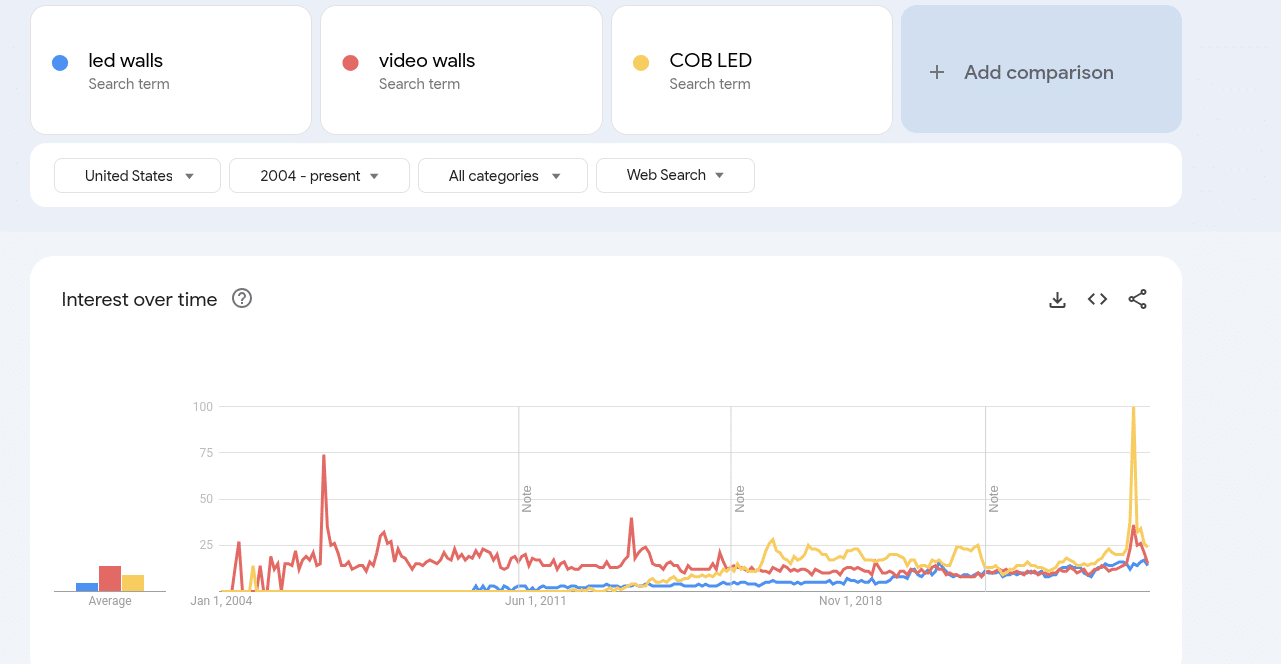
Video versus LED versus COB
Energy-efficient LED, COB and e-paper displays, solar-powered units, and recyclable components are setting new standards in environmental responsibility. Ultra-narrow bezel and 8K screens are making video walls (aka LED walls and immersive digital canvases more visually stunning and sustainable.fespa
You can see just by Google trends where the interest starts then tapers. Right now the up and coming is COB displays, especially for outdoor where 70% savings in energy compared to traditional SMD LEDs. Especially in situations requiring prolonged operation., 24-hour Drive Thru Menu Boards ring a bell?
For Menu Boards and Outdoor
Key Energy Efficiency Comparisons
-
COB displays typically consume 20% to 40% less power than SMD LED displays of similar size and brightness.
-
Real-world measurements show COB LEDs require around 117 W/m² compared to 195.8 W/m² for SMD, a 40% reduction in energy use.
-
COB technology achieves this through a closed cell structure and direct packaging, which reduces wasted energy as heat and maximizes luminous output.
-
For large outdoor installations, COB displays can yield up to 70% savings in energy costs compared to traditional SMD LED screens, especially in applications requiring prolonged operation.
Programmatic Advertising & Omnichannel Integration
Modern signage networks support programmatic ad buying and synchronize campaigns with mobile apps, websites, and physical stores for a seamless, omnichannel experience.aiscreen+1
These technologies, led by cloud, AI, IoT, and sustainability, are likely to further evolve in the next few years, making digital signage more dynamic, personalized, and deeply integrated with every aspect of customer engagement and business operations.friendlyway+4
- https://www.friendlyway.com/exploring-top-7-digital-signage-trends-2025/
- https://www.risevision.com/blog/top-trends-in-digital-signage-display-technology
- https://www.aiscreen.io/digital-signage/top-trends/
- https://www.lookdigitalsignage.com/blog/top-digital-signage-trends
- https://www.fespa.com/en/news-media/embracing-the-future-of-digital-signage/
- https://cirrusled.com/blog/8-winning-digital-signage-trends-for-2025
- https://www.aiscreen.io/digital-signage/digital-signage-statistics-2025/
- https://www.techradar.com/best/best-digital-signage-software
- https://invidis.com/news/2025/02/ise-2025-the-top-10-digital-signage-trends/
- https://www.digitalsignagetoday.com
- https://www.fastsigns.com/blog/about-products/digital-signage/the-future-is-now-digital-signage-trends-in-2025/
- https://www.fespa.com/en/news-media/embracing-the-future-of-digital-signage
- https://www.mvix.com/blog/10-features-and-examples-of-digital-signage
- https://screencloud.com/digital-signage/statistics-trends
- https://www.crowntv-us.com/blog/top-5-digital-signage-trends-2025/
- https://www.wallboard.us/blog/embracing-the-future-top-digital-signage-trends-to-watch-in-2024
- https://www.digitalsignagetrends.com
- https://blog.kitcast.tv/top-digital-signage-trends/
- https://www.poppulo.com/blog/the-future-of-digital-signage-in-the-retail-sector
- https://northamericansigns.com/branding-beyond-exploring-signage-industry-trends-of-2025/
when might the usual billboards along the highways be replaced with digital?
Traditional highway billboards are being replaced by digital billboards at a rapid pace, but full replacement is a gradual process likely spanning the next decade or more. As of 2025, digital billboards account for about 41% of worldwide outdoor advertising revenue and are growing much faster than traditional formats—at an estimated 6% compound annual growth rate. In the United States, there are over 16,000 digital billboards installed, with numbers rising annually as operators favor their ability to rotate ads, update content instantly, and target messaging dynamically.theneuron+1
However, the transition is influenced by local government regulations, costs, and operational concerns. Many cities and states restrict the conversion to digital due to safety and aesthetic reasons, requiring a balance between digital and static displays. Some regions allow gradual conversion: for example, San Antonio began permitting eight traditional billboards per year to be converted to digital, while removing four existing static billboards to reduce overall clutter.aaf+1
Industry experts expect digital billboards to steadily outpace static ones along major highways over the coming decade, especially in high-traffic and metro areas where ad rotation and dynamic features offer premium value. But rural and less regulated areas will likely retain static billboards for longer, due to lower costs and fewer restrictions. The complete replacement of traditional billboards with digital will depend on regional policies, public sentiment, and ongoing investments by outdoor media companies.signs+3
- https://theneuron.com/what-are-digital-billboards/
- https://www.signs.com/blog/billboard-advertising-statistics/
- https://www.aaf.org/Public/Public/Education-and-Resources/Government-Affairs-Policy/Position_Papers/Digital_Billboards.aspx
- https://www.expressnews.com/news/article/digital-billboard-rule-change-18130185.php
- https://v12marketing.com/marketing/are-billboards-still-relevant-in-2025/
- https://allvision.com/digital-superboards-the-future-of-advertising/
- https://avinashiads.com/future-of-static-billboard-ads.php
- https://www.youtube.com/watch?v=zn9HtuX_X-s
- https://www.reddit.com/r/signs_com/comments/1khng5k/are_billboards_still_worth_it_in_2025_heres_what/
- https://scenicutah.org/images/pdfs-doc/Primer_for_Local_Governments_3rd_Edition_Final_1.pdf
- https://www.csoaa.com/facts-vs-myths
- https://www.whistlerbillboards.com/friday-feature/billboard-advertising-on-highways/
- https://www.whistlerbillboards.com/marketing/traditional-formats-still-beating-digital/
- https://www.vcoutdoor.com/blog/2024/11/26/digital-vs-traditional-billboards-navigating-the-outdoor-advertising-landscape-in-chicago
- https://trueimpactmedia.com/blog/billboard-facts-2023/
- https://www.junglecommunications.com/are-billboards-dead-in-2025/
- https://vocal.media/journal/the-rise-of-digital-outdoor-advertising-how-technology-is-shaping-modern-marketing-strategies
- https://kreative-media.com/are-billboards-still-effective/
- https://www.alliancemedia.com/2025/08/22/ooh-vs-digital-marketing-in-2025/
- https://effortlessoutdoormedia.com/2025-billboard-trends-the-evolution-of-digital-and-traditional-ooh-advertising/
What About Power Over Ethernet PoE
Power over Ethernet (PoE) has transformed digital signage by enabling both power and data to be delivered through a single network cable, streamlining installations, reducing costs, and opening up new possibilities for placement and remote management. Here’s a detailed exploration of its impact, adoption timeline, prevalence, and major hardware providers.
Impact of PoE on Digital Signage
-
Simpler Installations: PoE eliminates the need for separate power outlets, making it easier and more cost-effective to install digital signage in locations where power access is challenging—such as ceilings, exhibition halls, transit stations, and building hallways.
-
Lower Costs and Increased Safety: Using low-voltage Cat5e/Cat6 cables with PoE reduces the need for electricians, lowers wiring complexity, and boosts installation safety.
-
Remote Management: IT teams can power-cycle, monitor, and manage signage remotely using standard PoE network switches, increasing reliability and operational efficiency.
-
Flexible Deployment: PoE allows displays to be installed up to 300 feet from the network source, supporting creative and space-efficient layouts.
When Did PoE Begin in Digital Signage?
-
The first official PoE standard, IEEE 802.3af, launched in 2003, delivering up to 15.4W per port. In the following years, enhancements like PoE+ (IEEE 802.3at, 2009) and PoE++ (IEEE 802.3bt, 2018) brought higher wattages (up to 60+W), enabling larger displays, media players, and advanced interactive signage.
-
PoE adoption in digital signage ramped up in the late 2010s, gaining momentum as businesses sought to modernize with smart displays and ease of installation.
Current Adoption and Future Prospects
-
Widespread in Modern Deployments: By 2025, PoE-enabled digital signage is common in retail, healthcare, transportation, smart buildings, and educational facilities due to the convergence of IoT devices and increased network speeds.
-
Rapid Growth Ahead: The global PoE market (across applications) is growing at over 17–21% annually. Smart building initiatives, 5G rollouts, and demand for energy-efficient, easily managed digital signage are accelerating PoE’s use.
-
Future: PoE will continue to expand its footprint, with improvements to power delivery enabling even larger and more complex digital canvases. Its ability to power sensors and interactive IoT elements positions PoE as a backbone for future digital and smart signage environments.
Major Hardware Providers
-
Bluefin: Offers a wide range of PoE-enabled digital signage displays with BrightSign built-in, known for reliability and ease of installation.
-
BrightSign: Leading supplier of robust digital signage media players, many of which support PoE and are widely used in retail, hospitality, and public venues.
-
Patton Electronics: Supplies PoE Ethernet extenders and network solutions tailored for extending PoE far beyond standard Ethernet limits, valuable for signage in large or distributed facilities.
-
Portworld: Specializes in customizable PoE display hardware for various digital signage applications.
-
Thinlabs – No AC power supply needed. Reduces power consumption by 60-75%. Reduces up front installation costs. We build All-In-Ones that make this possible. Innovative and Evolutionary but oddly not in the conversation. WHY? Maybe because we are the Worlds First PoE Computing Manufacturer. Check us out then circle back.
us.thinlabs.com -
Major network switch providers (Cisco, Netgear, Ubiquiti): Provide enterprise-grade PoE switches powering both signage and supporting network devices.
Wrap on PoE
Power over Ethernet is a cornerstone of today’s digital signage infrastructure, allowing for more flexible, sustainable, and remotely managed installations. Adoption is now widespread, especially in new and retrofit innovative building projects, with continued growth expected as the underlying technology continues to evolve and enhance digital experiences in public and private spaces.
Definitions
Skykit writeup is good — The term “digital signage” was first used in early 1992 in a UK shopping center, when a security guard described a network of video walls as “digital signage.” This informal naming caught on, and Neil Longuet-Higgins from SIS Digital is often credited with being the first to use and popularize the term in the industry. While some sources claim the idea or related technologies existed earlier, 1992 is widely recognized as the moment the term entered common usage.
Editor’s Comment: Neil Longuet-Higgins prefaces his title with “Inventor of the term Digital Signage”. A couple of notes on that. The term “Signage” is somewhat archaic and even a little conflated, and digital interactive screens are often conflated with digital signage. Inventing a term? Probably more accurate to say he took the phrase “digital sign” which was used to describe a sign in the store, and applied collective noun to widen the scope to any and all. He modified a term. “Inventing a term” derived from an existing term is a tough sell for me 🙂 Meanwhile “Sign” is very popular (electronic and digital) as is Display. Gee, and Screen is overtaking Sign! I am now going to invent the term “Digital Screenage”. Never been used till now and is now part of popular jargon. How about that? Perhaps as a term it will be ironically “ageless”.
Back then we called them video walls, not LED walls as LED walls hadn’t yet been “invented”.
From Patter — You cannot truly invent a term that already exists in the exact same form and meaning, since “inventing” a word means creating something new that wasn’t previously present in the language. However, you can take an existing word and give it a new meaning, usage, or context—this is a way of “inventing” a term in a specific sense by shifting its meaning, combining it with other terms, or modifying its form.
Wikipedia also references the UK instance as the origin. Bear in mind I am editor for Wikipedia and consider the current entry by them as hopelessly dated. The only permissible way to update is to locate some obscure technical lecture reference. Facts in reality have little weight. Its worth noting the most of the primary basis for its entry is from a consultant who wrote a book in attempt to increase his business.
Credit
Kiosk Industry Group
Covering everything from static screens to interactive intelligence.
Welcome to the Digital Screenage.
Digital Signage Picture Gallery
-
- nyc digital signage 1960

-
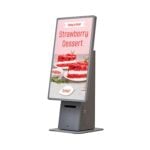
- LG Kiosk

-

- digital signage sitekiosk 2025

-

- amazon giada digital signage

-
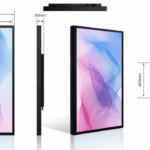
- Digital signage 2500 nit 43″ — $390 — judy@havistouch.com

-
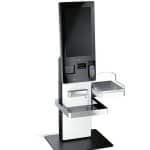
- A modern self-service kiosk with digital signage features, including a large touchscreen, payment terminal, and two metal shelves for customer checkout, set against a white background.

-
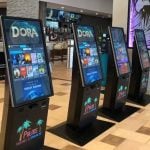
- Four digital ticket kiosks for Palms Theatres & IMAX stand in a row inside a lobby, displaying movie options like Dora on their digital signage screens. A bar and dining area are visible in the background.

-

- A kiosk labeled Holy Grail Autograph Hits displays a large autographed sports card with a player’s photo, signature, and digital signage on its side. The machine is illuminated with neon-style lighting.

-

- A large digital billboard showcases a vibrant red abstract image, surrounded by rows of purple and white LED lights against a dark sky—a pixel-perfect example of modern digital signage.

-

- digital signage ai

-

- Framed image titled AI Conversations featuring a person speaking, labeled Joey Zhao, 22Miles CEO, against a backdrop of digital signage AI. The background showcases a digital circuit design with interconnected blue lines and a central glowing light.

-
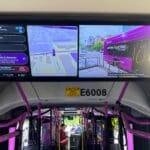
- transit station digital signage nanonation

-
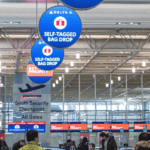
- The airport terminal features blue and red signs for Deltas self-tagged bag drop and Sky Priority. Passengers queue under modern bright lighting, while TSA and CLEAR signage is visible. Digital signage enhances the area’s efficiency, guiding travelers to multiple check-in counters.

-

- digital sinage example – An empty airport check-in area features sleek digital signage, with screens displaying @mspairport and @suncountryair next to Check-in instructions. It reminds passengers that face coverings are required. The modern space is enhanced by overhead lighting and a linoleum floor.

-

- A traveler with a red suitcase moves through an airport terminal toward the Delta International Check-In area. Digital signage above guides passengers to agent assistance, self-tagged bag drop, and other services. The terminal is spacious and well-lit.

-

- A busy airport terminal buzzes with travelers, their luggage in tow. Above, a row of digital signage screens updates flight and security information, casting a glow on kiosks below. Ceiling lights shine brightly over the bustling scene.

-

- A family stands at an airport check-in counter, surrounded by digital screens displaying Self-Tagged Bag Drop and Sky Priority. The area is empty, bordered by red ropes, with airport digital signage highlighting the South Security Checkpoint overhead.

-

- A traveler with a suitcase ascends an escalator in an airport terminal, where sleek digital signage efficiently guides passengers to baggage claim and ground transportation. Modern architecture showcases prominent circular ceiling lights, enhancing the futuristic ambiance.

-
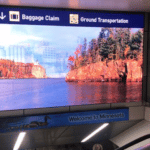
- A large piece of airport digital signage showcases a scenic view of a lake with autumn-colored trees. Signs for baggage claim and ground transportation hover above, with a welcoming Welcome to Minnesota message just beneath the vibrant display.

-
- mcdonalds coates digital signage

-
- digital signage outdoor

-

- A modern, open-air covered walkway with tiled flooring leads through an urban area. A digital kiosk, a recent winner of digital signage awards, displays an ad for a fitness gym. Green plants line the walkway on the left, and tall buildings are visible in the sunny background.

-
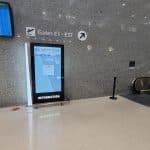
- An airport terminal features digital signage with a map, guiding travelers to Gates E1 – E37. Kiosks line the path, and an escalator stands on the right. A flight information display board hovers in the upper left corner.

-
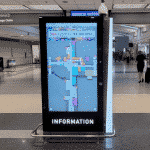
- A digital signage kiosk in an airport terminal displays a colorful map. The screen highlights various sections labeled in different colors, and nearby signs direct travelers to international and domestic baggage claim, while travelers bustle in the background.

-
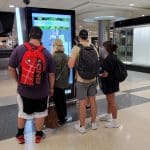
- Four people stand in an airport terminal, gazing at a digital signage directory. They wear casual clothing and backpacks. The area is spacious with a polished floor and overhead lighting. A nearby sign announces a new exhibit coming soon.

-
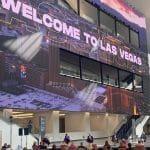
- LVCC LED digital signage

-
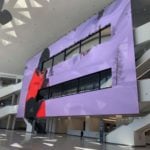
- Click for full size — LVCC Digital Signage kiosk by 22Miles

-

- Diagram titled The ClearConnect Solution showcasing interconnected services: Smart Locker Solutions, Back Office Solutions, POS Hardware and Software Solutions, Self-Ordering Kiosk and Digital Signage Solutions, Drive-Thru Solutions, Deployment and Managed Services.

-

- A blue car drives through a fast-food drive-thru, approaching the order kiosk adorned with digital signage. Menu boards display enticing images of burgers and more. The area is paved with a clear road, framed by trees and buildings in the background.

-

- A display shelf holds numerous Coca-Cola bottles next to Lenovo products. Three people are talking near a yellow wall adorned with Revolutionize the Shopping Experience, while digital signage enhances the kiosks modern allure.


-
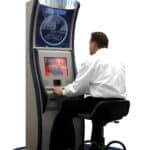
- Footjoy custom kiosk used laserdisc for custom fiiting in 2002. Won award with St. Clair Interactive

More Digital Signage Articles
-
IAAPA 2025 – Ticketing, Digital Signage and Accessible
-
Interactive Digital Signage ADA E-Book by 22Miles
-
Digital Signage, Kiosks and Wikipedia
-
Digital Signage Software Wayfinding Update
-
Digital Signage MiniPC Gold Sponsor – Giada
External Resource Links
- Kiosk Industry Group — all things to do with kiosks, particularly members of KMA
- Kiosks.io — all things to do with kiosks
- retailing.io — all things to do with retail
- selfservice.io — all things for selfservice
- KMA – the association site for the Kiosk Manufacturer Association
- Catareno Kiosk Consulting — included is AIOs and Touchscreens
- Check In Kiosk – website for check-in and check-out
- PatientKiosk — patient registration kiosks in healthcare along with EHRs like Epic with Welcome Kiosk are covered
- Patient Kiosk Check-In magazine (emphasis on EPIC)
- McDonalds Kiosks magazine and all the related to
- Bitcoin ATM Kiosk magazine news
- KMA Technology Corner
- Retail Automation (drive-thru, lockers, robotics, etc)
- Vimeo
- YouTube
- gokiosk.net — kiosk archives — 1998 to 2006
- gokis.net – kiosk archives — 1998 to 2006
- LinkedIn Group
- Kiosk Association AVIXA
- Craig Keefner AVIXA
Digital Signage Software & Displays
- Digital Signage Blog — more accurately interactive digital displays but we are stuck with “digital signage” for now.
- Menu Board — here we focus on digital menus, indoor and outdoor. Panasonic and LG are two of our members and contribute.
- Best Digital Signage Solution Provider News
- Menu Board Technology and Digital Menus
- AVIXA Exchange
Cloud Computing & Thin Client
- Thin Client Computing — Touchscreen Chromebooks, Zero Clients and your usual Wyse (oops I mean Dell) and HP thin client news
- Thin Client and Cloud Computing – flip feed
- Smart City RFPs and Design (focus on US local and state)
- Smart City Design — we see growing interest in smart city especially in renovating downtowns for better pedestrian access longterm
Automated Retail & POS
- Retail Automation — lockers and smart vending along with innovative drive-thru and retail robotics
- POS PCI and EMV
- EV Charging Technology magazine
- Point Of Sale RFPs — website for tracking and listing RFPs issued for POS primarily in SLED market
- Check In Kiosk – website for check-in and check-out
- Retailing.io
- LinkedIn Group
Healthcare Technology
- i-Telehealth — remote health monitoring and treatment by consumers themselves, sometimes with assistance
- Telemedicine News Telehealth magazine
- PatientKiosk — patient registration kiosks in healthcare along with EHRs like Epic with Welcome Kiosk are covered
- Patient Kiosk Check-In magazine (emphasis on EPIC)
Technology and Components
- Touch Screen Monitor News
- AIOs and Media Players (like Brightsign)
- Touch Screens — touchscreens come in sizes from 5″ to 100″. You have LED fine pitch which are only displays
- Digital Business — looking for software like browser lockdown or commercial-grade tablets and All-In-One computers?
- ADA and Accessibility in the news – magazine
- The Industry Group – top level website for the group
EV Charging Stations
- EV Charging Stations Website
- Flip It Channel — EV Charging News


