

Last Updated on August 4, 2026 by Craig Allen Keefner
30 Years of Self-Service & Kiosk Evolution
For most industries, history is marketing.
For the self-service kiosk industry, history is proof.
Long before “digital transformation” became a buzzword, kiosks were already solving real-world problems—reducing friction, extending access, and automating transactions. What is now called AI, edge computing, and unattended retail is simply the next phase of a journey that began decades ago.
Through archived coverage on gokis.net and gokiosk.net, we have documented that journey in real time—creating a continuous record of innovation, experimentation, and deployment across retail, healthcare, banking, and public services.
This is not retrospective storytelling.
This is documented prior art.
We also maintain a chronology by year here on kioskindustry.org
1990s: Foundations — ATMs, Early Kiosks, and Dial-Up Innovation
The 1990s established the blueprint.
- ATMs became the first widely accepted self-service machines
- Early kiosks appeared in airports, malls, and government offices
- Connectivity was limited, but ambition was not
One of the most telling examples was the Internet Vending Machine (IVM)—a dial-up enabled kiosk concept that allowed users to access online services before broadband was even viable.
At the same time:
- IDC began reporting early internet usage statistics
- Press releases from the era show vendors experimenting with information access, ticketing, and basic transactions
- Kodak developed and marketed its first photo kiosk in 1995, marking the start of its serious retail photo‑kiosk push.
-
By the 1990s overall, Kodak was rolling out multiple retail kiosk-style solutions (e.g., CREATE‑A‑PRINT in 1988 and then full photo printing kiosks), and since then it has deployed over 100,000 photo kiosks worldwide.
👉 The key takeaways:
Even in a dial-up world, the industry was already pushing toward self-directed digital interaction.
Consumers were not used to ATMs or Photo Kiosks and these were the units that actually “trained” the consumers that touching a computer screen was actually useful.
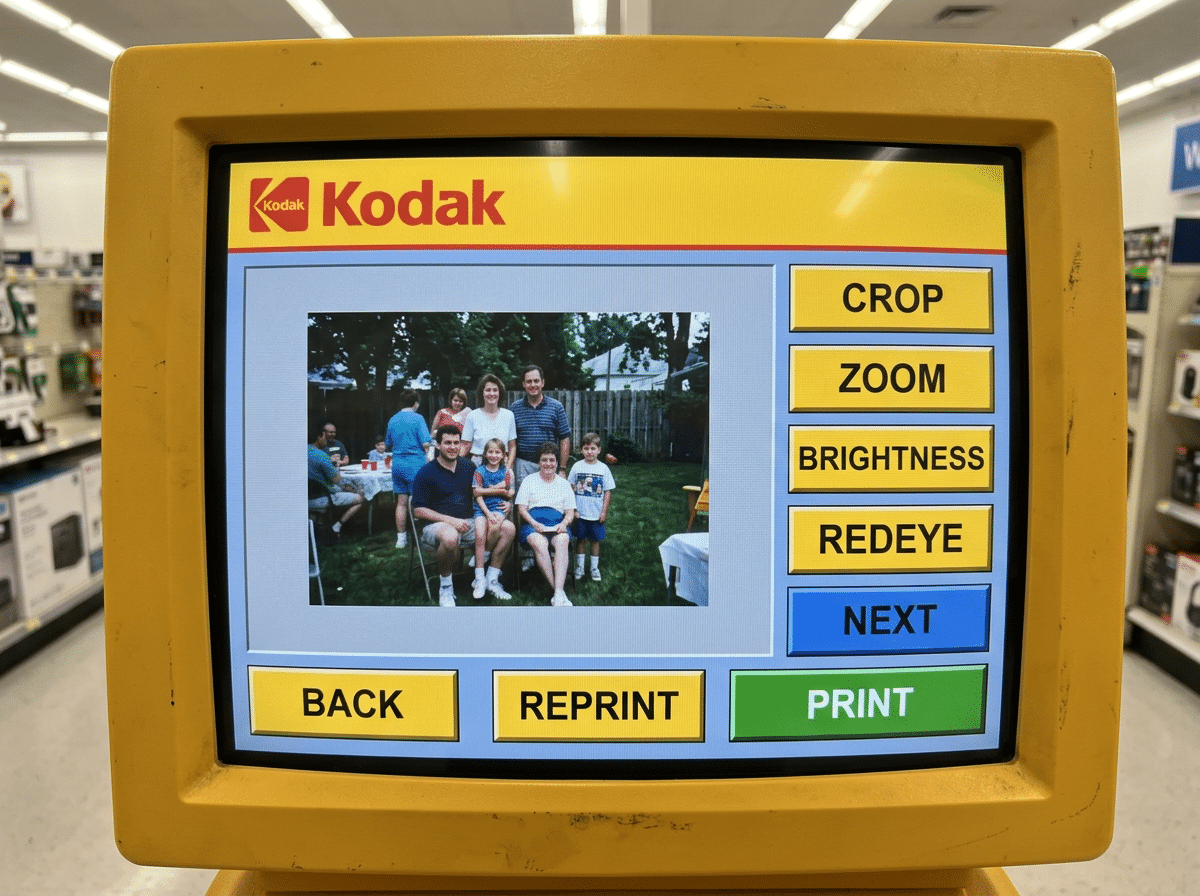
kodak kiosk interface rendering
2000s: Expansion — Internet Kiosks and Commercial Deployment
The 2000s were about scaling.
Connectivity improved. Hardware stabilized. Business models emerged.
Key developments included:
- Netkey supporting Linux (2000) — signaling early moves toward open, flexible kiosk platforms
- IBM manufacturing FastTake kiosks — enterprise-grade validation of the category
- Intel + Mosaic mobile payment initiatives — early signals of integrated digital commerce
This decade saw kiosks move from “interesting concept” to deployed infrastructure:
- Ticketing kiosks
- Check-in systems
- Retail self-service stations
👉 The shift:
From experimentation → commercial rollout
2010s: Acceleration — Self-Checkout, Tablets, and UX Focus
The 2010s introduced scale and usability.
Touchscreens improved. Tablets lowered costs. Software matured.
This is when kiosks became:
- Mainstream in retail via self-checkout
- Standard in QSR through self-ordering
- Integrated into healthcare via patient check-in
The industry also began focusing on:
- User experience (UX)
- Remote management
- Content systems
- Payment integration
👉 The key shift:
From hardware-driven deployments → software-driven ecosystems
2020s: Transformation — AI, Edge, and Unattended Retail
The current decade is not a reset.
It is an acceleration of everything that came before.
Today’s systems are defined by:
- AI-driven interaction (voice, vision, personalization)
- Edge computing (local processing for speed, privacy, reliability)
- Unattended retail (micro markets, smart stores, autonomous checkout)
The kiosk is no longer just a device.
It is a node in a distributed digital infrastructure.
Key themes:
- Zero-trust identity
- Accessibility compliance (ADA, Section 504)
- Cloud + edge hybrid architectures
- Integration with mobile and backend systems
👉 The reality:
Self-service is now a core operating model, not an add-on.
Why This History Matters
Most industries rely on trend reports.
This industry has receipts.
With over 30 years of documented deployments, vendor activity, and technology evolution:
- We can trace ideas from concept → commercialization
- We can validate what works (and what doesn’t)
- We can identify repeating patterns across decades
This is not just content.
👉 It is institutional knowledge.
The Industry Perspective
What appears “new” today often isn’t.
- AI at the edge? → evolution of local processing
- Mobile payments? → extension of early kiosk payment systems
- Digital front door? → refinement of check-in and access systems
The difference is not the idea.
The difference is scale, maturity, and integration.
From Archive to Advantage
The gokis.net and gokiosk.net archives are more than historical artifacts.
They represent:
- A credibility layer no competitor can replicate
- A prior art repository spanning decades
- Proof of continuous industry engagement since the 1990s
For operators, vendors, and investors, this matters.
Because in self-service:
👉 The future is best understood by those who have already seen its past.
