

Last Updated on September 29, 2026 by Craig Allen Keefner
The parcel locker industry got its own association this week.
The International Locker Association launched at Parcel+Post Expo in London with 13 founding members across 12 countries. Its stated mission is straightforward: move locker delivery toward a standard, and give buyers, operators and cities the tools to procure and run locker networks more effectively.linkedin
Founding members include ALFA 3, ARKA Smart Parcel Lockers, Bloq.it, Columat, Direct4.me, Flexity, KEBA, kernTerminal, Last Mile Logistics, Modern Expo, ROTTE, Rovenma and SwipBox.
For more information visit https://ila.locker
The first work items are sensible:
-
An industry glossary
-
A free tender toolkit
-
A standardisation roadmap
-
One security test to stop the “locker-per-tender demolition derby”linkedin
That last one is worth underlining. Parcel lockers are not just big metal boxes with doors and a screen. They are unattended public infrastructure: physical security, identity, notification systems, delivery workflows, remote monitoring, network connectivity, data privacy and, increasingly, consumer expectations around convenience. Every RFP should not require reinventing the same test regime.
Familiar territory for KMA
There is a recognizable parallel to the Kiosk Manufacturer Association.
KMA did not start as a grand global institution either. It started very much U.S.-centric, rooted in the early kiosk community, the old comp.infosystems.kiosks Usenet group, and a market that was then focused on North American deployments, U.S. manufacturers and U.S. regulatory concerns. The association’s origins go back to the mid-1990s, with the KMA and its surrounding industry community later taking on accessibility, payment, standards and education work that could actually be used by deployers and suppliers.
Over time, the membership and the technology spread globally. That is generally how these things happen.
First, a group of companies in a region decides that the market needs common language, a place to compare notes, better procurement guidance and some way to talk to regulators and large buyers. Later, if the work is useful, the tent gets larger.
The ILA appears to be at that first stage.
European by design—so far
The initial membership is heavily European. That is not surprising. Europe has many of the most mature parcel-locker environments in the world, with dense out-of-home delivery networks, carrier lockers, shared networks, retailer pickup and national delivery habits that make lockers a normal consumer option rather than a niche convenience.
But the absence is obvious:
-
No U.S. locker companies or major U.S. delivery-network players, at least among the founding members.
-
No China-based participants, despite China being one of the world’s largest and most sophisticated locker markets.
-
No visible representation yet from Japan, Korea, the Gulf states, Latin America or other rapidly evolving delivery markets.
So, International may be the direction of travel, but the starting point is Europe.
That is fine. KMA has always been global in aspiration, but it grew out of a very American self-service market—ADA, accessibility, PCI, EMV, procurement requirements, QSR ordering, retail kiosks, government use cases and the usual U.S. mixture of standards, lawsuits and large enterprise RFPs. The ILA’s equivalent starting conditions are European parcel networks, out-of-home delivery, locker density and the need to make procurement less repetitive.
Different markets. Very similar association DNA.
Where ILA can add value
The tender toolkit and terminology work could be particularly useful.
Anyone who has reviewed unattended-technology RFPs knows the problem. One customer calls it a smart locker. Another calls it a parcel locker. Another calls it an automated parcel terminal. Requirements get copied from a previous RFP, mixed with a vendor brochure, expanded by a security consultant and then handed to suppliers as if it were a technical standard.
The result is often expensive, inconsistent and hard to compare.
A credible toolkit should help buyers ask better questions about:
-
Indoor versus outdoor environmental requirements
-
Door and compartment configuration
-
Accessibility and reach requirements
-
Courier authentication and consumer pickup methods
-
APIs, network interoperability and integrations
-
Remote monitoring and service-level expectations
-
Cybersecurity, privacy and data ownership
-
Physical attack resistance and recovery procedures
-
Returns, oversized parcels, age-restricted goods and exception handling
-
Shared-network versus carrier-owned deployment models
There is also an accessibility opportunity here. Parcel lockers are a self-service interface in public space. The screen, the reach ranges, the doors, the QR code and smartphone assumptions, the audible feedback, the visual feedback, the physical force required to open doors—none of that should be an afterthought. This is an area where the kiosk industry has learned some lessons, sometimes the hard way.
The real test
The association will be judged not by the launch announcement but by what it publishes and who it includes.
If ILA produces genuinely open procurement guidance, practical security criteria and a roadmap that recognizes accessibility, APIs, privacy and operator realities, it could become a valuable industry resource. If it becomes a vendor club with another logo, another membership fee and documents that mainly favor founding-member architectures, then it will have a much shorter shelf life.
KMA’s experience is relevant. Associations gain credibility when they help buyers, deployers, regulators and suppliers solve real problems—not when they merely validate the companies already in the room. KMA’s work around accessibility and common industry guidance has mattered because it connected the technology vendors to the agencies, customers and standards environment that shape actual deployments.kioskindustry+1
The parcel locker market needs that kind of voice.
Europe is clearly taking the first step. The question is whether the ILA grows into a global organization with U.S., China and other major-market participation—or remains primarily the European locker industry talking to itself.
Parcel+Post Expo was a logical launch venue. The 2026 event at ExCeL London focused on postal, parcel and e-commerce innovation and highlighted lockers and out-of-home delivery as active industry topics.
Accessibility “Not Found”
For a European-origin locker association, it is a conspicuous omission—not necessarily a criticism of the organization at launch, but a major gap to watch. Regulatory frameworks are the basis of liability and locker providers want to know they have done their job just like kiosk manufacturers do.
Parcel lockers are public, self-service customer interfaces. Accessibility has at least three layers:
-
Physical access: approach routes, clear floor space, height and reach range, door force, parcel retrieval, lighting, weather exposure, wheelchair access and usable placement of scanners, screens and payment devices.
-
Digital interface: touchscreen interaction, contrast, non-color cues, readable text, timeouts, audio output, privacy, tactile controls where appropriate and compatibility with assistive technologies.
-
Alternative journeys: app-only pickup is not an accessible answer by itself. Users may not have a smartphone, may not be able to use a QR code, may have limited dexterity or vision, or may need a human-assisted exception path.
The EAA has applied since June 28, 2025 to covered products and services placed on the EU market. Its accessibility requirements are functional in nature, and the practical technical conversation for ICT commonly leads to EN 301 549—the European accessibility requirements standard for ICT products and services, developed through the European standards organizations including ETSI, CEN and CENELEC.etsi+1
EAA and lockers: be precise
It would be premature to say every parcel locker is automatically and explicitly regulated as an EAA product category. The legal applicability depends on the exact product, service and commercial model: e-commerce service, consumer terminal, payment function, mobile application, customer information system, delivery service interface and national implementation.
But an association writing locker tender guidance cannot avoid the issue.
If ILA’s tender toolkit tells cities, carriers, retailers, residential developers and operators how to buy lockers, it should include an accessibility section that requires buyers to identify applicable law and sets measurable minimum expectations. At a minimum, that guidance should address:
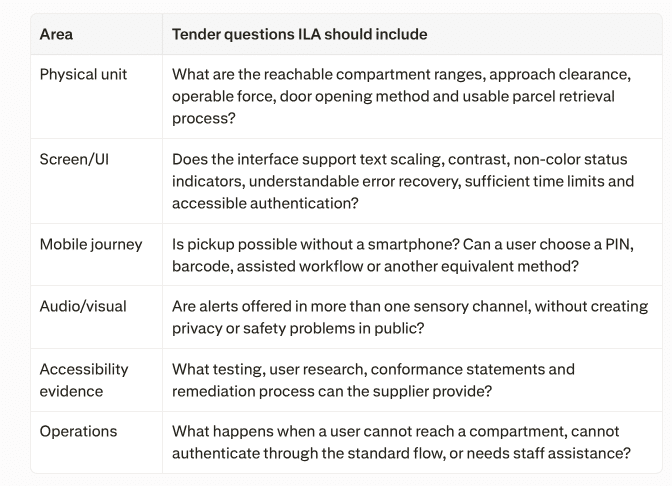
lockers accessibility
ETSI: relevant, but not the only answer
ETSI is relevant principally for the ICT part of a locker system: user interface, software, connectivity and potentially the customer-facing app or web journey. ETSI identifies accessibility and Human Factors as part of its standards work, while EN 301 549 defines functional accessibility requirements and test procedures for ICT products and services.etsi+1
However, an accessible locker specification cannot stop at EN 301 549. The locker is a physical self-service device in a real environment. It needs a combined framework:
-
EAA and applicable national implementation rules
-
EN 301 549 for ICT accessibility
-
WCAG where a web or mobile interface is involved
-
Relevant built-environment, product-safety, ergonomics and national accessibility requirements
-
Real-world usability testing with people with disabilities
That is familiar territory for KMA. In the kiosk world, the mistake is treating accessibility as a screen-only checkbox. A terminal can have a technically compliant-looking UI and still be unusable if the card reader, scanner, parcel door, receipt, camera, speaker or service workflow is inaccessible.
Conclusion
One early omission is accessibility. The launch material talks about security, standards and procurement, but not EAA, EN 301 549, ETSI or inclusive design. That will need to change if the association wants its tender guidance to be credible for public-facing, self-service delivery infrastructure.
Resources