

Last Updated on November 12, 2026 by Craig Allen Keefner
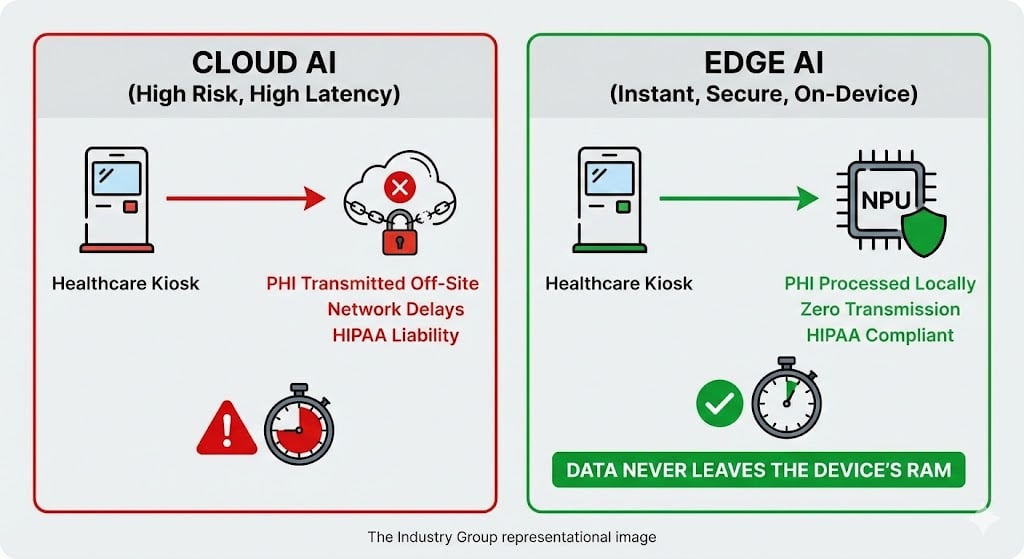
Edge AI is the HIPAA-compliant solution for patient-facing kiosks in healthcare because it processes Protected Health Information (PHI) locally on the device. This approach mitigates the significant HIPAA vulnerabilities associated with transmitting PHI to external cloud servers for processing, which introduces expanded exposure surfaces and complex Business Associate Agreements. By 2026, the industry standard for healthcare self-service systems involving PHI is shifting to require AI processing at the Edge, moving from concept to deployment reality at events like HIMSS 2026.
The Edge AI Paradigm Shift: Processing PHI on the Device
The push to modernize patient check-in has led to a dangerous oversight in hospital IT. In the rush to implement touchless interfaces, voice recognition, and biometric authentication, many facilities are relying on cloud-based Artificial Intelligence.
Bottom-line? For patient-facing kiosks handling PHI, edge inference should be the default architectural standard.
From a compliance standpoint, this (Cloud AI) can be a massive vulnerability. More precisely — Cloud AI introduces expanded exposure surfaces for PHI in patient-facing kiosk environments. Healthcare infrastructure needs to rethink AI architecture. At HIMSS 2026, Edge AI in patient-facing systems is moving from concept to deployment reality.
More information
- HIMSS Healthcare in Las Vegas — kiosks, badge and wristbands, surgical touch less and medical grade touchscreens
- HIMSS 2026: The “Digital Front Door” Survival Guide from PatientKiosk — 5 Point Patient Kiosk “No-Fail” Checklist — For IT Directors, Compliance Officers, and Patient Experience Leaders
- Healthcare– Modernizing the patient and staff journey. Discover the hardware and compliance standards driving the next generation of secure patient check-in, telehealth access, and HIPAA-compliant biometric interfaces.
- Edge AI – The new baseline for self-service computing. Learn how to eliminate cloud latency and protect data privacy by processing computer vision and natural language tasks locally via NPU-integrated processors and M.2 module retrofits.
- Accessibility Mandate Kiosks Asia and Korea Accessibility Regulations Editors Note — Other regulatory mandates …
- Accessibility and Self-Service Kiosks Video by Storm and imageHOLDERS
- The New Modality Stack: How Interactive Systems Are Moving Beyond the Touchscreen
- Reimagining Patient Check-In: ThedaCare’s Digital Arrival Model in Epic
- ANSI’s U.S. Standards Strategy 2026
Fact is
-
HIPAA allows cloud processing if BAAs are in place.
-
Many large healthcare systems already use cloud AI.
-
Liability depends on implementation, not architecture alone.
If a patient speaks their symptoms into a kiosk or uses facial recognition to check in, and that data is transmitted to an external server for processing, you have just introduced latency, bandwidth strain, and a complex web of Business Associate Agreements (BAAs) into your workflow.
For 2026, the standard for healthcare self-service has fundamentally shifted: If it involves Patient Health Information (PHI), the AI must be processed at the Edge. Okay that is pretty strong. How about “For patient-facing kiosks handling PHI, edge inference should be the default architectural standard.”
Editors Note — see us in booth 3461 at HIMSS next month. HIMSS Invite — Pass Discount: Use Code BH29KIOS — HIMSS Healthcare in Las Vegas — kiosks, badge and wristbands, surgical touch less and medical grade touchscreens
Why Cloud AI is a HIPAA Liability for Patient Kiosks (And The Edge Inference Fix)
The Cloud Vulnerability in Healthcare
When a kiosk relies on the cloud for Natural Language Processing (NLP) or computer vision, it transmits raw data across the network. Even with end-to-end encryption, this architecture introduces multiple points of failure:
-
Network Latency: A three-second delay while a server processes voice data frustrates patients and creates bottlenecks in busy waiting rooms.
-
Connectivity Drops: If the hospital’s external internet connection experiences a micro-outage, the kiosk becomes an expensive paperweight.
-
Data Residency: Transmitting biometric or voice data requires strict auditing of exactly where that server is located and who has access to the logs.
The Edge AI Paradigm Shift
Edge AI Inference flips this model. By utilizing modern hardware with an integrated Neural Processing Unit (NPU), the kiosk processes the data locally.
When a patient interacts with a camera for touchless vitals (like rPPG technology to measure heart rate) or speaks to a digital assistant, the NPU interprets the data instantly. The critical compliance factor is that the raw video or audio never leaves the device’s volatile memory (RAM). It is analyzed, the resulting text or data point is securely passed to the Electronic Health Record (EHR) system, and the raw biometric capture is instantly purged.
No transmission means no interception.
Hardware Specifications for Compliant Deployments
Achieving this level of local processing requires specific enterprise-grade hardware. While cheaper ARM-based chips exist, healthcare environments require a different standard of stability and manageability.
For patient-facing kiosks, the Intel Core Ultra (Meteor Lake) series paired with a Fanless Box PC is the prevailing architectural standard.
-
The NPU (AI Boost): The integrated NPU handles the heavy lifting of computer vision and voice processing natively, keeping the primary CPU free to run the main kiosk application and peripheral drivers (like wristband printers and ID scanners) without stuttering.
-
Intel vPro for Out-of-Band Management: This is the non-negotiable feature for hospital IT. If a kiosk in the ER waiting room experiences a blue screen or an OS failure at 2:00 AM, vPro allows IT administrators to securely access, diagnose, and reboot the machine remotely below the OS level. You cannot do this with consumer-grade or budget media players.
The Future of the Patient Journey
We are moving rapidly toward a frictionless patient journey, but innovation cannot outpace security. By adopting Edge AI hardware, healthcare facilities can deploy advanced touchless and conversational interfaces while keeping their HIPAA compliance ironclad.
Where can you see Edge AI hardware deployments live?
If you are evaluating self-service hardware for your facility, we will be analyzing these Edge AI deployments and the hardware that powers them at HIMSS 2026 in Las Vegas (March 9-12). For healthcare leaders evaluating compliant AI infrastructure, we’re discussing deployment frameworks during HIMSS 2026 in Las Vegas. The physical architecture, NPU integration, and hardware lifecycles required for secure patient check-in.
About the Author: Craig Keefner has over 40 years of experience in self-service technology, including major infrastructure deployments for enterprise networks. As the chief editor for Kiosk Industry and PatientKiosk.io, this guide is maintained independently by TIG – The Industry Group to provide fact-based, transparent hardware analysis.
You can see Edge AI hardware deployments live at HIMSS 2026 in Las Vegas (March 9-12). We will be analyzing these Edge AI deployments and the hardware that powers them, discussing deployment frameworks, physical architecture, NPU integration, and hardware lifecycles required for secure patient check-in for healthcare leaders evaluating compliant AI infrastructure.