Last Updated on March 6, 2026 by Staff Writer
ROI for Merchandising Displays
Editor Note — originally published in 2018 (thanks to Frank Mayerone of our original charter sponsors) but the math still holds up. Merchandising displays are naturally their own platform but its applicable to digital displays (aka DOOH).
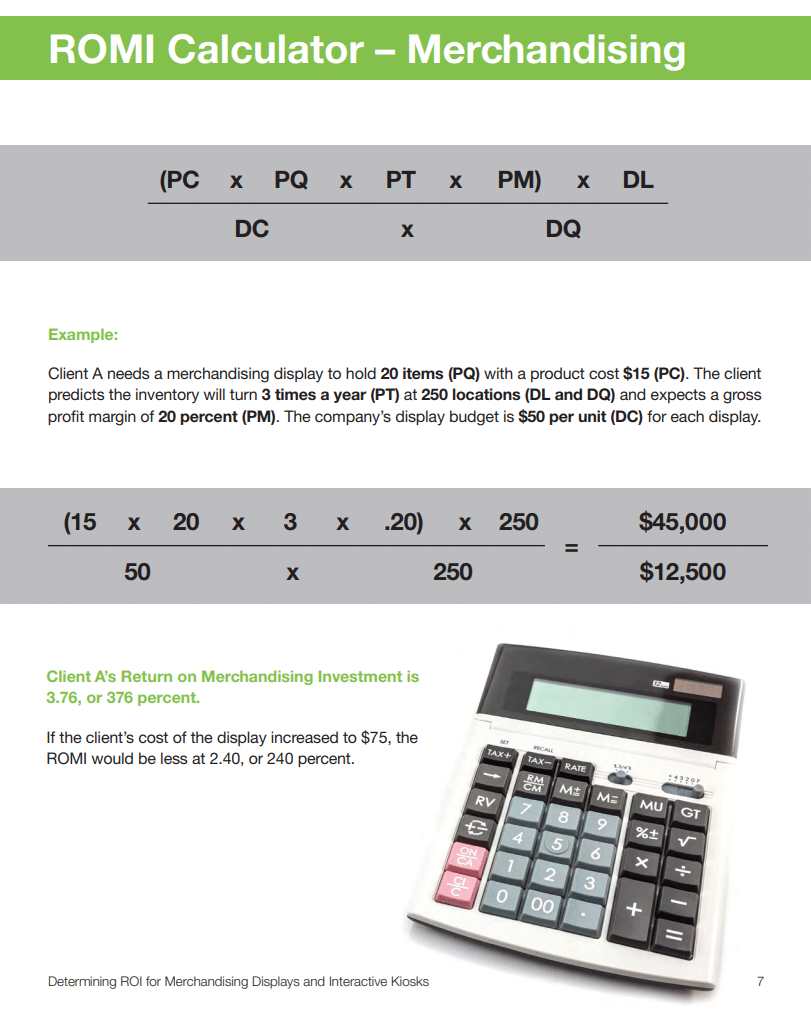
Key Definitions
- Display Cost [DC]: All costs associated with designing, producing, testing, and deploying the in-store merchandising campaign. This includes many variables associated with quantity required, size, preferred materials, messaging, and more.
- Display Quantity [DQ]: How many displays will be deployed in the field.
- Display Locations [DL]: Number of locations where displays will be located. An important factor to keep in mind is that some companies might order more display units than locations to take advantage of lower price points. Additionally, some may have more than one unit or kiosk at a singe location.
- Product Cost [PC]: The amount the retailer pays for the product.
- Product Quantity [PQ]: The number of items a merchandising display supports.
- Profit Margin [PM]: The actual or anticipated margin between the cost and gross revenue generated.
- Inventory Turn [IT]: The number of times the inventory does or is expected to turn.
Merchandising Display ROI
Original Article
Introduction
A recent article from The Business Journals sums up a common retail challenge best when it states, “Successful new product launches are not to be taken for granted.”
There’s supporting research behind that declaration. A 2013 white paper published in the Journal of Product Innovation & Management cites a study done by the Product Development & Management Association (PDMA) that reveals the new product failure rate across various industries averages 41 percent.
With so much at stake to ensure a product not only reaches consumers but delivers the revenue goals to keep it viable, it’s no wonder calculating return on investment (ROI) on the merchandising displays and kiosks that market these goods is a necessary, though sometimes difficult, endeavor.
Not only must marketing and merchandising teams keep in mind the different measurement standards on which to base the definition of successful merchandising, but they must also determine what hard factors play a role in estimating budgets for these display campaigns.
To simplify the process, a basic Return on Merchandising Investment (ROMI) calculator can benefit decision makers who want to feel confident their display and kiosk projects will offer the best value for the dollars spent. Read on to learn about outlining measurement standards and how to use our simple ROMI formula to help estimate cost and revenue baselines.
Defining Measurement Standards
When strategizing a point-of-purchase project, companies will first need to establish what factors will define if their program is successful. There are numerous options that can be measured, some more relevant for different types of point-of- purchase displays.
Dollars spent on a project versus sales dollars after implementing merchandising campaign
This measurement approach is common for companies producing traditional merchandising displays as it delivers quantitative results due to actual measurable revenue. A good example is Company A who manufactures portable speakers. Using this measurement practice, Company A judges their new speaker merchandising program by comparing the cost to produce the displays against the speaker merchandise revenue brought in after displays were deployed. Did the margin between the cost and revenue meet the company’s goals? (Hint: our handy calculator at the end of this paper can help you compute different variables to ensure your own program is successful).
Download full whitepaper with formulae
Determining ROI for Merchandising Displays and Interactive Kiosks – LO