

Last Updated on May 2, 2026 by Craig Allen Keefner
Longtime touchscreen manufacturer 3M is exiting the touchscreen monitor business, an event noted in the kiosk history file on July 30, 2020. 3M Touch Systems, established in 2001 through acquisitions like MicroTouch Systems, was known for commercializing surface capacitive technology, a preferred touch technology for heavy-use public access applications. This strategic move specifically impacts 3M's touchscreen monitor offerings, while its other self-service technology divisions, such as ID card and passport readers, remain unaffected.
What is the history of 3M Touch Systems and its exit from the touchscreen monitor market?
July 30, 2020
3M Touch Systems was created in 2001 through the acquisitions of MicroTouch Systems and Dynapro Thin Films, and is now exiting the touchscreen monitor business. This marks another entry for the kiosk history file as longtime touchscreen manufacturer 3M is exiting the business. We confirmed this with longtime contacts at 3M. We are sure the other self-service technology division are unaffected and that includes ID card readers as well as passport readers for example. MicroTouch Systems was founded in the early-1980s and was the company that patented and commercialized surface capacitive technology, which became and continues to be the preferred touch technology for many heavy-use, public access applications, especially for video slot and card games. Dynapro was a leading supplier of 4- and 8-wire resistive and developed projected capacitive touch solutions for industrial applications. 3M Touch Systems is headquartered in Methuen, Massachusetts, with dedicated technical and sales teams in North America, Europe, Australia and throughout Asia. Within the 3M Company structure, 3M Touch Systems reports to the 3M Electro Communications Business (Austin, Texas), which is one of the five 3M business units. Link
We read about it first on Sixteen:Nine who heard it from one of the manufacturers. We confirmed with longtime contacts at 3M since then. We are sure the other self-service technology division are unaffected and that includes ID card readers as well as passport readers for example. We updated the kiosk history file.
About 3M Touch
3M Touch Systems was created in 2001 though the acquisitions of MicroTouch Systems (Massachusetts) and Dynapro Thin Films (Milwaukee and Vancouver, Canada). MicroTouch Systems was founded in the early-1980s and was the company that patented and commercialized surface capacitive technology, which became and continues to be the preferred touch technology for many heavy-use, public access applications, especially for video slot and card games. Dynapro was a leading supplier of 4- and 8-wire resistive and developed projected capacitive touch solutions for industrial applications. 3M Touch Systems is headquartered in Methuen, Massachusetts, with dedicated technical and sales teams in North America, Europe, Australia and throughout Asia. Within the 3M Company structure, 3M Touch Systems reports to the 3M Electro Communications Business (Austin, Texas), which is one of the five 3M business units. Link
What is the chronology of 3M Touch Systems and touchscreen technology?
- 1982 founded
- 1984 first touchmonitor
- 1985 introduces capacitive touchscreen
- 1986 First Mac touchscreen
- 1988 First Windows touchscreen driver available (2.11 probably)
- 1999 First e-commerce site selling touchscreen technology
- 2001 3M Touch purchases Microtouch
Here is the media file for customers
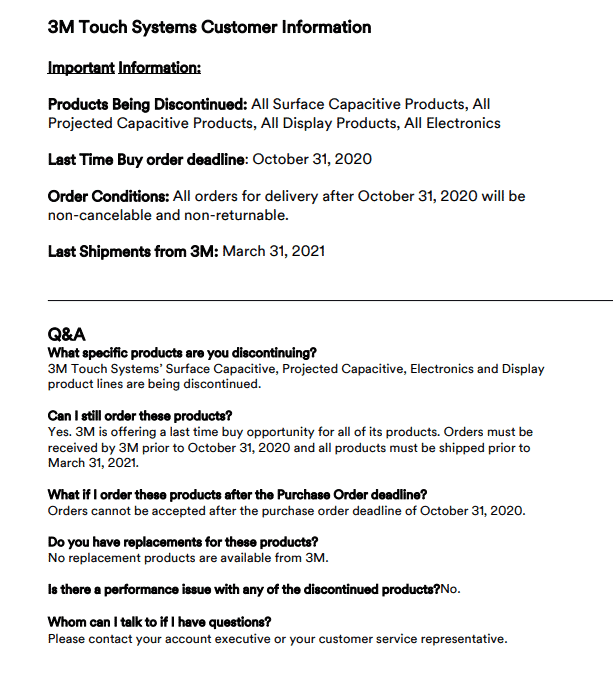
3M Touch Systems Touch Screen Status
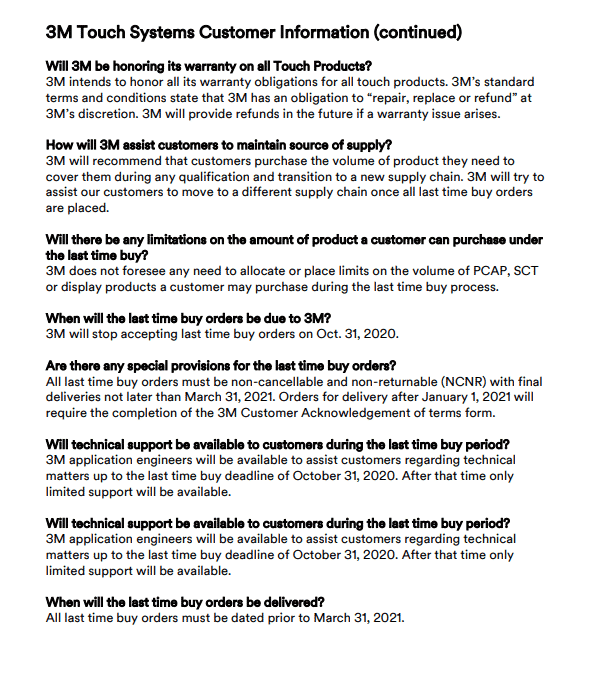
3M Touch Touch Screens
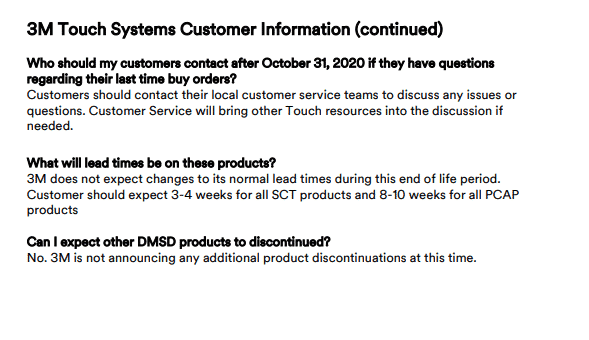
3M Touch Systems Touch Screen Status

