

Last Updated on August 5, 2026 by Craig Allen Keefner
Age Verify and IDVs
We were recently asked: Based on our experience in the market
- Do you think age and identity verification is becoming a real pain point for businesses in Europe or American market?
- Which industries do you think would have the strongest demand? (e.g. tobacco, alcohol, gaming, retail, hospitality, etc.)
- Do you think customers would prefer a dedicated verification device, or software/API integration with existing systems?
- Where do you see the biggest compliance pain around identity verification?
Fast Response?
- Yes and growing (greatly)
- Tobacco/vaping and alcohol are the near-term volume drivers because the regulatory pressure is immediate and the transaction volumes are massive.
- Hardware wins when the environment is unattended or self-service (vending machines, self-checkout, kiosks, entry gates).
- Fragmentation standards — What satisfies Texas may not satisfy France. A solution compliant for UK tobacco sales may be overkill or insufficient for German alcohol delivery. Businesses operating across borders face a combinatorial explosion of requirements.
Age and identity verification are absolutely becoming real pain points in both Europe and the US, driven by new regulation, fraud pressure, and political attention on “online harms” and age-restricted content.digital-strategy.
In Detail
1. Is this becoming a real pain point?
-
Regulatory fragmentation: The U.S. is moving from a handful of state-level laws to a patchwork where nearly every state has different age-gating requirements for tobacco, vaping, alcohol, gaming, and adult content. In Europe, the Digital Services Act, GDPR, and country-specific rules (like Germany’s Jugendschutz) create similar complexity.
-
Liability shift: Regulators and plaintiffs are increasingly placing liability on the platform or retailer rather than the user. This means businesses can no longer rely on simple checkbox self-certification (“I am over 18”).
-
Online-to-offline bleed: Age-restricted commerce is moving into channels that were never designed for verification—same-day alcohol delivery, vending machines, self-checkout kiosks, and curbside pickup. The old model of “a human checks your ID at the register” breaks down in these channels.
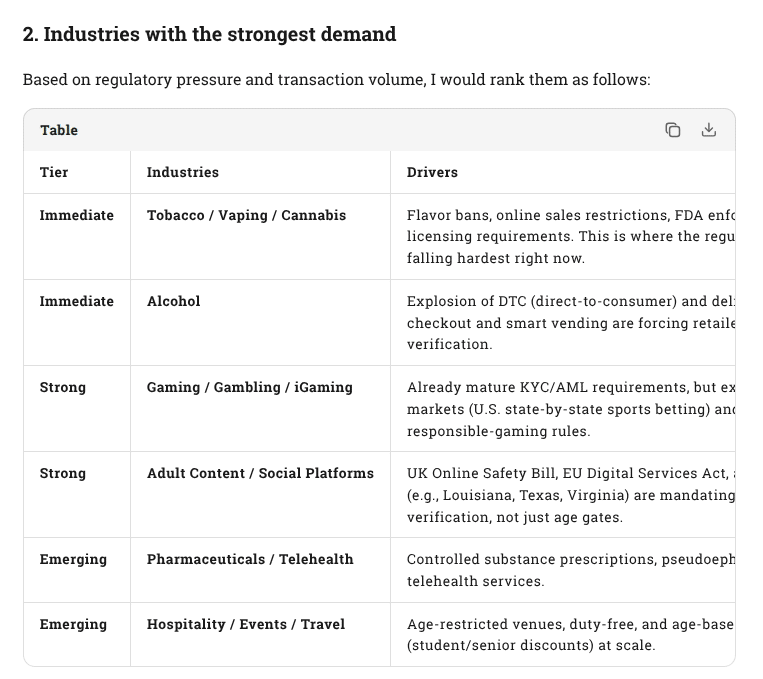
Industries with the strongest demand
3. Dedicated device vs. software/API integration
-
The environment is unattended or self-service (vending machines, self-checkout, kiosks, entry gates).
-
There is a need for tamper-proof audit trails and hardware-rooted security (casinos, high-compliance retail).
-
Network connectivity is unreliable, and local edge processing is required.
-
The business model is verification-as-a-service in a shared space (e.g., a device in a convenience store used by multiple brands).
-
The transaction is already digital (e-commerce, mobile apps, SaaS platforms).
-
User experience and speed are paramount (gaming sign-ups, streaming).
-
The business already has a captive device (POS terminal, smartphone, tablet).
4. Biggest compliance pain points
-
Regulatory fragmentation and cross-border inconsistency
What satisfies Texas may not satisfy France. A solution compliant for UK tobacco sales may be overkill or insufficient for German alcohol delivery. Businesses operating across borders face a combinatorial explosion of requirements. -
The privacy-verification paradox
The more accurately you verify age, the more personal data you must collect and retain. This collides head-on with GDPR, CCPA, and the emerging principle of data minimization. Biometric verification is accurate but creates a massive liability surface. The industry desperately needs selective disclosure (proving “over 21” without revealing name, address, or exact birthdate), but standards and adoption are immature. -
Liability and the “who is responsible?” chain
If a minor buys alcohol through a delivery app, is the liability on the app, the payment processor, the delivery driver, or the ID verification vendor? The lack of clear safe-harbor rules means businesses are buying verification solutions as much for legal cover as for actual security. -
Document fraud and deepfake resistance
Static ID photo matching is becoming less reliable. Liveness detection and document authentication are necessary but expensive and friction-heavy. The arms race with synthetic identity fraud is real. -
Customer friction and abandonment
Every additional step in a checkout or sign-up flow drops conversion. Businesses are being forced to add friction for compliance reasons while their competitors (or gray-market alternatives) may not. This is especially painful in gaming and e-commerce.
Perspective #2
1. Is age/ID verification a real pain point?
-
Regulatory pressure is clearly up:
-
EU is rolling out a harmonized age-verification framework so users can prove they are 18+ for restricted sites and services, with an official “EU age verification” initiative.digital-strategy.europa
-
The Commission’s new EU-wide age-verification app is already controversial for security and privacy, which signals both political urgency and implementation risk.techpolicy
-
Global online age verification is projected to grow from about 2.5B USD in 2024 to 7.1B USD by 2033, with North America and Europe as key compliance-driven markets.verifiedmarketreports
-
-
Penalties and enforcement are non-trivial:
-
Identity-verification non-compliance fines were already around 10B USD globally in 2019, with multiple top-50 banks hit; regulators show no signs of easing.unit21
-
Employers and regulated industries now face higher expectations for ID verification, especially with synthetic IDs and AI-generated forgeries entering the mix.fadv
-
-
Net: in Europe, age-gating (content, social, adult, gambling, kids’ apps) is becoming a front-burner topic; in the US, the driver is more classic AML/KYC plus fraud and chargeback risk, with state-level age-verification laws adding complexity.
2. Which industries will have strongest demand?
Think in two buckets: “reg-driven KYC/AML” vs “age-gated & high-risk consumer content.”
-
Strongest structural demand (identity + age):
-
BFSI (banking, financial services, insurance) – consistently the largest share of IDV spend in both US and Europe due to KYC, AML, sanctions, and remote onboarding.
-
Healthcare – access to electronic health records and telehealth now requires robust IDV; healthcare is listed as a key demand vertical.
-
Telecom – SIM registration, number portability, fraud, and account takeover risk drive IDV spend.marketsandmarkets+1
-
Government / public sector – adoption of NIST-style IAL2 standards and digital ID programs increases demand for strong verification.fadv+1
-
-
Age-restricted and high-risk consumer verticals:
-
Online gaming and gambling – heavy age and anti-money laundering requirements in Europe and many US states; operators are under intense scrutiny.digital-strategy.europa+1
-
Alcohol and tobacco (including vape) – retailers in North America and Europe face tightening rules and potential liability, which is pushing more robust age checks both in-store and online.
-
Adult content platforms and “online harms” categories – EU age-verification policy explicitly targets age-restricted sites, which includes adult content and potentially violent or harmful content categories.digital-strategy.europa+1
-
Retail and eCommerce – especially for high-risk goods (pharma, knives, certain chemicals, lottery, age-restricted products), where regulators increasingly expect more than “checkbox age gates.”verifiedmarketreports+1
-
-
For our kiosk / self-service world:
-
Self-checkout, vending, unattended retail for tobacco, alcohol, and lottery will likely see growing need to embed ID/age verification into devices and flows as online regulations “spill over” into physical unattended environments.
-
3. Dedicated device vs software/API?
-
Strong shift toward software/API and SDK:
-
Identity-verification vendors highlight APIs and SDKs as the primary way to embed KYC and ID checks into onboarding and transaction flows, emphasizing faster integration and better UX.
-
SDK-based flows are called out as easier to integrate and smoother for end users than standalone or bolted-on solutions, which also reduces fraud.entrust
-
-
Where dedicated devices still make sense:
-
Regulated physical environments (e.g., banks, border control, some retail/kiosk use cases) still use dedicated ID scanners and biometric devices, often to handle document variety and liveness detection in a controlled environment.
-
However, even here the trend is toward cloud services behind the scenes, with device vendors exposing APIs so hardware becomes a front-end to a central verification service.
-
-
Likely preference pattern:
-
Enterprise / omni-channel players prefer:
-
Cloud IDV platform + APIs/SDKs, orchestrated across web, mobile, POS, and kiosk endpoints.entrust+2
-
-
SMB and legacy retail may still gravitate to:
-
“Box” solutions (e.g., scanner + screen + built-in logic) when they lack dev resources or want a turnkey compliance story.regulaforensics+1
-
-
For your audience, “software-first with hardware endpoints” feels like the sweet spot: an IDV/age-verification API core, with optional certified devices (POS, kiosks, vending controllers) as channels.
4. Biggest compliance pain points
-
Fragmented and evolving regulation:
-
Identity-verification regulations differ across regions and are “constantly evolving,” which forces businesses to continually update processes to stay compliant.
-
Europe’s age-verification push creates a new compliance layer on top of GDPR and eIDAS; the EU-wide app has already raised questions about proportionality, privacy, and security.digital-strategy.
-
-
Data protection, privacy, and consent:
-
Businesses must obtain explicit consent, limit data use, and protect collected personal information while still satisfying KYC/AML and age checks.fraud
-
Balancing strong verification with minimal data collection and retention is a recurring headache, especially under GDPR-like regimes.digital-strategy.europa+1
-
-
UX vs security vs conversion:
-
Implementation pitfalls commonly include unintuitive user flows, insufficient testing of broad ID document sets, and poorly tuned risk settings that degrade UX.regulaforensics
-
For consumer-facing flows (e-commerce, apps, gaming), friction in ID verification directly hits conversion and revenue, so product teams resist “heavy” compliance flows.regulaforensics+1
-
-
Technical and operational complexity:
-
Supporting a wide range of global IDs, preventing synthetic identities and AI-forged documents, and meeting higher assurance levels (e.g., IAL2) is increasingly complex.fadv+1
-
Many organizations lack internal expertise, so they rely on third-party IDV providers but still remain responsible for the compliance outcome.marketsandmarkets+1
-
-
Cost and integration overhead:
-
Complexity and cost of implementing advanced age verification is cited as a major restraint on adoption, especially for smaller retailers.verifiedmarketreports
-
Integrating APIs across existing stacks (legacy POS, kiosks, CRM, risk engines) can be non-trivial and requires ongoing maintenance as providers update their models and SDKs.
-
Related
https://www.innovative-technology.com/age-checks/
https://www.innovative-technology.com/product/mycheckr/
https://www.sinosecu.com.cn
From NCR to AI Checkout: Goodwin’s Inside View on Walmart, Self-Checkout, and What Comes Next.
