

Last Updated on October 25, 2026 by Craig Allen Keefner
Bojangles AI Drive-Thru Expands: Bo-Linda Handles Hundreds of Menu Variations
By Craig Keefner | Kiosk Industry | October 25, 2026
Bojangles is expanding its AI-powered drive-thru ordering program with technology partner Hi Auto. The company’s Bo-Linda voice assistant is now deployed at nearly 500 restaurants, with another 100 locations targeted by mid-2027.
The bigger story is not simply the number of installations. It is the complexity of restaurant ordering, including menu modifications, substitutions, pricing exceptions, and the unpredictable requests customers make at the drive-thru speaker.
For restaurant operators considering conversational AI, Bojangles offers a real-world example of how voice ordering must integrate with point-of-sale systems and daily restaurant operations.
Bo-Linda Deployment Confirmed by Bojangles
Bojangles has publicly acknowledged the deployment of Bo-Linda at hundreds of its restaurants. The company recognized Hi Auto during its 2025 Supplier Summit and reported that the technology was already operating at nearly 500 locations.
That historical detail matters. The nearly 500-store figure is not an entirely new development in October 2026.
The more recent news is the multiyear extension of the Hi Auto partnership, plans for approximately 100 additional installations by mid-2027, and continued development of the ordering platform.
Points to Consider
-
Speech-to-Text Accuracy: Does the system transcribe words correctly amidst ambient drive-thru noise?
-
POS Mapping Accuracy: Are spoken customizations mapped to valid point-of-sale modifiers without breaking kitchen logic?
-
Unassisted Order Completion Rate: What percentage of transactions finish without requiring employee intervention or manual takeover?
-
Throughput & Speed of Service: How does total order time compare to a human-staffed drive-thru lane during peak hours?
Editor Note on Technology Partners — We would characterize the three companies this way:
-
Hi Auto: The drive-thru specialist with compelling large-scale deployment evidence.
-
SoundHound: The broader voice commerce platform with significant cross-channel potential.
-
Sodaclick: The edge AI challenger with a particularly interesting Intel-based architecture.
The system reportedly processes more than one million orders weekly, with published success rates approaching or exceeding 98%.
Those performance figures are company-reported and should not be confused with independently verified accuracy rates or the percentage of transactions completed without human intervention.
The Real Challenge: Hundreds of Menu Entries and Customizations
One of the most interesting aspects of Bo-Linda is the number of menu entries required to accommodate real customer behavior.
According to a published account referencing Bojangles CIO Richard Del Valle, approximately 550 unique menu entries were added during the first month of implementation to accommodate customer requests.
That does not necessarily mean Bojangles sells 550 distinct food products.
A restaurant menu may appear relatively simple to customers, but the underlying POS configuration can be much more complicated.
Consider the combinations involved in a typical drive-thru transaction:
- Selecting a chicken biscuit, sandwich, combo, or family meal.
- Changing side dishes or beverages.
- Adding or removing ingredients.
- Requesting different sauces or condiments.
- Adjusting quantities and portion sizes.
- Asking about unavailable products.
- Combining promotions with menu modifications.
- Making unusual requests that do not match standard menu configurations.
Each request must be interpreted correctly, translated into an order the POS system understands, and priced appropriately.
Earlier accounts of the Bo-Linda pilot also described approximately 300 additional price lookups associated with unusual customer requests.
The lesson is straightforward: recognizing speech is only one part of successful AI ordering. Understanding the menu and executing the transaction correctly are equally important.
Conversational AI Meets the Restaurant POS
Traditional self-service kiosks present customers with a structured menu. The interface determines which selections and modifications are available.
Voice AI reverses that process.
Customers describe what they want in their own words, and the system must determine whether the request can be fulfilled.
That introduces several technical requirements:
Menu synchronization: The voice assistant must understand current products, prices, combinations, and availability.
Modifier management: Customer requests must map correctly to valid POS modifiers and kitchen instructions.
Exception handling: The system needs a reliable method for addressing unusual orders or requests outside its supported configuration.
Human assistance: Employees must be able to intervene when the AI cannot complete an order confidently.
Transaction accuracy: An order that sounds correct during the conversation must also be transmitted correctly to the POS and kitchen systems.
These requirements are particularly important for chains operating hundreds or thousands of restaurants with regional menu differences and franchise-specific configurations.
What Does a 98% Success Rate Actually Mean?
Published reports describe Bo-Linda as achieving success rates of approximately 98% or better.
That is encouraging, but restaurant operators should ask how success is defined.
Possible measurements include speech recognition accuracy, order completion, successful POS submission, customer acceptance, and transactions completed without employee assistance.
Those are different operational metrics.
A system that correctly recognizes a customer’s words may still misunderstand a menu substitution. Likewise, an order successfully submitted to the POS could require employee intervention before completion.
For technology buyers, the most useful measurements would include:
- Percentage of orders completed without human intervention.
- Final order accuracy compared with customer intent.
- Frequency and causes of employee takeovers.
- Average ordering time compared with human attendants.
- Impact on drive-thru throughput and labor deployment.
- Incremental sales from successful upselling.
These measurements provide a more complete picture than a single headline success percentage.
Dynamic Upselling and POS Integration
The next stage of Bo-Linda’s development includes expanded POS integration and more context-aware recommendations.
The reported work involving Global Payments’ Genius POS platform points toward a more integrated ordering environment.
Rather than simply asking every customer whether they want an additional item, conversational AI can potentially adjust recommendations based on restaurant conditions.
For example, a restaurant with a long drive-thru queue might favor faster ordering interactions, while a restaurant with available capacity could allow more extensive product recommendations.
Inventory availability, time of day, and promotions may also influence recommendations.
These capabilities are promising, but operators should distinguish between functionality already deployed across the restaurant network and features being introduced or planned.
Implications for Self-Service Kiosks and Restaurant Technology
Bojangles’ experience raises an interesting question for the kiosk industry: Will voice AI eventually become a standard interface for restaurant self-service?
Touchscreen kiosks and conversational ordering solve related but different problems.
A touchscreen provides a visual representation of available products and valid modifications. Voice AI allows customers to express their preferences without navigating menus.
The two approaches can complement each other.
A future restaurant ordering kiosk could support touchscreen selection, voice requests, and AI-assisted recommendations within the same transaction.
For kiosk manufacturers, POS developers, and systems integrators, the critical issue will be access to accurate menu data and reliable transaction interfaces.
Conversational AI is only as effective as the systems supporting it.
Kiosk Industry Perspective
The Bojangles deployment demonstrates that AI drive-thru ordering has progressed beyond limited demonstrations and isolated pilots.
Hundreds of restaurants are using the technology in commercial operations, and Bojangles has committed to further expansion.
However, the most significant lesson may be the complexity hidden behind an apparently simple menu.
The reported addition of approximately 550 menu entries during early implementation illustrates why restaurant AI requires much more than a capable speech recognition engine.
Menu data, pricing logic, POS integration, exception handling, and employee workflows all determine whether the technology delivers value.
For restaurant operators evaluating voice AI, the essential question is no longer whether a machine can take an order.
It is whether the entire restaurant technology stack can execute that order correctly, efficiently, and consistently.
Sources
- QSR Magazine — Bojangles Expands AI Drive-Thru Ordering to Nearly 500 Restaurants
- Bojangles — Official Bo-Linda Information
- Bojangles — 2025 Supplier Summit
Craig Keefner is Executive Director of the Kiosk Manufacturer Association and editor of Kiosk Industry, covering self-service technology, restaurant automation, digital signage, and accessibility.
Addendum – Basic Technology Comparison
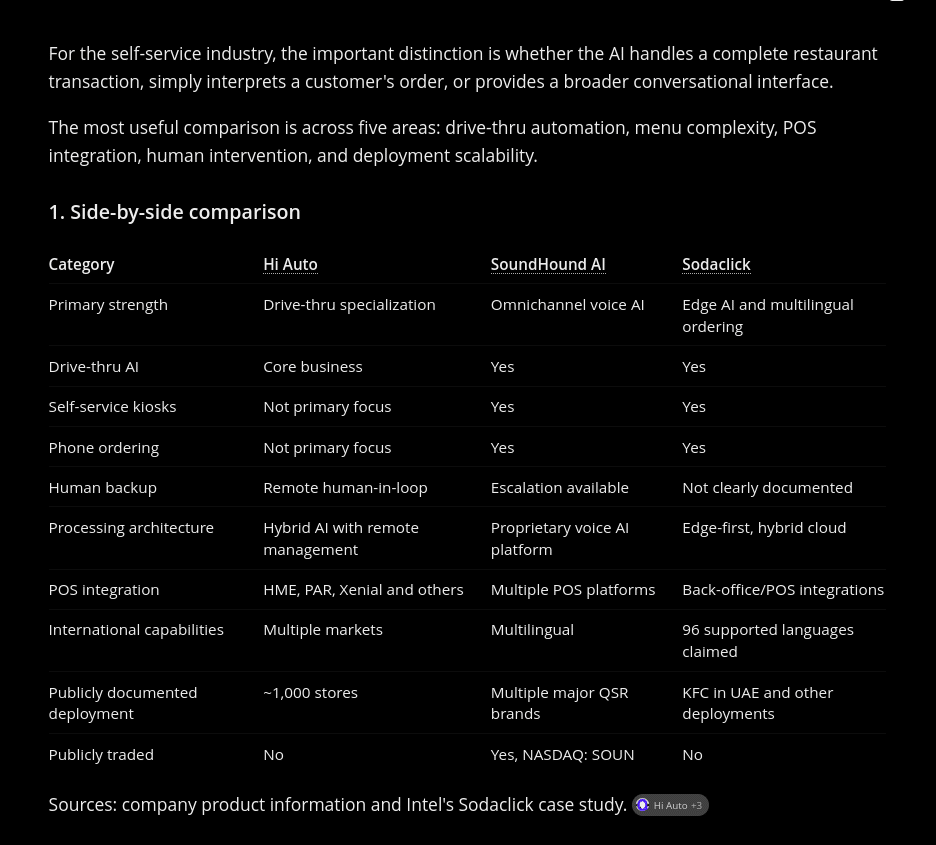
Conversational AI Kiosk technology comparison
Star Wars — The Next Leap in Drive-Thru AI: From Order Taker to R2-D2
Think Star Wars. Not just voice recognition, but an intelligent, situationally aware agent that understands the customer, the restaurant, the environment, and what needs to happen next.
Today’s systems from Hi Auto, SoundHound, and Sodaclick largely focus on understanding spoken orders and converting them into transactions.
The next order-of-magnitude advance would be something fundamentally different:
An AI that doesn’t simply take an order. It operates the entire drive-thru experience.
And the Star Wars analogy is useful. R2-D2 doesn’t need every instruction spelled out. It understands situations, interacts with other systems, solves problems, and acts.
Software architecture needs:
-
Open POS APIs for third-party ordering protocol validation.
-
Real-time dynamic pricing and inventory synchronization endpoints.
-
Universal digital identity standards for secure vehicle-based payments.
Five stages of drive-thru AI evolution

STAGE 1 · TODAY
Conversational order taking
Recognizes speech, handles menu modifiers, suggests upsells, enters orders into POS, and escalates exceptions.

STAGE 2 · NEAR TERM
Context-aware intelligence
Understands inventory, kitchen load, weather, queue length, and customer preferences. Changes recommendations in real time.

STAGE 3 · EMERGING
Multimodal intelligence
Combines voice, vision, vehicle context, digital menus, and customer-authorized identity. Knows which car is ordering and what the customer is looking at.

STAGE 4 · NEXT GENERATION
Agentic restaurant orchestration
Coordinates ordering, kitchen timing, payment, pickup windows, and exception recovery. Takes authorized actions across systems instead of simply responding.

STAGE 5 · STAR WARS VISION
Personal AI meets restaurant AI
Your own AI agent negotiates with the restaurant’s AI agent. You may never need to speak to the drive-thru system at all.
The Star Wars scenario: Your AI talks to their AI
Imagine arriving at a drive-thru in 2030.
A possible drive-thru conversation
Your car’s AI — “We’re approaching Bojangles. Would you like your usual order?”
You — “Yes, but something lighter today. And get Carolynn her usual.”
Restaurant AI — “The usual side is unavailable. We have an alternative, and your order can be ready in approximately four minutes.”
Your car’s AI — “I’ve checked the substitutions and total. Would you like me to authorize payment?”
You — “Go ahead.”
The restaurant confirms the transaction, times preparation to your arrival, and directs you to the appropriate pickup lane. No conversation with the ordering speaker is necessary.
This is not entirely science fiction. At CES 2026, SoundHound demonstrated agentic voice commerce for vehicles, including restaurant ordering, reservations, parking payments, and interactions among AI agents. These are early capabilities, not evidence that the complete scenario above is commercially deployed.
Where the real 10× improvement could come from
I would focus on four transformative changes rather than simply improving speech recognition.
| Capability | Current approach | Next-generation possibility |
|---|---|---|
| Order processing | Voice converted to POS order | AI agents negotiate structured transactions |
| Restaurant intelligence | Menu and inventory awareness | Predictive kitchen and queue orchestration |
| Customer interaction | Repeated spoken ordering | Customer-authorized persistent preferences |
| Performance | Accuracy and orders per hour | Total time, cost, and friction per completed transaction |
The biggest breakthrough may actually be eliminating the need for conversational voice at the drive-thru, rather than making the voice assistant sound more human.
A customer could authorize their personal AI to manage the transaction. Voice would remain available for changes, questions, and exceptions.
Which company is closest?
SoundHound appears strategically positioned for the agent-to-agent direction because it is already demonstrating vehicle-based commerce and broader agent orchestration.
Hi Auto is developing operational intelligence beyond order-taking, including pickup-window monitoring. Bojangles is also planning vehicle-image order matching and queue-aware upselling.
Sodaclick’s edge-processing approach could become important if these future systems need low-latency local interactions and resilience when connectivity is unreliable.
None has yet demonstrated the entire vision at scale.
The bigger question for the self-service industry
What happens to kiosks, menu boards, and ordering stations when the customer arrives with an AI agent of their own?
A restaurant may need an agent-compatible transaction interface more than another conversational ordering application. That interface would need to support secure identity, menu availability, modifiers, pricing, payment authorization, and order confirmation.
That could create a new technology category: Agent-to-Agent Self-Service Commerce.
It would also raise important questions about consent, authentication, privacy, and who controls recommendations. A customer’s agent might seek the lowest price or healthiest option while the restaurant’s agent seeks a higher ticket.
Proposed Kiosk Industry headline:
Beyond Bo-Linda: The Star Wars Future of Drive-Thru AI — When Your Car Talks to the Restaurant
And the central thesis:
The next revolution in conversational AI may not be a better conversation between a customer and a machine. It may be a conversation between two machines that completes the transaction without the customer having to participate.
That is the order-of-magnitude shift we will watch.


