

Last Updated on October 23, 2026 by Craig Allen Keefner
Self-service kiosks, digital signage, ticketing, and mobile applications are supposed to improve the customer experience. But when these systems operate independently, they can create new operational costs instead of eliminating them.
A new white paper from Acquire Digital, The Fragmentation Tax: What Disconnected Systems Cost, examines the hidden costs of disconnected technology in visitor attractions.
The central argument is straightforward: individual technology systems may perform exactly as intended, yet fail to deliver the expected business results because they do not communicate with one another.
For the kiosk and digital signage industry, this is an important distinction. Deploying more screens and self-service terminals does not automatically create a more efficient operation.
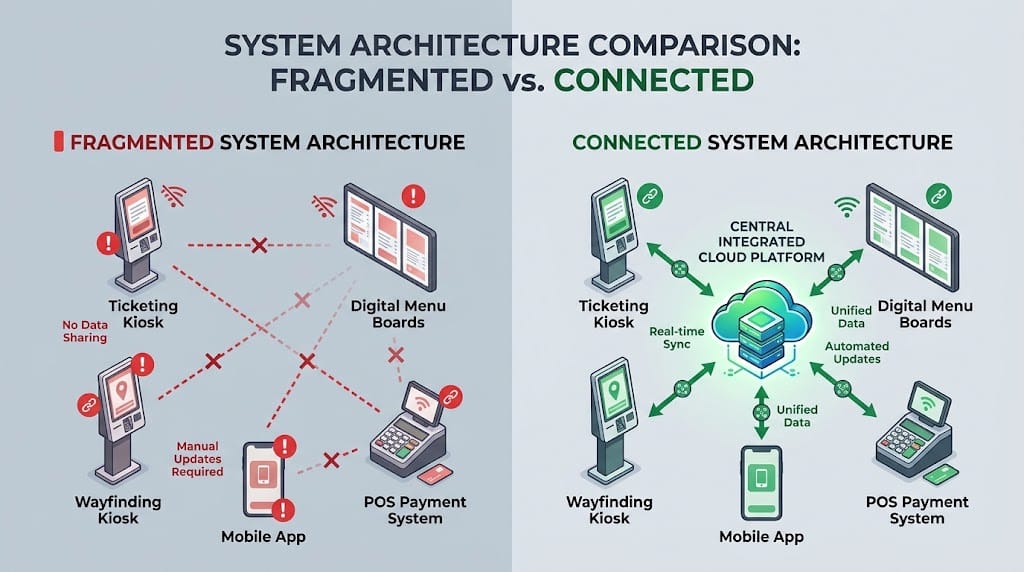
fragmented digital signage versus integrated digital signage
The £373,000 Fragmentation Tax
Acquire Digital presents an illustrative model of a mid-sized visitor attraction receiving one million guests annually.
The estimated cost of fragmented technology is approximately £373,000 per year.
According to the company, the largest component is lost food and beverage spending, representing almost two-thirds of the modeled total.
Other costs arise from staff time, guest trust, commercial inventory, and slower operational responses.
Importantly, these are assumed figures, not independently established industry averages. Acquire Digital encourages operators to substitute their own operating data.
Nevertheless, the model raises a legitimate question: How much money is lost because systems that should work together operate independently?
Where Self-Service Kiosks Fit Into the Problem
Consider a typical amusement park, entertainment center, or visitor attraction.
An operator may have several separate systems:
- Self-service ticketing and admission kiosks
- Digital menu boards and food ordering terminals
- Queue management and wait-time displays
- Wayfinding kiosks and interactive directories
- Mobile applications and loyalty programs
- Advertising and sponsorship displays
- Payment processing and back-office reporting
Each system may have been purchased independently, perhaps from different manufacturers or software providers.
The result can be an assortment of capable technologies without a coordinated operating environment.
For example, a ride temporarily closes, but its status is not immediately reflected on the attraction’s wayfinding kiosks. Guests continue walking toward an unavailable attraction.
Similarly, a restaurant becomes overcrowded while nearby food locations have available capacity. Digital menu boards display accurate prices, but the overall signage network provides little assistance in distributing demand.
The hardware is working. The information may even be technically correct. What is missing is coordination.
Connected Digital Signage Is More Than Centralized Content Management
One important distinction deserves attention.
A centralized content management system can simplify the administration of digital signage. It can distribute content, schedule promotions, and reduce the need to update individual screens.
But centralized content management does not necessarily mean that an attraction’s operational systems are connected.
True operational integration requires access to relevant information from other systems, potentially including ticketing, queue management, inventory, ordering, and facility operations.
That information must then be translated into useful actions.
A connected environment might automatically update wayfinding information when an attraction closes, adjust promotional content based on restaurant capacity, or communicate operational changes to both kiosks and mobile applications.
The objective is not simply to control more screens from one interface. It is to ensure that the information presented to customers reflects current operating conditions.
The Integration Challenge for Kiosk Manufacturers
For kiosk manufacturers, the fragmentation issue introduces a different set of questions.
A kiosk can have an excellent touchscreen, reliable payment hardware, durable enclosure, and accessible interface while remaining disconnected from the larger operating environment.
Manufacturers and software partners should consider how their systems interact with external applications and data sources.
Important considerations include:
- APIs and interoperability: Can the kiosk exchange information with existing business systems?
- Content consistency: Are prices, availability, and operating information synchronized?
- Transaction continuity: Can a customer move between mobile, kiosk, and staffed service channels without unnecessary repetition?
- Monitoring and support: Can operators identify whether a problem originates in the kiosk, network, application, or connected service?
- Accessibility: Do operational changes reach accessible interfaces, including audio and alternative interaction methods?
- Security and reliability: Can systems exchange data without introducing unnecessary security risks or single points of failure?
These questions are increasingly relevant to integrators responsible for deploying and maintaining large self-service networks.
Accessibility Is Part of the Connected Experience
Accessibility deserves particular consideration.
Suppose an attraction changes its operating schedule or redirects visitors because a facility is unavailable.
Updating a visual display is useful, but visitors using accessible kiosk interfaces or audio navigation should receive equivalent information.
Similarly, a transaction that begins at an accessible self-service kiosk should not become inaccessible when it passes to a payment, ticketing, or fulfillment system.
Integration should therefore include the complete customer transaction, not just the exchange of operational data.
This is an area where manufacturers, application developers, and operators share responsibility.
Measuring the Real Cost of Fragmentation
Acquire Digital’s financial model is useful as a starting point, but operators should develop their own measurements before committing to a major integration project.
Potential measurements include staff hours spent manually updating information, frequency of inconsistent content, abandoned transactions, lost sales opportunities, and time required to communicate operational changes.
An operator might also examine whether connecting digital menu boards, ordering kiosks, and restaurant capacity information improves customer distribution and purchasing.
The important point is to establish a baseline before making investment claims.
Integration has costs of its own, including software development, licensing, maintenance, cybersecurity, and vendor coordination. Those costs belong in any credible return-on-investment calculation.
Not every disconnected system needs to be integrated, and not every integration will produce a financial return.
Our Take: Integration Is Purchasing Criteria
The self-service industry has spent decades improving individual devices.
Touchscreens are better. Payment systems are more flexible. Remote management has matured. Digital signage platforms support increasingly sophisticated content.
But the next operational improvement may depend less on another hardware upgrade and more on how existing systems exchange information.
For operators, this means evaluating integration requirements earlier in the purchasing process.
For manufacturers, it means treating interoperability and supportability as product capabilities rather than optional features.
For integrators, it creates opportunities to deliver measurable value beyond installation and maintenance.
Acquire Digital’s fragmentation-tax concept provides a useful framework for discussing these issues. Its financial example should not be mistaken for a universal benchmark, but the underlying problem is worth examining.
The question is no longer whether a kiosk or digital display works. It is whether the entire self-service environment works together to complete the customer’s transaction.
Additional Information
Acquire Digital published The Fragmentation Tax: What Disconnected Systems Cost on October 21, 2026. The white paper includes a ten-question self-audit and a proposed sequence for addressing disconnected systems.
Read the original Acquire Digital article.
Download the whitepaper — fragmentation whitepaper-compressed
Amusement Park Attractions – POV by Acquire Digital(Opens in a new browser tab)
Addendum — Star Wars — What Next?
Yes. I think this is a very plausible next stage for self-service kiosks and digital signage. In fact, it could change the role of a kiosk from a device that customers operate directly into a service endpoint that their personal AI agents can interact with.
The important distinction is that the AI agent would communicate with the underlying service, not necessarily with the screen itself.
Imagine visiting an amusement park with an AI assistant on your phone. Instead of navigating several kiosks, apps, and digital signs, you could tell it:
Find the shortest ride queues, reserve lunch for four at 12:30, use my loyalty benefits, and make sure the route is wheelchair accessible.
Your agent could then coordinate with the park’s ticketing, queue management, restaurant ordering, payment, and wayfinding systems.
The digital signs and kiosks would still be useful, but they would become part of a connected environment serving both human customers and software agents.
Three possible levels of integration
|
Level |
How it works |
Likely role |
|---|---|---|
|
1. AI-assisted navigation |
Phone agent reads published information about services, locations, and wait times |
Near-term |
|
2. Agent-to-service transactions |
Phone agent communicates with authorized APIs to order, book, pay, or check in |
Emerging |
|
3. Agent-to-kiosk interaction |
Phone agent establishes a secure session with a physical kiosk to complete or hand off a transaction |
Longer-term |
The third level is particularly interesting for kiosk manufacturers because it could preserve the value of physical infrastructure while changing the customer interface.
The technology is already moving in this direction
This is no longer purely speculative. Several emerging standards address different pieces of the problem.
-
Model Context Protocol (MCP): Allows AI agents to use tools and retrieve information from connected services.
Google Cloud Documentation -
Agent2Agent (A2A): Enables independent AI agents to discover capabilities and collaborate.
-
Universal Commerce Protocol (UCP): Introduced by Google in January 2026 to support agent-based shopping, checkout, and business-system integration.
-
Agent Payments Protocol (AP2): Addresses authorization and payment by AI agents, including transactions performed under preauthorized instructions.
Google has also described restaurant AI ordering across mobile devices, kiosks, and in-car systems. That is evidence of cross-channel development, although it does not establish that independently owned phone agents can already interact with arbitrary kiosks.
What a future agent-ready kiosk might look like
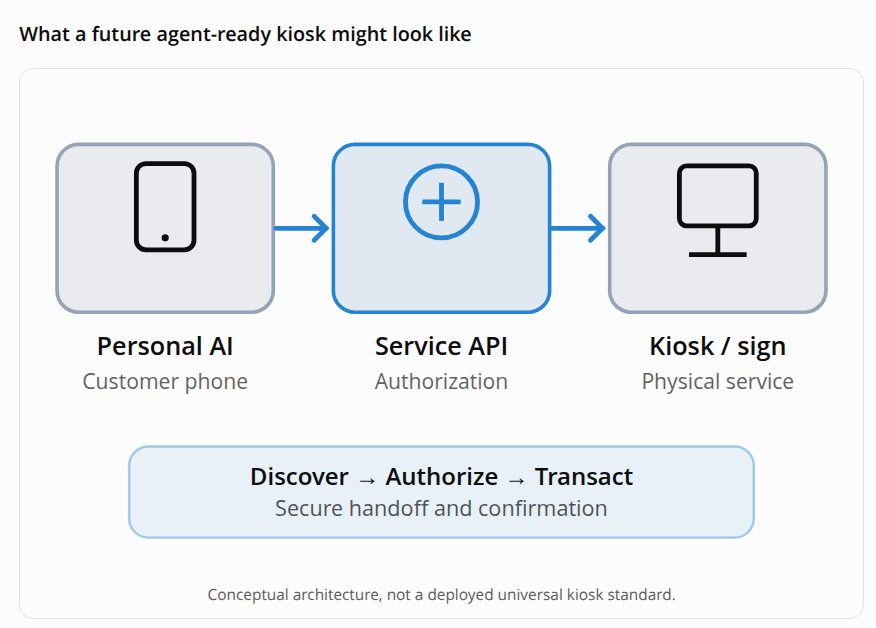
Conceptual agent
A physical kiosk could advertise its available services through a QR code, NFC interaction, or a published digital endpoint. The phone’s agent could discover the services, authenticate the customer, and request an action. The kiosk or backend would validate the request and complete the transaction.
The difficult parts will be authentication, privacy, payment authorization, preventing fraudulent agent actions, and maintaining accessible alternatives for people who do not use personal AI agents.
The bigger implication for the kiosk industry
I see a potentially significant shift in purchasing criteria:
Today’s question: Does this kiosk have a good touchscreen and easy-to-use interface?
Tomorrow’s question: Can this kiosk securely serve customers who interact through their own AI agents?
That could eventually reduce the need for customers to navigate complex touchscreen menus while increasing the importance of physical kiosks for dispensing, identity verification, payment, ticket printing, and fulfillment.
It also introduces a new question for digital signage: Should signage systems publish machine-readable information for personal AI agents, in addition to presenting information visually to humans?
That would be a natural extension of the fragmentation-tax argument. Connected systems reduce fragmentation between an operator’s technologies. Agent-ready systems could go further, reducing fragmentation between the operator’s systems and the customer’s personal technology.
I would consider this a strong follow-up editorial for kioskindustry.org:
“When Your Phone’s AI Agent Talks to the Kiosk: The Next Stage of Self-Service”
It is an emerging opportunity rather than an established industry-wide capability, but the enabling standards are already taking shape.


