

Last Updated on September 29, 2026 by Craig Allen Keefner
McDonald’s is getting into the advertising business in a more visible way.
At its September Investor Day, McDonald’s said it had moved into market testing of its McDonald’s Media Network across 450 company-owned U.S. restaurants. The company’s ambitions are considerably larger. McDonald’s CMO Morgan Flatley talked about building the Media Network into a $1 billion business across the McDonald’s system over time.
The assets are certainly there: the app, kiosks, digital menu boards and the restaurants themselves.
And McDonald’s has a lot of customers looking at a lot of screens.
That doesn’t necessarily mean they want to look at advertising.
We Have Seen This Movie at the Gas Pump
My first reaction to advertising on drive-thru displays was pretty simple.
Gas pumps.
For years, gas stations have been putting video screens on pumps. You insert the card, select the grade, start pumping and suddenly somebody is talking to you about pizza, insurance, the lottery or whatever else somebody bought that week.
Sometimes it works.
A promotion for a breakfast sandwich inside the convenience store while I am standing outside pumping gas makes sense. I can actually do something about it.
Other times it is mostly noise.
And occasionally it is downright irritating.
There is a lesson there for McDonald’s.
A captive audience is not necessarily an engaged audience.
The McDonald’s Experiment Is Real
There is an important factual distinction here because some very large numbers are starting to circulate.
McDonald’s has confirmed a pilot involving 450 U.S. company-owned restaurants. That is 450 restaurants — not 450,000 screens.
The company demonstrated the concept at Investor Day with third-party advertising, including a Geico example on a drive-thru digital menu board.
That is significant.
McDonald’s isn’t simply using its menu boards to sell McDonald’s anymore. It is testing whether those displays can become media inventory.
That changes the economics of digital signage.
McDonald’s supporting Investor Day materials also make clear that this is happening against a much broader Restaurant NEXT investment program. McDonald’s talks about eventual full deployment of NEXT elements across its U.S. and International Operated Markets.
And this isn’t a small capital program. McDonald’s estimates incremental investment of roughly $800,000 for a traditional U.S. drive-thru restaurant, with investment phased over time.
If some of that infrastructure can generate advertising revenue in addition to helping sell hamburgers, fries and drinks, you can certainly understand the attraction.
Retail Media Works — Under the Right Conditions
Digital signage advertising has precedent for actually moving product.
Walmart is probably the most obvious example.
Its retail-media operation can put an advertisement near the product being sold and then connect exposure to an actual transaction.
Customer sees an advertisement for cookies.
Cookies are six feet away.
Customer buys cookies.
That’s a pretty clean proposition.
There is also academic evidence behind the idea. A large field study published in the Journal of Marketing examined hundreds of digital-signage campaigns involving millions of shoppers and found an increase in the probability of purchasing advertised products.
One of the important variables was proximity.
Advertising works better when it is relevant to what the customer is doing and close to the point where the customer can act on it.
That’s where McDonald’s gets interesting.
When Does the Advertisement Appear?
Consider two scenarios.
I’m ordering at a McDonald’s drive-thru and Coke pays for preferred positioning on the menu board.
Perfectly logical.
Or there is a promotion for an Oreo McFlurry while I am deciding what to order.
Also logical.
Now change the sequence.
I’ve already ordered my Quarter Pounder, fries and Coke. My transaction is finished. The menu board changes and I get a Geico advertisement while I’m waiting to pull forward.
That’s a very different advertising proposition.
At that point McDonald’s hasn’t necessarily created retail media.
It may have created a really well-located billboard.
There is nothing inherently wrong with that. Out-of-home advertising is a large business.
But it isn’t the same thing.
The Kiosk Could Be More Valuable Than the Drive-Thru Board
The kiosk presents another interesting possibility.
A kiosk knows where I am in the transaction.
Before I order, it can influence my selection.
While I’m ordering, it can suggest an upgrade.
After I order, it could present an offer relevant to the transaction I just completed.
And if that is combined with loyalty data and the McDonald’s app, the targeting possibilities become considerably more sophisticated.
That is potentially much more interesting than simply putting a car-insurance commercial on a menu board.
Of course, there is another side to that equation: privacy, disclosure and just how much personalization customers are comfortable with while buying lunch.
Those questions will come.
McDonald’s Doesn’t Need Huge Engagement
There is one economic wrinkle that shouldn’t be overlooked.
McDonald’s already owns the real estate.
It already has the restaurants.
It already has the displays.
It already has the network infrastructure.
It already has enormous customer traffic.
That means the incremental cost of creating another advertising impression could be very low.
Even mediocre engagement might therefore produce attractive margins.
That’s one big difference between McDonald’s and a conventional media company that has to acquire an audience. McDonald’s already has one standing in front of the screen.
The question is what that audience is worth.
450 Restaurants Is the Number to Watch
For now, I would ignore claims about hundreds of thousands of McDonald’s advertising screens.
The factual number we have is 450 company-owned U.S. restaurants in the pilot.
That’s actually a better number anyway.
Four hundred fifty restaurants are enough to learn quite a bit.
McDonald’s can measure impressions, advertiser response, customer behavior, dwell time and potentially sales attribution. It can test different screen locations, different creative, different times of day and different categories of advertiser.
Most importantly, it can find out whether customers pay attention.
Because the gas-pump experience has already taught us something about digital signage.
Having somebody standing in front of a screen doesn’t mean they are watching it.
And if the advertising becomes disruptive enough, they may start looking for the mute button.
More Thoughts
- The economics may work even with mediocre consumer engagement. McDonald’s already owns the displays, CMS/network infrastructure, locations and customer relationship. Its incremental cost of creating advertising inventory on an existing screen could be extremely low. Thus a mediocre advertising product could still be a very high-margin business for McDonald’s.That may ultimately be the better explanation for the experiment than “people want to watch advertising while waiting for their fries.”
- The Media Network concept makes considerably more sense if McDonald’s uses the displays to influence something the customer can still do.
- A gas-pump screen has a captive audience, but captive doesn’t necessarily mean attentive. The customer has already made the principal purchase decision. The screen is competing with the customer’s phone, surroundings and desire to finish the transaction.The McDonald’s implementation potentially has exactly the same problem.
- An earlier Journal of Retailing field study examined digital displays across different store formats. Displays improved sales in large hypermarkets, had minimal effects in supermarkets and supercenters, and actually had a negative effect in smaller convenience-store formats. The researchers also found that price-promotional messages were important to generating lift.
- Any precedent? — Walmart has turned its stores into part of Walmart Connect. It sells advertisers digital screens, audio and experiential placements across more than 4,600 U.S. stores. Walmart says its initial Deli and Bakery screen tests produced up to 5% sales lift for food suppliers. It can also close the loop by correlating advertising exposure with actual sales. Walmart ConnectAnd Walmart explicitly recognizes the danger we’re talking about. Its description of the strategy says the advertising experience needs to be additive rather than interruptive to the customer’s shopping trip. Walmart Connect
- That distinction matters.
- The strongest evidence we have found is a 2025 Journal of Marketing field study covering 237 digital-signage campaigns and about 30 million shoppers. Digital signage increased the probability of buying the advertised product by 8.1%. But effectiveness was greater for low-priced, novel and hedonic products, and importantly, when the screen was physically near the advertised product.
- Digital signage will resume its hunt for ROI but we think destined for same outcome as powerpoint presentation. Visual cues are nice for sure but results are always problematic to quantify.
Financial Markets Look
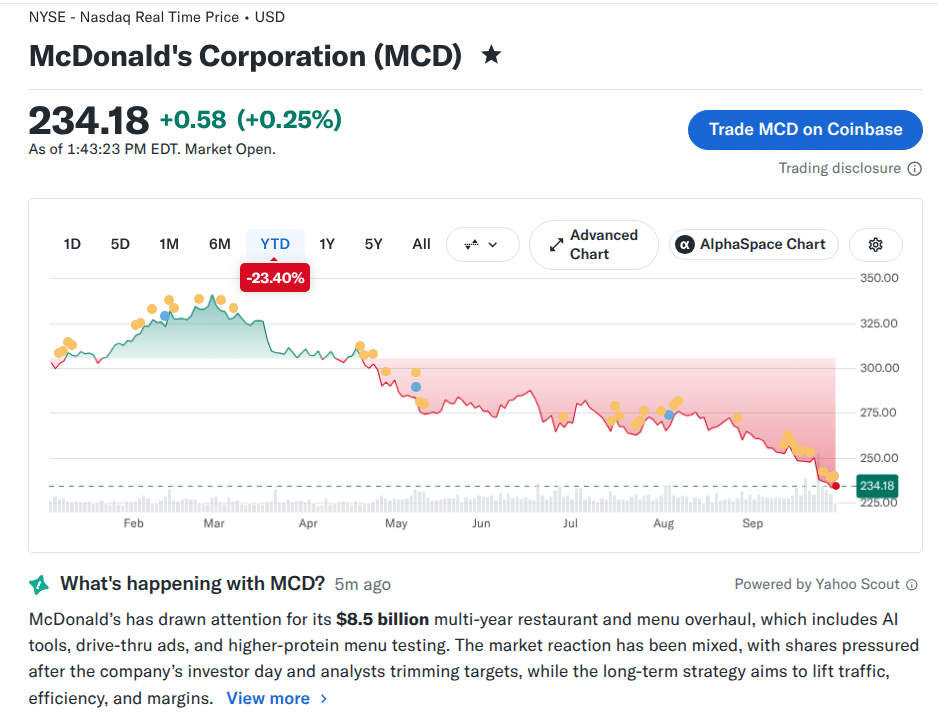
McDonald’s has drawn attention for its $8.5 billion multi-year restaurant and menu overhaul, which includes AI tools, drive-thru ads, and higher-protein menu testing. The market reaction has been mixed, with shares pressured after the company’s investor day and analysts trimming targets, while the long-term strategy aims to lift traffic, efficiency, and margins.
- Strategic Overhaul: McDonald’s is shifting toward a broader operating model that mixes hospitality, digital tools, and menu changes. Management wants to improve restaurant economics and lift long-term margins toward the low-to-mid 50% range by 2030.
- AI And Labor Efficiency: The company is rolling out ArchIQ, including the Archy ordering assistant. McDonald’s says the tools could remove about 50 labor hours per restaurant per week and support higher throughput.
- Advertising Business: McDonald’s is testing drive-thru and in-store ads across company-owned locations. The company says the media network could scale into a $1 billion revenue stream over time.
- Street Reaction: Analysts focused on near-term sales pressure and the size of the investment plan. Morgan Stanley projected 0.5% U.S. comparable sales declines in Q3 and 1% in Q4, then cut its target to $297.
Resources
- All started with comments during conference,
- invidis take on it – ” Advertising currently appears on drive-thru ordering screens, but expansion into additional digital channels is widely expected. Digital menu boards, self-order kiosks, and the McDonald’s mobile app are all logical extensions of the media network.”
- McD_InvestorDay_2026_Supporting Slides
- 2026 Investor Day Press Release
- https://www.sciencedirect.com/science/article/abs/pii/S0022435915000755
- https://finance.yahoo.com/markets/stocks/articles/mcd-stock-gets-price-target-175730609.html
- Transcript for Conference
Addendum – Listening to Presentation
The presentation lays out McDonald’s Next, a multi-year strategy to grow market share and improve productivity. Its core thesis is that, in a low-traffic restaurant environment, McDonald’s must create more customer demand while serving that demand more efficiently.
Executive summary
-
McDonald’s wants to become the first choice for more customers, more often, using better food quality, stronger value, loyalty personalization, AI-enabled operations, and more consistent hospitality.
-
The strategy has four pillars: Menu Next, Consumer Next, Restaurant Next, and People Next, with AI and a common global data/technology platform underpinning all four.
-
The company’s key 2030 targets include roughly 1.5 percentage points of market-share gain in both chicken and beverages, about 250 basis points of gross restaurant-level efficiency, and adjusted operating margin in the low-to-mid-50% range.
The four strategy pillars
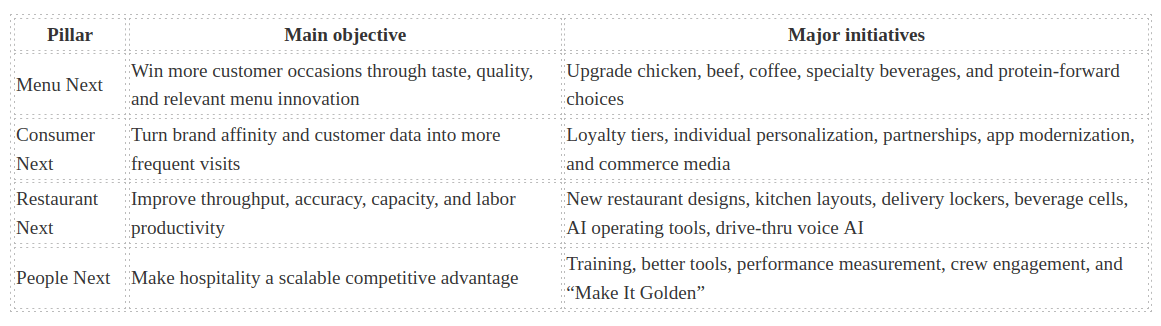
The plan is designed as a cycle: better food and experiences drive visits; greater volume and operational efficiency strengthen restaurant economics; those economics fund reinvestment in further growth.
Menu and demand growth
Chicken and beverages are the largest share opportunities
McDonald’s frames chicken and beverages as its clearest growth categories:
-
Chicken is described as a nearly $130 billion category across its top markets, growing more than 5% annually. McDonald’s has high-teens share and plans to grow through improved core execution, McCrispy expansion, strips, wings, grilled chicken, wraps, new Nugget flavors/sauces, and hand-breaded chicken pilots.
-
Beverages are a nearly $230 billion category and are growing faster than the broader informal-eating-out market. McDonald’s is scaling cold coffee, refreshers, crafted sodas, energy drinks, and coffee improvements. Management emphasized that beverage-led visits occur disproportionately after lunch, use otherwise available restaurant capacity, and tend to increase basket size.
-
In beef, the objective is less about share expansion and more about defending leadership through stronger execution, Quarter Pounder innovation, Double Quarter Pounders, Big Arch, and larger-burger offerings.
Protein and GLP-1-related menu shifts
The company sees a broader move toward protein, smaller or more flexible portions, and “satisfying but not too much” meals. It specifically cited GLP-1 users as a meaningful audience but stressed that the larger opportunity is the much broader protein-seeking consumer base. Potential menu formats include grilled chicken, bowls, snack wraps, breakfast protein options, and egg bites—while maintaining restaurant simplicity.
Value remains essential
McDonald’s repeatedly positioned value as complementary to quality, not a tradeoff. The intended message is: improved taste and food quality, but still delivered with McDonald’s traditional advantages in price, convenience, speed, and accessibility.
Digital, loyalty, and media
McDonald’s considers its customer-data base a major strategic asset:
-
It has nearly 220 million 90-day active loyalty users globally; active loyalty members reportedly visit about 2.5 times as often as non-members and spend more over a year.
-
The company intends to add a tiered loyalty program for frequent users, more personalized offers for occasional users, and re-engagement campaigns for an estimated 150 million infrequent loyalty customers.
-
Loyalty will extend beyond restaurant discounts through partnerships. The presentation cited planned U.S. offers involving Uber ride credits and Disney+ subscriptions.
-
McDonald’s is replacing country-by-country digital systems with GMA1 (Global Mobile App One), a common global app backbone for ordering, rewards, meal building, and checkout. A France pilot is planned first, with the top 10 largest operated markets targeted by the end of 2028.
-
It is also testing a McDonald’s Media Network, initially across 450 U.S. company-owned restaurants, with an aspiration to make it a billion-dollar systemwide business over time.
For a self-service and retail-technology perspective, the key point is that McDonald’s is treating its app, loyalty program, kiosks, menu boards, drive-thru, and in-restaurant touchpoints as a single connected commerce and engagement system—not separate channels.
Restaurant technology and AI
Restaurant Next is arguably the most operationally important part of the presentation. McDonald’s is combining new restaurant layouts with an AI-enabled operating system called ArchIQ.
Key components include:
-
Drive-thru voice AI (“Archie”) in English and Spanish, reportedly exceeding 90% order accuracy in early tests and expected to free at least 50 labor hours per restaurant per week as it scales.
-
Automated inventory using Bluetooth Low Energy tags, intended to save about five labor hours weekly and reduce food waste by 15%.
-
Connected equipment and computer vision to predict issues, improve food consistency, and increase key equipment/menu availability by about 50%.
-
Intelligent accuracy scales to detect missing or incorrect items before orders leave the restaurant. McDonald’s says they catch and correct 10% of orders; it already has these in more than 10,000 restaurants and expects to double deployment by 2028.
-
Restaurant redesigns featuring beverage cells, easier order assembly, improved delivery/courier fulfillment areas, delivery lockers, visible McCafé preparation, more open kitchens, and—where feasible—fast-forward drive-thru windows with up to 25% more capacity.
The technology strategy depends on a unified POS environment, edge computing deployed with Google, and a restaurant-level data lake gathering billions of data points daily across more than 46,000 restaurants.
People and hospitality
McDonald’s argues that labor productivity is not simply automation or labor reduction; it is about freeing crews to execute reliably and provide better hospitality.
-
It cited internal U.S. comparisons showing that restaurants in the top quartile for employee engagement and retention generate 10% more guest counts, 15% higher sales, and 20% more cash flow than those in the bottom quartile.
-
Its systemwide training program, Make It Golden, is described as the largest capability-building initiative in the company’s history, aimed at equipping 2 million people with training, tools, and support.
-
The program focuses on crew enablement, stronger operating and hospitality standards, and creating recognizable McDonald’s guest experiences across dine-in, drive-thru, pickup, and delivery.
The practical message: AI should take away repetitive decisions and administrative work so that staff can concentrate on food quality, speed, accuracy, and human interaction.
Financial and rollout implications
Management gave unusually explicit investment and return targets:
-
About 250 basis points of gross restaurant-level efficiency over time in company-owned markets. For an average U.S. restaurant, management equated that to roughly $100,000 in annual gross cash flow.
-
A full Restaurant Next deployment is estimated at about $800,000 incremental investment per traditional U.S. drive-thru restaurant, and approximately $650,000–$700,000 in other top markets.
-
McDonald’s expects the holistic program to generate roughly a four-year payback for franchisees after company support and a five- to six-year payback for McDonald’s.
-
The corporation expects to provide $8.5 billion in total partner support through 2036, including roughly $5 billion by the end of 2030 for technology bundles, kitchen improvements, and operational enablers.
-
Net restaurant unit growth is targeted at almost 4.5% in 2027, then approximately 3% to 3.5% annually from 2028 through 2030. New restaurants are expected to adopt the Restaurant Next design beginning in Q1 2028.
-
The franchise mix is targeted to rise from about 95% to approximately 98% globally by the end of 2028.
-
G&A is targeted to decline from about 2.2% of systemwide sales in 2026 to about 1.9% by 2030, aided by shared services, enterprise data, automation, AI, and refranchising.
Bottom line
This is not primarily a “new menu items” presentation. It is a large-scale operating-system transformation for McDonald’s: unified data and technology; AI-assisted drive-thru, inventory, quality control, and order accuracy; digital loyalty and personalization; simpler global marketing; restaurant redesign; and workforce enablement.
The strategic bet is that McDonald’s can use its global scale and franchise economics to achieve something smaller competitors cannot easily match: deploy a common self-service, digital, AI, and operational model across tens of thousands of locations—while using it to improve both customer frequency and unit-level profitability.


