

Last Updated on September 25, 2026 by Craig Allen Keefner
We are organizing our data over on selfservice.io
SelfService.io Market Intelligence: A Working Research Desk for the Self-Service Industry
The self-service business moves too quickly for static market reports alone. SelfService.io Market Intelligence is designed as a living research desk: a practical collection of financial comparisons, company intelligence, market-segment analysis, trade-show data, and timely news curated by TIG — The Industry Group.
The resource is curated by Craig Allan Keefner and is intended for operators, suppliers, investors, analysts, and anyone trying to make better-informed decisions in kiosks, restaurant technology, unattended retail, digital signage, payments, and automation.
Visit SelfService.io Market Intelligence
Why this matters
The question is rarely just “Is self-service growing?” The useful questions are more specific:
-
Which restaurant brands are translating digital investment into unit-level economics?
-
Which companies are active, changing direction, consolidating, or creating new risk for operators?
-
What are attendees and exhibitors signaling before a major trade show?
-
What can patents, financial releases, local regulations, and operating announcements tell us before the formal market-research firms catch up?
-
Where do customer acceptance, accessibility, labor, store design, payments, and automation intersect?
SelfService.io collects working material around those questions in one searchable, continuously updated location. It is less about repeating broad market-size forecasts and more about identifying what companies are actually doing, why they are doing it, and what the moves imply for suppliers and operators.
What is on the site
The Market Intelligence page is organized into several practical research areas.
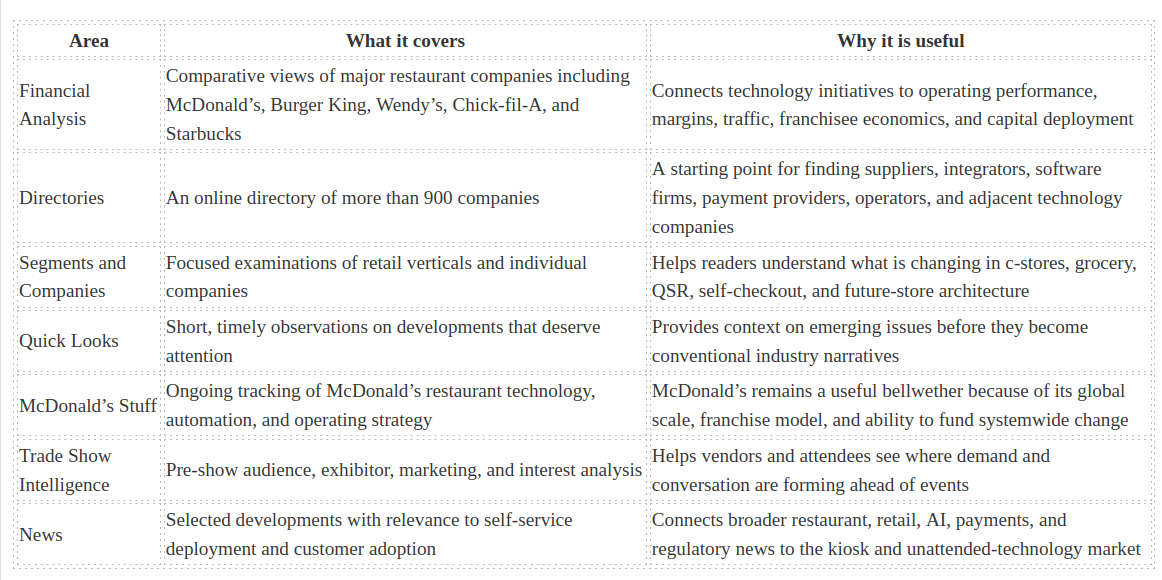
market intelligence
A closer look at current intelligence
Several current items illustrate the kind of analysis being assembled.
Restaurant financial and operational signals
The Financial Analysis section includes comparative material on Burger King, Wendy’s, McDonald’s, Chick-fil-A, and Starbucks. These are not simply brand scorecards. They are useful lenses for understanding the relationship between restaurant technology investment and the fundamentals that ultimately determine whether deployment scales: traffic, labor, speed of service, order accuracy, franchisee cash flow, and store-level profitability.
Links include:
For kiosk and restaurant-technology suppliers, the practical takeaway is straightforward: technology budgets increasingly need to be framed in terms operators recognize. That means throughput, labor leverage, reliable execution, customer adoption, and measurable returns—not just a better interface or more AI in the product description.
McDonald’s NEXT and the automation stack
McDonald’s September 2026 NEXT announcement is a major example of a company positioning technology as part of a scaled restaurant operating model rather than a collection of isolated digital touchpoints. The company’s Restaurant > NEXT pillar combines operational simplification, restaurant-design modernization, standardized technology and data platforms, and deployment of GenAI-enabled ArchIQ across its U.S. and International Operated Markets. McDonald’s targets roughly 250 basis points of gross restaurant-level efficiency, which it equates to approximately $100,000 in annual cash-flow benefit for an average U.S. restaurant.corporate.mcdonalds
The company also says it plans approximately $8.5 billion in NEXT partnering support through 2036, including about $5 billion through 2030, to accelerate modernization, technology deployment, and operational improvement. It estimates an approximately four-year franchisee payback after partnering.corporate.mcdonalds
That announcement is not a new kiosk rollout. But it is highly relevant to the kiosk industry because it reinforces the strategic direction of the market:
-
Customer-facing ordering, loyalty, pickup, drive-thru, digital menu systems, and personalization increasingly connect to a common data and operating layer.
-
Crew tools, scheduling, inventory, order validation, and kitchen execution are becoming part of the same automation architecture.
-
Technology suppliers need to show how their components fit into an interoperable restaurant system—not simply how a standalone device performs.
-
Franchisee adoption will depend on credible unit economics, deployment support, reliability, and an implementation plan that does not add complexity at the restaurant level.
Read the detailed TIG perspective: McDonald’s and integrated restaurant automation
McDonald’s own announcement is worth reading in full for anyone tracking restaurant productivity, franchise technology funding, or GenAI deployment at enterprise scale.corporate.mcdonalds
The customer-choice lesson in voice AI
Self-service intelligence is not just about identifying where AI is being installed. It is also about identifying where customer acceptance sets limits.
Burger King recently said it is reconsidering a model in which AI is the only way to order in a drive-thru. According to reporting from Nation’s Restaurant News, the chain found that some pilot locations experienced drive-offs from guests who did not want to speak to a bot. Burger King is testing voice AI in approximately 50 to 70 drive-thru locations and is developing a way to give customers more say in how they order.nrn
That correction matters. Early descriptions of the program cited a much larger number, but Nation’s Restaurant News later corrected the testing scale to 50–70 locations.nrn
The larger lesson applies across kiosks, voice ordering, mobile ordering, and automated retail: automation should expand choice and remove friction, not force a channel that customers do not want to use. The strongest self-service deployments retain a clear human-assistance path, support accessible interactions, and offer a graceful fallback when technology is not the right answer for a particular customer or transaction.
Read the source coverage: Burger King rethinks its drive-thru AI strategy.nrn
Research beyond the headlines
The collection also looks beyond large public restaurant brands.
Convenience stores and bitcoin kiosks
A timely c-store item examines the operational implications of bitcoin-kiosk removals and local ordinances. One question is especially important: when an operator is bankrupt, distant, consolidating, or otherwise difficult to reach, does responsibility for an unwanted or noncompliant kiosk effectively move to the retail host?
That is more than a cryptocurrency story. It is a broader unattended-retail issue involving:
-
Host-site liability
-
Equipment ownership and removal obligations
-
Lease and placement agreements
-
Facilities and electrical work
-
Consumer-protection exposure
-
Vendor continuity and end-of-life planning
Read the analysis: C-store operational shift and BTM removal
Walmart patents and future retail
The Walmart patent analysis looks at what patent activity can reveal about the possible direction of store operations, customer journeys, automation, checkout, and retail infrastructure.
Patent intelligence should be treated carefully—patents do not guarantee a deployed product or strategy—but it can be a valuable early indicator when paired with store pilots, vendor relationships, earnings commentary, and organizational changes.
Trade-show intelligence
Trade shows remain one of the best real-world indicators of where commercial interest is building. The Trade Show Intelligence section includes work around IAAPA and the National Restaurant Association Show, including pre-show audience and marketing analysis.
Available material includes:
For exhibitors, these reports can help sharpen positioning, target accounts, content priorities, and outreach. For attendees, they offer a way to identify what is likely to be noise, what is gaining traction, and which suppliers or market categories deserve limited show-floor time.
For a limited time these are free reports.
A useful resource for the industry
Self-service technology does not operate in a vacuum. Kiosk deployments are tied to payment architecture, digital signage, loyalty programs, accessibility, order management, data governance, store labor, physical infrastructure, security, and the economics of operating a location every day.
That is the value of a living market-intelligence resource. It puts individual announcements, financial results, policy changes, trade-show signals, and vendor activity into a context that is useful for real decisions.
Explore the full collection at SelfService.io Market Intelligence, and revisit it regularly as TIG adds research, quick looks, directories, and analysis.


