Last Updated on September 19, 2026 by Craig Allen Keefner
Section 508 • ADA 2010 • ACAA / 14 CFR §382.57 • European Accessibility Act • EN 301 549
Self-service kiosk accessibility is no longer adequately described by saying a product is simply “ADA compliant” or “EAA compliant.”
Get yours now is usual next line — $49
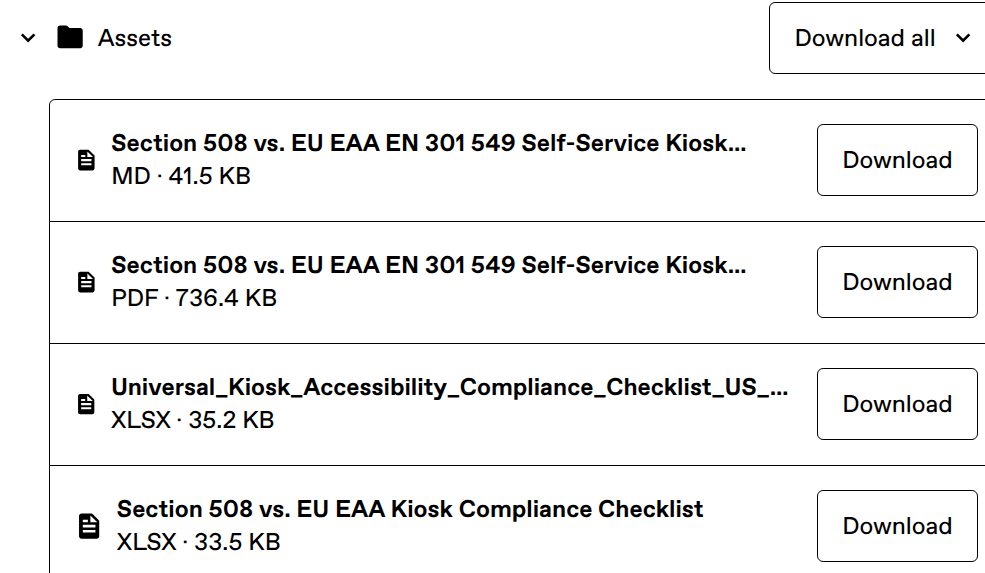
The U.S. vs. EU Self-Service Kiosk Accessibility Compliance Matrix — 2026 provides a practical side-by-side comparison of the five major accessibility frameworks affecting kiosk design, procurement and deployment:
- Revised Section 508 Standards
- 2010 ADA Standards for Accessible Design
- Air Carrier Access Act / DOT 14 CFR §382.57
- European Accessibility Act (EAA)
- EN 301 549 V3.2.1
The report is designed for kiosk manufacturers, OEMs, component suppliers, software developers, accessibility teams, procurement professionals, airports, transportation operators and enterprise deployers that need to understand where U.S. and European requirements overlap—and where they do not.
A key conclusion is that manufacturers do not necessarily need separate U.S. and EU kiosk hardware architectures. There is substantial convergence around reach, force, screen sightlines, speech output, tactile controls, volume control, transaction verification and nonvisual operation. A practical global strategy is to design to the stricter requirement in each technical category while handling deployment, documentation and conformity requirements separately.
What the matrix covers
The expanded 2026 edition includes detailed comparisons covering speech output and nonvisual operation; audio, privacy and hearing technology; tactile controls and input; biometrics; display requirements; reach and installed geometry; documentation; and deployment obligations.
It also adds ACAA / DOT 14 CFR §382.57 as a full comparison layer, including the airport-specific 25% accessible-kiosk deployment requirement, same-function parity, accessible identification, maintenance, priority access and equivalent service.
The DOT technical comparison examines requirements including speech output, privacy, tactile input, braille, display characteristics, captions, volume, floor space, operable parts, boarding passes and biometric alternatives.
More than a standards comparison
The report goes beyond identifying regulatory differences. It converts them into a Universal Kiosk Build Specification covering speech and audio, private listening and hearing support, tactile controls, input, display geometry, documentation and deployment.
For airport deployments, a dedicated compliance profile identifies the evidence procurement teams should request—including clause-by-clause technical conformance, kiosk-location inventories, function matrices, maintenance procedures, ambient-noise testing and display measurements.
Who should buy this
This is particularly useful for organizations that are:
Designing a kiosk for both U.S. and European deployment • writing kiosk RFPs • evaluating an OEM or kiosk platform • developing an accessibility roadmap • preparing for EAA requirements • evaluating airport kiosks under ACAA/DOT • creating an accessibility conformance report • deciding which requirements should become standard product features rather than market-specific options.
2026 Expanded Edition — 7-page engineering and procurement reference.
This matrix is an engineering and procurement comparison and is not legal advice. Regulatory applicability depends on the purchaser, location, service, ownership/control, installation context and transaction being performed.
US_EU_Kiosk_Accessibility_Compliance_Matrix_2026_SAMPLE