

Last Updated on August 6, 2026 by Craig Allen Keefner
The end of an era — how many times did I get pricing on F53/F56 or F510/F610. Trying to go direct with Fujitsu and sidestep ARCA. Today is the last day you can order from Fujitsu. Officially handing off to JCM Global (they make nice stuff too…) Good to react to what your customers expect and want from you, now. Just because it was profitable in the past is no guarantee it will in the future. Just ask Blackberry or Polaroid or Xerox. Being permanently married to your past has its drawbacks.
Comments

Jhonny Vides Premium Profile
Senior Business Development Manager @ Innovative Technology Ltd | Driving Market Expansion and Client Relationships
Sad to see the end of an era. I was fortunate to be part of this journey.
The OEM business really took off after Fujitsu decided to exit the ATM business. Under the leadership of a great mentor and true professional, Randy Fox , and alongside an outstanding team at ARCA Mort O’Sullivan, Kirk Nelson , Peter Sentowski , James Breese, and many others—we built one of the most successful and profitable OEM businesses in our industry.
The Fujitsu dispenser is an outstanding product, and today it’s used in thousands of ticket redemption terminals around the world, SCOs, car washes, parking kiosk,etc. I sincerely hope JCM continues to invest in it, honors its history, and builds on its legacy. Cash is king!!!
A special thank you to the Fujitsu team—Eric D., Eric B., Paul, Sean Culliton, Bob Brower, and everyone who contributed over the years. great memories, great partnerships, and a chapter I’ll always be proud to have been part of.
Casino|Slots|BarTops|Gaming|Routes|Sportsbet|Loyalty|CashHandling|Jackpot|FinTech|TITO|ATM|Kiosk|SelfService|SmartSafe|Vending|Design|CNC|Precision|Metal|Assembly|Testing|TurnKey|Electronic|Hardware|Software|Solutions
Just to add. Since 2003, Nevatronix was and still is the largest single OEM integrator of Fujitsu dispensers as it innovated numerous amounts of self service POS products saving Arca from the brink of extinction on numerous occasions. We are also very proud to be a part of so many of these successful stories.

Business Development Specialist- Hardware, Software, Service
This line of product has been the gold standard among cash dispensers- Uniquely positioned due to lack of competition on a component level in the most recent years. Fantastic product that was managed by a great team of highly experienced professionals.
Senior Business Development Manager @ Innovative Technology Ltd | Driving Market Expansion and Client Relationships
Craig, after all those pricing requests, you still ended up buying from ARCA! 😄 and so did the rest 🥂🥂. Thousand thanks 🙏
Casino|Slots|BarTops|Gaming|Routes|Sportsbet|Loyalty|CashHandling|Jackpot|FinTech|TITO|ATM|Kiosk|SelfService|SmartSafe|Vending|Design|CNC|Precision|Metal|Assembly|Testing|TurnKey|Electronic|Hardware|Software|Solutions
Thanks for sharing. Looking back at the statistics, I’d probably rephrase my earlier comment. I’d say Nevatronix was one of the major OEM integrators of Fujitsu dispensers, alongside many other great companies in the industry. What Randy and the Arca team accomplished was remarkable. Our companies worked together through many challenges over the years, and it was rewarding to see the business grow and ultimately be acquired by Sesami. I’m grateful to have worked with so many talented people and to have been part of that chapter.
Undisclosed but reputable
I don’t think that the F53 will die. JCM has no competitive product. This seems to allow them a easy way in to the dispense ONLY market.
Time will tell.
Sample Quote for Kiosk Project

f53 sample quote
History Notes
The F53 and F510 are dispensers, not acceptors — a naming confusion that’s been rampant in the kiosk trade for 20 years. Fujitsu’s acceptor/recycler line is the G-series (G600, G610/G611, G651, G750) and later the GSR50. The F53 pushes notes out at 2/second; the F510 at 7/second.
The company started making forks and spoons
Fujitsu Frontech traces to KANAIWA KOUSAKUSHO, founded 1940 in Tsubame, Niigata — a maker of Western-style tableware. Fuji Tsushinki (later Fujitsu) bought all shares in 1944. Financial terminals began in 1974, and bill recycling unit development started in 1984 — that 40-year-old recycler DNA is what eventually became the GSR50.
The F53 is the quiet monopolist of self-checkout
Fujitsu’s own OEM director said flatly in 2010 that “our F53 unit is used by all of the top manufacturers of self-checkout solutions. Install base went from ~60,000 units to over 80,000 by the 2023 datasheet. Very few kiosk components have that kind of run.
F53 vs F56: same chassis, different hat
ARCA’s product demo explains the whole difference is the presenter on top — the F53 uses an open semi-bunch exit, the F56 adds a shutter for outdoor/foul-weather installs plus a retract bin. Fujitsu also marketed a “SlimLine F53” at 160mm wide, sized specifically to fit the ergonomic zone of an OEM cabinet.
The F510 got resold under other badges
Change Italia distributed the dispenser family under a deck literally titled “JCM – Bill Dispenser Product Family – F53 / F56 & F510“. Also note the spec drift in the wild: Fujitsu Japan lists the F510 as 5 cassettes / 15,000 notes, while the North American and Spanish-language sheets claim 6 cassettes / 18,000 notes — the same product, two different marketing truths (Fujitsu Japan, Fujitsu US Spanish datasheet).
It was never really about cash
The F510 was pitched as a multimedia dispenser — postage stamps, coupons, prepaid phone cards. Fujitsu Frontech’s other historical oddity: it owns Totalizator Engineering, which supplies pari-mutuel betting terminals to Japanese public racecourses.
Second life in Bitcoin ATMs
The F53 outlived its original market. Lamassu’s Sintra and Sintra Forte crypto ATMs use it, and Lamassu publishes a teardown guide for removing it. It also lives on in Standard Change-Makers’ BX1020 bill breaker as the “Dual Note” dispenser.
North American arm was a rebadge
Fujitsu Frontech North America didn’t exist until 2009 — it’s the former Fujitsu Transaction Solutions Inc., acquired and renamed. So F53 paperwork from before and after 2009 carries different corporate names for the same Foothill Ranch, CA office.
How did it compare to NCR Hawk or Puloon or Genmega
They’re in three different leagues
The quick framing: Fujitsu F53/F510 are OEM component dispensers sold to whoever is building the machine. NCR Hawk was a captive dispenser for NCR’s own retail ATMs. Puloon LCDM is the budget Korean commodity part. Genmega isn’t a dispenser maker at all — it’s an ATM assembler that sources them.
The F53 is actually the slowest of the bunch. Its win was never throughput — it was footprint (160mm wide), 6-cassette denomination flexibility, and boring reliability in self-checkout lanes where you dispense four bills, not forty.
The real differentiator: what happens after the pick
Puloon and Genmega dispense note-by-note out a slot with mechanical double-detect (Puloon LCDM-2000 spec). Fujitsu offered semi-bunch, tray, bulk, and custom transports — plus the F56 sibling with a shutter and full retract bin for outdoor installs (ARCA demo). That presenter modularity is exactly why OEMs picked it: one chassis, many cabinet designs.
NCR went further still on the bank side. Their current S2 module uses vacuum-based adaptive pick, 5 notes/sec, 2,500–2,800 notes per cassette, 60-note bunch present, and separate purge compartments for single-note divert vs. bunch rejectcdn.prod.website-files. Nothing in the Fujitsu OEM line touches that — but nothing in that line costs what an S2 costs either.
Genmega is the giveaway
The Genmega G1900 explicitly supported De La Rue SDD and Puloon LCDM-1000 as drop-in alternatives to its own dispensersgenmega. That tells you the whole low-end segment was interchangeable commodity. Nobody ever advertised “also accepts a Fujitsu F53 instead” — Fujitsu units were designed into a product at engineering stage, not swapped at the field-service level.
Hawk’s odd historical footnote
Hawk shows up in the Tidel 3400 after NCR acquired Tidel’s ATM business, replacing Tidel’s own TCDMatmmarketplace, and in the EasyPoint 3600 as an expandable 1-to-4-cassette option alongside the legacy TCDM (EasyPoint 3600 datasheet). It was NCR’s answer to exactly the off-premise/retail tier Puloon was eating — and it’s long dead, while the F53 is still shipping into Bitcoin ATMs 20 years on.
Where each one won
-
F53 — self-checkout and kiosk OEM design-ins, 80,000+ units, small footprint, multi-denomination
-
F510 — high-volume bill breakers, teller assist, media dispensing (stamps, phone cards)
-
Hawk — NCR’s own retail ATM line, tied to their platform and service org
-
Puloon LCDM — price-driven retail ATMs, kiosks, parking, worldwide; RS-232 protocol so simple it’s a hobbyist favorite
-
Genmega — the machine around the dispenser, buying whichever mechanism hit the price point

F53 comparison
Final Notes
Hyosung’s retail CDU is the F53’s real-world rival, not Hawk. Same job, similar footprint, 4 notes/sec vs. the F53’s 2, friction separation, 1,000–2,000 notes. It’s also the volume leader in US off-premise ATMs — that 2,000-note cassette (P/N S7310000082) is common across the 1500SE, 1800SE, 1800CE, 2700CE, Halo, Halo II, and Force. One part, a decade of machines. Very Fujitsu-like in spirit.nextatm
Hyosung’s financial CDU is the F510 comparison — 3,000-note cassettes, up to 4–5 high, bundle present and retract with a powered shutter. Fujitsu never really competed here in the West because Fujitsu’s ATM business was mostly Japan and China; Hyosung took the global bank-ATM tier that NCR and Diebold didn’t.
Puloon’s UCDM is the forgotten one. It matches the F510 spec-for-spec — 7 notes/sec, 3,000-note cassettes, bundle presenter, 100-note transactions, polymer note support — at Korean pricing (Payprint). It’s the reason the F510’s premium became harder to justify after roughly 2015.
MS500 shows how far Fujitsu fell behind on recycling. Fujitsu’s GSR50 runs 3 notes/sec deposit and dispense (Fujitsu GSR50); Hyosung’s teller cash recycler does 12 in both directions with ~11,000 note recycling capacity. Different product class, but if you’re an integrator choosing a recycling engine, that gap is decisive.blog.qualitydatasystems
Revised placement
-
Bottom tier, commodity, field-swappable — Puloon LCDM, Genmega SCDU/MCDU
-
Retail workhorse tier — Hyosung retail CDU, Fujitsu F53, formerly NCR Hawk
-
High-volume dispense tier — Fujitsu F510, Puloon UCDM, Hyosung financial CDU
-
Bank/branch tier — NCR S2, Hyosung MS500
Fujitsu’s genuine remaining edge is the F53’s 6-denomination configurability in a 160mm envelope — Hyosung tops out at 4 cassettes and a wider chassis, which is why self-checkout OEMs stayed with Fujitsu even as Hyosung won the standalone ATM.
Two lineages hiding under “Diebold”
Post-2016 merger, Diebold Nixdorf sells two unrelated dispenser families: the Diebold AFD (Opteva heritage, US, 2,700-note cassettes) and the Wincor Nixdorf CMD (German heritage, 300–340mm fill). They aren’t interchangeable, and parts catalogs still split along that seam — the AFD/V6A cassette is listed for Opteva 5XX/7XX/8XX plus DN Series 100D/200A/250A/4X0A. The new DM7V is the first genuinely post-merger engine.
GRG has the same split: a kiosk/retail CDM6240 family and a bank-ATM H-series. And GRG’s spec sheets drift worse than Fujitsu’s — the same “CDM6240” name appears at 500 notes/2 per sec, 2,200 notes/4 per sec, and 2,200 notes/7 per sec depending on which manual you pull.
Expanded comparison
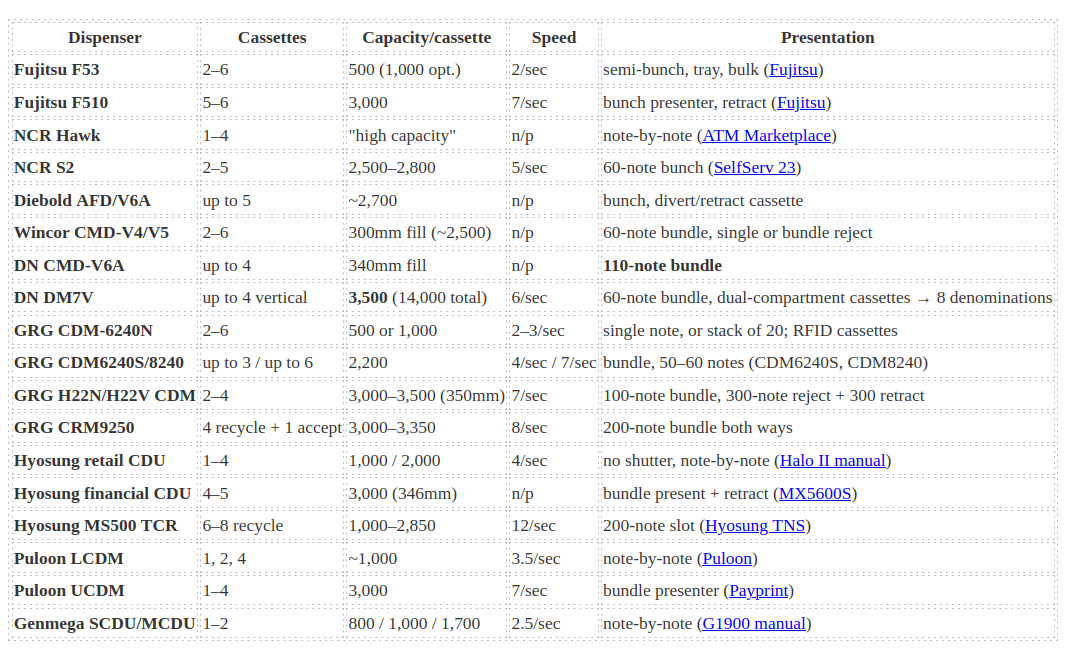
What the additions reveal
GRG’s CDM-6240N is the F53’s actual replacement in kiosks, not any Korean unit. Same job description — 2 notes/sec, friction feed, up to 6 cassettes at 500 or 1,000 notes, 20 notes max per transaction, front or rear service, 13.1kg base plus 4.1kg per added cassette. It’s explicitly sold for ticket vending machines and retail kiosks, and it added RFID-tagged cassettes, which Fujitsu never did on the F53. That’s the single feature that let GRG win cash-in-transit-conscious deployments.
Diebold’s DM7V is the current capacity champion — 14,000 notes across four vertical cassettes, 3,500 each, and dual-compartment cassettes that split into 195mm + 139mm to run eight denominations from four slots. Diebold claims ~40% greater availability over prior generations. At 6 notes/sec it’s slower than the F510’s 7, but nothing else in the table touches the density.
The CMD-V6A’s 110-note bundle is the outlier stat. Everyone else caps around 50–60 notes presented at once; NCR’s S2 does 60, GRG’s H22N does 100, Hyosung’s MX5600 does 50. Diebold doubling that is a legacy of European high-denomination markets where a large withdrawal is genuinely 100+ notes.
GRG quietly matches the Western tier at the top. The CRM9250 recycles at 8 notes/sec with 3,350-note cassettes, and the TCR71-606 does 12 notes/sec across 8 denominations — the same headline number as Hyosung’s MS500. GRG went from unknown to top-three ATM shipper largely on that module, and it’s OEM’d into third-party products in Europe, including a Novomatic changer.
Revised tiers
-
Kiosk/commodity — GRG CDM-6240N, Puloon LCDM, Genmega SCDU/MCDU
-
Retail workhorse — Fujitsu F53, Hyosung retail CDU, GRG CDM6240S, formerly NCR Hawk
-
High-volume dispense — Fujitsu F510, Puloon UCDM, GRG CDM8240/H22N, Hyosung financial CDU, Wincor CMD-V4/V5
-
Bank flagship — DN DM7V, DN CMD-V6A, NCR S2
-
Recycling — GRG CRM9250, Hyosung MS500, Fujitsu GSR50 (a distant third at 3/sec)
Fujitsu’s position looks worse with Diebold and GRG in the frame: it’s the only vendor here with no credible flagship and no competitive recycler. Its survival in self-checkout rests on the F53 being physically smaller than everything above it and on a decade of certified OEM integrations that nobody wants to redo.
We said earlier Fujitsu has “no competitive recycler.” That was wrong, and this round’s search turned up the counter-evidence: Fujitsu’s SRU does 10 notes/sec, 300-note bunches, up to 8 recycling denominations and 15,300 notes total. The 3-notes/sec GSR50 I cited is the retail/branch-teller unit, not the bank-ATM engine. Fujitsu is competitive at the top; it’s just invisible in North America.
The Glory lineage nobody traces
Glory’s OEM dispenser isn’t a Glory design. The D/50 and D/100 are the old NMD-050 / NMD-100 from De La Rue Cash Systems (Netherlands), which became Talaris in 2008 and was bought by Glory in 2012. That means the “De La Rue SDD” that Genmega listed as a drop-in alternative in the G1900 is the same product family Glory sells today. The low-end commodity story and the Glory story are the same story, thirty years apart.
Expanded Final comparison
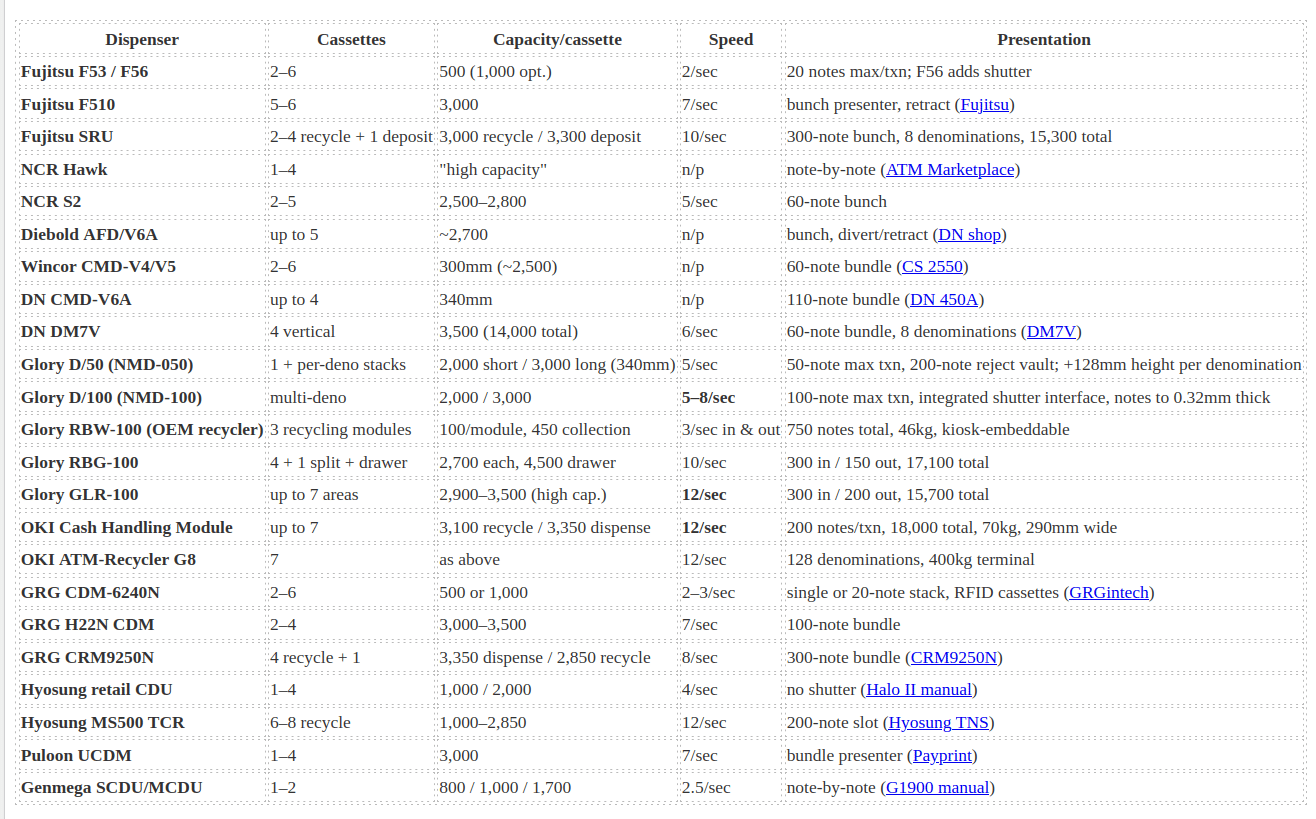
comparison final
What Glory and OKI change
OKI is the density king. 18,000 notes and 12 notes/sec out of a module 290mm wide and 70kg. Compare Glory’s RBG-100 at 17,100 notes but 360kg as a full unit. OKI sells its engine as a component, which is the Fujitsu playbook executed a generation later and far better. If you’re integrating a recycler into a kiosk today, OKI’s module and Glory’s RBW-100 are the two realistic answers at opposite ends of the size range.
Glory’s D/100 handles 0.32mm-thick media — four times the F53’s 0.09–0.3mm window and the widest in the table. That’s the ticket/voucher/card use case the F510 was marketed for, done better.
RBW-100 is the odd one out and worth knowing about. 750 notes total, 46kg, 240×450×680mm, 3 notes/sec both directions, with a “Follow me” LED guidance strip. It’s a recycler sized for a retail POS lane, not a bank. Nothing else in this comparison targets that footprint — the closest analogue is JCM’s drum-based MRX at 2 notes/sec.
Revised tiers
-
Kiosk/commodity dispense — GRG CDM-6240N, Puloon LCDM, Genmega SCDU/MCDU, Fujitsu F53
-
Mid dispense — Glory D/50, Hyosung retail CDU, GRG CDM6240S, NCR Hawk
-
High-volume dispense — Glory D/100, Fujitsu F510, Puloon UCDM, GRG H22N, Wincor CMD-V4/V5, Hyosung financial CDU
-
Bank flagship dispense — DN DM7V, DN CMD-V6A, NCR S2
-
Compact recycling — Glory RBW-100, JCM MRX
-
Full recycling — OKI CHM/G8 (12), Glory GLR-100 (12), Hyosung MS500 (12), Fujitsu SRU (10), Glory RBG-100 (10), GRG CRM9250N (8)
The 12-notes/sec cluster at the top is now four vendors deep and includes two Japanese, one Korean, one Chinese. Fujitsu at 10 is respectable but no longer distinctive — which explains why its remaining defensible business is still the small, boring, endlessly-certified F53.
In self-serve we hear alot about CI devices from Glory. How do the CI class recyclers from Glory position?
They’re a different machine class entirely
The CI series is CASHINFINITY, Glory’s retail cash automation line — and it doesn’t belong in the dispenser comparison at all, which is exactly the interesting part. Everything else in that table is a cassette-fed dispenser optimized for handing out a stack of notes fast. The CI class is optimized for making change — small denominations, both directions, notes and coins, at a checkout lane or in a back office.
The architectural tell is storage. CI devices use roll storage modules (RSM) — notes wound onto tape drums, 50 to 110 notes per module — not stacked cassettes. That’s why the capacities look absurd next to an OKI or Diebold engine.
The CI ladder
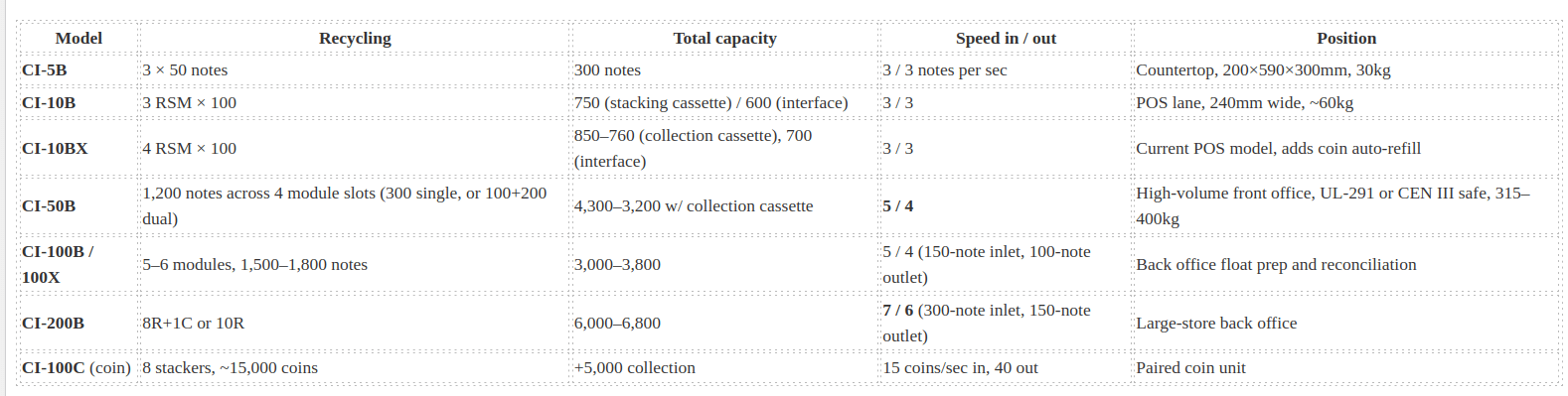
Glory CI
Where they actually sit
Speed is deliberately low and that’s not a weakness. 3 notes/sec on a CI-10X versus 12 on a GLR-100 looks like a two-generation gap, but a POS change transaction is 1–3 notes. Glory quotes a full transaction including change in under 8 seconds. Adding an 8,000-note cassette engine to a checkout lane would be pure cost.
Coin is the moat. Nothing else across this entire comparison — Fujitsu, NCR, Diebold, GRG, Hyosung, OKI, Puloon, Genmega — dispenses coins. The CI coin unit runs 8 configurable stackers at 150–350 coins each and auto-refills from a prepared cassette so the cashier never leaves the lane. That’s a retail problem the ATM vendors have simply never had to solve.
The product is the cassette logistics, not the box. An interface cassette moves cash from the CI-10X at the lane to the CI-100X in the back office without anyone opening a device, and CI-Server gives multi-store real-time visibility. Closed-loop is the pitch. Hardware specs are secondary to shrinkage elimination and CIT-visit reduction.
Direct relevance to your world
The CI-10B’s banknote engine is the RBW-100 — the same OEM recycler we listed last round at 3 notes/sec, 3 recycling modules, 750-note total. So the module Glory sells to self-checkout and kiosk integrators is the CI-10 with the branding removed. If you’re comparing SCO cash modules, the real matchup is:
-
Fujitsu F53 + separate acceptor — dispense only, cheapest, smallest, 6 denominations
-
Glory RBW-100 / CI-10B — true recycling in a 240mm-wide envelope, 4 denominations, coin unit available alongside
-
JCM MRX — drum recycling, 2 notes/sec, up to 8 denominations at 60 notes/drum (JCM)
-
GRG BR-15 / INFFITECH PRM-001 — Chinese drum recyclers at 140–260 notes total (INFFITECH)
Competitive set is also different. The CI series doesn’t fight NCR or Diebold. It fights Cima, Suzohapp/Scan Coin, Volumatic, Gunnebo SafePay, and Azkoyen. Glory’s advantage is that it owns both the retail line and the bank line, so it can sell a grocery chain the lane device, the back-office device, and the branch recycler that receives the deposit. Nobody else in the table spans that.
Glory has also localized aggressively for the US, launching the CI-10X and a US-specific CI-500X back-office unit in 2022 — a market that historically resisted cash automation at the lane and is now the growth story as labor costs push retailers toward it.
Market Analysis
Let’s Start with the warning
Almost every dollar-value “cash handling market” report you’ll find is fabricated. The spread between publishers for the same market and same year is 10x to 40x — bill acceptors quoted anywhere from $522M to $16.24B, cash-handling equipment from $2.3B to $46.9B, vending from $2.1B to $84.7B. Even self-checkout, a market with real shipment tracking, gets quoted at $3.9B to $6.3B for 2025. ATM is the only segment where the aggregators cluster sanely ($22.3B–$38.09B), and that’s because Datos/RBR numbers leaked into their models. So the sizing below is built on unit shipments, installed base, and company filings — not CAGRs.
The single best anchor number
Retail cash automation at the checkout, from the Datos Insights install-base work: roughly 470,000 cash devices at checkouts worldwide at end-2024, more than 80% of them recycling, plus about 650,000 back-office devices. Growth outside Japan was +39% since 2022 for front-of-store and +24% for back-office, and the forecast is 1.6 million combined units within five years (Datos Insights via EuroShop). That’s roughly a 1.12M → 1.6M installed-base move, ~7–8% annual unit growth in a market where the underlying cash transaction count is falling. That inversion is the whole story.
ATMs. 293,400 units shipped in 2025, +1% YoY, with recycler shipments +3% and MEA recyclers +72%. Installed base drifts from 2.9M toward roughly 2.7–2.75M by 2031 at –1%/yr. But if recycler mix goes 60% → 75%+, shipment value grows through 2031 even as unit count is flat. Call the hardware-plus-service ATM market $20–25B today, growing low single digits in nominal terms. The US is the swing factor: only ~5% of US financial institutions use recycling today versus broad adoption in LatAm, Europe and APAC (ABA Banking Journal). That is a large, identifiable, un-penetrated pocket.
Retail cash automation. 1.12M → 1.6M devices by ~2030. At a rough $8–20K blended ASP depending on front-of-store versus back-office, that’s a $2.5–5B annual equipment-and-service business growing at 7–8% units. Fastest-growing cash segment in the industry, and the one where Glory’s 53% teller-cash-automation share and CI-class positioning matters most.
Self-checkout. ~217,000 units shipped in 2023, forecast installed base >1.9M by 2028 (Datos Insights EPOS/SCO). But cash attach rate is the variable, not lane count — APAC SCO is 76% card-only. The 2023–2026 US backlash (Walmart and Dollar General cutting SCO at 9,000 stores combined, Target’s 10-item cap, Long Beach’s staffing ordinance) is a US item-limit recalibration, not a global retreat — NCR Voyix platform sites still grew to 83,000 by mid-2026.
Vending and unattended. This is the segment genuinely losing cash hardware. US vending is 78% cashless in 2025, up from 73% (Cantaloupe), UK paid vending is 95% cashless, and the ECB found vending’s cash share fell from 74% to 55% between 2022 and 2024 — the largest drop of any location category. Cash-in on vending is structurally declining through 2031. Crane NXT’s CPI segment already reflects it: down 3% to $846.6M in FY2025 on vending softness, with flat FY2026 guidance.
Bitcoin ATMs. Write this channel down. 39,586 units in October 2025 → 27,945 by July 2026, with the US losing 10,763 machines in 68 days to state regulatory shutdowns (Bitcoin News). That was a meaningful bill-acceptor and Fujitsu-F53-secondary-market channel and it is largely gone.
The policy floor is now real, not rhetorical
This is what changed since 2023. Cash-acceptance mandates have moved from advocacy to statute:
-
New York State S4153A effective March 2026 — cash required for in-person retail up to $20 bills, $1,000/$1,500 penalties, and unattended/self-service models must provide a cash path in failure scenarios (Holland & Knight)
-
Maryland HB191 effective October 2026; 16 states introduced bills in 2026 sessions
-
Australia — supermarket and fuel retailers must accept cash up to A$500 between 7am–9pm as of January 2026, ACCC penalties from July 2026 (ACCC)
-
China PBOC — national RMB acceptance regulation effective February 2026 explicitly requires unattended and self-service equipment operators to accommodate cash in special circumstances (Sina Finance)
-
EU Legal Tender Regulation — Council negotiating mandate reached December 2025, trilogue-stage
Layer on the resilience argument, which the April 2025 Iberian blackout handed to every central bank that wanted it. Sweden’s Riksbank in March 2026 told citizens to hold SEK 1,000 in cash per adult (Riksbank) — in a country with 5% POS cash usage. Norway legislated an explicit right to pay cash at staffed premises in 2024. The cashless-society policy consensus of 2018–2021 is dead.
Glory is the counterexample worth watching: FY2026 revenue down 7.9% to ¥339.6B with Financial Market down 31.9%, but that’s the Japanese new-banknote special demand rolling off, and management guides to +6% recovery in FY2027.
Bottom line for a 2031 model
Cash in self-service is a value-growing, unit-declining, mix-shifting market at roughly 2–4% nominal CAGR overall, with retail cash automation the 7–8% grower inside it and vending the offsetting decliner. The transaction-share trend is genuinely negative and will stay negative. The hardware trend is not, because policy is putting a floor under acceptance, recycling is raising ASP per endpoint, CIT economics are pushing automation, and cash in circulation keeps setting records. Anyone selling you a 12% CAGR on a $46B cash-handling TAM is selling you a spreadsheet.
Fujitsu Transition Note
Dear Valued Customer,
As we approach the close of Fujitsu Frontech North America’s cash handling hardware business transition to JCM Global, I wanted to personally thank you for the trust, loyalty, and partnership you have shown us over the years.
It has been our privilege to support your business with the F53/F56, F510/F610, and GSR50 product families. We sincerely appreciate the confidence you have placed in Fujitsu and in our team, and we are grateful for the relationships we have built together.
As a reminder, today is the final day to submit purchase orders to Fujitsu.
All customer orders accepted by Fujitsu through July 31, 2026, with scheduled delivery on or before December 31, 2026, will continue to be managed by Fujitsu through completion, including order administration, logistics, invoicing, and customer support.
Beginning August 1, 2026, new orders and orders with delivery dates beyond December 31, 2026 will transition to JCM Global. We have attached a communication from JCM that outlines the ordering process and points of contact going forward.
Although this chapter is coming to a close, our commitment to you remains unchanged. We will continue to support all existing Fujitsu‑managed orders through completion, and we are working closely with JCM to ensure continuity and a smooth transition for your future business.
On behalf of everyone at Fujitsu Frontech North America, thank you for allowing us to be part of your success. We wish you and your organization continued growth and prosperity, and we sincerely hope there will be opportunities for us to work together again in the future.
Thank you once again for your partnership and support.
With sincere appreciation,
Sean


