

Last Updated on August 29, 2026 by Craig Allen Keefner
Europe Wrote Most of One
Conversational AI, voice ordering, multilingual kiosks and the drive-thru lane sit almost entirely outside U.S. accessibility law. They do not sit outside European law. Here is what to specify.
The Industry Group | Summer 2026 | kioskindustry.org
This is the companion to our piece on the shelved Access Board kiosk rule, The ADA Kiosk Rule That Almost Happened. That article assembled an interim technical baseline for self-service transaction machines out of provisions already in force — chiefly 14 CFR 382.57(c), the airport kiosk rule the Access Board itself said it was modeling on.
Lengthy Addendum included covering vending, lockers, EV, Smart City, POS and other self-service verticals.
For US Access Board discussion —
Help Shape the Discussion
What accessibility problem creates the most deployment friction in your organization?
Is it audio privacy? Payment-terminal placement? Screen-reader support? Touchscreen-only workflows? Menu modifiers? Timeouts? Staff-assistance policies?
Send your real-world questions and examples to craig@kioskindustry.org. We will use industry input to help keep the September discussion grounded in what retailers, restaurants, operators, integrators and manufacturers are actually encountering in the field.
Every provision in that baseline assumes a screen and a keypad.
That assumption is now the weakest part of the entire framework, including the framework the Board was drafting. The fastest-growing unattended interfaces in this industry are conversational: AI voice agents in drive-thru lanes, voice ordering at counter kiosks, voice-driven wayfinding on transit and retail displays. ADA §707 was written for ATMs. 14 CFR 382.57 assumes a display, a keypad and a printed output. A voice agent may have none of those, and its accessibility failure mode is not a reach range — it is a recognition error.
This is where our industry is deploying brand-new public interfaces with no standard, no published test method, and no required alternative. It deserves a position of its own.
The one-sentence rule
Voice must never be the only way to complete a transaction.
That is not a new idea and it is not my invention. It is the generalization of rules already binding in U.S. law:
-
Color must not be used as the only means of conveying information, indicating an action, prompting a response, or distinguishing a visual element (14 CFR 382.57(c)(3)(iv))
-
Audible signals or cues must not be the only means of conveying information, indicating an action, or prompting a response (Revised Section 508 Standards §411)
-
Biometrics must not be the sole means of user identification or control unless at least two options using different biological characteristics are provided (14 CFR 382.57(c)(9))
The through-line is that no single sensory or physical channel may be the only path to the transaction. Voice is a channel. The rule already exists in principle; nobody has written it down for voice.
Except that somebody has. EN 301 549 v4.1.0 contains clause 6.4, “Alternatives to voice-based services” (ETSI EN 301 549 V4.1.0). It is a normative European requirement. There is no U.S. counterpart for kiosks.
Recognition accuracy is an accessibility requirement, not a KPI
This is the part most easily missed by teams that treat word error rate as a performance metric to be improved next quarter.
Automatic speech recognition performance for people with speech disabilities remains inadequate, in significant part because of limited public training data. That is the stated premise of the Speech Accessibility Project at the University of Illinois Urbana-Champaign and of the associated challenge run at Interspeech 2025 (Apple Machine Learning Research). Assistive speech technologies like Voiceitt and Google’s Project Relate exist precisely because mainstream ASR does not serve these users.
A system that works for typical speech and fails for dysarthric or stuttered speech is not a system with a tuning problem. It is a system that denies service on the basis of disability. Reframe it that way internally and the engineering priorities change.
Specific failure modes to design against, and to test for:
Endpointing. A silent block mid-word is a characteristic feature of stuttered speech. Voice-activity detection tuned to typical conversational rhythm reads that silence as end-of-turn and cuts the customer off mid-order. Endpoint timeouts must be extendable — and critically, the extension must not require the user to ask for it in speech. This is the existing timed-response rule at 14 CFR 382.57(c)(3)(ii) applied to a conversational turn rather than a screen.
Repair, not restart. After a misrecognition, the system must allow correction of the single misunderstood item without discarding the whole order. Forcing a restart compounds every subsequent recognition failure and is the single most common reason users abandon.
Escalation. A documented, time-bounded path to a human that is triggerable without a successful speech recognition event — a physical button, a screen control, or automatic handoff after a set number of failed turns. If the only way to reach help is to successfully ask for help, there is no escalation path.
Deaf and hard-of-hearing customers. A voice-first interface excludes them completely. There is no accommodation short of a parallel non-voice path. This is not a tuning question and cannot be solved with a better model.
Confirmation. Every voice transaction needs visual confirmation of what the system understood, presented before payment.
For procurement, the practical move is to require vendors to disclose measured recognition performance for atypical speech, tested with actual speakers rather than synthetic augmentation, along with the test population or corpus used. A vendor who cannot answer has not done the work. A vendor who refuses to measure has told you something important.
Multilingual, where accessibility breaks quietly
Multilingual kiosks fail in ways nobody logs, which is why they keep failing.
The U.S. regulatory record here is thin but worth knowing precisely. In developing the Revised Section 508 Standards, the Access Board determined it was unnecessary to address languages other than English, reasoning that business requirements would dictate which languages an interface used. But it stated that where the ICT interface is in a language other than English, the speech output would also be in that language. It changed the required keyboard layout from “QWERTY” to “QWERTY-based” specifically to accommodate settings where English is not the preferred language. And it declined to adopt an EN 301 549 provision concerning spoken language, on the grounds that the provision depended on undefined terms (U.S. Access Board).
Translated into a deployment rule, that is parity: whatever languages the visual interface offers, the speech interface must offer. A kiosk with six languages on screen and English-only speech output has not delivered six languages. It has delivered one accessible language and five inaccessible ones.
Two design traps show up repeatedly in the field:
The language-selection deadlock. If the language menu is visual only, a blind customer cannot reach the language they need in order to hear anything at all. Speech mode activation has to be language-neutral, and it has to precede or accompany language selection. Note that the braille instruction for initiating speech is itself language-specific — so at multi-language sites, tactile activation should be discoverable without reading, for example by initiating speech automatically on headset insertion or handset lift, which is what the ADA §707.5 advisory contemplates (U.S. Access Board).
Silent degradation. Many deployments quietly fall back to English speech output when a non-English text-to-speech voice is missing or fails to load, and never tell the user or the operator. Treat a missing TTS voice as a functional outage: log it, alarm on it, and report it in the same channel as a card reader fault.
Worth specifying alongside this: language must be programmatically determinable in the software layer. EN 301 549 delivers that by applying WCAG to non-web software in clause 11, now aligned to WCAG 2.2 in v4.1.0 (ETSI EN 301 549 V4.1.0). And machine-translated interface strings routinely break screen-reader pronunciation and plain-language quality at the same time. Translation quality is an accessibility dependency, not a marketing one.
The drive-thru, honestly
The industry deserves candor here, because U.S. case law is genuinely unfavorable to plaintiffs and nobody is served by pretending otherwise.
In Szwanek v. Jack in the Box, the Ninth Circuit held that a restaurant’s practice of providing service exclusively at the drive-thru, and refusing to serve pedestrians in the drive-thru line, does not violate the ADA — even where the practice prevents blind people from ordering independently. The reasoning: a facially neutral policy violates the ADA only where it burdens the plaintiff “in a manner different and greater than it burdens others,” and the court found the complaint did not plausibly allege that, given the significant population of non-disabled people without access to a motor vehicle who face the identical barrier. Judge Watford dissented, arguing the policy unduly burdens blind people because their disability prevents them from driving, and that a reasonable modification was required for full and equal enjoyment. A Northern District of Illinois court reached a similar result on similar reasoning — the plaintiff was denied service as a pedestrian, not as a disabled person — and that case went to the Seventh Circuit (Seyfarth, ADA Title III News & Insights).
Deaf customers have litigated drive-thru access too, including a New Jersey suit against Taco Bell (FindLaw) and an earlier action against McDonald’s (ABC News).
But the AI voice agent changes the analysis, and operators should think that through before someone else does it for them.
Every case above turned on policy — a facially neutral service practice, analyzed under the reasonable-modification framework, where the comparison class was other people who cannot drive. An AI ordering system in the lane is not a policy. It is a product: a fixed, unattended electronic interface that conducts a transaction. That is very nearly the exact definition of a covered device in the Board’s own ANPRM, which described fixed or built-in electronic devices designed for unattended operation by customers to conduct a transaction (SSTM ANPRM, 87 FR).
Products get specified, tested and regulated on different terms than policies. And a product is much harder to defend as facially neutral when the interface itself is the barrier. The favorable precedent covers drive-thru policy. It offers considerably less protection for drive-thru equipment, and voice AI converts the former into the latter.
So specify the lane:
-
An order-confirmation display meeting the same visual requirements as any other self-service screen — 3:1 minimum contrast, 3/16 in minimum cap height on an uppercase “I”, sans-serif — verified under real daylight and glare, not bench conditions
-
A non-voice ordering path available in the lane without a successful speech interaction: text or touch input, or mobile order-ahead bound to the lane
-
A physical, tactilely discernible call button reachable from a vehicle that summons a human and functions without speech
-
Documented staff fallback at the window, same menu and same pricing, with no requirement that the customer explain a disability to obtain it
-
Visual and audible confirmation of the final order and total before payment
-
Contactless payment in the lane
Europe already regulates these machines
Here is the fact that should end most internal debates about whether to wait for the Access Board.
The European Union has regulated self-service terminals since June 28, 2025. The European Accessibility Act, Directive (EU) 2019/882, names them explicitly: payment terminals, and self-service terminals dedicated to the provision of covered services including automated teller machines, ticketing machines, check-in machines, and interactive self-service terminals providing information (Axess Lab, quoting the Directive). In practice that reaches bank and independent-deployer ATMs, station and transit ticketing machines, airport check-in kiosks, retail and hospitality payment terminals, and information kiosks tied to a covered service (Accessible.org).
The transitional provisions matter for anyone planning a fleet refresh. Article 32 establishes a transitional period ending June 28, 2030, during which service providers may continue delivering services using products lawfully used before June 28, 2025. Self-service terminals lawfully in use before that date may continue in service until the end of their economically useful life, but no longer than 20 years (Includio, Accessible.org). Anything placed on the market after June 28, 2025 conforms now.
The harmonized technical standard is EN 301 549. Version 3.2.1 has been the in-force edition, referencing WCAG 2.1 Level AA. Version 4.1.0 reached final draft in June 2026, with clauses 9, 10 and 11 updated to align with WCAG 2.2, and Annex ZB mapping the standard’s requirements to the Directive. The standard’s own scope statement names information kiosks and transaction machines outright (ETSI EN 301 549 V4.1.0).
The clauses that matter for our sector, for anyone building a compliance matrix:
-
5.1 — Closed functionality
-
5.3 — Biometrics
-
6.4 — Alternatives to voice-based services
-
8.2 — Hardware products with speech output, including 8.2.1 speech volume
-
8.3 — Stationary ICT, including 8.3.7 reach depth, 8.3.9 forward reach, 8.3.10 side reach, and 8.3.11 free space underneath stationary ICT
-
8.4 — Operable parts
-
8.5 — Tactile indication of speech mode
-
11 — Non-web software, WCAG 2.2 aligned in v4.1.0
Read that list against the interim U.S. baseline in the companion article. The overlap is not coincidence. EN 301 549 clause 5.1 and the Revised 508 closed-functionality provisions descend from the same body of work, and the Board explicitly intended to build the SSTM rule on those 508 provisions. A kiosk engineered to EN 301 549 clauses 5 and 8 plus 14 CFR 382.57(c) satisfies both regimes with one build.
And it is not only Europe
-
Canada. CAN/ASC-EN 301 549:2024 adopts EN 301 549:2021 identically, and it is named as the “ICT Standard” in the Accessible Canada Regulations (SOR/2021-241). Accessibility Standards Canada published CAN-ASC-5.2.1:2026 on Accessible Service Delivery in June 2026 (Accessibility Standards Canada).
-
Ontario. Kiosk accessibility has been required there for over a decade. Section 6 of the Integrated Accessibility Standards Regulation provides that the Government of Ontario, the Legislative Assembly and designated public sector organizations “shall incorporate accessibility features when designing, procuring or acquiring self-service kiosks,” and that large and small organizations “shall have regard to the accessibility for persons with disabilities” when doing so. The definition is broad: a kiosk is “an interactive electronic terminal, including a point-of-sale device, intended for public use that allows users to access one or more services or products or both” (O. Reg. 191/11).
-
United States, software layer. DOJ’s Title II rule requires WCAG 2.1 Level AA for web content and mobile apps. An interim final rule published April 20, 2026 extended compliance to April 26, 2027 for public entities of 50,000 or more and April 26, 2028 for entities under 50,000 and special district governments (ADA.gov). The rule addresses web content and mobile apps and does not mention kiosks either way — but a DMV, transit or permitting kiosk rendering web content raises a question no agency has answered, and the conservative reading is to build kiosk software to WCAG 2.1 AA regardless.
Five tests to add to your acceptance checklist
Our companion article publishes a thirteen-point field acceptance test. Where voice, conversational AI, multiple languages or a drive-thru lane are in play, add these:
-
Voice is not the only path. Complete a full transaction without speaking. If that is impossible, the deployment fails.
-
Atypical speech. Test with at least one speaker with stuttered or dysarthric speech, or a validated recording set. Confirm the system does not cut off a silent block mid-word, and that a single misheard item can be corrected without restarting.
-
Escalation. Reach a human without a successful speech recognition event. Time it.
-
Language parity. For every language offered on screen, confirm speech output exists in that language, and confirm language selection is operable in speech mode before a language has been chosen.
-
Lane confirmation. In a drive-thru, confirm the order-confirmation display meets contrast and character-height requirements under real daylight and glare, and that a tactilely discernible call button is reachable from a vehicle.
The clause to add to your RFP
To sit alongside the base warranty language in the companion article:
Supplier warrants that no transaction can require speech input to complete, that a non-voice path to the same transaction is available at the same location and time, and that any conversational or voice-driven interface provides a documented, time-bounded escalation to a human that is triggerable without a successful speech recognition event. Supplier shall disclose measured speech recognition performance for atypical speech, including stuttered and dysarthric speech, and the test population or corpus used. Where the interface offers more than one language, Supplier warrants that speech output is provided in every language offered visually, that language selection is operable in speech mode, and that fallback to a different language for speech output is logged and reported as a fault. Supplier shall additionally deliver a conformance statement against ETSI EN 301 549 clauses 5, 6.4, 8 and 11.
TIG Intel Insight: Voice, AI and the Global Baseline
Author: Craig Allen Keefner
Extract: Every manufacturer shipping self-service terminals into Europe is already building to EN 301 549, which since June 2025 has required an alternative to voice-based services — so the U.S. industry is not waiting for a standard, it is declining to apply one it already builds to.
Field basis: I track the Access Board SSTM docket, publish the accessibility coverage at kioskindustry.org, and follow the EAA and EN 301 549 revision cycle because our readership sells into both markets.
Commentary: Two things in this piece deserve more attention than they get. The first is that recognition accuracy is an accessibility requirement rather than a performance metric, and the industry has not internalized that at all — a drive-thru voice agent whose endpointing cuts off a customer who stutters is not a model that needs more training data, it is a machine refusing service. The second is jurisdictional arbitrage, and it is uncomfortable. The design work for accessible terminals is already done. The bill of materials exists. The software has been through conformance testing for the European market. Shipping that same build into North America is close to free at the margin, and the sentence “there is no U.S. kiosk standard, so we are waiting” is therefore a procurement position rather than an engineering constraint. My prediction is that this ends badly for someone in the drive-thru, not the lobby, and not through rulemaking. Voice AI turns a service policy into a product, and products do not get the benefit of the facially-neutral-policy defense that has protected drive-thru operators so far.
Topics: conversational AI accessibility, drive-thru voice AI, automatic speech recognition, atypical speech, dysarthric speech, stuttering, multilingual kiosks, text-to-speech, European Accessibility Act, Directive (EU) 2019/882, EN 301 549, clause 6.4 alternatives to voice-based services, WCAG 2.2, CAN/ASC-EN 301 549, AODA O. Reg. 191/11, Szwanek v. Jack in the Box, U.S. Access Board, self-service transaction machines, 14 CFR 382.57, unattended retail
Sources
-
ETSI EN 301 549 V4.1.0 (2026-06), Accessibility requirements for ICT products and services — https://cdn.standards.iteh.ai/samples/etsi/etsi-en-301-549-v4-1-0-2026-06-/edf877c1591e45f3924a750b783a872b/etsi-en-301-549-v4-1-0-2026-06-.pdf
-
European Accessibility Act, Directive (EU) 2019/882, self-service terminal scope — https://accessible.org/eaa-self-service-terminals/
-
Directive (EU) 2019/882, Article 32 transitional provisions — https://www.includio.com/blog-post/european-accessibility-act-media
-
Directive (EU) 2019/882, ICT scope discussion — https://axesslab.com/ict-a11y-eu/
-
Accessible Canada Regulations, SOR/2021-241, naming CAN/ASC-EN 301 549 as the ICT Standard — https://laws-lois.justice.gc.ca/PDF/SOR-2021-241.pdf
-
Accessibility Standards Canada, CAN-ASC-5.2.1:2026 Accessible Service Delivery — https://accessible.canada.ca/standards-and-technical-guides/standards-and-technical-guides-database/can-asc-5212026-accessible-service-delivery
-
Ontario Regulation 191/11, Integrated Accessibility Standards, s. 6 (self-service kiosks) — https://www.ontario.ca/laws/regulation/110191
-
ADA.gov, Fact Sheet: Rule on the Accessibility of Web Content and Mobile Apps, compliance dates as extended April 20, 2026 — https://www.ada.gov/resources/2024-03-08-web-rule/
-
Seyfarth Shaw, Ninth Circuit Says Restaurant Does Not Discriminate Against the Blind by Providing Only Drive-Through Service — https://www.adatitleiii.com/2021/11/ninth-circuit-says-restaurant-does-not-discriminate-against-the-blind-by-providing-only-drive-through-service/
-
FindLaw, Taco Bell Sued for Drive-Through Discrimination — https://www.findlaw.com/legalblogs/consumer-protection/taco-bell-sued-for-drive-through-discrimination/
-
ABC News, deaf customer drive-through suit against McDonald’s — https://abcnews.go.com/TheLaw/story?id=5392628&page=1
-
Apple Machine Learning Research, Speech Accessibility Project Challenge at Interspeech 2025 — https://machinelearning.apple.com/research/accessibility-project-challenge
-
U.S. Access Board, Revised 508 Standards and 255 Guidelines — https://www.access-board.gov/ict/
-
U.S. Access Board, ADA Accessibility Standards — https://www.access-board.gov/ada/
-
14 CFR 382.57, Accessibility requirements for automated airport kiosks — https://www.law.cornell.edu/cfr/text/14/382.57
-
SSTM Advance Notice of Proposed Rulemaking, 87 FR, September 21, 2022 — https://www.govinfo.gov/content/pkg/FR-2022-09-21/pdf/2022-20470.pdf
This article is industry commentary, not legal advice, and is not guidance from the U.S. Access Board or any federal agency. Requirements cited are existing law; recommendations are labeled as such.
Addendum A — Adjacent device classes: vending, automated retail, lockers, smart city, digital signage, EV charging
The body of this document addresses fixed and built-in self-service transaction machines: self-checkout, point of sale, check-in, ordering, ticketing. That was the scope of the Board’s shelved rulemaking. It is not the scope of the problem.
Six adjacent classes present the same accessibility failure through the same touchscreen, and every one of them is regulated less than most operators assume. This addendum sets out what actually binds each class today and what to specify in the absence of a standard.
A.1 One sentence does most of the damage
The advisory to ADA Standards §707 reads: “Interactive transaction machines (ITMs), other than ATMs, are not covered by Section 707.” The advisory then redirects covered entities to DOJ’s ADA regulations and, for federally procured machines, to Section 508 (U.S. Access Board, Advisory 707).
That sentence is load-bearing for five of the six classes below. §707 is the only place in the ADA Standards that requires speech output, braille, tactile keys, or transaction privacy. Take non-ATM machines out of §707 and what remains is §§305, 308 and 309 — clear floor space, reach ranges, and operable parts at 5 lbf with one hand (U.S. Access Board). Those are dimensional rules. None of them require that a blind customer be able to use the machine.
The practical consequence is that most of these device classes can be fully ADA-compliant and completely unusable without sight.
A.2 Quick reference
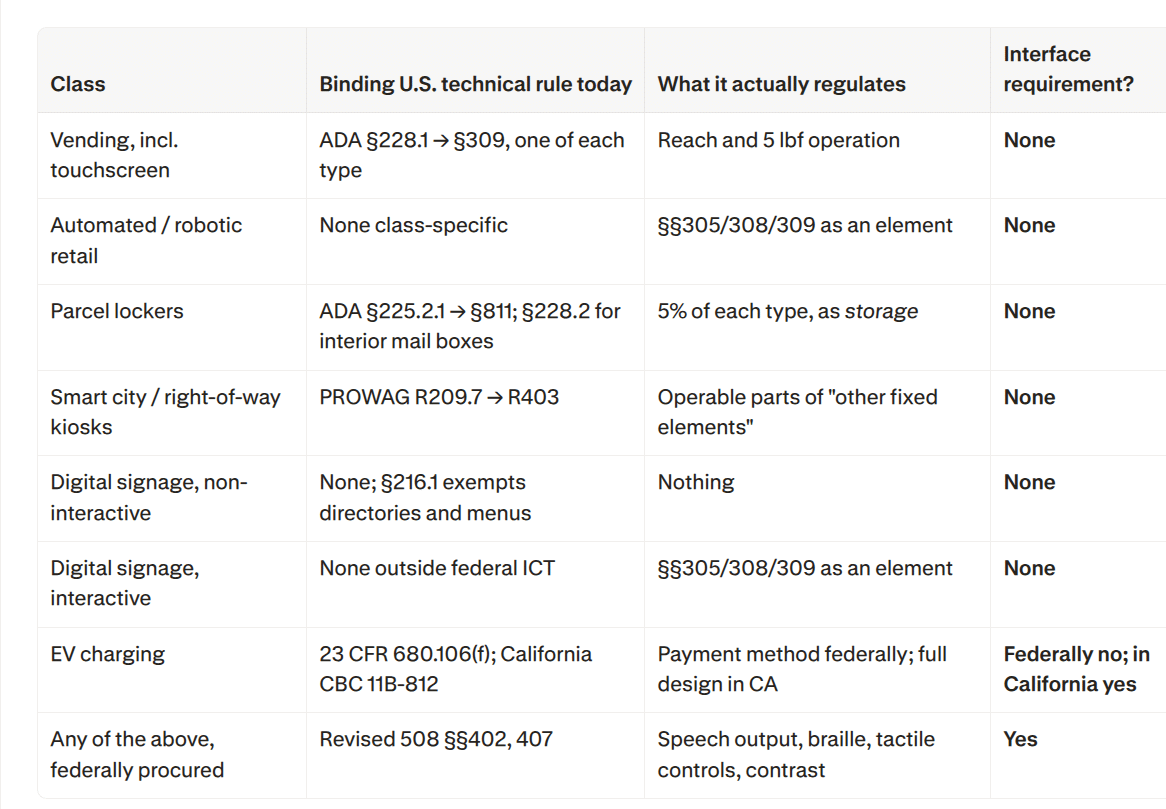
Read the bottom two rows together and the picture becomes absurd. The same machine, built by the same manufacturer, carries a full speech-output and braille obligation if a federal agency buys it, a full design obligation if the EV charger is installed in California, and none at all in a private retail store in most of the country.
A.3 Vending machines, including touchscreen and video-display units
Federal law regulates the reach of a vending machine, not its interface. ADA Standards §228.1 requires that “where provided, at least one of each type of depository, vending machine, change machine, and fuel dispenser shall comply with 309,” with an exception for drive-up-only depositories (U.S. Access Board, §228.1).
The machine is treated as equipment within a facility rather than as a place of public accommodation in its own right. In Magee v. Coca-Cola Refreshments USA, the Fifth Circuit held that glass-front vending machines “are not themselves ‘places of public accommodation’ under Title III,” while noting they may still be subject to ADA requirements by virtue of being located in a hospital or bus station (Justia). DOJ’s amicus brief agreed, and confirmed that “the public accommodation in which a vending machine is located bears responsibility for ensuring the machine’s accessibility” (U.S. Department of Justice).
Operators should read that as a liability assignment. The host site, not the machine owner, carries the exposure.
The Board saw the touchscreen problem clearly. The SSTM ANPRM observed that “many vending machines are now essentially SSTMs, offering a wide-array of choices via a video display, and utilizing touch-screen input to navigate those choices” (SSTM ANPRM, 87 FR). That is the rulemaking now on inactive status.
Enforcement has come from an unexpected direction. In May 2021 the New York State Division of Human Rights settled three Division-initiated complaints requiring Redbox and Coinstar to “install a non-visual user interface on at least one kiosk per location in New York State,” ecoATM to provide its non-visual Concierge Service on at least one kiosk per location, and all three to add “customer service numbers in the form of a Braille and large-print sticker on all kiosks,” complete by August 31, 2021, with three years of monitoring and $85,000 in total civil fines (New York State Division of Human Rights).
Recommendation. Treat any vending machine with a display screen and menu navigation as an SSTM and apply the Section 3 baseline. Note also that “micro markets” appear nowhere in the ANPRM (SSTM ANPRM); the closest covered concept is self-checkout, which is exactly what a micro market checkout station is. Specify it as one.
A.4 Automated and robotic retail
No class-specific federal technical standard exists. The generic element rules apply where there are operable parts, and §228.1’s one-of-each-type rule catches vending and change machines (U.S. Access Board).
This class is where the legal standard is genuinely contested, and the industry should understand both poles.
The defense pole. In NFB v. Walmart Associates, decided October 12, 2021 in the District of Maryland, the court held Walmart need not make self-checkout independently accessible because trained staff assistance satisfies effective communication — “staff assistance is sufficient to provide effective communication in a retail transaction” — reasoning that “the only inherently private action involved in self-checkout is the entry of a consumer’s financial information,” which the tactile PIN pad addressed (Lainey Feingold).
The independence pole. In an April 2024 structured negotiation, CVS agreed that inaccessible MinuteClinic check-in kiosks “will be phased out over an 18-month period” and that replacement technology will “afford blind individuals an opportunity to acquire the same information, engage in the same interactions, and enjoy the same services as a sighted individual in an equally effective, equally private and independent, and equally integrated manner, with substantially equivalent ease of use” (Lainey Feingold).
Earlier, the Jahoda, Nguyen & NFB v. Redbox Automated Retail class settlement required kiosks across all states except California to be modified with “a standard headphone jack; a tactile keypad; and text-to-speech output that reads texts and commands aloud,” with density rules, a modification window running to October 30, 2020, and NFB monitoring with quarterly reporting (American Council of the Blind, settlement notice).
The gap worth naming publicly: identical hardware is judged by opposite standards depending on who is enforcing. A litigated Title III claim may be answered with a staff member. A structured negotiation with a national disability organization will not be. And the second is where the reputational and contractual risk actually lives.
Recommendation. Design to the independence standard, not the litigation floor. Staff assistance is a legitimate backstop and an illegitimate substitute.
A.5 Automated parcel lockers
Lockers are regulated as storage, which is the whole problem.
-
§225.2.1: “Where lockers are provided, at least 5 percent, but no fewer than one of each type, shall comply with 811”
-
§811: clear floor space per §305, height within a §308 reach range, operable parts per §309
-
§228.2: where mail boxes are provided in an interior location, at least 5 percent, but no fewer than one, of each type shall comply with §309
All three from the ADA Accessibility Standards. None of them reaches the controlling touchscreen. A locker bank can satisfy every one of these provisions with a screen a blind customer cannot operate.
The ANPRM mentioned lockers only in passing, as an example of “pairing online ordering with pickup from an automated electronic locker at a local retail location” — the phrases “parcel locker” and “package locker” do not appear, and lockers were not the subject of any of the nine questions (SSTM ANPRM).
Current best practice exists only as a voluntary commitment. Amazon’s talking-locker feature, developed with the National Federation of the Blind, provides “a tactile keypad with Braille” and “a headphone jack” for audio instructions so customers can “independently pick up and return packages,” plus a “lower locker preference” selectable at online checkout and larger higher-contrast on-screen text, with rollout reported at “100% of Amazon Lockers across the US” and expansion to the EU and Hub by Amazon (National Federation of the Blind).
Recommendation. Specify the Amazon feature set as the floor: tactile keypad with braille, headphone jack with speech output covering all screen content, and a reachable-tier assignment mechanism. Add one requirement that voluntary practice does not cover — the compartment assignment itself must be accessible. A speech-enabled screen that assigns a package to a compartment at 70 inches has not delivered access. Reach compliance has to bind at assignment time, dynamically, not just as a static count of low compartments.
A.6 Smart city and public right-of-way kiosks
PROWAG is the one federal rule written specifically for the pedestrian right of way, and it does not cover interactive kiosks.
In PROWAG’s scoping chapter, street furniture at R209 is enumerated as drinking fountains, public street toilets, tables, sales or service counters, and benches, closing with R209.7: “Operable parts of other fixed elements to be used by pedestrians shall comply with R403.” The only electronic machine named anywhere is R210.2 Fare Vending Machines: “Where provided at transit stops and transit shelters, fare vending machines shall comply with R403 and section 707 of Appendix D to 36 CFR part 1191 (ADA & ABA Accessibility Guidelines), except for 707.2 and 707.3.” There is no provision mentioning kiosks, information kiosks, or electronic devices (U.S. Access Board, PROWAG scoping).
So PROWAG regulates benches by name and interactive city kiosks not at all. A sidewalk kiosk is at most an “other fixed element” whose operable parts must meet a reach and force requirement.
PROWAG’s final rule published August 8, 2023 (U.S. Access Board), and adoption has been partial: GSA adopted it via the Federal Management Regulation on July 3, 2024, and DOT issued a final rule adopting PROWAG for new construction and alterations of transit stops in the public right of way on December 18, 2024 (U.S. Access Board, About PROWAG). No DOJ adoption and no general FHWA-wide adoption is listed.
Two other hooks are worth knowing. DOJ’s Title II web rule adopts WCAG 2.1 Level AA for “web content and mobile apps” of state and local governments, with compliance dates of April 26, 2027 for populations of 50,000 or more and April 26, 2028 for smaller entities and special districts — physical kiosks are not among the covered categories (ADA.gov). And for transit, 49 CFR 37.167(f) requires an entity to “make available to individuals with disabilities adequate information concerning transportation services,” including “making adequate communications capacity available, through accessible formats and technology” (Cornell LII) — outcome-based, not a device standard.
The real technical requirements in this class have come from litigation and from city contracts.
The LinkNYC settlement is the most detailed accessibility specification any city kiosk program has ever accepted, and it is worth reading in full. National Federation of the Blind, Jacobsen, Carrico and Erkan v. City of New York, NYC DoITT, Roest and CityBridge LLC, S.D.N.Y. No. 1:16-cv-06018 (PKC), was filed with the court January 25, 2017 with the court retaining enforcement jurisdiction. It defines “accessible” so that blind individuals can “privately and independently acquire the same information” and “enjoy the same services as non-blind individuals” “with substantially equivalent ease of use.” Permitted design standards include Section 508, WCAG 2.0 A and AA, and WCAG 2.1 if it became effective during the term. Accessibility bugs must be fixed with “the same level of priority… the same speed… and the same devotion of resources” as equivalent non-disability bugs. Phase 1 commitments within six months included screen magnification and zoom, home- and app-screen colors meeting WCAG 2.0 SC 1.4.3 contrast, color inversion, TalkBack gesture navigation across all screen elements outside the navigation bar without explore-by-touch, a support-call shortcut such as long-pressing the zero key, an extended TalkBack timeout, a large-print idle-screen notice, and a spoken message audible without headphones explaining how to activate TalkBack if the user has taken no action within seven seconds (NFB–CityBridge settlement agreement).
A note on attribution, since this case is frequently misreported: the LinkNYC accessibility action was brought by the National Federation of the Blind. The American Council of the Blind of New York’s litigation against the City concerned accessible pedestrian signals, not kiosks (Disability Rights Advocates).
City permit conditions can also be enforceable in contract. San Diego’s ten-year digital wayfinding agreement with IKE Smart City requires that all kiosks be designed ADA-compliant, include “a call button connecting to a live person” and “a keypad with corresponding audio to provide manual navigation for the full menu of kiosk information available to users of the touchscreen,” and that IKE obtain third-party design-phase certification against the ADA, the Revised Section 508 Standards, WCAG 2.1 Level AA and California accessibility regulations, plus post-installation certification by a Certified Access Specialist (City of San Diego, Planning Commission report PC-23-017).
Recommendation for city CIOs and smart-city planners. Do not rely on PROWAG. Write the LinkNYC definition of “accessible” and the San Diego certification conditions into the franchise agreement or concession contract. Both are field-tested, both are drafted, and a contract term is enforceable on a schedule a rulemaking is not. The seven-second unprompted spoken message is a particularly cheap, high-value requirement that almost no deployment includes.
A.7 Digital signage
Split the class in two, because the legal position is completely different on each side.
Non-interactive display networks are essentially unregulated. §703 governs signs, but §216.1’s exceptions remove “building directories, menus, seat and row designations in assembly areas, occupant names, building addresses, and company names and logos” from signage scoping, along with temporary signs displayed seven days or less (U.S. Access Board, §216.1). A digital menu board and a digital building directory are both outside signage scoping.
Interactive touchscreen directories are not covered by §707 (Advisory 707), leaving only the §§305/308/309 element rules.
The only place U.S. law states a technical rule for electronic signage is Section 508 — and it reaches federal ICT only. §402.5: “Characters on variable message signs shall conform to section 703.7 Variable Message Signs of ICC A117.1-2009.” Exception 1 to §402.2 relieves conforming variable message signs from being speech-output enabled; Exception 2 relieves display screens that only provide status indicators. Interactive federal signage with a display screen must be speech-output enabled per §402.2, with braille speech-mode instructions at §402.2.5, non-private volume to at least 65 dB at §402.3.2, sans-serif characters at 3/16 in minimum with light-on-dark or dark-on-light contrast at §402.4, tactilely discernible input controls at §407.3.1, and 5 lbf one-handed operation at §407.6 (Section508.gov).
That §402.5 cross-reference is the single most useful and least used citation in commercial display work. It gives a specification for character height, stroke width, contrast and case on a variable message sign, published in a consensus standard, already adopted into federal regulation.
For transit, 49 CFR 37.167(b) requires stop announcements “sufficient to permit individuals with visual impairments or other disabilities to be oriented to their location” (Cornell LII) — the audible counterpart to a visual next-stop display.
Europe draws the line in the same place but says so explicitly. Under the EAA, for covered transport services, Article 2(2)(c) reaches “delivery of transport service information, including real-time travel information; this shall, with regard to information screens, be limited to interactive screens located within the territory of the Union,” so non-interactive information screens are expressly outside the service obligation (Directive (EU) 2019/882). Ontario reaches the same result by definition: s. 6(5) requires an “interactive electronic terminal,” so a passive display is not a kiosk (O. Reg. 191/11).
Recommendation. For interactive signage and directories, apply the full Section 3 baseline — it is an SSTM with a different name. For non-interactive networks, specify §402.5 and the ICC A117.1 §703.7 character requirements as the house standard regardless of whether federal procurement is involved, caption all audio content, and never convey emergency or wayfinding information visually alone. The absence of a legal requirement here is a gap, not a permission.
A.8 EV charging stations
This class is the exception, and the most instructive one, because it shows what interim guidance looks like when an agency actually publishes it.
The Access Board published a technical assistance document. Design Recommendations for Accessible Electric Vehicle Charging Stations, produced in partnership with DOT, published July 2022 and last updated July 17, 2023 (U.S. Access Board, announcement, PDF). It carefully labels “must” and “required” as existing law and “should” and “recommends” as non-binding. Its substance, all from that document:
-
Clear floor space per §305, 30 in × 48 in minimum; firm, stable, slip-resistant; no changes in level; slope no steeper than 1:48; free of grass, curbs, wheel stops and bollards; recommended positioned for a parallel approach and centered on the operable part
-
Reach: unobstructed side reach no higher than 48 in and no farther than 10 in away. The fuel-dispenser 54-inch exception “should not be used”
-
Operable parts include connectors, card readers, electronic user interfaces, switches, buttons and emergency stop; 5 lbf maximum, one hand, no tight grasping, pinching or twisting — connectors included
-
Screen: visible from a point 40 in above the clear floor space; no flashing above 3 Hz; sans-serif characters with adjustable size or 3/16 in minimum; speech output for all on-screen information including transaction verification, pausable and repeatable; braille instructions to initiate speech mode; volume control; tactilely discernible high-contrast controls; QWERTY and standard numeric layout; key-repeat delay of at least 2 seconds; timed-response alerts with extension; no audio-only or color-only information; charging status discernible by sound or touch
-
Connectors: release button and handle below 48 in; straps and loops recommended; automatic connection devices encouraged at fleet sites
-
Cables: heavier DCFC cables should reach a vehicle at least 60 in away; cables must not obstruct accessible routes; overhead systems must not become protruding objects
-
Route: accessible route required per §206.2.2 and §402; at least 98 in vertical clearance along the vehicular route
-
Space and aisle: charging space recommended at 132 in (11 ft) wide × 240 in (20 ft) long, access aisle at least 60 in wide for the full length; the §502.2 shared-aisle exception “should not be used”
Read that list against Section 3 of this document. It is the same specification. The Board applied the ATM and fare-machine logic to a charger and published it as recommendations without a rule. That is precisely the deliverable the kiosk sector has been asking for, and it establishes the precedent that the Board is willing to publish one.
Binding federal text is thinner but real. 23 CFR 680.106(f)(1) requires charging stations to “provide for secure payment methods, accessible to persons with disabilities, which at a minimum shall include a contactless payment method that accepts major debit and credit cards, and either an automated toll-free phone number or a short message/messaging system (SMS) that provides the EV charging customer with the option to initiate a charging session and submit payment.” §680.106(f)(4) requires operators to “provide access for users that are limited English proficient and accessibility for people with disabilities.” §680.106(k) requires operators to “enable access to accessible platforms that provide multilingual services.” §680.118(c) confirms the ADA applies and that stations “must comply with applicable accessibility standards adopted by the Department of Transportation into its ADA regulations (49 CFR part 37) in 2006, and adopted by the Department of Justice into its ADA regulations (28 CFR parts 35 and 36) in 2010” (23 CFR part 680, govinfo).
Note what §680.106 does that no kiosk rule does: it pairs a contactless payment mandate with a multilingual access mandate in the same provision. That is the answer to ANPRM Question 9, already written into federal regulation for an adjacent device class.
Also note the ABA hook, which is frequently missed: the Architectural Barriers Act “applies to certain non-government facilities constructed with federal funds, such as funds made available under the National Electric Vehicle Infrastructure Program” (U.S. Access Board). NEVI money brings ABA obligations onto private sites.
The rulemaking got further than the kiosk rule did, then stopped in the same place. An EV charging NPRM published September 3, 2024, docket ATBCB-2024-0001, proposing specifications for the charger itself including physical and communication access, the charging space, access aisles and accessible routes, with comments due November 4, 2024 (U.S. Access Board). It is now on inactive status under Executive Order 14192 (FY 2025 PAR).
California is the only enforceable technical code in the United States. California Building Code Chapter 11B, Section 11B-812, effective January 1, 2023 with July 1, 2024 amendments (2022 CBC 11B-812, via Corada). Selected provisions:
- 11B-812.3 Access aisle at the same level as the vehicle space; no changes in level; no slopes exceeding 1:48; no detectable warnings
- 11B-812.4 Vertical clearance 98 in minimum for spaces, aisles and vehicular routes
- 11B-812.5.2 Accessible route per 11B-402 between the vehicle space and the charger that serves it
- 11B-812.5.5 Charging stations designed so accessible routes are not obstructed by cables or other elements
- 11B-812.6 Vehicle spaces 216 in long minimum; widths — van accessible 144 in, standard accessible 108 in, ambulatory 120 in, drive-up 204 in
- 11B-812.7 Access aisles 60 in wide minimum for the full length; the blue color used for accessible parking aisles shall not be used
- 11B-812.9 Surface marking “EV CHARGING ONLY” in letters 12 in high minimum
- 11B-812.10.2 Operable parts and charging cord storage per 11B-309
- 11B-812.10.3 Point-of-sale devices shall comply with 11B-707.2, 11B-707.3, 11B-707.7.2 and 11B-707.9
11B-812.10.3 is the single most important line in this addendum. California pulls the ATM and fare-machine provisions — clear floor space, tactilely differentiable operable parts, speech output, braille instructions — directly onto the charger’s payment terminal. Federal law does not. California has already done, in a building code, exactly what this document recommends doing voluntarily for kiosks: applied §707 by analogy to a machine §707 does not name.
California’s Division of the State Architect confirms the obligation applies broadly: charging stations “installed at public buildings, public accommodations, commercial facilities and public housing are required to comply with the accessibility requirements in CBC Chapter 11B” (California DSA).
Internationally, EV charging is moving faster than the U.S. A dedicated draft standard, prEN 18324, “Accessibility requirements and recommendations for charging stations for electric road vehicles,” is in development by CEN/CENELEC covering operable-element heights, cable assembly and management, digital user interfaces, payment accessibility, and signage and wayfinding, associated with the AFIR regulation (CEN prEN 18324). And the European Commission’s Sustainable Transport Forum published Guidelines on accessibility of electric recharging infrastructure in the EU in July 2025, recommending that displays, payment terminals, connector handles and grip holsters be treated as operable parts positioned generally 750–1,300 mm above ground, with connector grip diameter of 19–43 mm, maximum connection force of 15 N, force to lift a 4 m suspended cable not exceeding 60 N, and cable length not exceeding 7.5 m (European Commission / Sustainable Transport Forum).
Under the EAA itself, the charger is not in the Article 2(1)(b) product list; only its payment terminal is captured, since a payment terminal is “a device the main purpose of which is to allow payments to be made by using payment instruments… at a physical point of sale but not in a virtual environment” (Directive (EU) 2019/882).
Recommendation. Specify the Access Board’s July 2022 recommendations as contract requirements nationally, plus CBC 11B-812 dimensions and 11B-812.10.3’s cross-reference to the ATM provisions, plus 23 CFR 680.106(f)’s contactless-and-multilingual pairing. That package is entirely assembled from published documents and it is better than what any single U.S. jurisdiction requires.
A.9 Cross-cutting recommendations
-
Apply one interface baseline across all classes. The distinctions between a self-checkout, a touchscreen vending machine, a locker terminal, a city kiosk and a charger are commercial, not technical. A user who cannot see the screen faces the identical barrier at all five. Maintaining different accessibility specifications per product line costs more than maintaining one.
-
Design to the independence standard. NFB v. Walmart is the floor a litigant may reach; the CVS agreement is the standard a national disability organization will demand. Build to the second.
-
Use contract terms where regulation is absent. The enforceable technical requirements in the smart-city class came from a settlement and a city franchise agreement, not from PROWAG. Procurement language works on a schedule rulemaking does not.
-
Watch the assignment logic, not just the hardware. For lockers and multi-bay installations, reach compliance must bind at the moment of dynamic assignment. A compliant count of low compartments is meaningless if the system assigns the top row.
-
Cite §402.5 for every display. ICC A117.1 §703.7 variable message sign characters, incorporated by the Revised 508 Standards, is the only published U.S. technical rule for electronic sign legibility. Use it as the house standard everywhere.
-
Do not read regulatory absence as permission. Five of these six classes have no interface requirement at all. All six have Title III auxiliary aids exposure under 28 CFR 36.303, which lists “accessible electronic and information technology” and “acquisition or modification of equipment or devices” among the required auxiliary aids (Cornell LII).
A.10 Suggested positions on ANPRM Questions 2 and 3, revised
Question 2 asked whether other types of electronic devices providing unattended interaction should be addressed. Based on this addendum, the industry position should name them specifically:
Question 3 asked which devices should not be covered. The answer should stay narrow: devices whose entire function is available through an equally usable accessible alternative at the same location and time, and portable or handheld devices the customer supplies. Do not accept an exclusion based on form factor, sector, or transaction value. Every exclusion of that kind fragments the standard and imports a boundary dispute that the field will resolve badly.
About the Editor
Craig Allen Keefner is editor of kioskindustry.org and manages The Industry Group’s network of self-service, kiosk, digital signage and unattended retail publications. He has tracked ADA and Section 508 accessibility rulemaking for the self-service sector for over two decades. Connect on LinkedIn.


