Last Updated on March 28, 2026 by Elliot Maras
Photo provided by the National Retail Federation.
NRF Big Show 2026 Report
One would be guilty of hyperbole to say that the NRF Big Show in New York City has become the largest self-service technology show in the world. But a veteran attendee can certainly say the number of unattended service exhibits has surged every year, driven by advances in AI and robotics, not to mention the retail industry’s push to better serve time-pressed customers.
Every aisle on the trade show floor at the Javits Center last week featured unattended displays showcasing AI powered merchandise offerings, digital marketing, virtual avatars, robotic delivery and electronic payment.
Echoing the previous week’s CES show in Las Vegas, the NRF Big Show unveiled a retail universe built on more personalized connection, more intuitive equipment design and better guided shopping journeys. Exhibits featured AI engines honing discovery, content directing purchases and data analyzing customer behavior.
KioskIndustry.org walked the trade show floor with an eye on self service applications. Here are our top 10 takeaways, followed by exhibitor highlights listed in alphabetical order.
Top 10 takeaways:
- AI has found real world application for most if not all retail tasks, engineering a commanding presence for self service equipment, where it supports robotics in addition to product selection, payment and loyalty rewards.
- Personalization of the customer experience has become the overriding factor for all types of retail, for self service as much as other retail channels. The customer expects the same level of personal engagement in self service as from social media, e-commerce, mobile shopping and in-store shopping. Virtual experience at the point of engagement has supplanted the old paradigm of weighing convenience against personal attention.
- As technology evolves, sales platforms must invest in innovation to win in today’s sensory intensive marketplace. AI, robotics, voice interaction and virtual assistants improve the customer experience, including self service platforms.
- As omnichannel technology advances, sales platforms must increase investment in human resources. As retail venues deploy more advanced technology, they need employees capable of managing the technology and assisting customers when needed. Technology eliminates certain jobs, mostly low skilled jobs, but it creates the need for higher skilled, tech savvy employees. Such jobs require more educated and better trained employees.
- All retail touchpoints, including self service equipment, must integrate more deeply with inventory management. Access to accurate real-time inventory is integral to a successful customer journey. Inventory availability marks a major trust factor in retail customer experiences, not just a logistics factor. It delivers speed of service, lessens the need for staff intervention and reduces the likelihood of customer abandonment.
- Voice recognition and interaction will continue to expand in self service due to the speed of service, the level of personalization and the ability to better serve blind and low vision customers. Like inventory availability, voice interaction boosts speed of service, lessens staff intervention and reduces customer abandonment. During the show, HiStone introduced its portfolio of AI driven checkout and recognition solutions, including Code Factory’s Voicetopping speech recognition tool. The technology can integrate with existing kiosk software.
- Edge AI will become prevalent in self service equipment, as well as other retail platforms, as it does not require a constant Internet connection and supports faster data processing. It leverages the combination of edge computing and AI to perform machine learning tasks directly on interconnected edge devices. During the show, MediaTek introduced its Genio platform for edge AI applications in retail and hospitality. This includes support for vision AI and on-device generative AI; dual-display support and remote management for desktop POS; 4K resolution; and a smart kiosk with self-checkout capabilities.
- Agentic AI will expand in self service applications. The technology achieves objectives by planning and executing sequences of actions, often tapping other software and APIs. Where generative AI is reactive, responding to user inputs, agentic AI is proactive. During the show, Google CEO Sundar Pichai announced Gemini Enterprise for Customer Experience, an agentic AI solution designed to bring shopping and customer service operations under a single interface. Agentic AI has particular importance for self service equipment, because it will allow it to be proactive rather than reactive.
- Neural processing units (NPUs), an architecture that simulates the human brain’s neural network, allows high bandwidth AI in real time, including recognizing voice commands and creating visual content with the click of a button, taking less power than a CPU or GPU, freeing up the CPU and GPU for lower bandwidth tasks. During the show, BrightSign demonstrated media players equipped with integrated NPUs that run AI applications without compromising video or audio quality. The applications provide real-time insights and deliver instant personalization. Users can also blend AI insights with video or graphics for enhanced customer engagement. NPUs will work in conjunction with edge AI in making self service equipment AI native as opposed to AI assisted.
- 3D printing, still young, will expand in retail and has a natural fit for self service, as it delivers personalization at scale. New technologies such as edge AI (on-device processing) and agentic workflows (selection-production-fulfillment) will create opportunities for 3D printing. During the show, the Sweet Robo exhibit demonstrated this personalization at scale: a vending machine stocked with a selection of phone case styles allows customers to find and create the best design for their phone case. Once they choose a case, they can browse an image library filled with case designs or upload their own picture for a more unique look. Once they pay for the case and select a design, the machine prints the design on the case and dispenses it to the customer.
Exhibit highlights
Following are exhibit highlights from the trade show floor.
365 Retail Markets Inc.
365 Retail Markets Inc., a provider of automated retail solutions, presented its Vision Smart Store modules that allow customers to shop from the glassfront cooler without scanning or waiting. The customer unlocks the cooler door using their payment device, then selects their products from the cooler shelves. The system’s AI powered cameras then track product movement and tag the selected products for automatic payment. Shoppers simply unlock the store, select their items and close the door.
The PicoCooler Vision offers an AI powered smart cooler, while the PicoAmbient Vision offers a standalone, AI powered ambient cabinet and the PicoFreezer Vision offers an AI powered smart freezer.
Aeritek Global Holdings
Aeritek Global Holdings demonstrated the Imbera VR27 Intuitivo self-service cooler merchandiser.
Customers access and pay for products using QR codes on their smartphones.
The system features cloud-based product recognition and transaction processing while three pop-out cameras, two on the top and one on the side, capture purchases at 60 frames per second.
The health timer can be turned on for perishable foods or off if not required, while a manual unlock button is located behind the bottom grill for power outages and health inspector testing.
Environmentally friendly hydrocarbon refrigerant offers low global warming potential and meets all federal and California refrigerant and energy standards.
Low energy interior LED illumination enhances merchandise visibility.
The cabinet comes equipped with a roller base to allow movement and precise placement during installation, plus four leveling legs for cabinet stability.
American Locker
American Locker, a provider of self-checkout parcel lockers, presented its electronic storage lockers featuring a touchscreen kiosk that allows users to access individual lockers. The system allows users to monitor issuance of stored equipment and features RFID transmitters that tag items and detect if any piece of equipment is missing from the locker.
The system also features sensors that track details of all activities happening at the lockers. The sensors and wired USB connections within the locker compartment can detect equipment failure and maintenance related issues. The system can put issuance of items on hold while notifying repair teams.
ARC by ChargeItSpot
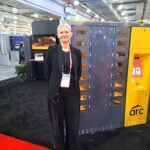
ARC by ChargeItSpot demonstrated its centralized device management locker system designed to secure, charge and monitor employee devices, including phones, scanners, tablets and more.
The locker technology gives real-time insight into where devices are, how they’re used, and automatically sends alerts when devices need attention.
The system confirms when each device is returned to its locker for charging. When an employee accesses the locker to remove a device, the system automatically releases the most charged device.
Management can monitor an entire device fleet and see what’s in use, idle, returned late or missing. The technology automatically flags issues like broken ports, damaged devices or failing batteries, and tracks usage patterns, including peak-hour demand and user trends.
The device management system integrates with company logins, employee badges, payroll and other management functions.
BrightSign
BrightSign, a provider of digital media players, demonstrated the benefits AI is bringing to its digital signage solutions.
- Media players equipped with integrated Neural Processing Units (NPUs) run AI applications without compromising video or audio quality. The applications provide real-time insights and deliver instant personalization. Users can also blend AI insights with video or graphics for enhanced customer engagement.
- The company’s all-in-one display solution with BrightSignOS integration eliminates the need for an external media player and requires minimal setup.
- The recently introduced BrightSign player toolkits make it easier to run AI applications at the edge, which eliminate latency and security risks associated with cloud-based AI.
- The company’s brightAuthor connected activation tool uses AI to detect activity in front of the display, capturing user interest in real time and transforming content to deliver maximum impact.
Cantaloupe Inc.
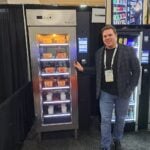
Cantaloupe Inc., a provider of automated retail solutions, introduced its Smart Store Hot Hold 24-hour access ready-to-eat meals machine.
The glassfront machine maintains temperatures up to 158 degrees Fahrenheit with adjustable settings to keep food safe and ready to be consumed throughout the day. The machine serves hot soups, sandwiches and cooked meals.
The pass-through design allows restocking from the back and selling from the front.
The machine features the Cantaloupe G11 chip card reader with sales reporting into the Seed Live software management system, as well as real-time inventory and reporting.
Unique access codes ensure that only the right person can access their food.
A lighted red alert signals when products are put back in the machine incorrectly.
The machine accepts credit and debit cards as well as mobile wallet payment.
Audio assistance is available for the visually impaired.
Cashmatic
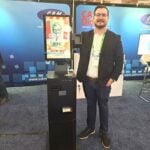
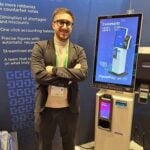
Cashmatic, a provider of payment and cash management products, presented its VisualPay customizable checkout kiosks to manage orders and payments without a cashier.
The touchscreen, available in 17, 22, 27 and 32 inches, enables customization from processor performance to the integration of contactless recognition and payment devices.
The kiosks can be installed on top of another device, on a counter or on a pedestal.
The kiosks can be configured with PCs of varying performance levels, running Android or Windows operating systems, and capable of running any type of software. They can also associate a self pay automatic checkout capable of managing both electronic and cash payments.
CDM USA
CDM USA presented its Cash DidEx (dispense, deposit, exchange) solutions designed to automate cash handling at the point of payment and reduce human error and operational risk.
The company demonstrated its Essential kiosk for automating cash handling, equipped with bill and coin recycling modules.
The bill recycler accepts all USD denominations individually and features a recycling capacity of up to 80 mixed denomination bills and a cash box capacity of up to 1,000 bills.
The unit features spectral imaging sensors for accurate bill validation, while the recycled notes can be transferred to the cash box.
The coin recycler features bulk acceptance of all USD coins and a processing speed of up to 12 coins per second. The recycling hopper and cash box hopper both have a capacity of 1,000 to 1,500 coins, depending on diameter.
The closed loop recycling system and validation sensors keep cash secure throughout the process to reduce fraud risk.
Cennox
Cennox, a provider of banking equipment and technology, demonstrated its RecyclerMax banknote and coin cash recycler which allows stores to automate cash management processes throughout the day.
The RecyclerMax prepares the recycler’s tills at the start of each shift, provides top-ups during the day, then deposits the tills’ contents at the end of each working day. The solution counts, sorts and stores the notes and coins.
The system provides real-time cash flow insights for cash-in-transit and banking needs.
The web portal displays real-time information, including detailed reports, and enables remote control and manages user administration.
The recycler features a 15.6-inch touchscreen and a 3-inch thermal printer.
Crane Payment Innovations
Crane Payment Innovations, a provider of automated payment solutions, demonstrated an integration between Mashgin’s AI-powered checkout system and CPI’s Paypod cash automation system. The integration is designed to allow locations using Mashgin’s touchless self-checkout kiosks to accept cash payments.
The Mashgin self-checkout system uses 3D cameras and computer vision to identify multiple items simultaneously when placed on the system’s tray for purchase without the need for manual scanning or barcodes. The Paypod integration adds a cash handling module to the process.
The Paypod accepts bills and coins and dispenses change, eliminating the need for staff to handle cash while increasing efficiency and security.
Custom America Inc.
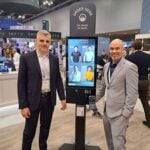
Custom America Inc. presented its Link kiosk, featuring a splash-proof and shatter-resistant PCAP touchscreen, FHD 27 or 32 inches, with 80mm receipt printer, 2D scanner, NFC reader and accessories such as LED light bar, payment device bracket, Storm AudioNav 1400 and webcam.
Configurations include MediaTek G700 (MT8390), 8 GB RAM, 128 GB SSD, Android 13 GMS, Intel N95, 16 GB RAM, 256 GB SSD, Intel Ultra 5, 125U, 16 GB RAM, 256 GB SSD.
The kiosks are available in countertop, floor-standing and wall mount models.
Diebold Nixdorf Inc.
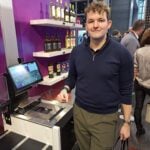
Diebold Nixdorf Inc. demonstrated its self-checkout solution that uses SeeChange Technologies’ computer vision AI technology. Diebold Nixdorf’s Vynamic Smart Vision uses SeeChange’s SeeWare machine learning to recognize fruits, vegetables, baked goods and items without a barcode.
The solution uses a computer vision algorithm to identify items, eliminating the shopper’s need to search a long list or remember the price look-up to find the desired item.
SeeChange’s edge-to-cloud AI platform also enables the self-checkout kiosk to improve the speed and accuracy of self checkout.
Elanda
Elanda, a provider of POS and self-checkout kiosks, introduced its K21 family of restaurant kiosks to improve performance and flexibility in POS and self-service solutions. The K21 line includes a POS kiosk, a countertop POS kiosk and a kitchen display system, each with a 21.5-inch LCD touchscreen.
The K21 kiosks operate on Windows 10/11 and Android 14 and are available in countertop and floor-standing models with printers and camera. Peripheral payment options include magstripe, NFC, RFID, fingerprint, EMV scanner and ADA keypad.
Flytech Technology Inc.
Flytech Technology Inc., a provider of POS, self service and embedded computing technology, presented its retail self-service kiosks.
- The K655N3 works on the Intel 14th generation operating system and features a 15-inch touchscreen, an AI camera and versatile peripherals.
- The K669N3 works on the Intel 14th generation operating system and features a 19-inch touchscreen, an AI camera and versatile peripherals.
- The K670 works on the Intel 14th generation operating system and features touch panels from 15.1 to 21.5 inches and accommodates different touch panel PCs with Intel processor platforms, including Intel Elkhart Lake, Tiger Lake, Alder Lake-N and Meteor Lake. It also features VESA mounting compliance and versatile peripherals.
- The K889 works on an Intel/Qualcomm processor and features a 21.5-inch touchscreen, mounting options, a lighting indicator and versatile peripherals.
- The K87BN3 works on the Intel 14th generation operating system and features a 27-inch touchscreen. It comes equipped with a variety of restaurant-specific peripherals.
- The K879 works on Intel and MediaTek processors and features a 21.5-inch touchscreen, an NFC display and versatile peripherals.
FTx POS
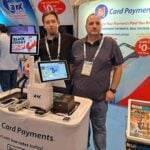
FTx POS, a provider of retail POS systems that support e-commerce, customer loyalty, age verification, digital signage, warehouse management and more, presented information about its upgraded POS bundle.
POS hardware peripherals include a 2D barcode scanner, biometric fingerprint scanner, digital signage integration and automated upselling.
The bundle also includes the FTx AdPro, offering access to a library of ready-to-use templates and built-in campaign management tools to create promotions on POS displays
Fujitsu North America
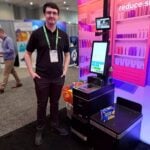
Fujitsu North America demonstrated its POSi avatar at a retail self checkout machine. The avatar, a personalized checkout interface, uses AI to guide shoppers through self checkout, helping customers scan items and complete transactions, even using their own devices.
The avatar was designed to assist, detect and adapt to all checkout situations, helping shoppers avoid and resolve issues at self checkout. POSi accesses data from POS, loyalty and inventory systems, providing AI‑driven automation that can help reduce queues, flag exceptions and support attendants at SCO stations.
Fujitsu also shared exhibition space with GK Software, which became part of Fujitsu in 2025. GK Software presented self-service solutions included the following:
- GK Vision offers AI-powered fraud detection, self-scanning and real-time interaction.
- GK Engage delivers real-time incentives and tailored communication to strengthen loyalty.
- GK Drive offers a cloud-native platform for fuel and convenience retail that unifies forecourt management, fast checkout and food service.
Funpad Technology Ltd.
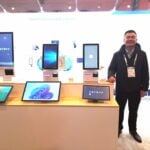
Funpad Technology Ltd., a provider of retail and foodservice hardware and software technology, demonstrated its freestanding, countertop and wall-mounted self-checkout kiosks serving supermarkets, restaurants, hotels, corporate breakrooms and transportation hubs.
The self-checkout kiosks offer AI food recognition, AI package recognition, AI loss prevention, interactive touch, RFID checkout, RF loss prevention and digital signage.
The kiosks run on Android 14 and Windows 10 and 11 operating systems and offer touchscreens ranging in size from 15.6, 21.5, 23.8 and 31.5 inches.
Gertec
Gertec, a provider of retail POS kiosks, payment and printer equipment, introduced three self-service kiosks running on the Android 15 OS: the SK315, the SK210S and the SK100.
- The SK315 kiosk features a 15.6-inch touchscreen display, along with NFC payment, a 1D/2D reader, a printer and a camera.
- The SK210S features a 10.95-inch touchscreen display, along with NFC payment, a 1D/2D reader, a printer and a camera.
- The SK100 features a 10.1-inch touchscreen, along with NFC payment, a 1D/2D reader, a printer and a camera.
Glory Global Solutions
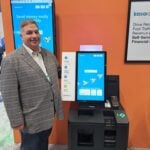
Glory Global Solutions, a provider of financial transaction technology, demonstrated its new kasaGO retail financial service kiosk which allows customers to manage their money while shopping. The kiosk allows people to send money, pay bills, deposit and withdraw cash.
The kiosk uses the Acrelec C24 which features a 24-inch display screen, printer, scanner, card reader, cash recycler, multilingual service and live customer support. Financial capabilities include cross border remittance, domestic transfers, stored value accounts, check cashing, bill payment and cryptocurrency acceptance.
The company plans to launch a pilot with customer-to-customer remittances from the U.S. to Mexico and Columbia.
HiStone/Code Factory
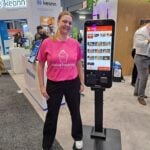
HiStone introduced its portfolio of AI driven checkout and recognition solutions, including the Voicetopping speech recognition technology from Code Factory. The technology can integrate with existing kiosk software.
Restaurant customers can order meals through voice commands, while shoppers at retail stores can use voice to locate products, check prices and navigate store layouts.
Speech recognition technology also improves accessibility for customers with visual or mobility limitations. Beyond helping locations comply with accessibility regulations, speech interfaces make kiosks more inclusive by enabling natural interaction for those who struggle with touchscreens.
The technology enables kiosks to understand complex requests, process natural speech and respond with natural sounding voices.
Ibase solution
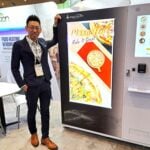
Ibase solution, a provider of kiosks, gaming machines and energy storage solutions, introduced its Hot Meal Station which stores, heats and serves precooked meals. The machine holds 24 SKUs for a total 72 items.
The customer selects their meal on the 21.5-inch selection screen, then pays via NFC reader to prompt the machine to heat and deliver the meal in a box. The average delivery time is two minutes.
The machine features a 55-inch interactive display screen for advertising messages. Options include a card reader, QR code scanner and bill acceptor.
Ibase solution does not provide the food for the machine.
I+diotlabs/Zebra
I+diotlabs, a provider of AI and IoT powered infrastructure for retail and foodservice, demonstrated its self checkout and autonomous capabilities at the Zebra Technologies exhibit. The company integrates AI, hardware and software into kiosks, tablets and smart lockers to support self service ordering and pickup at physical locations.
The company’s solutions include multi-lingual, voice enabled ordering. The main focus is on retail and foodservice locations.
ID Tech
ID Tech, a provider of payment solutions, introduced its NEO 3 family of unattended payment solutions.
- The Kiosk IV offers a contactless reader for ATMs and self-service kiosks. The unit supports contactless credit card payments and mobile payments as well as loyalty and reward programs.
- The VP3350 is a mobile reader that comes in three versions: MFi Apple Lightning, Bluetooth and USB-C. The reader integrates with a tablet or POS terminal, is equipped with pass-through charging, and offers flexible mobile and loyalty payments through Apple VAS and Google Smart Tap 2.1
- The VP7200 offers an NFC contactless solution with a QR scanning option. The reader hosts applications and can drive an external screen, supporting both open and closed loop payments.
- The VP6825 is a PIN-on-glass device that supports chip, PIN, contactless, QR codes, barcodes and magstripe payment methods. The device has a 4.3-inch digital touchscreen for video ads and supports Apple Pay, Google Pay, Samsung Pay and loyalty/rewards programs.
- The AP6800 runs on Android and features a 5-inch digital touchscreen with PIN-on-glass that supports chip, PIN, contactless, QR codes, barcodes and magstripe payment methods. The device can also support an external display of up to 4K resolution.
Ingenico
Ingenico, a provider of payment acceptance solutions, has partnered with Samsung Electronics America Inc. , a technology provider, and Talus, a fintech provider of integrated payments technology, on a mobile business operating solution for the North American marketplace.
With Ingenico SoftPOS tap-to-pay capabilities, the Talus mobile app transforms NFC-compatible Samsung mobile devices into payment terminals. No dedicated payment hardware is required.
Businesses can accept card and digital wallet payments in-store or in the field. Beyond payments, the platform brings together inventory, customer management and real-time insights in one intuitive experience.
Compliant with PCI MPoC and tap-to-phone frameworks, the solution has been designed to deliver secure contactless transactions.
Ingenico also presented its Axium SX platform running entirely on Android, offering an extensive payment applications portfolio.
Innovative Technology
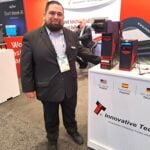
Innovative Technology introduced its NV4000 muti-bill recycler designed for high volume POS terminals or self-checkout applications to provide mixed denomination recycling.
The recycler has the capacity to dispense up to 680 bills of five different denominations, optimizing operational efficiency and reducing the need for frequent refills.
The company also presented the Spectral BNF (bunch note feeder) for the NV4000 to allow multi-bill deposits to accelerate transactions.
By combining the NV4000 with a smart coin system and coin elevator, retailers are equipped with a complete cash payment solution for both bills and coins.
The company also presented information about its age and identity verification solutions including MyCheckr, MyCheckrMini and ICU Lite, which can assist in selling age restricted goods such as alcohol or tobacco.
The devices can be utilized at the cash register as an aid for staff or fully integrated within self-service terminals to automate age checks.
The technology can also help prevent access to restricted areas where age-related goods are located such as walk-in coolers, bars and liquor stores. When the devices are linked to MyConnect, alerts can be sent to staff via an app to notify them of a potential underage access attempt which can be remotely granted or denied.
In addition to performing age verification, the technology is equipped with demographic data insights to provide retailers with analytical data to better understand customer demographic characteristics.
Intel/Unistop Tech
Unistop Tech, a provider of AI-powered robotic technology, demonstrated its Mr. R AI-Powered Autonomous Retail Solution at the Intel exhibit. The self-contained robotic store can hold 300 SKUs and more than 2,500 total items.
The robotic arm and shelf system can scan, pick and dispense products in the delivery chute under 12 seconds. Customers order on a touchscreen and watch the robotic pick and dispense via a window.
The machine includes ambient, chiller and freezer zones to enable diverse inventory, while the AI intrusion detection supports high security environments.
Features include dynamic pricing, whereby the AI automatically adjusts pricing based on weather, demand surges and expiry dates.
The AI also identifies rising product demand in real time and automatically highlights high velocity items, enabling locations to capitalize on buying trends. Using non-identifiable vision analytics, the system also detects demographics to recommend products and increase cart size.
JCM Commerce Mechatronics Inc.
JCM Commerce Mechatronics Inc., the U.S. sales arm of Japan Cash Management, owned by JCM Global, presented money handling and automated payment equipment.
The exhibit included cash deposit and cash recycling equipment.
The company offers components for ATMs, ticket dispensers, adjustment machines, vending machines and kiosk terminals for the banking, retail and transportation industries.
Kiosk Information Systems/Posiflex
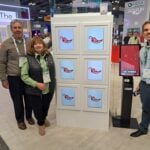
Kiosk Information Systems demonstrated its BOPIS pickup lockers for contactless order retrieval, which can be used for food, retail and package delivery, allowing customers to order via kiosk or app and collect items using a PIN or QR code from a designated locker. The solution streamlines pickup, reducing labor and improving convenience.
The company partners with Toast and Pebble for restaurant POS technology and with Grubbrr for ordering software.
Posiflex demonstrated its Autonomous Device Intelligence to provide AI-enabled commercial IoT and self-service solutions in the retail, hospitality and healthcare sectors.
The Autonomous Device Intelligence solution supports self-checkout kiosks, voice interaction for self-order kiosks, and remote monitoring and self-check-in for healthcare.
Kisan America Inc.
Kisan America Inc., a provider of cash handling equipment, introduced its KR10 kiosk option, a cash and coin recycling solution.
The kiosk runs on the Linux operating system and features a 4.3-inch touchscreen and holds four drums, holding 1,00 notes per drum, with a 2,000-note collection cassette. It is available as a standalone unit or a self-checkout payment unit.
The kiosk contains four modules for recycle storage that each process a maximum of 100 notes.
The cash management dashboard connects with Kisan smart safes and recyclers to automate cash handling and deliver insights on cash activity.
Laurenti Brasil LTDA
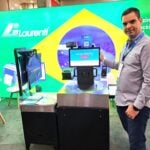
Laurenti Brasil LTDA demonstrated its Flex kiosk which integrates the functions of a cash register and self-checkout kiosk. With one movement, a location can switch between assisted mode and self-checkout mode. Software systems such as CresLane’s Flex Check-out enable switching between cashier and self-checkout modes.
Features include a 17-inch touchscreen, a barcode scanner, an RFID reader, a printer and an option for a cash recycler.
The kiosk accepts credit and debit card payments as well as digital wallets and WIC/EBT.
To address shoplifting, a weight verification device can validate whether the product placed on the tray matches the product read on the barcode reader.
Livex.ai
Livex.ai, provider of an AI agent that connects digital, voice and physical environments, presented its Livex Gateway, an interactive AI screen for use in physical settings that provides a conversational interface for customers to get information, find products and interact with the brand.
Tapping Google Cloud and NVIDIA technology, Livex Gateway extends its intelligence into the real world through holograms, kiosks and QR experiences that inform, guide and convert prospects into customers in person, turning stores, kiosks or products into active customer touchpoints that sell, support and retain customers.
The company’s virtual agents on the 86-inch, 4k interactive display can see, hear and respond like humans, delivering real-time problem
Loomis
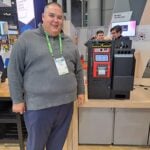
Loomis, a provider of cash management, logistics and financial services, demonstrated its Titan R7 cash automation system that delivers cash recycling and automates deposits and withdrawals to reduce errors, save time and streamline cash handling, while providing visibility and control over every transaction.
The machine features a 21-inch touchscreen and eight recycle/dispensing drums to support handling of high transaction volumes.
Turnkey cash automation delivers automated cash-recycling technology that can simplify cash-handling procedures and reduce operating costs for businesses operating 10 or more cash registers.
Payment options include credit/debit cards, mobile wallets, QR codes and contactless payments.
Maken
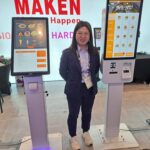
Maken, a manufacturer of POS hardware, introduced its next-generation kiosks to address key retail trends: the shift toward autonomous shopping, labor optimization and seamless omnichannel experiences. Each solution is designed to help retailers reduce wait times, enhance transaction efficiency and scale seamlessly across store formats.
- The KH 2730 is a 27-inch freestanding ordering kiosk with a built-in receipt printer and scanner, a camera and an indicator light. A ticket number holder is optional, as are countertop and wall-mounted options.
- The KH1500C is a 15.6-inch countertop kiosk with a built-in 88mm receipt printer, a 2D scanner, a card reader holder and an availability indicator light.
- The KKR2400 is a 23.8-inch self checkout terminal featuring a 88mm receipt printer and a Datalogic 9300i scanner. The customer can place items on the tray, scan barcodes, review the product list on the digital screen, modify the selections if needed, choose the payment method, pay and take a printed receipt.
Masterworks Automodules Tech Corp.
Masterworks Automodules Tech Corp., a manufacturer of cash handling equipment, demonstrated a prototype of a new cash recycler.
Besides cash recyclers, the company’s product line includes a coin deposit side cart, self-serve payment kiosks, a self checkout kiosk, cash deposit machines, smart safes, a cash handling machine for public transportation hubs, a front office payment system, cash sorting machines, a cash deposit machine with rear access bag collection, note and coin recycle modules and bank note validators.
MediaTek
Mediatek, a provider of fabless semiconductor designs, unveiled an IoT platform that combines 5G and Wi-Fi 7 support with edge AI and multimedia capabilities. The platform, which leverages an octa-core ARMv9 CPU and embedded NPU to support generative AI, is designed for an array of retail IoT products, including automatic identification and data capture applications, table-service kiosks, point-of-sale systems and digital signage.
The company also presented the Genio platform for edge AI applications in retail and hospitality. This includes support for vision AI and on-device generative AI; dual-display support and remote management for desktop POS; 4K resolution; and a smart kiosk with self-checkout capabilities.
MediaTek also demonstrated the Posiflex HK 1610 self checkout kiosk, for which it provides the chipsets. The HK 1610 is built around a Rockchip RK3399 processor with integrated peripherals support and can host scanners, payment devices and wireless connectivity.
MediaTek also provided information about its integrated platform for intelligent devices, including scalable edge AI, carrier-grade 4G/5.
NCR Voyix
NCR Voyix debuted its next-generation portfolio of microservices-based applications built on the Voyix Commerce Platform.
- VoyixPOS uses a cloud-to-edge design to enable centralized management, real-time insights and rapid innovation across grocery, fuel and convenience stores.
- Voyix Self-Checkout integrates with POS, loyalty and analytics along with Picklist Assist, which uses computer vision and machine learning to automatically suggest and fill pick-look-up codes, streamline item lookup and improve accuracy.
- Voyix Back Office provides a unified retail management application that organizes inventory, purchasing, loyalty and analytics. It delivers near real-time visibility and automation to reduce complexity and improve efficiency across multiple locations.
- Voyix Supply Chain integrates planning, analytics and execution, including warehouse management, to deliver real-time visibility and control receiving, picking, packing and shipping. The tool enables data-driven decisions for manufacturing, distribution and service operations across multiple warehouses.
- Voyix Kitchen offers a kitchen display system that accelerates order fulfillment and improves communication between front- and back-of-house.
- Voyix Insight with conversational AI provides an analytics application with conversational search that provides real-time insights, recommended actions, alerts and automated targeting for forecasting, labor and shrink.
- Voyix Loyalty offers an AI-driven loyalty application for omnichannel personalization, rapid offer deployment and predictive insights that launches promotions in minutes, predicts churn and next‑best actions, and keeps earn‑and‑redeem active even offline.
PAL Robotics
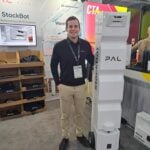
PAL Robotics demonstrated StockBot, its autonomous inventory robot that combines RFID technology and robotics to automate daily inventory counts and optimize stock management, provide real-time updates and streamline order fulfillment. The solution has been designed to provide an understanding of what is in stock, where it is located, and what needs immediate attention.
StockBot autonomously navigates the sales floor and the backstore, scanning products and detecting items that are not where they should be. By providing precise positional information, the robot enables the workers to correct errors quickly and restore availability.
Through accurate and systematic RFID scans, StockBot uncovers misplaced products and restores full visibility over the sellable inventory.
Where retailers often rely on physical shielding materials to prevent cross-readings between adjacent areas such as the sales floor and the stockroom, this approach requires installation work, limits store layout flexibility and must be maintained over time. StockBot removes this dependency through virtual shielding by scanning only the intended areas and avoiding unwanted cross reads. The robot delivers accurate, targeted data without any additional materials or structural adjustments.
Partner Tech
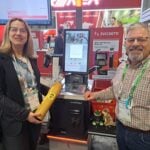
Partner Tech, a provider of POS terminals, mobile solutions, self-checkout and kiosk systems, presented its enterprise-grade retail technologies, with a strong focus on AI-powered self-checkout.
The company introduced its cash drawers, cash management accessories and an ADA compliant keypad from Anker Group. The tactile keypad provides a non-touch input option for self-service environments and supports voice-guided assistance, helping retailers offer more inclusive checkout experiences. The solution also aligns with global accessibility initiatives, including the European Accessibility Act.
The company’s self checkout kiosks also integrate LOC Software ThriVersA technology, enabling AI-powered product pick lists, intelligent theft prevention and real-time in-store analytics.
Through its partnership with Vispero, Partner Tech now offers the JAWS screen reader for kiosks, available across Partner Tech’s self-service portfolio, including Alfred, K27II and PS-137 kiosks and Starling, Alfred and Paula self-checkout solutions.
JAWS speech-guided interaction also integrates with Partner Tech’s ADA tactile keypad, enhancing inclusive self-service experiences for customers with disabilities.
PAX Technology
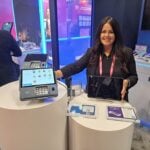
PAX Technology presented information about its recently announced partnership with Wink that combines PAX’s payment hardware with Wink’s AI-driven platform, creating persona-powered commerce where a customer can pay simply by being recognized, with no wallet, card, or phone required.
Through semi-integration, Wink’s application interfaces with PAX’s BroadPOS app to deliver biometric identity authentication, including face, palm and voice recognition. This enables fast, frictionless and secure checkout experiences, while safeguarding merchants against fraud.
The combined solution works with Wink’s payment platform that provides real-time transaction processing across payment acquirers.
The company also demonstrated its M11 unattended payment device to support the usage of QR codes and contactless payments in retail environments.
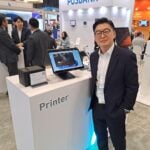
POSBank
POSBank demonstrated its Forged printer for foodservice and retail. The printer works on the Intel Core and Celeron processors and features 15- and 15.6-inch ultra thin bezel displays.
The fanless thermal management system evenly distributes heat throughout the aluminum case, enabling stable operation without noise and minimizing internal dust flow as well as efficient cooling.
The powered USB supports versatile peripherals, while the modular input/output box enables expansion of peripherals.
The display screen is made of tempered glass to enhance durability and clarity, and the adjustable touch angle provides usability in various work environments.
Pyramid North America Inc./Kiosk Manufacturer Association
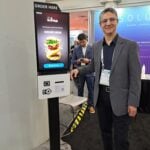
Pyramid North America Inc., exhibiting in the Kiosk Manufacturer Association booth space, presented its Polytouch line of self checkout kiosks.
The Polytouch kiosks are available in basic configurations to address a variety of use cases off the shelf. Add-on components such as touch display or peripheral modules such as printers are available.
- The Polytouch pSyCo offers a countertop self-checkout terminal featuring the POS 500 as the POS system. Features include a scanner integrated into the worktop and a VESA mount which can fit most POS systems with a screen diagonal of 15.6 to 23.8 inches. Scanner, printer and payment modules are optional.
- The Polytouch Fex 21.5 features a compact chassis and various mounting options. With its minimal frame, flat touchscreen and portrait orientation, the unit resembles a tablet.
- The Polytouch Passport 321 autonomous store kiosk features a 32-inch display screen. The two-screen version serves several customers simultaneously.
- The Polytouch self-checkout project Portal designed by Edeka features a 15-inch touchscreen and optional scale, coin dispenser and bill dispenser.
- The Polytouch Swift is available in 24-, 27- and 32-inch projective capacitive touchscreens, a printer camera, scanner and attached payment keypad.
Pyramid North America mainly uses PCs and touchscreens from its AKHET and Faytech partner brands.
Sesami
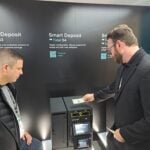
Sesami, a provider of self-serve banking solutions, demonstrated its Tidel S4 single and bulk note validator, which can be configured with a storage vault, mailbox drop vault or pedestal to reach counter height compatibility.
The unit accommodates two note cassettes that hold up to 1,200 notes per cassette or 2,250 notes per cassette.
Features include a 7-inch console screen; a personal identification number and/or iButton to allow managed access to functions, reports and instant access; a note validator maintenance door that enables the validator heads to be removed in the event of a note jam, and an integrated printer with a see-through screen, paper cutter and feeder.
Shekel Scales
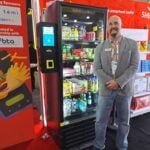
Shekel Scales, a provider of retail weighing technology, demonstrated a self-serve retail cooler which customers access by presenting a payment option. The customer opens the cooler door after presenting their payment card, then removes products from the shelves and closes the door.
Product recognition sensors ensure the proper product was removed from the cooler. The system uses AI to create “product-aware” scales and real-time shelf monitoring systems. The system tracks item removal by weight signatures and supports frictionless payment flows.
Shenzhen Meking Electronic Technology Co. Ltd.
Shenzhen Meking Electronic Technology Co. Ltd. demonstrated its M6 Series POS modules, all of which combine a screen module with a system box module. The screen module comes in 15-, 15.6-, 18.5- and 21.5-inch configurations. The system box module is available as an Android box module, a Windows box module and a touch monitor box module.
Peripherals include:
- MSR
- Fingerprint reader
- RFID reader
- I-button
- 9.7-inch second display screen
- 11.6-inch second display screen
- 15-inch second display screen
- 15.6-inch second display screen
USB peripherals include a 5MP camera, a 2D barcode scanner, a fingerprint reader, an i-button reader and a magnetic stripe reader.
The company also provides touch monitors, touch panel PCs, PC boxes, distributed screens and pole mounts.
Simbe
Simbe, a provider of retail shelf digitization and store intelligence, introduced Tally 4.0, its newest shelf-scanning robot and the flagship data capture method of its store intelligence platform. The robot introduces improvements in runtime, vision, sensing and edge AI.
With up to 12 hours of runtime, high-resolution and specialty cameras, expanded 3D and 360-degree coverage, and the full-stack NVIDIA AI infrastructure platform, Tally 4.0 delivers insights into what’s in stock, how it’s priced and where it’s placed.
Tally 4.0 provides a foundational data layer for the physical store, connecting shelf conditions to the decisions that shape initial use cases, including on-shelf availability, price and promotion accuracy, and item location precision, while elevating store team and shoppers’ experiences with more mature applications for planogram compliance, forecasting, replenishment, omnichannel fulfillment and merchandising.
Soundhound AI
Soundhound AI demonstrated its Employee Assist technology that provides in-store employees with access to information that allows them to complete tasks they may be unfamiliar with. The tool offers a form of on-the-floor training without the need for manuals.
In a restaurant, a server wearing a headset can get answers to questions about many aspects of the operation, including order status, manuals, ingredients and allergens. A kitchen staffer can get updates on inventory, supply orders or other operations issues.
A store manager can build an AI agent to prompt conversations with employees or to send links to customers’ phones in response to questions.
Star Micronics
Star Micronics, a manufacturer of POS hardware and systems, presented a real-time conversational solution from Mobile Insight, a provider of a virtual interactive brand ambassador.
No matter where the shopper is in their buying journey – browsing, comparing or ready to buy – Mobile Insights’ VIBA engages shoppers with relevant information, personalized recommendations and answers to their questions.
Leveraging Google Cloud, Mobile Insight delivers tailored AI brand personas for a guided shopping experience with human-like interaction in-store. Deployed through tablets, kiosks or QR codes, the combination of structured buyer journeys and AI recommendations boosts purchase intent, driving sales conversations.
The virtual agent identifies shoppers’ needs and provides the appropriate product details at the right time in the journey, moving shoppers toward purchase, and handing conversations to live sales reps as needed.
Storm Interface
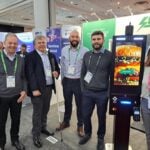
Storm Interface, a manufacturer of keypads, keyboards and computer interface devices, was one of several exhibitors demonstrating the Jaws for Kiosk, providing accessible keypads for blind and low vision users. The solution offers speech-guided interactions through a screen reader purpose-built for kiosks.
Combining tactile input, custom scripting and enterprise support, Jaws for Kiosk enables consistent, compliant experiences across physical environments.
The screen readers offer efficient navigation using the following:
- Flexible reading controls: Users can read content continuously or move through it by sentence, word or character.
- Structured navigation: Keyboard commands allow users to jump directly to headings, links, regions, form fields, lists, tables and other elements. JAWS also provides features such as the Virtual HTML Viewer and element lists, allowing users to scan a page’s structure without wading through every line of text.
- Element context and feedback: Screen readers announce the type of element, allowing users to understand how the interface is structured, how components behave and which actions are available at any given time.
- Form interaction and error handling: Screen readers announce labels, required fields, input types and validation errors, allowing users to complete tasks independently.
- Braille support: Screen readers can output information to refreshable braille displays, offering users tactile access to text, structure and formatting.
Stratacache
Stratacache, a provider of consumer, audience and passenger engagement technology, displayed the Walkbase millimeter wave sensor solution to provide retail locations a way to accurately measure in-store customer behavior without collecting or divulging customers’ personally identifying information.
Walkbase is Stratacache’s in-store analytics solutions provider focusing on how customers, employees and resources interact with stores and locations.
Using electromagnetic waves to capture location, pathing and dwell time data, the solution is a privacy-centric solution to measure in-store customer behavior. The millimeter wave sensors contain no camera lenses and capture no biometric or personally identifiable information.
As the millimeter wave sensor solution works without using a camera, it is also a versatile analytics tool, able to work in environments where other sensors fail, such as in bright sunlight or darkness.
The millimeter wave sensor technology cBan cover wider areas than typical in-store tracking tools and is able to plug directly into retail media video players. The solution is available to retailers following trials within a large regional U.S. grocery store.
Sweet Robo
Sweet Robo, which specializes in food and entertainment product vending machines, presented its Casebot phone case 3D printing machine.
The machine is stocked with a selection of phone case styles, allowing customers to find the best fit for their device. Once they choose a case, they can browse an image library filled with various designs or upload their own picture for a more unique look. The customer then pays for the case and the machine loads a blank case from its inventory, prints the selected design on the case and delivers it to the customer. In 90 seconds, the machine brings their vision to life.
The company also recently introduced a chocolate candy 3D printing machine, allowing customers to choose from hundreds of pre-set shapes across dozens of product categories.
The company also offers cotton candy, ice cream, popcorn, lollypop, marshmallow vending machines, along with balloon machines.
Telpo
Telpo, a provider of kiosks, cash registers, ticket validators, voice over internet and biometric devices, demonstrated its K1 self-service kiosk designed for retail, foodservice and healthcare environments.
The kiosk runs on the Android 14 operating system and features a 25-inch display screen, along with a dual lens camera for facial recognition, SIM slots, peripheral ports, a thermal printer, a payment module and a digital audio speaker.
Tillster
Tillster demonstrated its restaurant self-order kiosks for QSR and fast casual brands that tie directly into a restaurant’s POS, payments and loyalty stack to boost ticket size and improve throughput while keeping pricing and menus in sync.
The kiosks run a locked-down, secure OS with encrypted connections; payment is handled at EMV terminals with P2PE so card data is not stored on the kiosk.
Monitored dashboards alert operators to performance issues, sync errors or connectivity issues.
The self-order kiosks also integrate with kitchen display systems to route orders efficiently to the kitchen and adjust prep times based on menu complexity and volume.
Toshiba Global Commerce Solutions
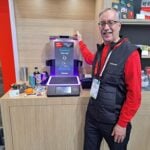
Toshiba Global Commerce Solutions demonstrated its Vision Kiosk which allows shoppers to place multiple items on a tray and have them scanned simultaneously without barcodes, enabling transactions of multiple items in less than 10 seconds.
The solution uses AI computer vision and loss prevention tools with a smartpad weight based scale for ensuring accurate payment.
The biometric camera monitors customer behavior and identifies potential shrink activities at checkout.
The kiosk integrates with scanners, cameras and NFC payment.
The Vision Kiosk was one of several technologies the company demonstrated in the convenience, grocery, specialty, hospitality and entertainment venues.
Touch Dynamic
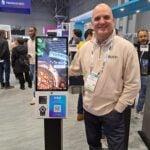
Touch Dynamic, a provider of touch computer and POS systems, introduced its Summit self-checkout kiosk, featuring a 21.5-inch portrait display, using SoftPOS technology to offer contactless payments directly through the device via tap-to-pay, requiring no external terminal. The unit operates on Intel, Alder Lake, Meteor Lake or MediaTek G700 processors, performing across Windows, Linux and Android 13 with GMS.
The Summit has been designed with multiple CPU options, wireless connectivity and is compatible with Epson printers. It can be wall mounted, counter mounted or on a stand and is designed for retail, hospitality and enterprise environments.
Options include an ADA pad, a 2D barcode scanner and a variety of payment modules.
TouchWo
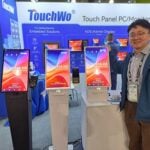
TouchWo, a manufacturer of touch panels, PCs and kiosks, presented its smart order kiosks and service kiosks for restaurants.
The company’s self-order kiosks offer customizable menus that can be updated in real time, allowing restaurants to change promotions, pricing and menu items as needed.
Most kiosks offer integrated payment processing, enabling customers to pay directly through the kiosk using credit/debit cards, mobile wallets or other payment methods.
Customers can also personalize their orders, adding or removing ingredients, selecting portion sizes and choosing special instructions.
- The company’s restaurant reservation kiosks let guests reserve tables, select seating preferences and confirm arrival times, streamlining reservations and reducing staff workload. The kiosks’ sealed enclosures block food crumbs, drink spills and cleaning sprays from damaging internal components while the tempered glass with a smudge-resistant coating repels fingerprints, ketchup and grease. The reinforced edges on the frames withstand accidental bumps from chairs, trays or bustling guests.
- The company’s kitchen display kiosks centralize orders, update statuses in real time, and keep staff aligned. Cooks tap to mark items as “in progress” or “complete,” while servers track orders instantly. The units withstand splatters, high temperatures and constant use.
UIC Connect
UIC Connect presented its products and services, which include real-time transaction, aggregation, L3 certified payment applications, terminal and device management, cloud-to-cloud integration, payment engine, PCI-DSS gateway and tokenization.
Terminals include 4-, 5- and 6-inch Android terminals for mobile payment, embedded contactless devices for unattended payment and Android and PIN pad terminals for countertop payment.
UST
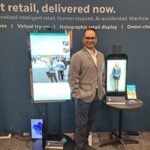
UST, a provider of generative AI in retail, demonstrated its solutions for enhancing in-store customer engagement, including 3D holograms that offer voice interaction with customers and virtual try-on that allows customers to see how they look in apparel before making a selection.
Solutions also include:
- Intelligent inventory management: Cameras and IoT devices track inventory from the warehouse to the sales floor, providing real-time visibility into stock levels.
- Enhanced in-store operations: IoT enhances various in-store operations through connected devices, including smart shelves equipped with weight sensors to detect and report stock levels, while IoT-enabled tags help in asset tracking and management. Sensors can also monitor the in-store temperature control and humidity levels.
- Reduced shrink: IoT devices such as smart cameras and motion sensors work in tandem with vision intelligence systems to provide comprehensive surveillance and real-time alerts on potential security breaches or theft.
- Personalized promotions: Vision intelligence analyzes customer demographics and behavior through surveillance footage, enabling stores to offer real-time personalized promotions, enhancing the shopping experience and boosting sales.
VenHub Global Inc.
VenHub Global Inc., which provides a fully-robotic, autonomous retail store, presented its VenHub Smart Store, enabling 24/7 unattended shopping.
The store is designed to serve both operators and consumers by eliminating the need for on-site staffing, thereby reducing operational overhead and providing a personalized shopping experience.
The platform offers mobile customer engagement, adaptive product displays, real-time inventory automation and precision in-order handling.
The AI-driven platform streamlines restocking, ensures high-demand items are available and reduces product waste.
The company is also developing mobile units.
Verifone
Verifone announced its expansion of the Verifone Victa device portfolio alongside new ecosystem partnerships. New relationships announced at NRF 2026 include:
- Shopify: Verifone now supports Shopify POS with select Victa devices, expanding merchants’ choice of enterprise-grade payment devices. Anchored by Shopify POS Hub, the integration enables consistent performance, expanded peripheral compatibility and flexible checkout configurations.
- Bilt: A new partnership brings Bilt’s customer experience platform to Verifone’s merchant network. Built on Verifone’s Android-based developer platform and leveraging the Verifone gateway, the integration enables loyalty, member engagement and personalized experiences to run seamlessly on Victa devices.
- Aevi: A single global integration provides access to Aevi’s cloud-based payment orchestration and commerce capabilities across Verifone devices, simplifying multi-region deployment, local payment support and ongoing estate management.
Built on a single, unified platform, all Victa devices share the same EMV certification foundation — allowing partners to certify once, deploy across the portfolio, and stay compliant through future over-the-air upgrades. The platform also benefits from Verifone’s biometric capabilities, including palm vein and facial recognition.
Product introductions included the following:
In-lane and countertop checkout:
- Victa Register – A merchant-facing POS solution combines a touchscreen, modular accessories and scalable performance.
- Victa Lane – A customer-facing payment terminal delivers fast, in-lane checkout, whether deployed standalone or paired with Victa Register.
Mobile and portable commerce:
- Victa mini – An portable payment device designed for mobility and space-constrained environments, supporting secure checkout for pop-up retail, curbside service and mobile use case.
- Victa mobile plus and Victa portable plus – Designed for commerce on the move, these devices deliver multitasking across payment and business workflows. Powered by an Octa-core processor, they support in-aisle, curbside or high-traffic environments.
SoftPOS device:
- Victa SoftPOS mobile and Victa softPOS tablet enable contactless payments and business workflows without dedicated payment hardware. Victa SoftPOS mobile supports on-the-go use with integrated contactless payments, while Victa SoftPOS tablet offers a larger touchscreen to support customer-facing and operational tasks.
Unattended and rugged environments:
- Victa unattended – A payment solution engineered for self-service environments such as kiosks, vending, transit and parking.
- Victa mobile ruggedized – A mobile payment device enabling secure payment acceptance and Android-based business applications in the field.
In addition to new devices, Verifone introduced Verifone Touch, a customer-facing self-service kiosk available in 22-inch and 27-inch display options. Verifone Touch enables content delivery and customer engagement alongside Victa devices without requiring a dedicated payment terminal.
WestarPOS
WestarPOS, a POS and kiosk hardware maker, introduced its CRS001 POS kiosk that can be used for self checkout, self ordering and as a cashier station. Users can switch between horizontal and vertical screens to adapt to different retail scenarios.
The kiosks are available with 15.6-, 18.5- and 24-inch main screens and 15.6- and 18.5-inch secondary screens.
Features include a built-in 80mm thermal receipt printer, a 2D scanner and a speaker. Optional peripherals include an NFC reader, a camera, a microphone, POS bracket, wall-mount kit and a floor-standing column.
Yo-Kai Express
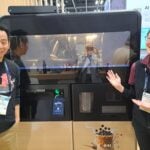
Yo-Kai Express introduced its Yo-Kai Express beverage vending machine, an AI powered, fully robotic machine offering fully customized, fresh cooked boba on demand. The machine offers both cold and hot drinks, as well as toppings.
Cold drinks include traditional Boba Milk Tea, Oolong Milk Tea, Mango Pomello Sago, Matcha Milk Tea, Taro Milk Tea, Thai Iced Tea, Grape Green Tea, Coconut Milk Tea, Jasmine Green Milk Tea, Chai Milk Tea, Hojcha Milk Tea, Chocolate Milk Tea, Iced Coffeee and Protein Shakes.
Hot drinks include coffee and tea, while toppings include Boba, Lychee Jelly, Coconut Jelly, Sago, Fresh Grape and Mango Jelly.
Media Gallery
-

- Thomas Guthmann presents the I+diotlabs retail technology at the Zebra Technologies exhibit.

-
- Michael Stocker introduces the kasaGO retail financial service kiosk at the Glory Global Solutions exhibit.
-
- Andy Lin and Amanda Tsung introduce Yo-Kai Express robotic beverage vending machine.
-
- Lori Leung introduces the CRS001 POS kiosk at the WestarPOS exhibit.

-
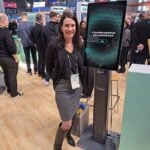
- Heather Hooks shows a prototype of a new kiosk at the Verifone exhibit.
-
- Show attendees explore the fully automatic Venhub store.

-
- Robert Wang presents connection and payment services at the UIC Connect exhibit.

-
- Raul Chang shows the 3D hologram avatar at the UST exhibit.
-
- Weiqi Kuang presents the restaurant kiosks at the TouchWo exhibit.
-
- Garrett Russell introduces The Summit kiosk at the Touch Dynamic exhibit.
-
- Don Richardson demonstrates the Vision Kiosk at the Toshiba Global Commerce Solutions exhibit.
-
- Paul Burchard demonstrates the Tillster self-order kiosk.

-
- Bruno Molfetto presents the phone case printing machine at the Sweet Robo exhibit.

-
- Pedro Sanchez presents the Telpo self-serve kiosk.

-
- Bjorn Sjolund and Larry Payne present the Walkbase wave sensor solution at the Stratacache exhibit.

-
- Demonstrating interface technology for blind and low vision users at the Storm Interface exhibit are Marty Oakton, Matt Ater, Matthijs Verhagen, Luca Pappalardo and Nicky Shaw.
-
- Ken Froese presents the virtual interactive brand ambassador at the Star Micronics exhibit.

-
- Ishai Reinfeld presents the Employee Assist technology at the Soundhound AI exhibit.

-
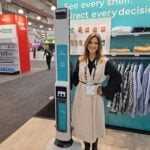
- Caitlin Allen introduces the Tally 4.0 robot at the Simbe exhibit.
-
- Shayne Boelter presents the Tidel S4 single and bulk note validator at the Sesami exhibit.
-
- Bob Madson presents the Shekel Scales smart cooler.
-
- Zahdan ELZahdan presents the Polytouch line of self-checkout kiosks from Pyramid North America at the Kiosk Manufacturer Association exhibit.
-
- Steve Kwon presents the Forged printer at the POSBank exhibit.
-
- Pernilla Gibson of Partner Tech and Dennis Lavallee of CK Systems introduce features for a self checkout kiosk including an ADA compliant keypad.
-
- Kate Torrey presents information about PAX Technology’s partnership with Wink to offer persona powered retail purchases.
-
- Alex Font Ibanez demonstrates the StockBot inventory control robot at the PAL Robotics exhibit.
-
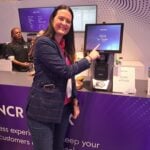
- Jessica Bryant introduces a self checkout kiosk at the NCR Voyix exhibit.
-
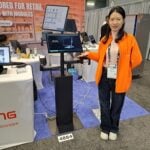
- Yingfeng Xie demonstrates POS modules at the Shenzhen Meking Electronic Technology Co. Ltd. exhibit.
-
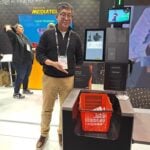
- Nelson Wu presents the Posiflex HK 1610 self checkout kiosk at the MediaTek exhibit.
-
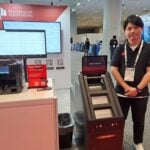
- Kenji Huang presents a prototype for a new cash recycler at the Masterworks Automodules Tech Corp. exhibit.
-
- Ivy Zhang introduces the new retail kiosks at the Maken exhibit.
-
- Kendall Walker presents the Titan cash automation systems at the Loomis exhibit.
-
- Jerry Li demonstrates the virtual agent at the Livex.ai exhibit.

-
- Daniel Ha introduces the KR10 cash recycling kiosk at the Kisan America Inc. exhibit.

-
- Luis Laurenti demonstrates the Flex kiosk at the Laurenti exhibit.
-
- Joe Scutellaro, Kim Kenney and Jed Sullivan present food pickup lockers at the Kiosk Information Systems/Posiflex exhibit.
-
- Francisco Hincapie, Samuel Quiroz and Aldo Coronado present cash handling kiosks at the JCM Commerce Mechatronics exhibit.

-
- Nigel Tsui presents the Unistop Tech robotic store at the Intel exhibit.

-
- Brian Bellerose introduces the NV4000 muti-bill recycler at the Innovative Technology exhibit.
-
- Mike Parker demonstrates the Axium SX payment platform at the Ingenico exhibit.

-
- Justin Ning introduces the NEO 3 family of unattended payment solutions at the ID Tech exhibit.

-
- Kevin Liao introduces the Hot Meal Station vending machine at the ibase solution exhibit.
-
- Mateus Larrabure introduces retail kiosks at the Gertec exhibit.

-
- Wei Li presents the Funpad retail self-checkout kiosks.
-
- Charles McCluskey introduces the POSi avatar at the Fujitsu North America exhibit.
-
- Chloe Chen and Irene Lee present retail self service kiosks at the Flytech Technology Inc. exhibit.

-
- Patrick Smith and Dino Harba demonstrate a POS hardware bundle at the FTx POS exhibit.
-
- Judy Lu presents the K21 self-order kiosk at the Elanda exhibit.

-
- Richard Lawler presents the product recognition technology at the Diebold Nixdorf exhibit.
-
- Giulio Mineo and Jeremy Lemcke demonstrate the Link kiosk at the Custom America Inc. exhibit.
-
- Jacob Blair presents the integration of the Mashgin AI powered self checkout with the CPI Paypod at the Crane Payment Innovations exhibit.

-
- Melanie Endres of Code Factory demonstrates the VoiceTopping speech recognition technology at the HiStone exhibit.
-
- Peter Sentowski presents the RecyclerMax at the Cennox exhibit.

-
- Andres Renoso demonstrates the Essential kiosk at the CDM USA exhibit.
-
- Giuseppe Rossi demonstrates the VisualPay kiosks at the Cashmatic exhibit.
-
- Tony Danna presents the Smart Store Hot Hold merchandiser at the Cantaloupe Inc. exhibit.
-
- Victoria Martensen demonstrates the ARC by ChargeItSpot centralized device management system.
-
- Misty Chalk presents benefits AI is bringing to digital signage solutions at the BrightSign exhibit.

-
- Adam Antoniou presents the Imbera VR27 Intuitivo self-service cooler merchandiser at the Aeritek Global Holdings exhibit.

-
- Chris Hobson shows the self-serve smart lockers at the American Lockers exhibit.

-
- Jon Floyd and Bill Reidy present the Vision Smart Store modules at the 365 Retail Markets exhibit.

Related Content:
AI Reflections for November 2025
AI & the New Era of Intelligent Kiosks – WIP
AI, Connectivity, Robotics And Data Spur Self Service On Multiple Fronts