

Last Updated on November 21, 2026 by Craig Allen Keefner
Weekly TIG news digest | November 21, 2026
Payments, stadium checkout and local AI computing lead this week’s kiosk news. Nayax has introduced a prepaid card kiosk for amusement operators, VisioLab reports its biggest deployment month, and Giada is promoting a new industrial PC for on-device AI. Also on the radar: cash-to-card at IAAPA, Royal Mail’s parcel kiosk trial, personalized gift cards and the practical question of how to service a kiosk once it is installed.
This Week at a Glance
- Nayax brings prepaid card sales and reloads together in a kiosk available in the United States and Canada.
- VisioLab reports 120 new kiosk deployments in September as optical self-checkout gains attention in stadium concessions.
- Royal Mail is testing self-service parcel kiosks across 26 shops in a three-month trial.
Payments and Attractions: Nayax Adds a Prepaid Card Kiosk
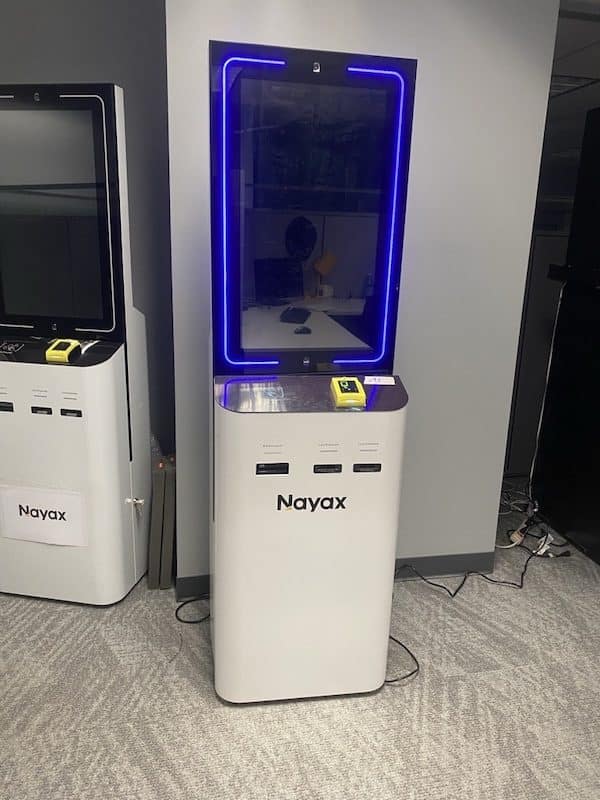
Image from https://www.amusementsandattractions.com/attractions/products/nayax-adds-prepaid-card-kiosk-to-amusement-solutions
Nayax has launched its Prepaid Card Kiosk, allowing amusement operators to sell and reload prepaid game cards from one self-service station. The kiosk accepts cashless payments through a built-in VPOS Touch, with cash acceptance available as an option. It is available now in the United States and Canada.
The system pairs with VPOS Touch readers on games, which can accept both credit cards and game cards. Nayax positions the product alongside its Tigapo offering, extending its options for street routes and smaller game rooms as well as broader amusement operations.
Our take: The useful distinction is payment choice. Operators can offer a prepaid play experience without requiring every customer to use a bank card at every game. Before buying, confirm the cash-acceptance configuration, card costs, reload workflow and how unused balances are handled.
Read the Nayax Prepaid Card Kiosk announcement at Amusements & Attractions.
IAAPA: Cash-to-Card, Ticketing and Accessibility in One Booth
An IAAPA booth worth noting: Gateway Ticketing featured a REDYREF cash-to-card reverse ATM, with ParTech and Vispero also represented, according to the shared show update.
Our take: That combination puts several related operator questions in the same conversation: ticketing, payments, cash access and accessibility. For a venue considering cashless operations, the evaluation should include the customer who arrives with cash—not just the customer already carrying a payment card.
Ask what cards the reverse ATM dispenses, where they can be used, what fees or minimum loads apply, and how customers retrieve or spend any remaining balance. Evaluate accessibility across the complete transaction rather than treating it as a separate hardware feature.
See the shared IAAPA booth update.
Stadium Checkout: VisioLab Reports 120 New Kiosks in September
VisioLab deployed 120 new kiosks in September, described as the company’s “biggest month ever,” according to Stadium IT Forum. The report positions VisioLab as a challenger to Mashgin in optical-scanning self-checkout and highlights competitive pricing and smaller, lighter devices as attractions for venue concession operators.
Our take: Physical flexibility deserves attention alongside recognition accuracy. Buyers should ask how easily a unit can be positioned, moved and integrated into an existing concession layout—and what happens when an item is not recognized or a customer needs assistance.
The 120-unit figure describes September deployment activity, not VisioLab’s total installed base. Pricing and performance comparisons should also be evaluated against the specific venue configuration rather than assumed to apply universally.
Read Stadium IT Forum’s VisioLab report.
Edge AI: Giada Promotes LDF-310 Industrial PC
Giada’s LDF-310 is the latest local AI computing platform on our radar. According to the company’s shared product information, it supports optional RK1820 and RK1828 AI accelerator modules, with up to 26 TOPS of inference performance using the RK1820.
Giada also lists on-device deployment of large language models with up to 7 billion parameters, targeting applications including multimodal inference, machine vision, robotics and industrial systems.
Our take: For kiosk developers, the question is not simply whether a model fits on the device. Ask for a demonstration of the intended workload, including memory configuration, model quantization, response time and sustained thermal performance. The headline TOPS figure is a starting point, not a substitute for an application benchmark.
See the Giada LDF-310 product post.
Parcel Kiosks: Royal Mail Tests Self-Service at 26 Shops
Royal Mail has announced a three-month self-service kiosk trial across 26 Royal Mail Shops, including locations in Manchester, Sunderland and Cornwall. The stated objective is to help customers send parcels faster.
In its announcement, Royal Mail describes an out-of-home network of approximately 30,000 parcel points, including 3,300 lockers, 8,500 Royal Mail Shops, 1,200 Customer Service Points, 11,500 Post Office branches and 1,400 parcel postboxes.
Our take: Keep the trial scope separate from the network headline. This is a 26-shop kiosk test, not a network-wide kiosk rollout. What we would like to see next: transaction completion rates, the amount of staff assistance required and whether the kiosks reduce queues during busy periods.
Read Royal Mail’s kiosk trial announcement.
Restaurant Watch: Burger King’s Counter Gains and Remodel Friction
A shared Burger King update highlights a contrast between gains at the counter and franchisee resistance to restaurant remodels. Our app uses the direct earnings reports to create stats and comparisons for BK, McDonalds and Wendys. We wish they would break out in-store versus drive-thru but they don’t, as yet.
Our take: For restaurant technology suppliers, it is worth separating the appeal of an improved customer experience from the economics of the full remodel. A franchisee still has to evaluate capital requirements, installation disruption and the expected return. A promising counter experience does not, by itself, settle those questions.
Read the Burger King discussion on LinkedIn.
Gift Cards: REDYREF Highlights PerfectGift.com Kiosk
REDYREF shared a look at an RFID gift card kiosk for PerfectGift.com at Ross Park Mall in Pittsburgh. The distinguishing feature is the gift presentation: shoppers can select a gift card holder that lets them record and send a personal video message with the gift.
Our take: It is a useful example of adding something beyond card dispensing. The kiosk connects a physical gift purchase with a digital message, giving shoppers a way to make a gift card feel more personal.
See REDYREF’s PerfectGift.com kiosk post.
Thin Client IT Tools: Proton Pass Versus Bitwarden
For readers managing publishing systems, administrative accounts and remote-access tools, this week’s practical software read is a MakeUseOf contributor’s explanation of switching from Bitwarden to Proton Pass.
Bitwarden is already a straightforward option in our experience. The article makes the case for looking at Proton Pass, but it is a personal workflow comparison—not proof that one service is the better choice for every organization.
Our take: Evaluate a switch around your actual requirements: account recovery, credential sharing, export options and compatibility with the browsers and devices you use.
Read the Bitwarden-to-Proton Pass comparison at MakeUseOf.
Research Resource: Self-Service Research Catalog
The Industry Group’s Self-Service Research Catalog brings together accessibility resources, vendor risk analysis, Voice AI research, industry databases and market reports.
One example is the kiosk accessibility compliance matrix covering Section 508, ADA, ACAA, EAA and EN 301 549. Other resources address identity verification and data retention, infrastructure planning, and retrofit-versus-replacement decisions.
Use the catalog to identify the resource that matches your project, and check individual listings for scope, pricing and access terms. Kiosk Manufacturer Association members may qualify for reduced pricing or complimentary access to selected resources.
Browse the Self-Service Research Catalog.
Practical Tip: Front or Rear Kiosk Servicing?
Front serviceability should be the default for most retail and restaurant kiosks, but the real issue is maintenance time—not which side opens. Rear access can be the better option when the kiosk backs into a secure staff area.
Our servicing guide includes an Olea Kiosks video and a practical procurement test: can a technician replace the printer, payment terminal, PC or power supply while the kiosk remains anchored in its installed position?
A front-opening door is not enough if components remain buried behind brackets and cables. Ask suppliers to demonstrate routine maintenance and document door swing, component extraction clearance and technician working space. Check whether servicing obstructs customer circulation or accessible routes.
Read Front vs. Rear Kiosk Servicing: Which Is Better?
What to Watch Next
- Royal Mail: Whether the 26-shop trial produces measurable improvements in parcel transactions and customer assistance requirements.
- Optical checkout: How deployment growth translates into repeat orders, operating results and support requirements.
- Local AI: Application-level benchmarks that show what the advertised hardware can deliver in a production kiosk.
Recently Updated Articles
- GRUBBRR Self-Ordering Kiosks: Software, POS Integrations and Restaurant Results
Updated November 2026 GRUBBRR provides self-ordering kiosk software …
- McDonald’s Times Square Kiosks: Flagship Design and Self-Service Lessons
Updated November 2026 McDonald’s Times Square flagship …
- Home Depot Self Checkout Kiosks Review – Francie Mendelsohn
Field hardware review by Francie Mendelsohn, President, …


