

Last Updated on August 6, 2026 by Craig Allen Keefner
RetailNOW 2026 – Discovery and execution call for stronger tech partnerships: 10 takeaways
Retail author Carl Boutet describes challenges facing tech providers to RSPA’s Jim Roddy during the general session.
Table of Contents
Show Report
The pace of change in retail technology is coming faster than many people realize. That much was evident at last week’s RetailNOW 2026 at Caesars Forum in Las Vegas.
Those who attended came away better prepared to take on the challenges and opportunities posed by AI-powered data analytics as it redefines retail IT and connected commerce. RetailNOW serves as the annual confab where the Retail Solutions Providers Association (RSPA) orchestrates alignment and knowledge transfer among independent software vendors (ISVs), value added resellers (VARs), manufacturers and distributors.
As technology creates new tools for retail IT infrastructure – networking/connectivity, omnichannel integration, cybersecurity, cloud computing and data analytics – discovery and execution decisions multiply, amplifying the need for partnerships among VARs, ISVs, manufacturers and distributors. Such players recommend hardware, install systems, integrate software, provide service managed fleets and influence replacement cycles.
“We’re sort of moving away from just pure solutions and we need to create value more and more through what I call insights,” Retail author Carl Boutet noted during his keynote presentation interview with RSPA President/CEO Jim Roddy. “We’re not in the hardware or software business. We’re in a business that helps retailers and companies alike create value for their customers.
“You’re not selling a solution, per se, you’re selling an opportunity to create insights for your customers,” Boutet continued. “And those insights are going to become more and more accessible because we have technology now that really allows us to capture those insights and aggregate all the information that comes from the technologies that you’re installing day in, day out; front of house, back of house, supply chain logistics, all the way to loyalty and delivery.”
RSPA members’ role also becomes more critical as retailers seek a more unified technology ecosystem to eliminate operational friction and elevate customer experience.
“It’s such a huge ecosystem and it’s more and more intertwined,” Boutet said, adding that all retail technologies today capture information.
To this end, Intel Corp., a provider of processors and a first-time RetailNOW exhibitor, sponsored a RetailNOW Walking Tour in partnership with The Industry Group to guide solution providers through a curated set of 20 exhibitors: Intel Corp., Advantech-Aures, Ingenico, Crane Payment Innovations, Datacap Systems Inc., NMI, FreedomPay, PAX Technology, Posiflex, Square Inc., Toshiba Global Commerce Solutions, Shift4, Diebold Nixdorf Inc., Magtek Inc., ID Tech, Datalogic, Partner Tech USA, POSBank, Star Micronics and MicroTouch.
The Walking Tour demonstrated how POS, self-service kiosks, payments, digital signage and AI devices are working together to create unified platforms. Attendees discovered hardware and software providers working to combine edge AI, omnichannel payments, kiosks, self-checkout, printers, remote management and customer engagement, all orchestrated as one managed environment to eliminate operational friction.
10 Takeaways
Following are takeaways from the trade show floor.
1) Value added resellers (VARs) and independent software vendors (ISVs) play an important role in helping retailers develop a unified technology stack. This role is important as retailers adapt AI technology to add new capabilities. VARs and ISVs offer the unifying thread to help retailers move from a patchwork of solutions to a unified, data sharing tech stack. Retailers must evaluate how new tools meet their needs, which ones scale best and which providers they should trust. The Intel Corp. sponsored Walking Tour demonstrated how kiosks, POS, payments, digital signage and AI edge devices are merging into unified platforms. Examples from the show floor include:
- Datalogic introduced its Smart Portal, a self-service hub connecting people, devices and digital services to make interactions faster, more autonomous and easier to manage.
- LANDI Global’s new partnership with Valor PayTech brings LANDI’s Android-based payment and POS devices to Valor’s U.S platform ecosystem — creating an operational foundation for a product collaboration.
- Magtek showed how real-time communication between MagTek’s commerce ecosystem and the cleverQ orchestration platform can provide a secure ecosystem.
2) Embedded payments are taking a lead role in defining the retail infrastructure. Software now allows embedded payments to improve the user experience, provide secure transactions, reduce administrative work, generate customer data, boost customer loyalty and create new revenue streams. The anonymized data can deliver market insights to customize the user experience. Embedded payment software can serve as the “central nervous system” of a retail tech stack by making the payment event the main data and workflow trigger tying together POS, inventory, accounting, loyalty, CRM and analytics as opposed to a bolted-on, siloed activity. Exhibitors showcasing payment innovation included: Bluefin, Datacap Systems Inc., Dejavoo Systems, Datalogic, Pax Technology Inc., ID Tech, Verifone, Ingenico, Global Payments Inc., FreedomPay, HP Inc., LANDI Global, NMI, Optima, Shift4, Toshiba Global Commerce Solutions and Verifone.
3) Mobile POS continues to accelerate at a fast pace. Downsized POS hardware allows more versatile ways to serve retail and restaurant customers. Mobile POS enhances the retail order-and-pay toolbox, enabling retailers to meet diverse customer needs. SoftPOS in particular enables existing mobile devices to accept contactless card and mobile wallet payments without investing in traditional payment hardware. Exhibitors displaying mobile POS technology included: Datacap Systems Inc., Dejavoo Systems, Esper, Global Payments Inc., Histone, ID Tech, Ingenico, KwickPOS, LANDI Global, LOC Software, MicroTouch, Mobil POS, NMI, Optima, OrderCounter, Partner Tech, Pax Technology Inc., POSBank Co. Ltd., Posiflex, Shift4, Sound Payments, Square Inc., Star Micronics, T-ROC Global, Topwise, Toshiba Global Commercial Solutions, Touch Dynamic and Verifone.
4) AI-powered biometric identity verification offers beneficial payment options. Facial, fingerprint and voice recognition can eliminate the need for card or phone payment and offer a higher level of fraud protection. They also offer a customer convenience once a customer creates a profile linked to funding sources that the retailer can access. The retailer can automatically apply the stored identity to loyalty, membership rewards and other benefits without the need for apps, enhancing customer loyalty. Examples from the show floor included:
- Global Payments Inc.’s AI-first Genius handheld features AI-powered voice ordering technology, which allows servers to have live conversations with customers while the POS builds the ticket in the background.
- Partner Tech uses AI-powered voice ordering and accessibility solutions in its Alfred PS-137 and Paula kiosks in partnership with Code Factory, Vispero, and URWay Holdings.
- Toshiba Global Commerce Solutions uses a camera with biometric edge computing in a self-checkout kiosk to enable biometric payments and monitor customer behavior.
- Verifone uses facial recognition and palm vein scanning to verify customer identity before authorizing payment or loyalty actions on its Victa kiosks.
5) AI creates operational insights it can act on in real time.
An AI education panel agreed that AI tools conduct ongoing operational tasks in real time with increased accuracy. Benefits include improved payment settlement, transaction reconciliation, chargeback review and fraud prevention. Examples from the show floor included:
- Toshiba Commerce Global Solutions’ AI-enabled computer vision uses a camera to monitor customer behavior and identify potential shrink activities at checkout. In situations where a customer has made a mistake at the point of sale, the system can alert an employee in real time and allow the employee to assist the customer.
- FreedomPay’s AI-enabled real-time payment Observability tool lets teams see, correlate and act on payment performance across in-store and digital channels. The tool monitors live payment telemetry data – including transactions, devices and processor connections. AI alerts and anomaly detection report any unusual patterns automatically, identifying a probable cause and suggesting a remediation.
- Shenzhen Meking Electronic Technology Co. Ltd.’s AI Kitchen Display System combines digital order management with data analysis. Unlike traditional KDS solutions that mainly display orders, the AI-enabled KDS helps restaurants optimize kitchen workflows by analyzing order status and preparation time, kitchen workload, cooking efficiency and operational patterns.
6) AI helps retailers build trust with the customer. In making in-stock inventory and pricing more accurate, AI enables the retailer to assure the customer that what they want to buy is correctly priced and available. It also enables fair pricing across different locations and different retail channels. In addition, it reduces out-of-stocks by improving demand forecasting and supply chain accuracy. Keynote speaker Carl Boutet said AI algorithms continue to identify ways retailers can build customer trust. Retailers now have more tools to find ways to improve their public reputations. Research has shown, for example, that when companies post sponsored links, it undermines customer trust since customers don’t give credence to such links. Businesses also have opportunities to access customer feedback on websites which they can use to improve their reputation.
7) As technology advances, retailers and tech providers alike must vet tech partners carefully. A panel on what VARs and ISVs need to know in facilitating evolving retail payment technology agreed many companies base their partnerships on personal contacts rather than vetting qualifications. “Once you’re embedded, you made a quick decision without fully understanding what you are doing, it’s really hard to unwind that,” said panelist Kim Fitzsimmons, CEO of Talus Pay, a financial technology and payments processor. At the outset, partners must have a deep understanding of the technology and must understand where each partner’s liability begins and ends.
8) To succeed with AI, businesses must foster a supportive company culture. While many companies embrace AI, not all employees are on board. The media has made it clear that many people fear AI will replace their jobs. Such individuals do not welcome AI initiatives. It is therefore imperative for owners to remember the slogan: “Technology is supposed to empower your employees, not replace them.” Any type of change can be unsettling for people. But to succeed in any field, people need to accept change. Keynote speaker Carl Boutet observed that while the core of a business decision evaluation will be driven by technology, a human ultimately makes a decision. “AI plus human equals happy,” agreed Jim Roddy, president and CEO of RSPA.
9) Retail IT needs to embrace Agentic Engine Optimization (AEO). AEO is a tool for structuring product data so AI coding agents can find it. It is the practice of structuring, formatting and serving technical content for AI coding agents, not just human readers. When the Internet came on the scene, users structured their content for search engines (search engine optimization – SEO). AEO serves a different consumer: AI agents that autonomously fetch, parse and reason over a company’s content. “You need to get your customer data clean and ready in the next 18 to 24 months because this agentic freight train is coming down the tracks,” panelist Brett Bennett, president and co-founder of POSitive Technology said in the session, “Turning Data into Dollars: Analytics Opportunities for VARs and ISVs.” According to a recent article by Addy Osmani, a director at Google Cloud AI, AEO content must include:
- Discoverability: Can agents find your documentation without rendering JavaScript?
- Parsability: Is the content machine-readable without requiring visual layout interpretation?
- Token efficiency: Does the content fit within typical agent context windows without truncation?
- Capability signaling: Does the documentation tell agents what your API does, not just how to call it?
- Access control: Does your text actually let AI traffic through?
10) ADA compliance continues to enhance the customer experience. Studies have shown that most people hold a more positive view of businesses that work to be inclusive. The Americans with Disabilities Act requires that newly constructed facilities, occupied on or after Jan. 26, 1993, meet or exceed the minimum requirements of the ADA standards. Alterations to facilities, spaces or elements (including renovations) on or after Jan. 26, 1992, also must comply.
An example from the trade show floor was Partner Tech’s AI-powered Alfred PS-137 and Paula kiosks, which feature generative AI-powered voice ordering and accessibility solutions, including: Anker ADA-Pad and Vispero JAWS for Kiosk accessibility solutions; Voicelaier from Code Factory, a generative AI voice-ordering technology; and the AI Connect Bar from URWAy, offering integrated microphones and speakers for improved voice interaction.
Exhibit Highlights
Following are highlights from the exhibit floor in alphabetical order:
Advantech-Aures
Advantech-Aures presented its services to assist companies working to manage POS and kiosk hardware and software, including AI and IoT based solutions.
The company designs, develops and manufactures POS and kiosk solutions for the retail, commerce, hospitality (hotels, restaurants and food service), leisure, entertainment, transportation, public and other sectors.
Services include consulting, staging, decommissioning, asset tracking, real-time POS monitoring and customized on-site support and warranty.
When the task of replacing old POS hardware or finding the right solution for a new installation is beyond a company’s expertise, Advantech-Aures can guide them to the optimum choice of equipment and peripherals.
When upgrading POS infrastructure, Advantech-Aures engineers can manage the removal and disposal of old hardware (including HDD or SSD data deletion) in line with international environmental norms.
Services include the preparation of machines, pre-loading of the necessary OS and software, system mastering, development of special images and tailored configurations.
Beelta
Beelta, a manufacturer of displays, kiosks, tablets, cash drawers and digital signage, introduced a kiosk stand that supports display screens equipped with a receipt printer and a payment device.
The company’s stands integrate with POS systems and offer the advantage of customizable branding. The dedicated space for receipt printers allows businesses to select the printer model that best suits their needs.
Bluefin
Bluefin, a provider of data security infrastructure that uses PCI-validated point-to-point encryption (P2PE), tokenization and orchestration across processors and platforms, presented its P2PE Manager and its ShieldConex Orchestration platform for securing data across every stage of the customer journey.
The PCI-validated P2PE for card-present payment security encrypts payment data immediately at the point of interaction and protects it until it reaches a secure decryption environment. The solution supports more than 120 PCI-validated devices, including contactless, face-to-face, mobile, unattended and call center environments for manufacturers such as Pax Technology, ID Tech, Verifone, Ingenico and more.
The ShieldConnex Orchestration platform secures payment and personal data across every stage of the customer journey, combining real-time, vaultless tokenization with PCI-validated P2PE, giving locations control and flexibility without locking them into a single processor.
Bluefin recently announced a strategic partnership with LANDI Global, a provider of POS terminals and payment technology, to offer a direct-to-processor P2PE solution designed to simplify and accelerate secure payment acceptance across terminal environments.
The joint solution combines LANDI’s Android-based payment terminals with Bluefin’s PointConex platform, enabling processor-agnostic, PCI-validated P2PE without requiring merchants, ISVs, gateways or processors to redesign existing payment flows. Designed as a no-code proxy infrastructure layer, PointConex secures cardholder data in transit while preserving existing processor message formats and certifications.
- This illustrates Takeaway # 2 on embedded payments.
Bluestar
BlueStar, a value-added technology distributor for digital signage and POS solutions, introduced Samsung’s spatial signage technology on an 85-inch display screen.
The display, powered by Samsung’s patented 3D plate technology, brings 2D content to life in 3D video in a 2-inch profile.
The user uploads images and writes a prompt to generate video content. Samsung’s cloud-based VXT technology combines remote device management with content management and converts images into 3D visuals.
Samsung’s video processing technology enhances clarity and consistency while UHD technology, powered by Samsung’s Quantum processor, enhances lower-resolution video to UHD.
An anti-glare panel and optimized haze level reduce reflections from sunflight and indoor lighting.
CPI Service
CPI Service, the service arm of Crane Payment Innovations and a first time RetailNOW exhibitor, offered information on its service model, which connects installation, maintenance, repair and support under a unified service model to maximize uptime and simplify operations.
The company services self-checkout machines, kiosks, smart safes, cash automation, ATMs and teller cash recyclers for the retail, hospitality, gaming and healthcare industries.
The end-to-end service experience consists of: installation and deployment; preventive maintenance; repair services; and management and optimization.
Rather than treating service as a series of handoffs, CPI Service connects four lifecycle stages into a coordinated model. Each stage contributions data, context and accountability to the next. The result is not merely a faster response, but a service environment capable of improving with time.
Parent company Crane Payment Innovations is a manufacturer of payment, authentication, cash processing and self-service technologies.
Datacap Systems Inc.
Datacap Systems Inc., a hardware and processor-agnostic omnichannel payments provider, introduced SureTap, a SoftPOS bring-your-own-device solution that enables POS providers and their merchants to accept mobile payments without the need for dedicated payment hardware.
The solution supports contactless tap transactions directly on NFC-enabled Android devices and is powered by Datacap’s omnichannel payments gateway, allowing POS providers to seamlessly activate SoftPOS with the same standardized integration used for countertop, mobile and unattended devices.
SureTap key features include:
- Simple integration: Datacap’s partners use the same Android API stack leveraged for traditional card-present terminals, minimizing the time to develop and activate the solution.
- Channel-friendly deployment: ISVs control pricing and customer ownership with no direct-to-merchant competition.
- Consolidated reporting: An extension of a unified commerce offering, SureTap transactions display alongside traditional credit, debit, ACH, ecommerce and gift transactions in Datacap’s reporting dashboard, enabling a unified commerce experience.
- Consistent experience: SureTap’s position in a broader payments ecosystem enables unified settlement, reporting and reconciliation across mobile, countertop, online, unattended and recurring payments.
- This illustrates Takeaway # 2 on embedded payments and Takeaway #3 on mobile POS.
Datalogic
Datalogic, a provider of automatic data capture, introduced its Datalogic Smart Portal, a self-service hub connecting people, devices and digital services to make interactions faster, more autonomous and easier to manage.
More than a kiosk or mounted tablet, Smart Portal combines enterprise-grade scanning, NFC technology and connectivity in one wall-ready platform. Its 25-degree tilted scan engine places every scan at an angle, allowing users to access information, services and self-service workflows without adjusting their posture or device height.
The solution turns self-shopping into a connected journey. Shoppers can identify themselves using loyalty cards, activate self-shopping devices, access promotions, verify prices, check availability and complete checkout tasks such as NFC payments or age verification.
The solution also streamlines appointment management, information access and facility navigation, reducing administrative workload while improving service continuity. The digital concierge services help reduce queues while allowing staff to focus on more personalized and higher-value guest interactions.
Smart Portal helps retail, hospitality and healthcare clients install, power and maintain self-service points quickly and consistently, reducing deployment effort and operational complexity through VESA standard mounting, PoE or standard power, and remote management capabilities. To support long-term performance, security and lifecycle continuity as self-service needs evolve, the solution is powered by the Qualcomm Dragonwing platform and upgradeable through Android 19.
- This illustrates Takeaway #1 on unified tech stack and Takeaway #2 on embedded payments.
Dejavoo Systems
Dejavoo Systems highlighted its Android P line, including the P8 wireless dual screen (customer facing and operator/attendant facing) payment terminal running on Android 15 and accesses connectivity networks via 4G/3G/2G and Bluetooth Wi-Fi. The 6.7-inch main screen is a glass touchscreen while the 2.5-inch subscreen has a touch panel NFC reader. The device comes in a four-sided carbon fiber shell.
The P8 Dual Screen Go is a handheld variant of the P8 that is designed for line busting, tableside payments or curbside payments.
The company’s P12 mobile device has a scratch-resistant 4-inch touchscreen and is powered by a quad-core processor, dual-band Wi-Fi connectivity.
Dejavoo mobile devices also feature “tap-to-Pay” and QuickBooks integration.
The company won the Bronze Medal for the RSPA Vendor Award of Excellence.
- This illustrates Takeaway #2 on embedded payments and Takeaway #3 on mobile POS.
Diebold Nixdorf Inc.
Diebold Nixdorf Inc., a technology provider to the banking and retail industries, displayed its Beetle A2110 all-in-one POS system, a front-end kiosk/POS solution featuring a modular platform consisting of interchangeable touch panels, motherboards and I/O hubs.
The new high-performance CPU module features Intel Alder Lake PS and Raptor Lake PS processors, with integrated graphics and the low power consumption of a mobile processor and the flexibility of a socketed desktop processor.
Features also include:
- Angled and height adjustable desktop stand
- Antiglare display surface
- LCD supports individual adjustments, reducing light reflections
- Two solid-state drives
- Supports remote asset management and remote monitoring
- VESA 100 mounting on a counter, pole or wall
- Adaptable peripherals: MSR, iButton, NFC/RFID, 2D BCR, rear-mounted customer display
- Windows 10 and 11
Epson America Inc.
Epson America Inc., a manufacturer of industrial and robotics, office and home printing, and visual and lifestyle devices, showed a range of solutions from POS and kitchen printers to color labeling and business inkjet printing, along with technologies supporting self-service, mobile and back-office applications.
- The OmniLink TM-T88VII receipt printer offers connectivity between multiple devices.
- The TM-U220II kitchen printer allows for online ordering and mobile and PC-POS systems support.
- The OmniLink-mSeries thermal receipt printers deliver connectivity in a compact enclosure.
- The ColorWorks color label printers, including the new CW-D3800, enable retailers and restaurants to produce customized color labels on demand, including to-go, shelf tag and baked goods labels. Businesses can also create color to-go labels with customizable promotional messaging using ColorWorks printers and TrueOrder KDS, a kitchen display system that digitizes kitchen operations to enhance productivity and streamline workflow.
- The OmniLink TM-L100 liner-free thermal label printer helps retailers meet demand for digital orders or item labeling in-store for buy-online-pickup-in-store (BOPIS), curbside pickup or delivery.
- Mobilink portable receipt printers enable retailers to untether operators from the POS terminal, even taking them beyond the four walls if necessary.
- The EU-m30+ kiosk printer integrated into the REDYREF interactive kiosk enables line busting.
- Epson’s business printers, powered by PrecisionCore heat-free technology, reduce downtime, minimize operational interruptions and support everyday retail workflows.
Esper
Esper, a provider of mobile device management (MDM) solutions for kiosks, POS systems and tablets, highlighted its edge device management infrastructure and its “build once, deploy everywhere” capability for VARs and ISVs to manage fragmented hardware fleets.
The company recently introduced its Esper Airwave solution for Android OEMs seeking firmware delivery without building the delivery layer themselves. The solution handles the full over-the-air lifecycle – uploading, staging and rollout – and works with any Android Open Source Project build without requiring MDM enrollment.
Esper provides the infrastructure, including cloud storage, cryptographic signing and rollback logic while the client provides the firmware package.
The client does not need to change their device management strategy and can work with any MDM vendor or no MDM vendor.
- This illustrates Takeaway #3 on mobile POS.
FreedomPay
FreedomPay, a payment gateway and a provider of a payment orchestration platform, highlighted its real-time payment Observability tool, letting teams see, correlate and act on payment performance across in-store and digital channels.
The Observability tool monitors live payment telemetry data – including transactions, devices and processor connections – to find and correct issues before they impact sales. The tool identifies every authorization, decline, timeout and device heartbeat.
The tool pinpoints exactly where a payment failed and follows any transaction from the first tap through authorization. When payments break, the IT team can see exactly where the degradation occurred in the journey. AI alerts and anomaly detection surface unusual patterns automatically, identifying a probable cause and suggesting a remediation.
The tool leverages Dynatrace’s AI-powered Observability platform to detect anomalies and prevent degradation before it reaches a customer.
Through this partnership, the Observability payment layer becomes a native part of Dynatrace dashboards, alerts and workflows.
- This illustrates Takeaway #5 on AI-enabled operational insights.
Global Payments Inc.
Global Payments Inc., a payment technology and software provider, introduced its AI-first Genius handheld designed for both the physical demands of frontline environments and AI advances that are transforming how businesses run. The handheld slips into standard aprons and pockets while delivering the capability to communicate with intelligent agents that can drive faster, smarter operations.
The handheld features AI-powered voice ordering technology, which allows servers to have live conversations with customers while the POS quietly builds the ticket in the background.
The AI-first handheld POS also enables a range of opportunities to use the device for improving operations, including real-time upsell prompts, natural language commands for updating pricing and menus. These include:
- Advanced computing power: Neural processing capability handles inference workloads locally, enabling AI features to run on the device rather than relying solely on the cloud.
- Multiple built-in microphones: Microphones are built into the design to support servers with order taking, leveraging natural language processing to support voice-driven workflows like spoken order entry – and other use cases.
- Always-on connectivity: 5G capability and offline mode ensure payments can be made anywhere, anytime. EMV and NFC payments are built in with an optional magnetic stripe reader.
- Faster charging and all-day reliability: USB-C fast charging, plus multi-bay stations, support full-service shifts.
- This illustrates Takeaway #3 on mobile POS and Takeaway #4 on AI biometric payments.
Histone
Histone, a manufacturer of POS hardware, demonstrated customizable self-checkout solutions for foodservice and retail, including retail self-checkout kiosks, touchscreens, monitors, all-in-one POS devices, POS boxes and mobile POS systems.
The company introduced its HM638 mobile POS tablet to bring ordering, payment and customer service directly to the point of interaction.
Running on Windows 10 and 11, the HM638 mobile POS tablet features a 11.6-inch wide screen with 1920 1080 resolution, a capacitive touchscreen, Intel N Series CPU, 8GB up to 16GB, 128GB up to 512GB, an integrated MSR card reader with three tracks, an 8MP AF rear-facing camera, a 5MP AF front-facing camera, a 1-G sensor and I/O ports.
The company plans to introduce an Android version of the HM638 tablet.
- This illustrates Takeaway #3 on mobile POS.
HP Inc.
HP Inc., a provider of AI powered workplace devices, software and services, introduced its HP Engage One Pro G2q, an enterprise-grade Android all-in-one POS platform powered by the Qualcomm Dragonwing Q-6690 processor and running Android 16 with Google Mobile Services.
The HP Engage One Pro G2q is built on the same enterprise industrial design as the Windows-based HP Engage One Pro G2 — giving customers a true OS choice without compromising on the hardware, peripheral ecosystem or manageability.
HP now supports one of the broadest sets of operating systems in retail, including Windows, Windows IoT, Linux and Android.
The G2q is designed for continuous operation with fanless construction, integrated peripheral options, Wi-Fi 7, Bluetooth, NFC, and on-device AI processing for vision and voice workloads at the counter. Features also include:
The single-tap multi-function NFC enables contactless payments and instant loyalty engagement.
It is available in three screen sizes, multiple orientations and a flush-mount ecosystem of peripherals.
The unit is built with 85% post-consumer recycled plastic and is Electronic Product Environmental Assesment Tool (EPEAT) registered.
The company also demonstrated its Engage Express which converts the its Engage One Pro into a self-service kiosk that works with multiple-size head units in landscape or portrait mode. The unit comes in countertop or pedestal stand configurations and offers configurable features, including an optional integrated printer, barcode scanners and an integrated payment terminal.
ID Tech
ID Tech, a manufacturer of payment hardware and data capture products, introduced its NEO 4 Android based solutions tailored for POS and unattended kiosks.
The NEO 4 series builds on ID TECH’s established Common Kernel infrastructure to support EMV, magstripe and contactless (Apple Pay, Google Pay) transactions with industry-standard P2PE and PCI security. It brings Android OS functionality and networking capabilities directly to unattended retail and commercial systems.
The Neo 4 series includes:
- The AP6825 Payment Terminal features a 4-inch touchscreen, a 2MP front camera and supports magstripe, chip and PIN and contactless payment, Google Pay, Apple Pay and Samsung Pay.
- The AP6828 Payment Terminal features a 4-inch touchscreen, a 2MP front camera and supports magstripe, contactless, Apple Pay, Google Pay, Samsung Pay and Google Smart Tap.
- The AP6885 Outdoor Payment Terminal features a 5-inch touchscreen and 5MP front camera and supports magstripe, chip and PIN, contactless, QR barcode, Google Pay, Apple Pay, Samsung Pay and Google Smart Tap.
The company also displayed units from the earlier Neo 3 line:
- The VP3350 Mobile Payment Reader is a 3-in-1 mobile device designed for flexible payment processing, supporting USB-C, Bluetooth and Lightning connectivity.
- The AP3880P Handheld POS Terminal is an all-in-one portable device that integrates payment acceptance, barcode scanning and a built-in receipt printer.
- This illustrates Takeaway #2 on embedded payments and #3 on mobile POS.
Ingenico
Ingenico, a provider of payment solutions, highlighted its recently introduced AXIUM payment device family and Ingenico 360, a unified cloud platform designed to deliver consistent, enterprise-grade payment experiences while simplifying large-scale payment operations.
The AXIUM family is built on a common architecture that spans mobile, countertop, multilane, self-service, PIN pad and SoftPOS form factors. Every AXIUM device shares the same core design principles, is certified to PCI PTS v7, and runs Android 14, ensuring consistent security, compliance and behavior across global deployments.
Capabilities of the AXIUM family include:
- Unified architecture that streamlines certification and lifecycle management across diverse payment environments.
- Android 14 foundation field-upgradable to future Android versions.
- PCI PTS v7 regulatory compliance.
- AI-ready design in combination with Ingenico 360.
- Support for digital identity, stablecoin acceptance, loyalty and digital receipts.
- Redesigned UX with secondary display, LED guidance, integrated flows, haptics and audio cues.
Ingenico 360 is a cloud-native platform that integrates device management, transaction services, POS connectivity, applications, merchant tools, data and analytics, digital receipts and developer capabilities through a single, cohesive architecture. Common data services operate consistently across the platform, providing complete visibility and enabling deeper operational insight.
- This illustrates Takeaway #3 on mobile POS.
Intel Corp.
Intel Corp., a provider of processors for the retail ecosystem and a first-time RetailNOW exhibitor, used its exhibit space to network with partner companies and familiarize attendees with Intel’s role in augmenting retail technology.
In concert with these goals, Intel also sponsored the RetailNOW Walking Tour in partnership with The Industry Group to guide solution providers through a curated set of 20 exhibitors. The tour was designed as a roadmap for channel partners looking to extend beyond traditional countertop POS into unattended and software-defined deployments.
The Walking Tour also demonstrated how kiosks, POS, payments, digital signage and AI edge devices are merging into unified platforms. Providers that can combine secure payments, AI, remote management and customer engagement are likely to dominate the retail landscape.
The Walking Tour also demonstrated the role Intel processors play in much of today’s retail infrastructure. From AI-powered vision systems and digital signage to restaurant kiosks, pharmacy automation and enterprise fleet management with Intel vPro, Intel continues to provide the performance, security and remote manageability that retail solution providers depend on.
- This illustrates Takeaway #1 on unified tech stack.
Kitchen Armor
Kitchen Armor, a provider of Power over Ethernet Plus (PoE+) kitchen technology, recently launched its all-in-one Windows Stainless-Steel Touch PoE+ display devices powered by Windows 11 IoT Enterprise LTSC, a version of Windows designed for fixed purpose, mission critical devices.
The release brings together Kitchen Armor’s all-in-one Touch PoE+ devices with a Windows operating system.
Power over Ethernet Plus, delivering both power and data through a single Ethernet cable, offers an approach that simplifies installation by removing the need for additional electrical infrastructure while reducing cable clutter throughout the kitchen.
The solution is designed to optimize performance for kitchen workflows.
KwickPOS
KwickPOS, a provider of a cloud-hybrid POS solution called American Table for restaurants, introduced an AI powered phone call-in service customers can call to place orders. The customer calls the number and speaks to an AI agent that asks questions, allowing the customer to place an order, be prompted to make additional purchases, pay for the order and know when it will be ready for pick-up or delivery. The software sends the order to the participating restaurant.
The company also presented its mobile app which unifies gift cards, loyalty programs, reservations and marketing tools into a single platform.
KwickPOS recently announced a partnership with Samsung Electronics America to enhance payment flexibility for restaurants across North America by enabling card and digital wallet payments at tables, counters or in the field.
- This illustrates Takeaway #3 on mobile POS.
LANDI Global
LANDI Global, a manufacturer of POS terminals, electronic cash registers (ECRs) and payment devices, introduced its C20 Pro, its flagship ECR powered by Android 13, as well as the upcoming Windows version, the Cx20.
Equipped with a Qualcomm Octa-Core processor, the C20 Pro also features SoftPOS capability and high resolution displays. Connectivity options include dual-band Wi-Fi, Bluetooth 5.0, and 4G support.
The company also showed the following:
- The Kx20 offers an enterprise-grade Windows self-checkout and POS kiosk for retail and hospitality, an all-in-one terminal featuring a 500-nit touchscreen, and peripheral integrations such as customer facing cameras for barcode scanning, NFC readers and built-in printers.
- The LANDI Connect, an all-in-one, device management platform, features software and payment integration capabilities, enabling clients to manage all devices and apps from one central platform while safeguarding data.
- M20 and M20 SE mobility solutions feature all-in-one Android powered mobile POS terminals with an ARM Quad-core 2.0GHz processor. The M20 features a built-in receipt printer and larger battery, whereas the M20 SE is a more compact device optimized for quick digital payments and scanning.
The company also announced a partnership with Valor PayTech, a provider of payment technology for ISVs, ISOs and retailers, to bring LANDI’s Android-based payment and POS devices to Valor’s U.S platform ecosystem — establishing the operational foundation for a deeper product collaboration. The alliance will initially focus on bringing LANDI’s Android-based device portfolio to Valor’s platform while the companies establish a joint partnership to identify and prioritize next-generation device opportunities.
- This illustrates Takeaway #1 on unified tech stack, Takeaway #2 on embedded payment and Takeaway #3 on mobile POS.
Linga
Linga, a provider of POS, kiosk, KDS and online ordering hardware, offered information about its self-order kiosk for hospitality. The all-in-one cloud-based solution includes self-service ordering, integrated payments, real-time loyalty and discount features.
Functions include taking orders, tracking inventory, loyalty integration, insights reporting, a built-in thermal printer and managing staff. The system is processor agnostic but offers its own payment processor.
Models include 32- and 21.5-inch floor stands, a 21.5-inch table stand and a 32-inch wall mount.
LOC Software
LOC Software, a provider of retail software, introduced a retail kiosk using the company’s ThriVersA self-service POS software. This add-on to LOC POS allows shoppers to place and pay for orders and print a receipt. They can also join a loyalty rewards program and manage their accounts at the kiosk. Customers can also view and clip coupons before checking out.
The company also demonstrated its ThriVersA Fuel fuel station POS software module, a part of the LOC POS and back office systems. The solution allows clients to manage prices at the point of sale, back-office workstation or head office.
- This illustrates Takeaway #3 on mobile POS.
Magtek
Magtek, a manufacturer of electronic systems and hardware for the issuance, reading and security of payment cards, checks and pins, demonstrated how Message Queuing Telemetry Transport (MQTT) technology and cloud-based solutions can facilitate a secure commerce ecosystem.
By partnering with cleverQ, a digital queue management and appointment scheduling platform, Magtek showed how real-time communication between MagTek’s commerce ecosystem and the cleverQ orchestration platform can provide a secure ecosystem.
The companies developed a unified customer flow solution that integrates secure identity authentication with digital queue management. The collaboration allows retailers to consolidate registration, identity verification and payments into a single, hardware-efficient workflow, reducing operational complexity and countertop clutter.
The integration of MagTek and cleverQ addresses the growing demand for streamlined retail operations by merging disparate systems into one cohesive journey.
By utilizing secure identity authentication, ISVs can offer a platform where a single QR code scan initiates the entire customer interaction. This mobile-first authentication approach removes the need for multiple standalone applications, allowing businesses to manage everything from line placement to final payment through a unified framework.
The integration accomplishes the following:
- Eliminates multiple terminals and redundant countertop hardware.
- Reduces friction during the customer registration and check-in process.
- Preserves retail space by consolidating digital and physical touchpoints.
MagTek’s Quantum Multi-Factor Authentication (QMFA) provides an API-driven framework that secures digital experiences without interrupting the user journey. The technology enables trusted identity verification across both digital and in-person environments, ensuring that every time-bound QR token issued is authenticated and secure. By embedding security directly into the queue management process, retailers can protect transactions while maintaining a high-speed, modern customer experience that prevents “lost customers” due to long or unmanaged wait times.
- This illustrates Takeaway #1 on unified tech stack.
MicroTouch
MicroTouch, a provider of touch technology and interactive display solutions, showcased its Mach POS all-in-one touch models featuring Windows 11 IoT Enterprise LTSC as well as Android 15 capabilities.
Operator and customer displays can both be configured with NFC readers embedded directly behind the glass, offering tap-to-pay functionality without external hardware. The design supports SoftPOS solutions, simplifying transactions for both staff and guests.
The Mach Ruggedized Line features ruggedized hardware for retail and QSR operations, including drive-thru tablets and outdoor kiosks.
The Mach Mobile 10.1-inch Android Tablet powered by the MediaTek MT8390 processor features a bright 500-nit, full HD touchscreen with anti-reflective optical bonding, ensuring visibility under direct sunlight. Features also include an integrated barcode scanner, front and rear cameras and a multi-color LED status bar. Optional accessories include a rotating hand strap, multi-port docking station and side-mounted peripherals.
The Mach Outdoor Touch Monitors are available in 10-, 21.5-, and 27-inch screen sizes. Each display features a metal enclosure, an optically bonded touchscreen with etched anti-glare, and a 1500 nit high-brightness panel for readability in direct sunlight. When integrated into an enclosure, these monitors are IP66-rated and provide IK10 impact protection, ensuring they can withstand sun, rain, snow, dust, wind and vandalism. Built-in features include ambient light sensors and UV protection to maximize longevity.
- This illustrates Takeaway #3 on mobile POS.
Mobil POS
Mobil POS, a provider of POS solutions for stationary, mobile, e-commerce and m-commerce, introduced integrations for LANDI Global retail and foodservice POS systems.
The integration for the LANDI C20 PRO supports an Android all-in-one checkout solution featuring a workstation, integrated customer display and built-in receipt printer. Features include:
- SKU, price and quantity look-up
- Capture/access customer information
- Mix-and-match promotions
- Gift and loyalty cards
- Email and/or print recipes
- Interface to QuickBooks, Sage SAP, RMH and Retail Pro
The integration for the food and beverage POS, which includes a workstation, built-in printer, payment terminal and cash drawer, supports the following functions:
- Assign tables, seats and servers
- Works online and offline
- Tableside orders and payments
- Route orders to the kitchen or bar
- Add-ons and modifiers
- Hold orders and reopen tickets
- Split checks by seat or plate
- Gift and loyalty cards
- Email and/or print receipts
- Recipe building and food costing.
- This illustrates Takeaway #3 on mobile POS.
NMI
NMI, a provider of embedded payments infrastructure, launched AXIUM SmartPOS, its first all-in-one card-present terminal line for ISOs, ISVs, SaaS platforms and their merchants. Built on Ingenico’s AXIUM Android platform and integrated with the NMI payment acceptance platform, the solution offers partners and their merchants an all-in-one POS solution for in-person payment acceptance.
AXIUM SmartPOS is designed for partners that need a single card-present solution to support retail environments. Unlike solutions that limit partners to a fixed application, closed ecosystem or single processor, the combined NMI and Ingenico solution supports customized software experiences, helping partners tailor the device around the way retailers actually work.
Retailers can speed up checkout, manage inventory and serve customers anywhere in the store. Hospitality businesses can accept payments across properties, at events or on the move for more personalized guest experiences. Restaurants can take orders and payments tableside or at the counter to improve service. Field service providers can invoice and securely accept payment as soon as a job is complete.
The combined solution supports all the major in-person payment methods, including chip, swipe, tap and mobile wallets. Its offline-first architecture also allows retailers to continue accepting payments even when connectivity drops, with transactions syncing automatically once service is restored.
- This illustrates Takeaway #3 on mobile POS.
Optima
Optima, a provider of all-in-one POS hardware, introduced three additions to its APOS POS line:
- The APOS-04 features a 10-inch touchscreen with a multi-line customer display and a 2.25-inch auto-cutter printer. The unit is Wi-Fi and Bluetooth enabled.
- The APOS-A4 features a 10-inch touchscreen, a 3-inch auto-cutter printer and a 4.3-inch customer display for promotions. The unit offers an optional charging base with 7.4V.
- The APOS-06 features dual-15.6-inch touchscreens, a programmable full-color status ring, USB 3.0 and an auto-cutter.
- Other products in the series include APOS-01, APOS-02, APOS-03, APOS-05 and APOS-05L.
In partnership with Datacap, a payment integrations provider, the APOS POS series connects to U.S. and Canadian processors with compatibility across PAX Technology, Global Payments, Maneris, TD Bank, PayFacta and thousands of ISOs. Payments are handled using a separate pin pad.
The APOS series POS units are embedded with the Optima GOPOS software which is periodically updated with functions and performance improvements.
- This illustrates Takeaway #2 on embedded payments.
OrderCounter
OrderCounter, a POS solutions provider, demonstrated its hybrid POS for restaurants, featuring the reliability of a server and the accessibility of a cloud solution.
The company presented its booking by OrderCounter, a hybrid-cloud-based integrated booking, POS and payments solution for retail and education locations. The solution is payment processor agnostic.
The platform offers the following features: online and in-store bookings, customer marketing and relationship management, memberships and recurring billings, in-store and in-app payments, client profiles, staff management, subscriptions, reporting and business insights.
The company also displayed its self-service kiosk for restaurants which offers flexible payment options and allows customers to give tips, both fixed and percentage based.
The company won the Gold Vendor Award of Excellence in the RSPA software category and the Retail IT Community Leadership Award for software, a back to back winner.
- This illustrates Takeaway #3 on mobile POS.
Partner Tech
Partner Tech, a provider of AI-powered self-checkout solutions and accessible self-service kiosks with voice ordering capabilities, introduced its Android GMS certified and Windows 11 POS platforms to help retailers streamline operations, reduce shrink and enhance the customer experience.
The platform for the company’s Alfred PS-137 and Paula kiosks features generative AI-powered voice ordering and accessibility solutions in partnership with Code Factory, Vispero, and URWay Holdings.
The company also showcased its AI-powered self-checkout, self-service kiosks and POS platforms:
- The Alfred PS-137 and Paula Kiosk solutions are available in floor-standing and countertop configurations and feature generative AI-powered voice ordering and accessibility solutions in partnership with Code Factory, Vispero, and URWay Holdings. The offerings include:
- Anker ADA-Pad and Vispero JAWS for Kiosk accessibility solutions for customers with visual impairments and other disabilities.
- Voicelaier from Code Factory, a generative AI voice-ordering technology.
- URWay AI Connect Bar, featuring integrated microphones and speakers for improved voice interaction in busy restaurant environments.
The company’s self-checkout offerings include its Starling solutions with the Otter SCO software platform, combining AI, computer vision and self-service technologies to help retailers reduce shrink and prevent theft, increase checkout speed, improve customer convenience and integrate with existing POS.
The POS offerings include the new Sofia5 Android POS terminal, second-generation Audrey and Cleo POS terminals for Android (GMS certified) and Windows 10/11, and the M10 Windows 11 tablet for mobile and table-side ordering.
- This illustrates Takeaway #3 on mobile POS, Takeaway #4 on biometric payment and Takeaway #10 on ADA compliance.
PAX Technology Inc.
PAX Technology Inc., a provider of electronic payment solutions, introduced its self-ordering Smart Kiosk (SK900). Running on an Android 16 operating system and available with a 16- or 21.5-inch display, the kiosk is designed to redefine self-service ordering with a scalable platform for restaurants.
PAX Technology restaurant solutions include countertop, mobile, self-service and kitchen technologies that can be tailored for quick-service, fast casual and full-service dining environments. The Android-based platforms allow restaurants to scale and adapt as business needs evolve.
The company also displayed a pin pad to be released in the fourth quarter. The company’s pin pads feature high-resolution color displays, intuitive keypads and compact designs.
- This illustrates Takeway #2 on embedded payments and Takeaway #3 on mobile POS.
POSBank Co. Ltd.
POSBank Co. Ltd., a POS and kiosk hardware manufacturer, educated attendees about its Forged POS and PAI 1010 tableside mini ordering kiosk.
The Forged POS features a 15.6-inch display and Intel 13th generation CPU, as well as water and dust resistance, slim bezel and various installation options. The slide-in expandable I/O box is designed to add interfaces and provides connectivity with various port configurations including powered USB. Features also include:
- The front of the display is made of tempered glass to enhance durability and clarity, while the adjustable touch angle provides usability in various work environments. VESA mounting enables it to respond to various installation environments such as wall, arm and desk mounting.
- A fanless thermal management system enables heat control without a separate fan, evenly distributing heat throughout the aluminum case, enabling stable operation without noise and minimizing internal dust inflow.
The PAI 1010 mini kiosk allows customers to order and pay at the table. The display can be swiveled and tilted, and built-in battery and external battery options allow use in places with limited electrical power. Features also include:
- The built-in battery enables use without power wiring, and the reinforced bottom stand protects the device from substances on the table.
- The kiosk can swivel left and right up to 90 degrees, allowing multiple people sitting at a table to share the screen at any angle. The ordering screen can be tilted up to 20 degrees to the side, allowing each user to adjust the optimal viewing angle.
- Optional peripherals include a card reader, an NFC payment and MSR in built-in USB and external USB-C types.
- This illustrates Takeaway #3 on mobile POS.
Posiflex
Posiflex, a provider of POS and self-service hardware solutions, showcased its latest portfolio of POS terminals, self-service kiosks, mobile computing solutions and kitchen display systems. Highlights include:
- The GT Series POS terminals are powered by Intel Core i3/i5 series processors. The GT7115 features a 15-inch on-cell touch panel with multi-touch support; the GT7116 and the GT7116A both feature a 15.6-inch on-cell touch panel with multi-touch support;
- The Mozart BT Series transitions between traditional POS and self-service kiosk configurations. The Mozart BT8015 and BT8016 feature a design that conceals all cables and incorporates Intel 13th Gen processors, dual 15- or 15.6-inch multi-touch screens, and an optional integrated thermal printer.
- The Mercury Series Kiosk features a 15.6-inch or 21.5-inch projected capacitive touchscreen, supports Windows or Android, and can be mounted on a countertop or floor-standing pedestal.
- The Cachet Series Kiosks are available in 24-, 27- and 32-inch sizes, featuring integrated printing and payment components to support ordering, ticketing and self-service.
- The mobile and kitchen display kiosks feature tablets and displays running on Windows and Android platforms.
- This illustrates Takeaway #3 on mobile POS.
Shenzhen Meking Electronic Technology Co. Ltd.
Shenzhen Meking Electronic Technology Co. Ltd., a POS solution manufacturer, introduced its AI Kitchen Display System that combines digital order management with data analysis, helping teams organize orders by analyzing preparation time and workflow data.
Beyond displaying orders, AI KDS can help restaurant operators understand daily performance. By collecting operational data, restaurants can identify preparation bottlenecks, peak service periods and workflow improvement opportunities.
Unlike traditional KDS solutions that mainly display orders, the AI-enabled KDS can help restaurants optimize kitchen workflows by analyzing order status and preparation time, kitchen workload, cooking efficiency and operational patterns.
The KDS receives orders directly from the POS system and displays menu items, modifications, special requests and order progress.
Connected with restaurant POS systems and other digital platforms, the KDS can also create a smoother workflow between front-of-house and kitchen teams.
The solution can help restaurants improve order prioritization, station coordination, service speed and kitchen efficiency.
- This illustrates Takeaway #5 on AI operational insights.
Shift4
Shift4, provider of a restaurant POS system, introduced a handheld POS device equipped with the same order-and-pay software as the traditional POS, allowing servers to streamline orders and payments at the table.
Servers can take orders and process payments at the table using the 6.5-inch touchscreen. Customers can pay by dip, swipe or tap, using card payments supported by EMV, NFC and swipe backup. They can also tap their phones to pay with Google Pay, Apple Pay and gift cards.
The built-in 4G connectivity allows customers to be served tableside, curbside or out on delivery.
If the connectivity gets disrupted, the offline mode enables payments, which are secured by tokenization and PCI validated point-to-point encryption.
The handheld works seamlessly with the Shift4 workstation, synchronizing orders, payments and reporting across all devices and terminals.
- This illustrates Takeaway #3 on mobile POS.
SOTI Inc.
SOTI Inc., a provider of business mobility solutions, demonstrated Stella powered by SOTI, the nexus of natural language AI and the SOTI One Platform, managing devices for IT administrators. The AI pulls insights from SOTI MobiControl, an enterprise mobility management and mobile device management software, and SOTI XSight, a diagnostic support solution designed to improve the performance of mobile devices.
Stella will be available as a beta release with the launch of SOTI MobiControl 2026.0 and SOTI XSight 2026.0.
The company also highlighted product updates for its SOTI One platform to enhance frontline and enterprise operations.
- SOTI MobiControl XS combines SOTI MobiControl and SOTI XSight to deliver enterprise grade device management with real-time visibility. Users can unlock performance metrics about every device fleet, including smart battery health, signal strength, app usage, lost devices and more. Such metrics can identify areas that impact operational costs.
- SOTI Snap offers a cross platform solution that enables organizations to build mobile apps using the data-capturing capabilities of mobile devices (camera, barcode scanning, video and more) to digitize processes and replace paper-based workflows, all from one dashboard. Once data is collected, SOTI Snap moves it through automated, customized workflows to required stakeholders for decision making.
- SOTI Connect provides enterprise-grade management for mobile and industrial printers. From a single point of control, the user can manage different makes and models to speed up deployment and enhance security. SOTI Connect can manage a mix of printers from different original equipment manufacturers for printing needs. It continuously monitors printer health and performance to detect issues and prevent downtime.
Sound Payments
Sound Payments, a processor-agnostic POS and payments software provider, presented its Quantum Cloud, which powers connectivity between POS systems and semi-integrated payment devices through the internet. The architecture eradicates challenges faced by POS developers, such as IP addressing and firewall issues.
Retailers have the option for a customer-facing payment terminal, a thermal printer, a cash drawer and a barcode scanner.
The company’s mobile POS terminal can operate as a stand-alone or companion solution for line busting, deliveries or the option to take payments anywhere in the store.
The crossover POS terminals provide merchants the flexibility to use the device as a handheld or a countertop.
Recent system upgrades include:
- GTIN product scanning, which enables adding products by scanning Global Trade Item Numbers in addition to SKU, expanding scanning options.
- Enhanced end-of-day reports, enabling viewing totals for different forms of payments and printing sales by category.
- Flexible global price change options, allowing price increases by a dollar amount in addition to existing options for percentages and direct price entry.
- Decimal support for weighing items, supporting decimal quantities when registering weighted products.
- The print button on the sales page supports routing to specific printers for different order types.
- A pop-up keyboard for entering birthdays simplifies input for faster, more accurate customer proof of age.
- Sorts reports by dollar amount or units sold, in ascending or descending order.
- Selects multiple forms of payments when downloading transaction and payment reports.
- This illustrates Takeaway #3 on mobile POS.
Square Inc.
Square Inc., provider of a financial services ecosystem, self-order kiosks, kitchen display systems and restaurant automation, highlighted its Square Dashboard to manage business operations by tracking orders, processing transactions, managing inventory, engaging with customers, running detailed reports and more.
Retailers can review orders and track an order’s progress from delivery to fulfillment. They can use the orders API to build applications to track and manage the lifecycle of a purchase.
Dashboard also provides tools to engage with customers and gain insights into customer behavior.
Reports include sales summary, sales trends, payment methods, item sales, category sales, taxes, transaction status, disputes and more.
Developers can sign in to the Square Dashboard with their own Square account to see how their API calls appear in the dashboard and affect the retailer’s workflow.
Star Micronics
Star Micronics, a manufacturer of POS hardware, including printers, cash drawers, scales, stands and scanners, introduced its mC-Connect Drawer, a cash drawer controller designed to support both traditional and modern POS environments among its hardware partner integrations. The mC-Connect Drawer enables direct control from tablets, mobile devices, POS systems and cloud-based applications, while continuing to work with printer-driven setups.
With USB, Ethernet, Wireless LAN, and Bluetooth Low Energy 5.0 in a single device, it simplifies deployment across retail and restaurant environments while reducing interface-specific hardware complexity.
Compatible with cash drawers using standard RJ-12 connectivity, the mC-Connect Drawer helps modernize existing setups, support shared till and mobile POS workflows, and standardize deployments across multiple locations with a single solution.
- This illustrates Takeaway #3 on mobile POS.
TD SYNNEX
TD SYNNEX, a distributor and solutions aggregator for the IT ecosystem, presented information on its work delivering technology solutions that help partners adapt in a fast evolving market.
As a global technology distributor and field services organization, the company supports VARs, ISVs, payment providers, OEMs, distributors and other solutions providers with the operational infrastructure needed to scale across multi-site retail and restaurant environments. From procurement and staging through installation, logistics, project management and ongoing support, TD SYNNEX helps partners deliver consistent execution without the burden of building and managing a nationwide service organization internally.
The company works with channel partners to strengthen service delivery, accelerate implementations and improve the customer experience. Whether supporting national POS rollouts, technology deployments, digital signage, networking or store infrastructure projects, the company provides the operational execution layer that allows channel partners to focus on innovation, customer relationships and growing recurring revenue opportunities.
Services include:
- Technology rollout project management and real-time visibility through its PartnerFirst portal, including scheduling, asset tracking, reporting, technician management and field documentation.
- On-site technology services for POS systems, payment devices, mobile devices, kiosks, digital signage, networking, structured cabling and low-voltage infrastructure.
- Ongoing maintenance, depot repair, advanced exchange, and lifecycle support programs.
- Value added services: Network operating center, BTO (built to order) in two locations – Missippi and Ohio, integration solutions, kitting, staging and supply chain management
- Marketing as a service, carrier connectivity/activation, cloud solutions, cybersecurity and AI.
Global footprint of 12 U.S. warehouses.
The Revenue Optimization Companies (T-ROC Global)
The Revenue Optimization Companies (T-ROC Global) showcased its VIBA (Virtual Interactive Brand Ambassador) connecting customers with expert agents and/or with a bot named Valerie who can answer questions, discuss particular use-cases, play videos, list product specs, offer discounts, print relevant paperwork and give product demonstrations. VIBA can be tailored to a store’s clients based on local demographics, in-store traffic, and other key elements that impact the customer experience.
VIBA’s bots are multi-lingual and can recognize what language a client is speaking and adjust accordingly. If a retailer has a customer base that primarily speaks Spanish, VIBA can bridge the language barrier by transferring customers to a Spanish-speaking agent. The same can be said with a particular knowledge an agent may have as a subject matter expert.
Customers can access VIBA through a QR-code, smart sign or web link. Once VIBA is alive, customers can activate a curated user experience on their desktops, phones and mobile devices – transforming stores’ online sales and support channels into dynamic journeys. The solution combines a branded, responsive microsite providing in-context videos, documents, links, contacts and events as well as customized forms, 3D photorealistic augmented reality images, and e-commerce and CRM integration.
Off ramps allow customers to transition to a live agent, continue their conversation on a mobile device while retaining all context, or move directly into an integrated checkout/scheduling experience. VIBA also supports a digital product catalog and integrations with e-commerce platforms, payment providers, inventory systems and third-party APIs.
- This illustrates Takeaway #3 on mobile POS.
Topwise
Topwise, a manufacturer of payment terminals and retail solutions, made its U.S. debut at the show, offering a range of Android handheld devices and mini kiosks. The Android devices can meet retail needs in checkout, ordering, order receiving and management with functions of printing, barcode scanning and voice broadcast.
The Mini Kiosk-SK210, is a handheld device with a 10.1-inch screen, barcode scanner and printer that supports self-checkout, ticket purchase, membership registration and digital payment.
The SK315, with its larger screen, handles more complex transactions requiring higher interaction, supporting flexible payment methods and customizable interfaces.
- This illustrates Takeaway #3 on mobile payments.
Toshiba Global Commerce Solutions
Toshiba Global Commerce Solutions showed its MxP Self-Checkout 820 retail kiosk, powered by its CHEC software running on its Elera Self Service platform.
The AI-enabled computer vision allows shoppers to place multiple items on a smartpad and have them scanned simultaneously without barcodes, enabling transactions of multiple items in less than 10 seconds. The smartpad weight based scale also ensures accurate item charging.
The integrated EDGEcam ID camera with biometric edge computing, positioned at the top of a pole overlooking the smartpad, correlates items placed with the transactions, enabling additional verification. The camera also monitors customer behavior and identifies potential shrink activities at checkout.
Elera-enabled payment options include cards, contactless and biometric payments.
The cash-recycling, cashless, and kiosk designs prepare retailers for the future by allowing modules to be added or reconfigured as store needs change.
- This illustrates Takeaway #2 on embedded payments and Takeaway #4 on AI biometric payments.
Touch Dynamic
Touch Dynamic, a POS hardware manufacturer, introduced two touchscreen computers among a slew of live demonstrations.
The Pulse Ion Touchscreen Computer marks a re-engineered version of the Pulse Ultra WS, equipped with Intel N150 or Intel Core 13 CUPS, DDR SoDimm memory up to 32GB, running on Windows, Linux and Android 13. The unit features a 15.6-inch symmetrical bezel, PCAP multi-touch display, and peripherals including MSR, barcode scanners, fingerprint readers, customer displays and USB I/O ports.
The Razor Neo Touchscreen Computer marks the next evolution of the flagship Razor terminal, equipped with Windows, Linux and Android 15, pairing a slim-edge, 15.6-inch high-resolution display with Intel processors, a 360-degree swivel base and support for optional peripherals, including rear display, fingerprint reader, 2D barcode scanner, MSR and ID Tech VP 3300.
The company was awarded the silver Vendor Award of Excellence in the hardware manufacturer category at RetailNOW, marking the 12th consecutive year it has earned a vendor award from RSPA.
Verifone
Verifone, a provider of payment and commerce solutions specializing in POS hardware, payment processing software and transaction services, highlighted its Victa Lane and Victa Register solutions.
Verifone Victa Lane enables in-lane payments delivered through an intuitive interface and runs on Android 13 and is ready for Android 14.
The device features an 8-inch touchscreen along with sensors and cameras for facial recognition and palm vein scanning to verify customer identity before authorizing payment or loyalty actions.
A downward facing scanner enables loyalty and QR code scanning while wired and wireless connectivity that integrate with POS and ECR systems.
The Victa Register is an Android-based POS with a 14-inch touchscreen. When paired with Victa Lane, retailers gain an optional 8-inch customer-facing display that offers biometric payments.
The unit’s app-driven workflows simplify the navigation of POS, loyalty and order tasks while NFC enabled digital receipts provide paperless checkout.
The Octa-Core processor enables multi-app usage and supports peripherals including printers,barcode scanners and cash drawers.
The unit meets PCI PTS 7 standards for secure transactions while supported integrations provide trusted payment acceptance.
- This illustrates Takeaway #2 on embedded payments and Takeway #4 on AI biometric payments.
WTI Wireless
WTI Wireless, a provider of machine-to-machine connectivity, introduced its multi carrier eSIM, a digital SIM card built into hardware that allows the device to connect to a mobile network without inserting a plastic chip. The device can store multiple digital profiles simultaneously, and provides connectivity across Verizon, T Mobile and AT&T.
The eSIM can be used as an automatic failover solution, so the user doesn’t have to worry about which carrier has coverage at each location.
The eSIM can be used for operating kiosks, ATMs, POS systems, digital signage and more.
The company also presented its wireless 4G and 5G routers for 2-, 4- and 5-port devices.
The router’s remote power switch automatically reboots a locked device. The redundant power supply pings the assigned IP address once per minute, and if the equipment does not respond following 10 attempts, the RPS turns off the outlet for 10 seconds, then turns it back on.
The routers have magnetic antennas, cloud monitoring, power adapters, PCI compliance, Ethernet cables, split data routing, dual SIM, plug and play, and primary or failover capabilities.
Media Gallery
 Cole Barratt and Marck Garcia introduce eSIM technology at the WTI Wireless exhibit.
|
 Michael Vinson shows the Verifone Tap SoftPOS that turns devices into contactless payment terminals at the Verifone display.
|
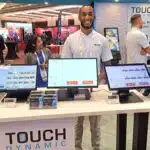 Kristian Polycarpe introduces upgraded touchscreen computers at the Touch Dynamic exhibit.
|
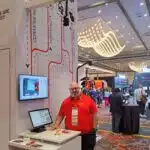 Manuel Manserrate demonstrates the self-checkout kiosk at the Toshiba Global Commerce Solutions exhibit.
|
 Alice Chen introduces a mini kiosk at the Topwise exhibit.
|
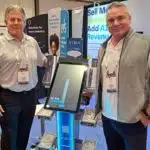 Ed Crowley of URway Holdings and Brett Beveridge of T-ROC Global introduce the Virtual Interactive Brand Ambassador at the TROC Global exhibit.
|
 Mark Rasho presents a Lenovo kiosk equipped with a Star Micronics printer at the Star Micronics exhibit.
|
 Mike Collins displays the Square Dashboard at the Square Inc. exhibit.
|
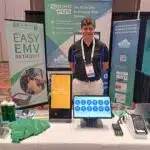 Cesar Rivas presents cloud-based POS options at the Sound Payments exhibit.
|
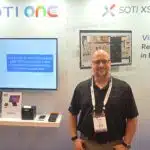 Ralph Pileggi introduces an AI tool and highlights product updates at the SOTI Inc. exhibit.
|
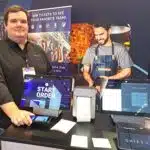 Dan Barlow introduces the handheld POS device at the Shift4 exhibit.
|
 Rowena Leogrande presents a restaurant self-order kiosk at the Posiflex exhibit.
|
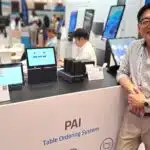 Steve Kwon describes restaurant POS and mini kiosk options at the POSBank exhibit.
|
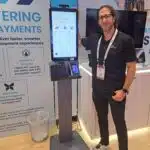 Mathew Halawa introduces the self-ordering kiosk at the Pax Technology Inc. exhibit.
|
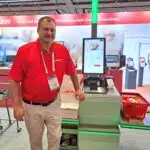 Shane Colvin demonstrates a self-checkout kiosk with AI enabled computer vision at the Partner Tech exhibit.
|
 Ryan Simmons shows a restaurant self-order kiosk at the OrderCounter exhibit.
|
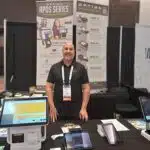 Jason Lee introduces additions to Optima’s APOS POS line.
|
 Michael Connelly shows the AXIUM SmartPOS at the NMI exhibit.
|
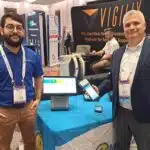 Jonathan Vazquez and Matthew Glaze introduce integrations for retail and foodservice POS systems at the Mobil POS exhibit.
|
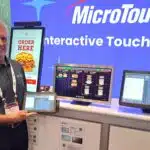 Scott Smith educates attendees on the Mach POS all-in-one touch displays at the MicroTouch exhibit.
|
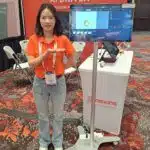 Mia Hsieh introduces the AI Kitchen Display System at the Shenzhen Meking Electronic Technology Co. Ltd.
|
 Colin Haase demonstrates Message Queuing Telemetry Transport (MQTT) technology at the Magtek exhibit.
|
 Dave Cooper introduces a retail kiosk at the LOC Software exhibit.
|
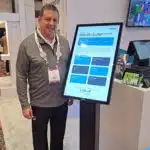 Paul Alcivar uses a Linga kiosk to inform attendees about an AI education session featuring panelists from Linga.
|
 David Janes introduces the Kx20 kiosk at the LANDI Global exhibit.
|
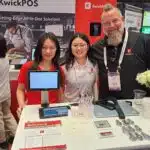 Lala Yan, Teresa Zhang and Matt Proctor introduce attendees to AI enabled order options at the KwickPOS exhibit.
|
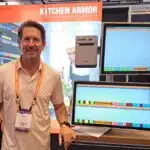 Brent Sides demonstrates Power over Ethernet Plus technology for improving kitchen workflows at the Kitchen Armor exhibit.
|
 Kathy Crumley of Intel Corp. networks with partner companies and familiarizes attendees with Intel’s role in augmenting retail technology.
|
 Dan McDonald introduces the AXIUM payment device family at the Ingenico exhibit.
|
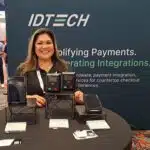 Theresa Fogarty introduces Android payment terminals with touchscreens at the ID Tech exhibit.
|
 Anum Hussain and Trent Ashwill demonstrate retail POS devices at the HP Inc. exhibit.
|
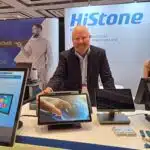 Chris Yost introduces a mobile POS tablet at the HiSone exhibit.
|
 Tim Caldwell introduces the AI-first Genius handheld at the Global Payments exhibit.
|
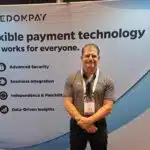 David Smith introduces the Observability tool at the FreedomPay exhibit.
|
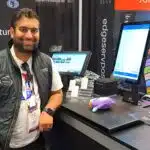 Andre D’Cunha discusses mobile device management solutions at the Esper exhibit.
|
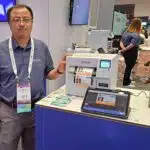 Kelvin Shu shows the ColorWorks color label printers at the Epson America Inc. exhibit.
|
 Lora Coggins displays the Beetle A2110 all-in-one POS system at the Diebold Nixdorf Inc. exhibit.
|
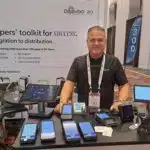 Andres Caraballo shows Android powered POS offerings at the Dejavoo exhibit.
|
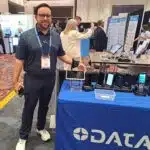 Mauricio Sanchez introduces the Datalogic Smart Portal at the Datalogic exhibit.
|
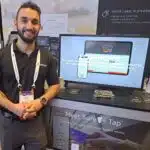 Jared Ortega introduces a SoftPOS bring-your-own-device solution at the Datacap Systems Inc. exhibit.
|
 James Arvia and Jeff Lockshier introduce hardware service capabilities at the CPI Service exhibit.
|
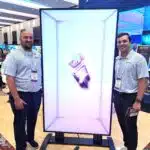 Blake Clary and Gavin Pearson introduce Samsung’s spatial signage technology at the Bluestar exhibit.
|
 Sono Nagel and Pat Ward offer data security infrastructure technology at the Bluefin exhibit.
|
 Mila Wang introduces a kiosk stand at the Beelta exhibit.
|
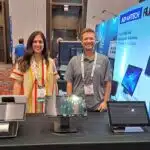 Victoria Fulbright and Nick O’Connor introduce attendees to management and consulting services for kiosk hardware and software at the Advantech-Aures exhibit.
|
 Russell Feaster and William Reed discuss TD Synnex’s role as a distributor and solutions aggregator for the IT ecosystem.
|