

Last Updated on May 6, 2026 by Craig Allen Keefner
Self-Service Technology Creates Jobs
Instead of taking away jobs, self-service technology is opening up a host of new opportunities. A look at how self-service adds employees and also an internal look at compensation for people in the self-service industry.
By Richard Slawsky contributor
Nearly everyone who’s been involved with the self-service technology industry for any length of time has heard the refrain. Applications such as self-order kiosks, patient check-in tablets and similar technologies are allowing evil corporations to replace employees with machines, putting people out of work and eliminating entry-level opportunities.
In fact, nothing could be further from the truth. Deploying kiosks to handle mundane tasks such as taking orders or filling out patient forms is helping to increase business for companies that deploy those devices. And far from being a job-killer, the development of self-service technology is creating a host of new job opportunities
Show me the money
While restaurant franchisees tend to view self-service initiatives as an unnecessary expense and employees view them as a threat, in practice the opposite appears to be true.
Sales at Panera Bread’s nearly 500 company-owned stores, for example, were up 6.2 percent in Q1 thanks to the ongoing deployment of Panera 2.0, a suite of technologies designed to improve the customer experience. Those technologies are centered around tablet-based self-order kiosks.
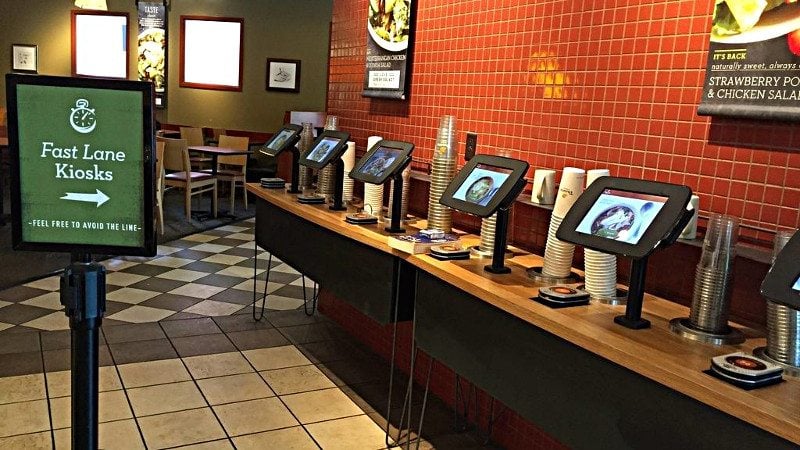
Tablets are made by LILITAB
“The consumer-facing technology results in labor savings for Panera; these hours are redeployed in the café,” Panera Chief Transformation & Growth Officer Blaine Hurst told Business Insider. “In fact, in most cases, Panera increases the number of associate hours in our cafes; and they see increases in overall guest satisfaction.
Probably the biggest explosion in job growth, though, is taking place in the kiosk industry itself. Although studies that purport to put a dollar value on the size of the kiosk industry vary from one to the next, they all agree on one thing: The market is expected to continue growing for the foreseeable future.
Transparency Market Research, for example, pegged the global kiosk market at $12.2 billion in 2015, with that market expected to grow at a 10.9 percent clip over the next eight years, reaching $30.8 billion by 2024.
That growth means tremendous opportunities for people with skills in design, engineering, software creation and sales, to name a few. And in many cases, pay for those positions is well above what other industries are offering.
“Engineering talent is the most critical and hard to fill,” said Pete Snyder, who served as VP of sales and co-owner KIOSK Information Systems for nine years, later founding Middle East Kiosks.
“You want mechanical engineers with experience.,” Snyder said. “Mechanical engineering in the kiosk industry is very specialized. You want to keep experienced mechanical engineers at all costs.”
Factory floor people are important too, Snyder said.
“You want to keep these guys since it takes about eight months for a factory floor guy to become experienced enough to be productive,” Snyder said. And today, software is such a consideration that hiring software developers has added a whole new pay tier. A kiosk deployer can easily spend several million dollars in setting up a software department.

“For me, it was set up in the fashion of a medium-size base with a lot of back-end commission,” said Eric Olmsted, who did an 18-month stint as VP of Kiosk Information Systems.
“It was kind of a ‘what have you done for me lately’ model,” he said. “Some of the deployments we did were multimillion-dollar deals, so it was very lucrative to get those. You could also make a lot of money on higher-margin deals for deployments of five or six kiosks.”
Commissions were paid once the purchase order was paid, with deployments taking place over months or years paying as the various stages were completed. And in Olmsted’s case, at least, items such as software or service plans provided the opportunity to make higher commissions.
“Those margins were a lot higher because we already had the software in-house,” he said. “Obviously each individual’s going to have different needs and wants, and that’s going to affect commissions.”

Click to expand
The accompanying sidebar gives a rough estimate of what the various positions in a large kiosk manufacturer might pay. Obviously, compensation is likely to be much less in a smaller company, and in many cases one person might hold multiple positions. In addition, salaries depend on factors including the cost of living in a particular community, the value of a particular employee and how long they have been with that company.
Riding the cycle
Staffing a kiosk manufacturer can be made a bit more complicated by the cyclical nature of the kiosk industry. A major deal that keeps a company running at full steam for several months may be followed by a period where the only business is a few five- or six-kiosk deployments. It’s critical, though, to keep those workers in preparation for the next up cycle.
“You need to keep your core experience and adapt to the up-and-down cycles using temp workers,” Snyder said. “Sales and engineering is a bit more complex in that you cannot use temps for salesmen or mechanical engineers.”
It’s the same with project managers and buyers. Companies need to optimize their structure to be able to adapt to sales fluctuations.
“There’s ways to double up,” Snyder said. “An engineer could also be a project manager. You can slip and slide them in between positions that way, but you’ve got to keep a certain amount of people on the bench. Project managers, engineers and factory floor production people are hard to find. If you get one you like, you keep them.”
Complicating matters is the fact that companies are faced with the challenge of competing with other technology industries for qualified employees.
“It’s a challenge, especially when it comes to engineers,” Snyder said.
“It’s really hard to find a good mechanical engineer who has any background in the kiosk world, because it’s a whole different ball game,” he said. “You’re talking about bending metals. You’re talking about bend radiuses and metal stretching when you bend it. You’ve got to be aware of all these things. Usually, a kid coming straight out of college knows the basics but not the specifics of a kiosk operation.”
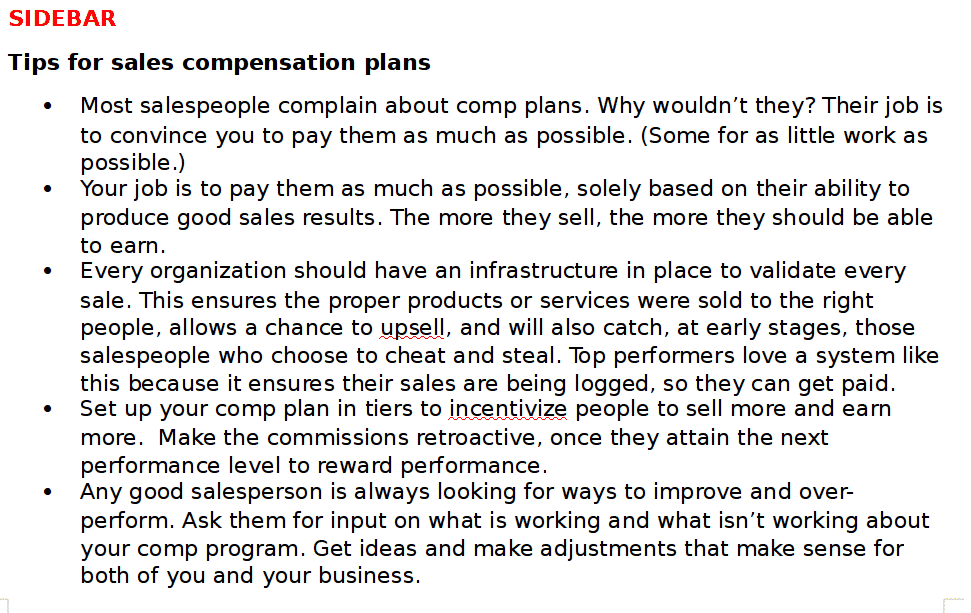
See sidebar graphic for Tips for sales compensation plans.
Click to expand
As the industry continues to grow, companies can work to overcome those challenges by going out to universities and tout the opportunities the industry holds. Most engineering schools require students to do a co-op as they near graduation, so getting involved with those types of programs can help meet staffing needs as well.
“What they can do to foster it is they can go to universities and say, ‘We have openings for college kids to come in and co-op’,” Snyder said. “Obviously, you’re then going to get a better result if you give them some level of compensation. It doesn’t need to be much, but you have to give them something.”


