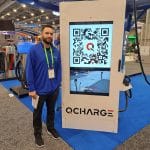
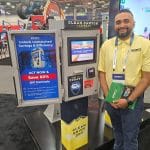
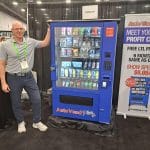
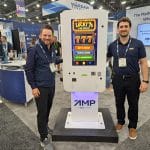
The kiosk market in Latin America is highly active and experiencing robust growth. In 2024, the self-service kiosk market in the region generated USD 3.18 billion in revenue. This market is forecast to grow at a compound annual growth rate (CAGR) of 11.4% from 2025 to 2030, reaching nearly USD 5.92 billion by 2030. Hardware remains the largest revenue segment, but services are projected to be the fastest-growing segment during this period1.
The bank kiosk segment is particularly dynamic, with revenues of USD 2.02 billion in 2023 and an expected CAGR of 15.8% through 2030, reaching USD 5.66 billion. Hardware dominates this sector, but software is the fastest-growing component, reflecting increasing adoption of advanced digital banking services4.
Note: we are NOT big fans of Grandview Research.
While Latin America’s kiosk market is smaller than those of North America, Europe, or Asia-Pacific, its growth rate is among the highest globally. Key drivers include economic growth, urbanization, rising middle-class incomes, and government incentives for digital transformation. Brazil and Mexico are leading contributors, with significant adoption in retail, banking, telecom, and government services63.
In summary, the kiosk market in Latin America is vibrant, with strong double-digit growth rates, expanding applications across industries, and increasing investment from both local and international players146.
While many global kiosk manufacturers operate in Latin America, the regional market is dominated by both international and local players, particularly in the banking and retail sectors. Data marts typically pull in ATM and banking companies so they are always over represented in “kiosk market”. Strip away the ATMs, SCOs and banks and you get an entirely different list. SITA does airline kiosks in Mexico for example. According to the biased Grandview outlook, the key global kiosk companies active in Latin America include:
These companies provide a range of hardware and software solutions for self-service kiosks, especially in banking, payments, and retail environments. AKA as bank ATMs and supermarket SCOs…
Additionally, there are specialized kiosk software providers with significant presence in South America, such as:
(Chile, with presence in Peru, Brazil, and Colombia)3
These integrators are recognized for their expertise in AV solutions, automation, and digital signage deployments across sectors like retail, transportation, and corporate environments.
Latin America’s payment landscape is rapidly evolving, with a mix of fintech startups, established payment processors, and digital banks leading innovation.
:
(cross-border and local payments, supports 100+ methods)71112
This list covers the most recognized and active companies in Latin and South America across kiosks, AV/digital signage, and payments, reflecting both international leaders and influential regional players134567101112.
More Latin America Kiosk Resources
Alveni – kiosk and digital signage based in Mexico
Crypto Kiosk acceptance in self service: How fast is it moving?
Elliot Maras in a doctored photo has been writing for 30+ years on vending, kiosks and payment.
One key takeaway from Bitcoin 2025 in Las Vegas last week was promising signs of retail acceptance of cryptocurrency as a method of payment, a development that bodes well for crypto acceptance in self-service kiosks. The growth of crypto payment acceptance jibes with the ongoing expansion of retail self-service as consumers become more comfortable with unattended, cashless payments.
Both of these dual trends played into Steak ‘n Shake’s introduction at the show of its self-order kiosk that accepts bitcoin along with other payment methods. While attendees lined up at the Steak ‘n Shake booth on the trade show floor to order sandwiches, the introduction was cited during Bitcoin 2025 education sessions as the first nationwide restaurant chain to accept Bitcoin payment.
[Editors Note: interesting to see Steak and Shake accepting bitcoin — see video]
“Our experience so far with bitcoin is that it has been faster than credit cards, and when customers choose to pay in bitcoin instead of credit cards, we are saving about 50% in our processing fees,” Dan Edwards, Steak ‘n Shake’s chief operations officer, said during a presentation at Bitcoin 2025.
[Note — 50% is nice but UPI in India or Pix in Brazil save 100%. See Reforming Retail]
Edwards said the company began accepting bitcoin in all locations where permitted by law at all stores on May 16, including the U.S., France, Monaco and Spain. The company has also added Bitcoin to its logo on its website.
“This means that bitcoin is a win for the customer, it’s a win for us as the merchant and it’s a win for you in the bitcoin community,” Edwards said. “There’s no question we have seen an upsurge in our business.”
Since the day of the launch, Edwards said there has been a sustained spike in customer guest counts thanks to Bitcoin.
“Accepting bitcoin just allows us to meet our customers where our customers are,” he said. “We understand that allowing customers to pay with bitcoin alongside cash and credit cards puts bitcoin on par with those other globally accepted payment methods.
“We believe we have enhanced the utility of bitcoin,” he said, adding that the company is also allowing franchisees to pay for their franchise fees in bitcoin.
A new era for crypto acceptance
According to veteran observers, Steak ‘n Shake’s announcement marks a significant achievement for both attended and unattended retail crypto acceptance. The evolution can be traced to Bitcoin’s early years.
The payment industry recognized the benefits of crypto in self-service equipment shortly after Bitcoin emerged in 2009, when cashless payments were making inroads on the self-service landscape.
In 2012, Upstate Networks introduced a software solution that enabled bitcoin use in a vending machine, as reported by vendingmarketwatch.com. The Utica, New York-based company manufactures hardware and software to interface vending machines with PCs. Some tech-savvy vending operators invested in the solution, but the industry’s focus then was on credit and debit card acceptance. [Ref: Vending market watch link]
[Note — Upstate sued several kiosk companies in 2004. Patent 5822215. Several settled including AT&T and remember Moonrise? We have complete writeup in kiosk history 2004]
Fast forward to 2016, LibertyX, a provider of cash-to-bitcoin kiosk software, introduced an over-the-counter bitcoin cashier platform allowing users to purchase bitcoin at retail checkout counters. NCR Corp., the retail point-of-sale equipment provider, acquired LibertyX, in 2022 to enable crypto acceptance for retailers, restaurants and banks.
Crypto acceptance faced challenges
The adoption of crypto acceptance in self-service, however, was hamstrung by the complications of redeeming the value of a fluctuating electronic currency for fiat currency. Not to mention lengthy transaction times compared to other forms of payment.
In 2021, Cantaloupe Inc., a provider of digital payments for self-service equipment, announced a partnership with Bakkt Holdings LLC to enable users to pay using the digital assets in the Bakkt payment app, including bitcoin. The solution, however, did not come to market.
“As far as crypto, we worked to integrate it but we never took it to market,” Elyssa Steiner, Cantaloupe’s chief marketing officer, told KioskIndustry.org in a recent email interview. “I just think crypto fluctuates a lot and it’s hard to manage the value when purchases are made, money transferring, etc.
“It’s a payment type that may take off eventually, but I think the biggest challenge is we haven’t as an industry or even in the payments world found an easy way to make it completely frictionless to accept,” Steiner said. “Similar maybe to like 10 years ago when contactless was just so hard to get people to attempt to use their mobile wallets, and now, look at society.”
Innovation continues
Nonetheless, payment innovation continued.
PayRange Inc., a payments services provider to the self-service equipment trade, introduced crypto acceptance to its prepaid payment app in 2023. The app allows crypto users to load crypto onto the prepaid app instead of paying for purchases directly with crypto. The solution is available for laundry machines, vending machines, amusement machines, car washes and other self-serve machines.
“It is a way for somebody to utilize the cryptocurrency they hold in a transactional nature through unattended retail,” Matt Birchard, director of marketing at PayRange, told KioskIndustry.org in a recent phone interview. “The user can use Bitcoin to add funds to their PayRange wallet, and then they have a balance that they can spend on any PayRange-enabled machine. At the time of purchase, at a machine, they’re not using cryptocurrency per se, they’re just using their prepaid PayRange balance.
“That’s the same as it works if they add balance to their account with ACH in their checking account or credit or debit card, Apple Pay, Google Pay; there’s a lot of ways to get funds into the PayRange app.”
PayRange does not disclose the number of its crypto users or the amount of crypto purchases. However, Paresh Patel, company founder and CEO, said activity has increased since crypto acceptance was introduced.
“It’s not our most popular payment source, but you’d be surprised how many people load our wallet through cryptocurrency today, because people just have that, and so we have that as an option as well,” Patel said during a presentation at the recent NAMA show in Las Vegas.
Tech innovation has since delivered new ways to improve retail adoption of crypto that are destined to impact unattended retail – innovations, such as faster blockchain transaction networks, stablecoins, which are designed to reduce crypto volatility, and “bitcoin treasuries” that allow businesses to allocate a portion of their revenues to bitcoin.
Much attention at Bitcoin 2025 focused on Lightning Network, which supports the Steak ‘n Shake bitcoin payments. Lightning Network, according to the company’s website, enables blockchain payment transactions in milliseconds. By transacting and settling transactions off-blockchain, the Lightning Network also enables low transaction fees, which allows for emerging use cases such as instant micropayments.
“Bitcoin payments act faster than credit card processing,” said Jeff Gopehring, vice president of technology services at Steak ‘n Shake. “They’re also cheaper.”
Crypto technology innovators say the best is still to come.
“Having that (Lightning Network) on top of bitcoin I feel is almost like the tipping off point of ‘we’re here,’” said Bobby Shell, vice president of marketing at Voltage, which provides Lightning Network infrastructure, during a Bitcoin 2025 panel session on retail crypto tools.
Panelist Lyle Pratt, CEO of Vida Global Inc., a provider of AI voice solutions, pointed out that the Lightning Network can also transact in multiple currencies.
Panelist Stephen Cole, CEO of Orquestra, a crypto solutions provider, pointed out that “bitcoin treasuries” enable even small businesses to allocate a portion of their revenues to bitcoin automatically. This capability allows for a company to accumulate bitcoin on an ongoing basis and could motivate more businesses to accept bitcoin.
“You as the business owner can select whatever percentage of exposure (to bitcoin) is right for you,” Cole said. “Whatever percentage that is will be automatically converted behind the scenes and customers don’t have to do anything differently.
“Bitcoin eventually absolutely needs payments,” Cole continued. “Right now I would observe a lot of merchants over the years would adopt bitcoin at the point of sale because they see it as a better savings tactic…I think the whole ecosystem is doing a fantastic job of kind of leveling up all the products, making them usable so you no longer need to be tech savvy in order to be successful with bitcoin as a merchant.”
Here Come The Feds
The federal government, meanwhile, is moving forward on creating a regulatory structure for stablecoins under the GENIUS Act, thereby supporting stablecoins as a payment system for Americans. The Senate passed the act and is awaiting Congressional approval.
JD Vance at Bitcoin 2025
In his Bitcoin 2025 presentation, Vice President J.D. Vance said President Trump supports the GENIUS Act. “In fact we view them (stablecoins) as a force multiplier of our economic might,” Vance said.
Cole of Orquestra compared the current state of crypto payments to the early Internet days.
“I think an interesting parallel is the early days of the Internet,” he said. Those who wrote off the Internet as a “computer thing” were disproven.
“If you (as a merchant) were early to embrace the Internet and do online marketing and SEO, then you had this incredible leg up on all of the competition,” Cole said “I think bitcoin has this similar trend of adoption where there will be early adopters who take a calculated bet, investing into it, whether it’s accepting it as payment or allocating to it in their treasury, and they will just get this incredible leg up on all the competitors. Competition will drive its adoption.”
“Crypto adoption is no longer an option of ‘if’ but when,’” agreed Ali Tager, vice president of communications at the National Cryptocurrency Association, in a KioskIndustry.org interview at Bitcoin 2025.
Some observers interviewed at Bitcoin 2025 said the adoption will be gradual rather than sudden.
“Bitcoiners are not very energized to spending (bitcoin), so there isn’t a market incentive to accept it,” said exhibitor Garrett Glass, a customer support specialist at Blockstream, a blockchain technology provider. “ He further noted there are tax consequences to spending crypto.
“The network and support system needs to evolve a little more,” said exhibitor Scot Johnson, president and CEO of Digital Shovel, a bitcoin mining company that introduced a desktop mining solution at the show. “You can’t buy a coffee with something that takes 20 minutes to transact.”
Anonymity
Crypto’s user anonymity also presents a challenge for retailers who want to collect customer data, said Rob Chilcoat, president and co-owner of Unattended Card Payments Inc., in a recent KioskIndustry.org phone interview.
“A lot of credit card and point-of-sales systems have a huge amount of data-driven AI tools behind them,” Chilcoat said. “They (retailers) have all sorts of AI tools now that apply customer profiles to, like, ‘Rob likes Bud Light and he comes at this time of the day,’ and they’re able to understand all of that based on my purchase habits and my credit card history, whereas with bitcoin they’re not able to make those assumptions about their customers to tailor their products at certain times to maximize their profit. Implementing a loyalty program is always an option for merchants who want to accept Bitcoin and or alternative payment methods while still being able to collect valuable data regarding their customer’s purchasing habits.”
“For anything in self-service to be successful, it must be intuitive and easy to use, and accept all forms of payment.”
Exhibitor Jahmarley Henry, vice president of business development for Toeshee, a provider of blockchain services, said more customer education is needed for retail adoption to reach its potential. He thinks the industry could be doing more in this area.
“It takes some education and some time to take over from fiat currency,” Henry said. “I think it will happen.”
Comments
From Kevin Medina, “At Mojave Technologies, we aim to stay on track and ahead of evolving trends in the payments space. We see the rise of BNPL, SoftPOS, and other rapidly advancing payment method innovations gaining traction. It’s clear that embedded and unattended systems must support more than just credit and cash; they should accommodate a wide range of tender types for the consumer’s benefit.”
“While Mojave remains focused on technology and integration, the true value of any system will always be in offering consumers choice and following their behavior patterns. Bitcoin has matured significantly in offerings and trust, and has our attention as it enters mainstream payment systems, as seen in Steak ‘n Shake’s impressive Bitcoin-enabled terminals.”
See release on APNews and also PRnewswire — ORLANDO, Fla., and WESTMINSTER, Colo., June 6, 2025 (SEND2PRESS NEWSWIRE) — Come see the Kiosk Association in booth 3489 (InfoComm site). Digital signage software and outdoor smart city wayfinding highlighted along with conversational AI hardware and a self-order kiosk. The “big” demo is a dual 75-inch outdoor smart city kiosk. New digital signage software for multiple platforms and “pixel-perfect” creation on display. We are an association of over 50 companies and 700 listed companies with US, Europe, and Asia chapters.
– Visit Booth 3489 for Kiosks and Digital Signage at InfoComm Show –
ORLANDO, Fla., and WESTMINSTER, Colo., June 6, 2025 (SEND2PRESS NEWSWIRE) — Come see the Kiosk Association in booth 3489 ( InfoComm site ). Digital signage software and outdoor smart city wayfinding are highlighted along with conversational AI hardware and a self-order kiosk. The “big” demo is a dual 75-inch outdoor smart city kiosk. New digital signage software for multiple platforms and “pixel-perfect” creation on display. We are an association of over 50 companies and 700 listed companies with US, Europe, and Asia chapters.
Thanks to solution partners Intel(Kathy), Pyramid Computer(Zahdan),TPGI(Traci) and Olea Kiosks(Frank). Our existence is based solely on member support.
Pyramid Pixi Kiosk – 15.6″ Touchscreen Self-Order Countertop — Three models to pick from from Basic to Premium.
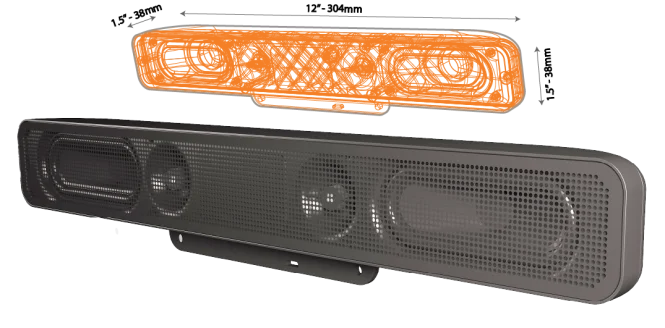
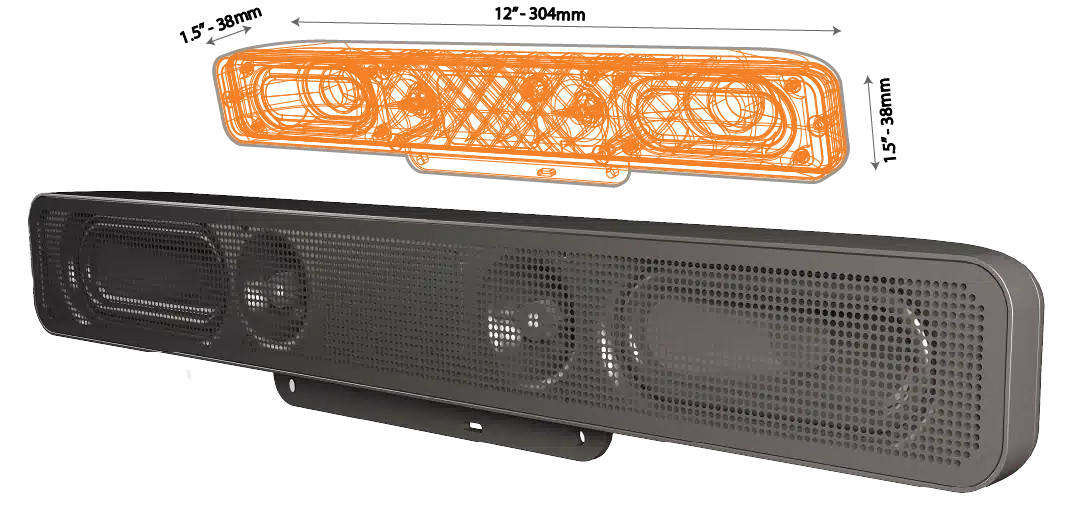
AI Connect Bar for Conversational AI — hi-quality noise cancellation mics, speakers that face customers, video camera with AI, edge-enabled, easy mounts and outdoor rated.
Contact [email protected] with questions or contacts. We accept no financial commission or paid advertising. It is free for companies to participate networking and insight.
About Kiosk Industry
The source for experienced opinions, insider insights, news, and market trends. Learn from the experts.
Keywords: Point of Sale and Kiosks, Kiosk Industry Association at InfoComm, Kiosks and Digital Signage, ORLANDO, Fla.
This press release was issued on behalf of the news source (Kiosk Manufacturer Association) who is solely responsibile for its accuracy, by Send2Press® Newswire. Information is believed accurate but not guaranteed. Story ID: S2P126759 APNF0325A
See at the InfoComm – make appointment — Digital Signage Software StudioDX — Acquire Digital is set to turn heads at InfoComm 2025 with the official launch of StudioDX, its new flagship media server and CMS platform. Designed for high-resolution digital signage environments, StudioDX delivers unmatched control, visual precision, and playback performance.
The platform will be showcased live at Booth #3489, where AV professionals can get hands-on with a digital signage solution, built to handle media-server quality playout, without the headache or cost.
“We built StudioDX for the AV operators and environments where failure is not an option,” said Neil Farr, Managing Director, Acquire Digital. “Whether it’s an airport, a stadium, or a spectacular attraction with architectural LED, StudioDX delivers pixel-accurate playback with an interface simple enough to scale fast, and smart enough to handle the complex demands of a more advanced package.”
Built for the Screens That Matter Most
StudioDX is purpose-built to manage massive, multi-zone digital displays with pinpoint accuracy and zero latency. It combines advanced video playback, live content control, and integrated advertising tools in one flexible platform.
Key features include:
Pixel-perfect screen mapping for complex LED installations
Live and scheduled content blending with full 3D-rendered previews
Fail-safe “hot” backup players to ensure 100% uptime
Triggered playback functions for immersive, event-based experiences
Drag-and-drop CMS editor for fast content deployment
Integrated programmatic ad support to maximize screen revenue
Ultra-low latency for real-time responsiveness and smooth transitions
Installs onto industry-standard hardware to reduce cost and enhance support
StudioDX isn’t just powerful. It’s reliable, secure, and built to support AV environments where every second counts. Unlike cloud-only signage systems, StudioDX runs on-premise for maximum uptime and data security. With plug-in-based architecture and broad media support, it fits right into complex AV ecosystems without compromise.
See It in Action at InfoComm 2025
Visit the Acquire Digital team at InfoComm 2025 to: Explore StudioDX with a real-time demo
Get hands-on with the playlist editor and mapping tools Discover how it simplifies even the most demanding digital signage setups Connect with our team for partnership opportunities or technical deep dives If you manage large-scale digital signage infrastructure, or need mission-critical playback that never misses a beat, StudioDX is built for you.
💬 Let’s Talk Visit us within the Kiosk Manufacturer Association booth at Booth #3489, or book a private demo by filling in the form below.
Will the Kiosk Integrate With My Other Systems and More Questions
Customers and prospects always have a set of questions they want answers to before they purchase kiosks, especially in event venues that involve ticketing. How easy, how fast and definitely, how much!
Example question that Chatgpt gets asked is “Will it integrate with my existing systems (POS, CRM, inventory, payment)? Seamless integration with back-end systems is one of the most important considerations”.
The Olea Kiosks article talks about the questions Olea sees for businesses considering the purchase of self-service kiosks for entertainment venues. Good to understand the various aspects of kiosk deployment, including design, functionality, and customer experience.
Six Questions We Came Up With:
“Will It Integrate With Our Existing Systems?”
“Is It ADA Compliant and Accessible to All Guests?”
“Can It Handle Our Environment?”
“How User-Friendly Is the Interface?”
“What Will It Cost —and What Will We Gain?”
“Who Supports Us After the Install?”
Five Questions Chatgpt Is Asked to Compare
What is the purpose of the kiosk?
How much does it cost (including total cost of ownership)?
Will it integrate with my existing systems (POS, CRM, inventory, payment)?
Is it ADA-compliant and accessible to all users?
What features and hardware options should I include?
Here is our look at “Things to Think About”
Understanding Kiosk Types:
There are different types of kiosks tailored for various applications, such as ticketing, food ordering, and information services. Businesses should assess their specific needs to choose the right type of kiosk.
Customization Options:
Kiosks can be customized to fit the branding and operational requirements of the venue. This includes options for hardware, software, and user interfaces. Customization enhances user engagement and satisfaction.
User Experience:
A focus on user experience is crucial. Kiosks should be intuitive and easy to navigate. Features like touchscreens, clear signage, and personalization can significantly improve customer interaction.
Integration with Existing Systems:
It’s important to ensure that the kiosks can integrate seamlessly with existing systems, such as point-of-sale (POS) systems and inventory management. This integration helps streamline operations and improve efficiency.
Technology Considerations:
The article discusses the importance of selecting kiosks with the latest technology, including AI capabilities for predictive menus and personalized recommendations. This technology can enhance the overall customer experience.
Maintenance and Support:
Businesses should consider the maintenance and support options available for the kiosks. Reliable support ensures that any issues can be resolved quickly, minimizing downtime and maintaining customer satisfaction.
Cost Factors:
The initial investment in kiosks can vary widely based on features and customization. Businesses should evaluate the total cost of ownership, including installation, maintenance, and potential upgrades.
Regulatory Compliance:
Compliance with local regulations and accessibility standards is essential. Kiosks should be designed to accommodate all users, including those with disabilities, ensuring an inclusive experience.
Marketing and Promotion:
Effective marketing strategies can drive traffic to the kiosks. Simple signage and promotions can encourage customers to use the kiosks, enhancing their visibility and usage.
Future Trends:
The article highlights emerging trends in self-service technology, such as the increasing use of contactless payments and mobile integration. Staying ahead of these trends can provide a competitive advantage.
Conclusion
Investing in self-service kiosks for entertainment venues can significantly enhance operational efficiency and customer satisfaction. By understanding the various factors involved in selecting and implementing kiosks, businesses can make informed decisions that align with their goals and improve the overall guest experience. The article serves as a comprehensive guide for organizations looking to navigate the complexities of kiosk deployment effectively.
Type-C Sports Betting Kiosks Will Go Offline in June
From SportsBettingDime — Intralot, a key player in the sports betting market, is set to exit the Type-C sports betting sector in Ohio, which will result in a significant reduction in available kiosks for bettors.
Ohio has always been a bit of mudhole when it comes to sports betting and it seems mismanagement and bad strategy played into the deal.
One bright spot are VLTs (video lottery terminals. Excerpt:
VLT by IGT
With sports betting kiosks never reaching expectations, Ohio bar, grocery, and restaurant owners are looking to a new form of gaming. Video lottery terminals (VLTs), electronic slot machines that are currently live but illegal in Ohio, could offer a potential lifeline for small business owners in the state, Herf said.
The machines are currently illegal in Ohio, but nearly 40,000 are currently located in gaming parlors throughout the state. Several supporters of the gaming machines testified during the third hearing of Manning’s iGaming bill last week, asking the lawmaker to include legalized VLTs in his legislation and allow them to be placed in state establishments.
“I think the VLTs will work. It’s a totally different game than sports betting. You can mindlessly place a $2 bet, potentially win $100. They will work better. There are many legislators in the state that want to find a way to leverage gaming, but also help people in their districts. Unless you live in a district with a casino or racino, you’re not seeing these revenues. Every district has a bar, a bowling center, a truck stop, a convenience store where these could be. I think they want to help these types of business owners,” Herf said.
Westmeyer agreed, noting that UBETOhio has strong connections with its partners, who have all expressed strong interest in offering VLTs.
With Intralot (operating as Sports Bet Ohio) shutting down its betting kiosks in Ohio by June 22, 2025, the state’s sports betting kiosk market will be reduced dramatically. Intralot is the largest vendor in this segment and currently operates 656 of the 704 active kiosk locations, which accounts for about 93% of the total market41. Once Intralot withdraws, nearly all of Ohio’s Type-C sports betting kiosks will go offline.
After Intralot’s exit, only a few locations will remain operational, specifically those run by UBETOhio. According to UBETOhio’s CEO, the company will continue to operate its kiosks at 48 locations across the state. No other major kiosk operators are expected to remain active after Intralot’s departure, as BetSkyBox exited the market in July 20244.
Key Points
Kiosk Shutdown:
By June 22, 93% of Ohio‘s Type-C sports betting kiosks will be taken offline due to Intralot‘s decision to withdraw from this market segment.
Impact on Locations:
This shutdown will affect most of the kiosks, which are typically located in bars and restaurants across the state, limiting betting options for many users.
Regulatory Context:
The Ohio Bar Association has been involved in discussions regarding the implications of this move, highlighting the regulatory environment surrounding sports betting in the state.
The article raises questions about the future of sports betting in Ohio, particularly how this kiosk reduction will affect overall betting activity and consumer access.
Conclusion
The exit of Intralot from the Type-C sports betting market in Ohio marks a significant shift, with many kiosks going offline. This change could have lasting effects on the state’s sports betting landscape, prompting discussions about regulatory responses and future betting options.
Will your next crypto transaction be at a crypto ATM or at Self-Order?
Any doubts about cryptocurrency’s future as both a payment method and a financial asset were laid to rest at last week’s record-setting Bitcoin 2025 conference in Las Vegas.
Elliot Maras has written extensively about the self-service space for over 30 years. Kiosks, Vending, Bitcoin and more
What’s less certain is crypto ATMs’ role in this promising crypto future.
Crypto ATMs, which allow users to buy crypto with fiat currency, have fallen victim to their own success in making crypto available to consumers since bitcoin emerged in 2009. In the early years, crypto ATMs played an important role making crypto available to a less bitcoin savvy public and expanded rapidly across the retail landscape. The number of crypto ATM installations jumped from six in 2013 to 39,539 in 2022, according to coinatmradar.com, a website that tracks crypto ATMs.
Consumers have since become more comfortable doing transactions on crypto exchanges via laptops, I-pads and phones, which are less expensive and more convenient than crypto ATMs. On July 1, 2023, the number of crypto ATMs took a hit of 4,080 before recovering in April of 2024 and has since hovered under the 39,000 mark.
[Editors Note: interesting to see Steak and Shake accepting bitcoin — see video]
“That initial phase is over,” Mark Mason, international publisher of Bitcoin Magazine, owned by BTC Inc., which produced Bitcoin 2025, told KioskIndustry.org on the Venetian Expo trade show floor. “There are much easier ways for people to access bitcoin.” Mason observed that mainstream adoption of crypto has progressed significantly in recent years and the industry is currently in its corporate adoption phase.
“If it’s a seasoned investor, they’re probably not going to do it (use an ATM) because it’s expensive,” said Lorenzo Abbatiello, owner of Miami, Florida based Lorenzo Tax, an expo exhibitor offering tax planning services for crypto businesses.
A new era for crypto ATMs
Ryan Rudden, owner of Mount Airy, Maryland-based Hodl Bitcoin ATMs, which operates 65 crypto ATMs in Maryland, Virginia, South Carolina, and Washington, D.C., agreed that crypto ATMs’ fast growth phase has subsided. His machines’ average monthly location sales peaked at around $30,000 in 2021 and have since slipped to around $10,000.
Rudden no longer retains as many repeat customers since they are aware they can more readily and more economically use an exchange on their desktop, laptop or mobile phone. Another reason is that during COVID, people were getting payments from the government and were looking for ways to spend their money. Still another reason crypto ATM installations have slowed is crypto ATM market saturation.
“They’re in virtually every gas station,” Rudden said. “The barriers to entry are getting higher and higher.”
Rudden, formerly a CPA, launched his bitcoin ATM business in 2018, serving mostly fuel stations on a revenue share basis. He attended Bitcoin 2025 to network with other crypto ATM operators about his newly introduced bitcoin ATM software business, BTMIQ.
Crypto ATMs are currently constrained by two key factors, according to Zack Shapiro, head of policy at the Bitcoin Policy Institute:
High pricing. U.S. crypto ATM operators typically mark up the exchange rate by 5% to 23%, sometimes more, and may tack on flat fees on top. By contrast, a customer using Coinbase’s basic “Advanced Trade” interface pays roughly 0.60% maker/1.20% taker at the highest tier and as little as 0.00%/0.05% at volume.
The fee gap can easily exceed 10-to-one.
Cumbersome know-your-customer/anti-money-laundering (KYC/AML) requirements. Since ATMs are classified as money transmitters under FinCEN’s 2019 virtual-currency guidance, operators must register as Money Services Businesses and perform Bank Secrecy Act KYC. In practice, that usually means scanning a driver’s license or passport at the machine, plus downloading the operator’s mobile app in advance or completing selfie/biometric checks on site. Sometimes there are lower KYC thresholds for smaller withdrawals or deposits, but those hurdles erase much of the “walk-up convenience” that initially made ATMs popular.
Regulatory challenges rise
In addition to these constraints, Rudden also believes crypto ATMs are facing serious regulatory challenges and has taken it upon himself to provide input to state lawmakers on proposed legislation. The need for political action was echoed during Vice President J.D. Vance’s keynote Bitcoin 2025 presentation.
“Our politicians are going to need your pressure,” Vance told his listeners. “What happens in the world of politics, what happens in the world of bureaucracy, it will affect even the most transformational and valuable technology if we don’t make the right decisions. The first thing I ask you is to take the momentum of your political involvement in 2024 and carry it forward in 2026 and beyond. Don’t ignore politics because I guarantee you my friends, politics is not going to ignore this community. Not now and not in the future.”
While Rudden would prefer to see the crypto ATM industry self-regulate, he recognizes that state and federal governments are proposing laws that could destroy his business. At the state level, he has met with Maryland lawmakers to make its proposed regulations more compatible with operator needs while at the same time addressing what he considers the very important issue of bitcoin scams. He recognizes that much of the proposed legislation is designed to protect people from scammers who lure them into depositing money in crypto ATMs.
The Maryland legislation was originally modeled on California’s law, which mandates what Rudden considers overly restrictive limits on the amount of crypto users can purchase in a single day and the transaction fees ATMs can charge. Maryland lawmakers moderated these restrictions.
Rudden also gave Maryland lawmakers input on a mandatory anti-scam warning to ensure that the warning is visible to the user, as well as a warning against using a QR code someone has instructed them to use to buy crypto from the machine, and not to allow someone on the phone to instruct them how to use the machine. “That’s a scam,” he said.
The bill has passed the Maryland legislature and is currently awaiting the governor’s signature.
Lobbying challenges on the rise
One problem Rudden encountered was that crypto ATM operators were not united on some of the law’s requirements. One operator, for example, wanted a requirement that the crypto ATM owner/operator could not also be the crypto ATM compliance officer.
“The owner/operator or CEO cannot also be the compliance officer,” he said, a requirement that is not economically feasible for smaller operating companies such as his.
This requirement isn’t necessary, Rudden said, because under the Bank Secrecy Act, which authorizes the Department of the Treasury to impose reporting requirements on financial institutions and other businesses to detect and prevent money laundering, requires an annual review for compliance officers by an independent auditor. “And that’s how you achieve your independence.”
Ultimately, Maryland lawmakers didn’t include that requirement, but the language did make it into an amendment proposed by Illinois Senator Richard Durbin, who has been active in federal crypto ATM legislation. Durbin recently proposed an amendment to the bipartisan GENIUS Act, which establishes a regulatory framework for stablecoins, which are designed to provide a more stable value by tying their value to specific assets that make them suitable for everyday transactions.
Rudden supports the proposed Durbin amendment’s goal – to protect users from crypto ATM scams – but not some of its requirements.
One Durbin stipulation Rudden does favor requires the crypto ATM operator to call and check with the customer before processing a transaction of $500 or more. “I do that right now,” Rudden said. “That’s a great regulation.”
On the other hand, another stipulation requires the operator to provide the customer a receipt that includes the transaction’s blockchain hash. “We have a conflict now,” Rudden said. “If I need to call the customer before the transaction, there won’t be any blockchain hash because the blockchain hash is generated when we sell the bitcoin to you.”
Another troubling part of the Durbin amendment entitles users who have been scammed to be fully compensated as long as they contact the crypto ATM operator within 30 days of their transaction.
“A full refund in the event of a scam is nothing more than mitigating an operator must take the position of a scam victim,” Rudden said. “That’s not going to stop scams.” In addition, people can game the system; buy crypto at the machine, then claim they were scammed and get their money back.
“It’s easy to see that these are very aggressive measures that in the end will blow up on our face,” Rudden said. He thinks the solution is to have lawmakers and operators meet to discuss workable solutions.
Targeting bitcoin scams
Durbin has claimed scammers contact elderly Americans, and using threats, intimidation and fabricated stories, coerce them into depositing money into the criminals’ crypto wallets via crypto ATMs. According to Durbin’s website, the amount consumers reported losing in this form of fraud increased nearly tenfold between 2020 and 2023 — from $12 million to $114 million, citing Federal Trade Commission data. In addition, in 2023 the FBI’s Internet Crime Complaint Center received nearly 2,700 crypto ATM fraud complaints from individuals aged 60 and older — more than all other age groups combined.
“They allow you to trade in cash for cryptocurrency, but they also are a frequent tool of scammers and fraudsters who prey on Americans, especially senior citizens,” Durbin stated in a recent press release announcing his amendment.
“States such as Nebraska, Arizona, and Connecticut have passed legislation to crack down on these scams,” Durbin said. “It’s time for Congress to do the same. The result of the so-called GENIUS Act is a dramatic increase in crypto activity. That means dramatic exposure to fraud. Let’s make sure this amendment, which I’m going to offer to the GENIUS Act, is adopted to protect innocent victims.”
The status of the Durbin amendment was uncertain at the time of this report. The GENIUS Act, passed by the Senate and awaiting Congressional approval, will enhance stablecoins as a payment system for Americans. President Trump, according to Vice President Vance, intends to sign the bill.
Trump embraces crypto
Meanwhile, the crypto industry continues to grow with the support of a more crypto friendly government under President Trump.
“You will never see this administration trying to handicap your community or diminish the impact it’s had on the economy,” Vance said during his presentation. “Instead, we reject the Biden administration’s legacy of death by a thousand enforcement actions. We reject regulators.”
“After four years of mistreatment and outright hostility led by Democrat regulators, lawmakers in this country have a choice,” Vance said. “Will we lead our nation into a future of financial sovereignty of innovation and prosperity, or will we let unelected bureaucrats and foreign competitors write the rules for us? And I’m here today to say, loud and clear, with President Trump, crypto finally has a champion and an ally in the White House.”
Vance further stated that Operation Chokepoint 2.0 – an Obama initiated supervisory action against banks that provided services to crypto businesses, gun manufacturers, payday loan companies and other businesses disfavored by the Obama Administration – has been terminated.
“To put it simply, Operation Chokepoint 2.0 is dead and it’s not coming back under the Trump Administration,” Vance said. “We reject the Biden administration’s legacy of death by a thousand enforcement actions.”
Lobbying efforts continue
Challenges still remain, however, in undoing the prior administrations’ damage, according to a conference panel during Bitcoin 2025.
Caitlin Long, founder and CEO, Custodia Bank, which focuses on digital asset payment and custody solutions, said Vance overstated his case when he said Operation Chokepoint 2.0 is dead. The Federal Reserve has rescinded some but not all of its guidance impacting the crypto industry, she said. She tweeted this to Vance following his talk and encouraged her listeners to do the same.
These restrictive actions, Long said, were controlled by Massachusetts Senator Elizabeth Warren, who has been vocal about the national security threat posed by not properly regulating cryptocurrencies. Warren has publicly stated that without proper anti-money laundering regulations, bad actors are using crypto to evade U.S. sanctions, and that those actors are making hundreds of millions of dollars annually by acting as middlemen in the growing crypto ecosystem.
“The Fed is supposedly an independent agency, but I’m told by a lot of people that a number of career staff in D.C. were talking to Senator Warren all the time,” Long said.
Session moderator Seth Hertlein, head of policy at Ledger, a crypto wallet provider, noted that the recently introduced Digital Asset Market Clarity Act is designed to establish a regulatory framework for digital assets. The bill was introduced by Arkansas Congressman James French Hill, a Republican who is chairman of the House Committee On Financial Services, and has the support of five Republican co-sponsors and three Democrats..
“Our bill brings long-overdue clarity to the digital asset ecosystem, prioritizes consumer protection and American innovation, and builds off our work in the 118th Congress,” French said in a press release announcing the bill. “I look forward to delivering our bill to President Trump’s desk and securing America’s position as the global leader in digital assets.”
As crypto innovation and adoption increase, regulatory initiatives are bound to follow suit.
“I think we are in a new regulatory era not because of the Trump administration, but we’re still in a new regulatory era where crypto and bitcoin exist,” said conference panelist Zack Shapiro, head of policy at the Bitcoin Policy Institute. “The rules didn’t anticipate this type of technology to exist…How are we going to deal with this particular moment?”
The laws assume that if you transfer money electronically there will be an intermediary institution that is regulated as a money service business or money transmitter, Shapiro said. “And now it is possible to transfer money electronically with bitcoin, with stablecoins, without such an intermediary. There is no intermediary. And the question is, ‘What are the laws and regulations going to do about it?’”
Under the GENIUS Act, introduced by Senator Bill Hagerty, a Tennessee Republican, only permitted issuers can issue a payment stablecoin for use by U.S. persons, according to congress.gov. Permitted issuers must be a subsidiary of an insured depository institution, a federal-qualified nonbank payment stablecoin issuer or a state-qualified payment stablecoin issuer. Permitted issuers must be regulated by the appropriate federal or state regulator. Permitted issuers may choose federal or state regulation; however, state regulation is limited to those with a stablecoin issuance of $10 billion or less.
Photos
A kiosk labeled Holy Grail Autograph Hits displays a large autographed sports card with a player’s photo, signature, and digital signage on its side. The machine is illuminated with neon-style lighting.
A man in a blue suit speaks at a podium with a presidential seal, set against a blue backdrop featuring logos and text like EXODUS and frax.com, resembling the impactful messaging of digital signage or an information kiosk.
A man stands at a Cardsmiths kiosk at a convention, with colorful trading card artwork on the wall, digital signage promoting a limited edition Bitcoin token, and cards and promo items displayed on the table.
Four men sit on a panel stage at a Bitcoin 2025 event, with a bright orange backdrop displaying their photos, names, and the session title “Building the Tools for Merchant Adoption,” highlighting topics like kiosk and digital signage solutions.
A man stands smiling with arms crossed in front of an orange banner at a conference. Attendees are seated facing a stage with a panel discussion and large digital signage screen in the background.
A man in a suit stands indoors next to a kiosk featuring digital signage advertising Beef Tallow Fries at a Steak n Shake booth. The backdrop displays milkshake dispensers and black-and-white checkered flooring.
The outlook for Bitcoin ATMs and broader crypto ATMs is highly optimistic, with forecasts pointing to rapid global expansion, technological innovation, and deeper integration into both financial and everyday consumer landscapes.
Explosive Market Growth
The global crypto ATM market is experiencing exponential growth. Estimates project the market will surge from around $232 million in 2024 to as high as $7.6 billion by 2032, reflecting a compound annual growth rate (CAGR) of over 54%1. Other analyses are even more bullish, projecting the market could reach over $16.85 billion by 20334 or even $452 billion by 2037, with annual growth rates exceeding 55%24.
In the United States alone, the market is expected to climb from $181.8 million in 2025 to nearly $4 billion by 2033, at a CAGR of 47.1%6.
Drivers of Adoption and Expansion
Increasing Accessibility: The number of crypto ATMs has grown from just a handful in 2013 to nearly 38,000 worldwide by early 2025, with the majority located in the U.S.15. Installations continue at a rate of 10–20 new machines per day in the U.S., making crypto more accessible and familiar to the public5.
Bridging Digital and Physical Worlds: Crypto ATMs simplify the process of buying and selling digital assets, providing a tangible and user-friendly interface, which is especially important for those less comfortable with online exchanges35.
Financial Inclusion: These machines offer essential services to the unbanked and underbanked, enabling access to digital assets without requiring a traditional bank account57.
Regulatory Clarity: Governments are increasingly establishing regulations for crypto ATMs, particularly around anti-money laundering (AML) and know-your-customer (KYC) compliance, which is helping to build trust and legitimacy146.
Technological and Service Innovations
Multi-Currency Support: There is a growing trend toward ATMs that support multiple cryptocurrencies, not just Bitcoin, making them more versatile and attractive to users24.
Enhanced Security: Future machines are expected to feature advanced security measures, including biometric verification, to protect users and transactions3.
Expanded Services: Beyond simple buy/sell functions, crypto ATMs are beginning to offer bill payments, remittances, and portfolio management, further embedding them in everyday financial activity4.
Regional Trends
North America: Continues to lead in both adoption and infrastructure, with the U.S. dominating global installations57.
Europe and Asia-Pacific: These regions are seeing rapid growth, driven by increasing crypto awareness, favorable regulations, and technological investment7.
Emerging Markets: Latin America, the Middle East, and Africa are leveraging crypto ATMs for financial inclusion and as a hedge against economic instability7.
Challenges and Considerations
Regulatory Uncertainty: While regulatory frameworks are improving, ongoing changes could impact deployment and usage in some regions46.
Competition from Digital Platforms: As mainstream crypto exchanges and fintech apps become more user-friendly, ATMs will need to continue innovating to maintain their relevance.
Operational Costs: The cost of hardware, maintenance, and compliance may affect profitability and the pace of expansion in less developed markets.
Bitcoin ATMs and crypto ATMs are set for robust growth over the next decade, driven by increasing crypto adoption, regulatory clarity, and their unique role in bridging digital assets with the physical world. They are expected to become more widespread, technologically advanced, and integral to both mainstream finance and financial inclusion efforts globally134567.
Few days ago PRnewswire reported Diebold kiosks for Tillster — That initiates the “trampoline media sites” to bounce it into the airwaves. We always track Diebold (and Wincor even longer). The company has manufactured ATMs since late 2019 in the northern portion of the former Hoover Co. headquarters on Orchard Avenue NE. Diebold Nixdorf also builds a few retail products, such as self-ordering kiosks for Tillster, a digital ordering company for quick-service restaurants. The expansion will include self-checkout machines like the DN Series EASY, primarily for the grocery and general merchandise industries.
Introduction
The ATM market continues to survive, and some repeatedly say it is growing (albeit single-digit CAGR and that is being optimistic).
Combined with the company’s supply chain strategy, this in-house manufacturing approach provides quality, responsiveness and full customer focus for domestic Grocery, General Merchandise, Quick Service Restaurant (QSR) and Fuel & Convenience retailers. This enhancement is a result of Diebold Nixdorf’s strategic approach to managing global supply chains and production to achieve greater control and predictability in its manufacturing processes.
Tradeshow In Miami in 2024 – Growing kiosk business in USA — Abraham Panahi
And then there is Walmart. Historically NCRs biggest hardware and service customer for SCO, but for how much longer?
There is a quote from Tillster after that. Tillster is 40,000 locations worldwide (and 15 different POS supported?). 20% of their workforce is in Europe. Burger King is named as one of their customers. They are estimated to have kiosks in 50% of their restaurants and they have 4 different providers we know of. BK just announced “they plan” on remodeling 400 restaurants and how many of those in the US?
Tillster supports over 40,000 restaurant locations both in the United States and internationally, partnering with more than 100 restaurant brands. While this figure includes locations globally, the majority of Tillster’s partnered restaurants are situated in the U.S., as the company collaborates with prominent American quick-service and fast-casual chains such as Burger King, Pizza Hut, Arby’s, and Steak ‘n Shake. [See Steak and Shake kiosk video from our Bitcoin story. Pretty terrible kiosk app.] However, available sources do not provide specific data on the exact number of locations in the U.S. alone. The most accurate public figure is that Tillster supports over 40,000 restaurant locations, with a significant portion of these in the United States. See picture below of wallmount DN kiosks for Popeye’s (another Tillster client as of May 2024).
Generally, Tillster doesn’t provide a any real depth of information, it seems. Whatever they end up with we hope they are more attractive than past models they have made.
Wall-mount self-service Diebold kiosks Popeyes
Mobile Ordering Trojan Horse — From ReformingRetail 2016 — We can look at a simple example within foodservice: restaurant innovation vs grocery innovation. Olo (whom I love) started providing mobile ordering services to restaurants. In their first decade they successfully penetrated 150 restaurant brands and raised $25M. McDonald’s JUST announced its commitment to rolling out online ordering 15 years after online ordering made its debut. Another restaurant ordering service, Tillster, announced a 2.5 year effort to bring mobile ordering to Burger King. In that same 2.5 year period, Instacart, who handles mobile ordering and delivery for grocers, not restaurants, raised $265M and counts names like Costco and WholeFoods as partners.
Sounds like the ATM production lines are being phased out to us and new “US-based” proxy mechanism for avoiding rollercoaster tariffs in now in place. International manufacturing, maybe even in Paderborn, will serve all of those markets. New model for globalization…
What About Pictures?
Diebold self-order kiosks Burger King
From my AI — There is no publicly available, official photograph of the specific Tillster self-ordering kiosk unit manufactured by Diebold Nixdorf at the North Canton, Ohio facility in the search results provided. The press releases and industry news confirm that Diebold Nixdorf is producing these kiosks for Tillster and reference the modular DN Series® EASY family as a related product line, but they do not include or link to an image of the actual Tillster-branded kiosk unit1235.
A LinkedIn post discussing the announcement also includes a comment asking for a picture of the Tillster unit, but no image is provided in the post or replies4. Gee, I wonder who that was and no I haven’t seen it 🙂
Tillster’s own website describes the features and benefits of their self-ordering kiosks but does not show a photo of the Diebold-manufactured model6.
Steak and Shake taking bitcoin
In summary, while details about the manufacturing partnership and product capabilities are available, no direct image of the Diebold-manufactured Tillster kiosk is present in the provided sources.
Dave and Busters Kiosks
Dave & Buster’s kiosks are designed and supplied by Diebold Nixdorf. These self-service kiosks allow customers to purchase and reload game cards, place food and beverage orders, and use a variety of payment methods. The current generation of kiosks is based on Diebold Nixdorf’s K-TWO series, which features a 32-inch touchscreen and won a Reddot Award for design in 201917.
Diebold Nixdorf provides both the hardware and software solutions for these kiosks, replacing legacy systems and streamlining the customer experience in over 140 Dave & Buster’s locations across North America345. The company acts as the primary partner, offering a single source for kiosk hardware, software, and support services45.
Historically, the original kiosk provider was Frank Mayer, but Diebold Nixdorf now manages the design, supply, and ongoing support for Dave & Buster’s kiosks17.
McDonalds Kiosks
Diebold Nixdorf self-service kiosk displays a Whopper menu
Diebold Nixdorf is involved in supplying self-service kiosk solutions for McDonald’s. Main contact. The kiosks have been featured at McDonald’s events, such as McDonald’s Worldwide 24, and are described as making the ordering process faster and more convenient27. Diebold Nixdorf promotes its self-service kiosk technology as part of digital transformation efforts within the quick service restaurant (QSR) industry, and McDonald’s Sweden, for example, has implemented self-service order kiosks in over 100 restaurants, referencing Diebold Nixdorf’s role as a technology partner1.
However, for the specific hardware manufacturing of McDonald’s kiosks in the U.S., Diebold Nixdorf acts primarily as a solution integrator and reseller. The actual kiosk hardware for McDonald’s cash and coin kiosks in the U.S. is manufactured by Pyramid Computer, with Diebold Nixdorf selling and integrating these units3. Thus, while Diebold Nixdorf is closely associated with McDonald’s kiosk deployments—especially in software, integration, and supply—they are not always the direct manufacturer of the physical kiosks for McDonald’s, particularly in the U.S. market, where Pyramid Computer is the primary hardware suppliers.
And there are SCOs (Self-Checkout)
EASY eXpress Max
Diebold Nixdorf is the second largest supplier of self-service checkout (SCO) systems globally and has been rapidly expanding its presence in the U.S. supermarket sector. According to the latest RBR Data Services study, Diebold Nixdorf’s shipments of self-checkout units increased by more than 60% in 2023, with significant growth driven by deployments in both Europe and North America126.
While Diebold Nixdorf holds a dominant 40% market share in the EMEA region, the company is actively working to expand its footprint in the North American market, including U.S. supermarkets12. The U.S. self-checkout systems market is highly competitive, with NCR Corporation, Diebold Nixdorf, and Toshiba Global Commerce Solutions identified as the main players5. Although exact U.S. supermarket market share figures for Diebold Nixdorf are not published in the available sources, the company is recognized as a key provider and is growing faster than the overall market6.
In summary:
Diebold Nixdorf is a leading provider of self-checkout solutions for U.S. supermarkets, competing closely with NCR and Toshiba.
The company is the global #2 in self-service checkout shipments and is expanding its U.S. presence, but does not currently hold the #1 position in the U.S. supermarket checkout market1256.
Diebold Nixdorf’s market share in the U.S. is substantial and growing, but specific U.S.-only penetration rates are not disclosed in the available data.
Current Market Growth for SCO
The U.S. self-checkout systems market was valued at approximately $1.9 billion in 2024 and is projected to grow at a compound annual growth rate (CAGR) of 12–14% through 2030256.
Globally, the market is expected to more than double in size from 2025 to 2030, reaching over $11 billion, with North America (and especially the U.S.) leading adoption15.
Self-checkout shipments to the Americas rose by 5% in 2023, and the U.S. remains the world’s largest self-checkout market4.
Drivers of Continued Growth
Retailer Demand: Supermarkets, convenience stores, and other retailers are expanding self-checkout offerings to address labor shortages, lower operational costs, and meet consumer demand for faster, contactless transactions257.
Consumer Preferences: A majority of shoppers now prefer self-checkout over traditional cashier lanes, and retailers are responding by installing more terminals and refreshing older hardware6.
Technological Advancements: Innovations such as AI-powered product identification, touchless and mobile payments, and loss prevention features are accelerating adoption and enabling new use cases123.
Market Dynamics and Competitive Landscape
The market is highly competitive, with established players like NCR, Diebold Nixdorf, Toshiba, and Fujitsu continuing to invest in R&D and new features15.
While some major retailers (e.g., Walmart, Dollar General, Five Below) have scaled back or adjusted their self-checkout strategies due to concerns like shrinkage or customer experience, most are expanding or upgrading their systems, and the overall market trajectory remains upward4.
What About The ATM Market? Is it Gaining or Declining?
If you listen to press releases, or client portals like ATMmarketplace or ATMIA you come away with the sense of expanding growth due to burgeoning cash use desire. The nice thing about our AI is that while it tends to present the most optimistic judgement first, it has no problem providing the opposing point of view from less “dependent” media outlets with vested interests. I still use cash but just $10 a week to get into the golf Skins game. I lost my “billfold” a year ago.
Our take is more along these line —
Declining Demand and Structural Challenges
Cashless Trend: The U.S. ATM manufacturing industry is facing headwinds due to the ongoing shift toward cashless payments. According to IBISWorld, the share of Americans not using cash in a typical week has risen sharply (41% in 2022, up from 24% in 2015), and younger generations are increasingly reliant on mobile banking apps. This trend is projected to continue, leading to a decline in ATM market size over the next five years7.
Market Size and Growth: While the U.S. ATM manufacturing market is still sizable—estimated at $341.7 million in 2025—growth has been sluggish, with a CAGR of just 0.4% over the past five years. The outlook is for contraction, not expansion, as cash becomes less relevant in the economy7.
Rising Costs and Fees: Consumers face rising fees at independent ATMs (about $4.73 per out-of-network withdrawal), which discourages usage and pushes people toward digital alternatives7.
Independent ATM Deployers (IADs) Under Pressure: The majority of U.S. ATMs are operated by independent deployers, not banks. These IADs are struggling with thinning margins, increased regulatory scrutiny, and a rise in ATM-related crimes. Many banks are also de-risking by cutting ties with IADs, making operations even harder8.
Social and Regulatory Headwinds: There is a “war on cash” sentiment in some circles, and ATMs—especially those run by IADs—are sometimes linked to high-risk activities, leading to additional regulatory and reputational challenges8.
Comments — Craig – several high profile IAD failures recently have caused real pain for FIs. This should help NCR and the larger ATM outsource partners. EMV is largely complete. Keypad upgrades to PCI 5 (PCI 5.0 vs PCI 4.0) and Windows 11 upgrades are causing operators to evaluate and potentially downsize their fleets.
Another Take From RBR Research
RBR research has consistently reported that the number of ATMs in the United States is in gradual decline, reflecting broader shifts in consumer behavior and banking infrastructure:
U.S. ATM Count Declining: RBR’s reports show that the number of ATMs in the U.S. has been decreasing, with a notable drop of 1,000 machines from 2018 to 2019 (431,500 ATMs in 2019)4. The primary reasons cited are bank branch closures, consolidation among non-bank deployers, and the growing adoption of digital and cashless payments24.
Temporary Upticks: There have been brief periods of growth, such as a 3,000 machine increase in 2021, largely driven by independent ATM deployers (IADs) restarting or installing machines post-pandemic. However, this was an exception, and the overall trend remains downward5.
Long-Term Forecast: RBR forecasts that the global ATM base will continue to shrink through at least 2028, with the U.S. following this trend due to ongoing branch closures and increased use of digital payments135. By 2027, the worldwide ATM base is expected to fall below 3 million units for the first time since 20135.
Drivers of Decline: In the U.S., the decline is attributed to both the closure of physical bank branches and retailers choosing to remove ATMs rather than upgrade them to newer standards like EMV. The shift toward digital banking and payments is accelerating this reduction245.
Summary:
RBR research concludes that the U.S. ATM market is experiencing a slow but steady decline in installed machines, with only occasional short-term increases. The long-term outlook is for continued contraction as digital and cashless payment methods become more prevalent and banks rationalize their ATM fleets for efficiency
We manage the Asia chapter of The Industry Group. This site is dedicated to companies that operate in Asia. If you wish to participate, send email to [email protected] or you can text 720-324-1837
Why Multimodal Interaction Is Replacing Single-Interface Design
For more than three decades, interactive systems—from kiosks to digital signage to self-checkout—were defined by a simple formula: screen plus touch. That model powered the first wave of self-service and automated interaction across retail, healthcare, transportation, and government. But it is no longer sufficient.
Today’s interactive environments demand more flexibility, ...
What Giada Is Highlighting
Giada is exhibiting at ICE Barcelona 2026, where visitors can find the team at Booth 3D70. At the show, Giada presents its latest innovations in embedded computing, designed to meet the demanding requirements of modern casino and gaming environments. ICE Barcelona is widely recognized as the premier international exhibition for gaming, entertainment, ...
Insight: NCR Isn’t Leaving Hardware — It’s Leaving the Factory
When NCR Voyix announced it was transitioning its self-checkout and POS hardware operations to Ennoconn (aka Hon Hai), some industry observers rushed to frame the move as “NCR exiting hardware.”
That’s the wrong conclusion.
What NCR is really doing is exiting manufacturing ownership — a very different thing ...
Why It Matters for Kiosks, AI, Payments, and Self-Service in 2026
American National Standards Institute (ANSI) quietly set the tone for the next decade of technology competition with the release of the U.S. Standards Strategy 2025 (USSS). While framed as a
policy document, the implications are immediate and operational—especially for companies working in kiosks, unattended retail, payments, ...
Glory Global Goes For Scale with Acrelec
This is not a leadership shuffle—it’s a business model declaration.
Glory is now signaling that Acrelec will be its growth engine for unified commerce in foodservice automation. Glory’s push to integrate Acrelec and Flooid reflects a deliberate move to redefine itself from a cash automation vendor to a full-stack retail ...
Recognizing Industry Pioneers and Innovators
The Kiosk Industry Group Hall of Fame recognizes individuals whose long-term contributions have materially shaped the self-service, kiosk, accessibility, automation, and interactive technology industries. It exists to document and honor sustained impact over time, not short-term success or product cycles.
Announcements
2026 Hall Of Fame Inductees
Best of 2025 Kiosk Industry Group Awards
Hall of ...
And The Winners Are
LG’s new self-order kiosk offers easy access for all and smart chat features — What stands out about LG’s newest kiosk is how it puts access first. Instead of treating ease of use as something added later, the system uses voice-driven AI so people can speak their choices – browsing options, selecting ...
Predictions from The Industry Group
For more than two decades, self-service technology advanced in cycles—touchscreens improved, hardware got cheaper, networks got faster, and operators layered efficiency gains on top of familiar models. That era is ending.
2026 is not about incremental improvement.It is about structural shifts already underway becoming unavoidable.
This pillar article outlines where those shifts converge—and ...
LG Rolls Out New Self-Order Kiosks in Japan with USEN
USEN Corporation and LG Electronics launch self ordering/payment kiosk in Japanese market.
Importance of Announcement
Restaurant and retail operators should care because LG’s Japan/Korea kiosks show where global self-order tech is heading: accessibility-by-design hardware (height-adjustable, screen reader, tactile, and voice) that can serve more customers independently and reduce ...
Touch Screen Rockchip® RK3576 processor Android 14/Debian 12
The future of human-machine interaction is here. Giada is thrilled to launch the AN708 HMI Panel PC, a groundbreaking all-in-one solution engineered to revolutionize touch-based interfaces for a smarter, more connected world. Designed for seamless integration and robust performance, the AN708 is set to become the intelligent heart ...
Embedded Systems Award for Giada
Giada’s announces that the company has been elevated to the status of Intel® Prestige Partner, highlighting a significant strengthening of its relationship with Intel.
Giada has been honored as an Intel® Prestige Partner, which is presented as an important milestone for both Giada and the broader technology sector.
This recognition reflects Giada’s capabilities ...
Self-Service Asia
We manage the Asia chapter of The Industry Group. This site is dedicated to companies that operate in Asia. If you wish to participate, send email to [email protected] or you can text 720-324-1837
Learn more about Kiosk Asia
China is currently a global leader in “unattended retail” and self-service automation, largely driven by the integration of AI, 5G, and high-speed ...
Starbucks Kiosk
Starbucks announced on Monday a plan to implement the coffee franchise’s first self-order kiosks in select stores across tourist-heavy areas in South Korea and Japan.
The kiosks are aimed at enhancing the customer experience by reducing wait times and streamlining the ordering process.
In South Korea, the kiosks will debut at the Starbucks Korea branch in ...
Vending Automation at NAMA
The future of unattended retail was on full display last week at the Las Vegas Convention Center. And the take-home for the approximately 5,200 attendees at the three-day NAMA Show was that the future has already arrived, thanks to the rapid pace of self-service technology and the consumer’s rising acceptance of self-service. ...
Skechers and We Are Social Singapore Launched the Luna Kiosk
Nice modern iteration of AI enabled kiosk. Personalized stylist recommends clothes and shoes based on what you are wearing and talks and listens.
Here’s a summary of the article titled “Skechers and We Are Social Singapore“:
Overview
Skechers has partnered with We Are Social Singapore to launch an innovative marketing initiative that focuses on ...
China is currently a global leader in “unattended retail” and self-service automation, largely driven by the integration of AI, 5G, and high-speed mobile payment ecosystems. As of early 2026, the technology has moved far beyond simple vending machines into complex, multi-functional robotics and “doctorless” infrastructure.
Here are the key self-service technologies currently emerging from China:
1. Unmanned Retail & Advanced Vending
The traditional “grab and go” model has evolved into high-precision robotic kiosks that replicate human service.
Robotic Baristas & Mixologists: Companies like Anno Robot have deployed 6-axis robotic arms that create latte art and mix cocktails with 0% recipe error, operating 24/7 in malls and transit hubs.
Smart “Future Stores”:Yum China (KFC/Pizza Hut) has launched “Future Stores” in cities like Hangzhou, featuring fully automated dessert stations and “Smile to Pay” facial recognition.
Intelligent Micro-Markets: Unlike standard vending machines, these are modular kiosks that use 3D computer vision to track what you pick up, allowing for “limitless” product variety including fresh produce and hot meals.
2. Autonomous Public Infrastructure
China is automating high-labor utility and transport sectors with “unmanned” service points.
Robotic Gas Stations: The Senstar robot fuel dispenser uses AI and 3D positioning to identify a car’s fuel cap, open it, and refuel the vehicle without the driver ever getting out.
High-Speed EV Charging Hubs: Companies like CHAEVI are deploying modular megawatt charging platforms that use AI to schedule and manage power for fleets of electric trucks and cars autonomously.
3. “Doctorless” Healthcare Kiosks
One of the most ambitious shifts is the deployment of medical self-service terminals.
AI Diagnosis Booths: These clinics-in-a-box use facial recognition and sensors to check vitals (heart rate, oxygen, blood pressure).
Instant Pharmacy: After a 5-minute AI analysis, the kiosk can provide a probable diagnosis and immediately dispense common medications for minor ailments, targeting remote towns and busy transit squares.
4. Embodied Intelligence (Humanoid Service)
The “self-service” experience is becoming more interactive through humanoid robots designed for public spaces.
Interactive Guides:AgiBot’s A2 series and Unitree’s G1 are being deployed as showroom guides and presentation assistants. They use multimodal AI to understand voice, gestures, and environment.
Delivery & Service Robots: Beyond the familiar “waiter robots,” new models can now autonomously call and ride elevators to deliver packages or meals to specific floors in hotels and office buildings.
5. Smart Living & “Whole-Home” Ecosystems
Self-service is moving into the home and garden via “Embodied Intelligence.”
Intelligent Gardeners: Companies like Dreame have released robotic mowers and outdoor maintenance bots that require zero human intervention and integrate with a “whole-home” smart ecosystem.
AI-Powered Translation Kiosks: Specialized devices (like those from Timekettle) are appearing in government and business centers to provide real-time, self-service translation for international visitors.
Key Manufacturers to Watch: | Company | Primary Focus | | :— | :— | | GRG Banking | Moving from ATMs to diverse commercial self-service terminals. | | Sunmi Technology | Dominates the Android-based restaurant self-ordering market. | | AgiBot / Unitree | Leaders in humanoid robotics for service industries. | | Hisense Commercial | High-end smart displays and interactive kiosks. |
Several companies listed on KioskIndustry.org (and its parent, the Kiosk Manufacturer Association) have strong ties to Asia, ranging from manufacturing hubs and regional offices to deep partnerships with Asian tech giants.
1. Key Manufacturers with Asian Factories
KT Group: A major “Gold Member” of the association.While founded in Denmark, their primary manufacturing facility is located in the industrial heart of Asia.They explicitly market themselves as a partner for corporations needing large-capacity, cost-efficient manufacturing and assembly in the region.
Acrelec: A global leader in QSR (Quick Service Restaurant) kiosks (serving brands like McDonald’s and KFC). They have a significant international footprint with manufacturing and deployment capabilities that span Europe, the Americas, and Asia-Pacific.
2. Hardware & Component Providers (Asian Roots)
Many of the hardware partners listed on the site are either headquartered in Asia or are the commercial divisions of major Asian conglomerates:
LG Electronics Business Solutions: A Korean giant that is a primary sponsor. They provide the displays and outdoor signage used by many Western kiosk integrators.
Panasonic Kiosk Solutions: Another primary sponsor (Japan) focused on POS, self-order kiosks, and restaurant technology.
AUO (AU Optronics): A Taiwan-based global leader in interactive touchscreen monitor displays and digital signage.
Giada (Shenzhen JIEHE Technology): A Chinese company featured for their MiniPCs and media players, which serve as the “brains” for many self-service kiosks globally.
FEC Kiosks (Firich Enterprises Co.): A Taiwanese manufacturer specializing in custom and standard kiosk hardware.
Advantech: A massive industrial computing company (Taiwan) that recently acquired the French kiosk firm AURES, further bridging the gap between Western design and Asian manufacturing.
3. Strategic Partnerships & Joint Ventures
Diebold Nixdorf / Inspur: Historically, Diebold (a major industry name often featured) has operated a significant joint venture with Inspur Group, a leading Chinese IT provider, to manufacture financial self-service solutions (ATMs) for the Chinese market.
Intel: As a core solution partner, Intel powers a vast majority of the kiosk hardware coming out of the “ODMs” (Original Design Manufacturers) in Taiwan and China.
4. Regional Associations & Events
KioskIndustry.org often highlights its connection to KioskAsia.org, which serves as a hub for the Asia-Pacific region. They also cross-promote major trade shows like:
News from Advanced Kiosk. TSA Touchless Identity Solution (TIS) pilot with 45 secure, touchless ID kiosks at 15 U.S. airports; the notable bits are the scale, TSA trust, and the speed/engineering story more than any new technical revelation.
Core facts
ASRC Federal (Agile Decision Sciences, LLC) and Advanced Kiosks completed a TSA TIS pilot deploying 45 kiosks ...
The European digital identity ecosystem is taking shape and SiteKiosk is becoming part of it.
With the launch of the official German EUDI Wallet website, the rollout of digital identities across Europe is gaining even more visibility. It marks another important step toward bringing the EUDI Wallet into real world use cases across member states.
At SiteKiosk, ...
Best to remind ourselves of deadlines for regulations.
“If you run kiosks, digital signage, or unattended retail, you’re now in the middle of overlapping calendars: accessibility mandates with named compliance dates, payment and privacy regimes that version in the background, and new rules spilling over from banking, healthcare, and EV charging.
This piece is a quick way ...
Summary of Key Points for New Drive Thru by Square
1. End-to-End Drive-Thru Integration Square for Drive-Thru is a purpose-built solution that connects order capture, kitchen operations (KDS), and customer handoff into one workflow. It is designed specifically to help Quick-Service Restaurants (QSRs) manage their highest-volume sales channel.
2. Strategic Partnerships The hardware and digital signage components ...
How to Pick the Right Manufacturing Partner
Kiosks are just one slice of the global OEM/ODM universe. So are:
LCDs and touchscreens (many “US-branded” panels are actually designed and built in China, then labeled and supported locally).
Devices of all types (POS, media players, payment terminals, ticketing, sensors) assembled into finished systems in the US.
Lockers for pickup, parcel, ...
National Restaurant Show, May 16-19, McCormick Place, Chicago
The race is on in the restaurant space. Consumers, time pressed and increasingly tech savvy, rely on commercial foodservice for their daily meals, inflation notwithstanding.
To meet this demand, foodservice operators cannot take a breather in acquiring the most cost efficient tools at their disposal. No small feat for ...
Olea Kiosks is a California-based designer, engineer, and manufacturer of enterprise self-service kiosks focused on healthcare, retail, government, hospitality, financial services, and QSR deployments. Olea differentiates itself through in-house U.S. manufacturing, industrial design, long lifecycle planning, and deep customization capabilities for enterprise and regulated environments. The company is best suited for organizations requiring scalable deployments, ...
From selfservice.io
TAIPEI (February 21, 2025), Acer Inc. (TWSE: 2353) announced plans to acquire 25.6% of Enrich Investment Inc. and 100% of Embedded City Limited (ECL) common shares at a total amount not exceeding NT$3.45 billion. https://news.acer.com/acer-to-acquire-all-of-posiflex-technology-incs-preferred-shares
Acer is effectively becoming a strategic “anchor shareholder” and distribution/solutions partner for Posiflex Group’s SDA-based AIoT platform, which should tighten ...
See post on KMA — WESTMINSTER, CO — The Kiosk Association (KMA) today announced the appointment of Matthijs Verhagen, European Sales Manager at Storm Interface, as Co-Chair of its Accessibility Committee. APnews
Verhagen joins Michael O’Hare (TFA Consulting) and Oscar Rozo (LG Electronics) to lead the committee at a critical inflection point for the self-service industry. With ...
NAMA Los Angeles (Post-Show) + the 2024–2025 Census: growth is real, but the category is changing
The NAMA show in Los Angeles is now in the books—and the 2024–2025 State of Convenience Services Census is out. Together, they confirm what operators already feel day-to-day:
This is no longer “just vending.” It’s becoming a distributed network of self-service ...
22Miles April Update Signals Shift from Digital Signage to Experience Platform
The latest update from 22Miles is not just a product recap—it’s a positioning statement. The company is clearly moving beyond digital signage CMS into a broader role as an experience orchestration platform spanning workplace, venues, and transportation.
At a high level, the message is consistent: digital ...
Ron Bowers of FMA passed away in April 2026. We’ll make entry in our kiosk history
Ron’s value was not just that he had a long, respected career at Frank Mayer. He was part of the foundation of the kiosk industry’s professional identity. As a Kiosk Association and Kiosk Industry Hall of Fame honoree, he belongs ...
Giada Edge AI Media Player — Giada (Shenzhen JIEHE Technology) designs embedded computing platforms that power kiosks, digital signage, and edge AI systems.
Giada is not the kiosk. It is not the software.
Giada is the pragmatic edge compute layer for high-volume, display-driven self-service deployments.
Where Giada Fits
Modern self-service systems follow a consistent architecture:
User Interface — kiosk, display, HMI
Application Layer — kiosk ...
AI plays a key role in convenience services post-COVID rebound
“Fresh Food, No Kitchen Required” was how Aramark Refreshments greeted visitors at Imagination Way, the entry point at the NAMA 2026 trade show in Los Angeles last week. That theme carried itself throughout the Los Angeles Convention Center as attendees discovered the myriad ways unattended retail ...
The $50,000 Question
Why scrap a $4,000 stainless steel enclosure because a $400 PC or a $200 card reader is obsolete?
The Compliance Hammer: HHS 504 and EAA 2025/2026.
The Hardware Reality: Transitioning from “Passive Terminals” to “Edge AI Hubs.”
Retrofit or Replace Toolkit — discount for NRA
Section 1: The “Brain” Swap
Legacy PC Assessment: Identifying the limits of J1900/older ...
EasyPay betting kiosks are self-service terminals designed to facilitate sports betting and other payment services in various venues, including casinos, sports bars, clubs, and gaming halls. Developed by EasyPay Group, a leader in self-service technology since 2010, these kiosks are recognized for their advanced features, customization options, and reliability.
Key Features and Technology
User Experience: EasyPay betting kiosks offer a seamless, intuitive interface with HD touchscreens (19 to 43 inches, including curved monitors for premium models), making the betting process fast and user-friendly.
Payment Options: They support multiple payment methods, including cash, card, and contactless payments, ensuring convenience for many users.
Customization: Kiosks can be tailored in both hardware (monitor size, printers, bill/coin acceptors, RGB LED lighting) and software (user interface, branding with customer logos) to fit the specific needs of each operator or venue.
Security and Compliance: All EasyPay products are CE and ISO9001:2015 certified, meeting European quality and security standards.
24/7 Operation: Designed for continuous use, these kiosks reduce queues and waiting times, allowing for instant transactions at any time.
About us
EasyPay System was set up in 2010 to meet the customers’ payment needs for various services available on the market, offering the easiest way to make payments through self-service pay-as-you-go terminals. We are proud of the success achieved by implementing the first payment terminal in Romania, in the role of agent. We assumed the status of a payment terminal manufacturer in 2012, producing the first payment terminals in Romania, while respecting the European quality standards and offering our customers a “turnkey” business with the best value for money.
Our Values
Your projects will always be treated professionally, seriously, and responsibly. Efficiency is the word that describes the EasyPay System team, as proven by the recommendations of our partners. Our customers benefit from our guaranteed support because we are interested in the quality of our products.
Why Choose Us?
We want to be leaders in meeting our customers’ needs, so we’ve expanded our range of products. And we won’t stop here! We continue to expand our product because we like to create and implement ideas.
Betting Solutions
Placing a sports betting terminal in your games room or bar offers customers a direct way to bet. Sports betting terminals offer customers the intimacy of betting and printing the ticket without the intervention of a staff member.
Three EasyPay self-service sports betting kiosks are shown, surrounded by sports balls and gold coins on a blue background. The text reads EasyPay Kiosk Solutions and EasyBet Betting Made Easy. Romanian flag and logo are visible.
Six different sports betting kiosk machines labeled EasyBet 1, 2, 3, 4, 7, and 8 are displayed on a blue background with the EASYBET logo at the top and “Click for details” buttons below each easypay machine.
Five betting and payment kiosks, including the sports betting kiosk EasyBet 9 and easypay-enabled Cash In-Out, are displayed on a blue background with a Click for details button. The text EASYBET appears at the top.
An infographic for EasyPay Kiosk Solutions showcases company highlights: 15+ years of experience, 30+ models, 20,000+ units sold, and a presence in 28+ countries. It features company info, values, reasons to choose them, and sports betting kiosk solutions.
A black and red sports betting kiosk labeled EasyBet 8 is shown from several angles. Features include two monitors, scanner, printer, banknote acceptor, and easypay system. Dimensions: 183 cm tall, 63 cm wide, 46 cm deep; weight: 90 kg.
EasyBet 2 sports betting kiosk by EasyPay features two monitors, scanner, printer, and banknote acceptor. Measuring 193 cm x 65 cm x 47 cm and weighing 90 kg, it offers intuitive icons and a highlighted Back to menu button.
A tall, black sports betting kiosk easypay with two monitors, scanner, printer, and banknote acceptor. Dimensions: 189 cm high, 62 cm wide, 50 cm deep; weight: 90 kg. Features are displayed clearly on a blue background.
Four views of a black and red EasyBet 4 sports betting kiosk with dual monitors, printer, scanner, banknote acceptor, and easypay options. Dimensions: 176 cm tall, 68 cm wide, 50 cm deep; weight: 95 kg. Features and website listed.
Four views of a red self-service EasyBet 7 sports betting kiosk with two monitors, printer, scanner, and banknote acceptor. Product dimensions: 183 cm tall, 63 cm wide, 46 cm deep, weight 90 kg. Easypay icons and features on a blue background.
A tall, black and red sports betting kiosk easypay with a large touchscreen, scanner, printer, and banknote acceptor. Dimensions: 209 cm high, 63 cm wide, 51 cm deep; weighs 95 kg.
Four views of the black EasyBet 1 sports betting kiosk, featuring two monitors, scanner, printer, and banknote acceptor. Measures 164 cm tall, 61 cm wide, 51 cm deep; weighs 90 kg. Orange icons display easypay and other key features.
Three views of the EasyBet 12 sports betting kiosk: open and closed. This black and red EasyPay unit features three monitors, a scanner, printer, banknote acceptor, and measures 174x63x48 cm, weighing 95 kg.
A black, freestanding sports betting kiosk with three monitors, a printer, scanner, and banknote acceptor. Dimensions are 209 cm tall, 63 cm wide, and 48 cm deep. EasyBet 10 and easypay branding are visible at the top.
A self-service EasyPay sports betting kiosk is shown from multiple angles, highlighting features like a screen, ID scanner, receipt printer, and banknote acceptor. Dimensions are marked: 167 cm tall, 57 cm wide, 44 cm deep, and weighing 80 kg.
The sports betting kiosk easypay features a user-friendly interface, two screens, scanner, printer, and banknote acceptor. It stands 183 cm tall, 63 cm wide, 46 cm deep, and weighs 90 kg—perfect for convenient self-service betting.
Promotional flyer for Easybet, a sports betting kiosk company. Featuring contact info, website, “Call for a quotation today!” button, and highlights on expertise and Romanian-made EasyPay machines. Blue and orange background.
Check Out Our 22Miles 2025 InfoComm Wayfinding App!
Looking to see 22Miles in action? We created a 2025 InfoComm Map complete with a full floor plan, booth and amenity locations, and even an AI Assistant! Download the “22Miles IC25” app in the App Store or Google Play store to seamlessly navigate the tradeshow.
How to Switch Digital Signage Providers: Conversations with a Leading Defense CompanyMaking the switch to a new digital signage provider doesn’t have to be scary, take it from one of the leading defense companies in the US. When Paul* was tasked with finding a new digital signage vendor, he didn’t take the mission lightly.
We would be remiss if we didn’t mention the Self-Service Innovation Summit, now with yet another promising name, ARKI. Held in a hotel, there are speakers, a few educational sessions, and they hand out some awards. The hotel ballroom serves as the expo. People ask about it, what it is, how popular it is, etc. They seem to focus on smaller attendance with higher sales per attendee. Overall, it’s a much smaller event, usually held in a nice hotel in Florida during early winter.
The latest development is the newest rebranding to ARKI (Automated Retail and Kiosk Innovation). Remember – ARKI is a much smaller industry gathering (hotel seminars with less than 200 attendees) where vending, micro-markets, and unattended retail receive more focus, and only a limited number of kiosk innovations are featured.
We have to mention KioskCom (albeit a dead trademark). KioskCom eventually tried to diversify into digital signage and “retail engagement,” whatever that is. It was a sweet ride for a while.
The largest reported attendance for the KioskCom tradeshow was more than 1,400 qualified buyers, with over 200 exhibitors at the 2009 event held in Las Vegas. This event is cited as a high-water mark for attendance and exhibitor participation, illustrating KioskCom’s position as the world’s largest kiosk and self-service event during its peak years.
While earlier and later years saw strong participation, the 2009 figures of 1,400+ attendees and 200+ exhibitors stand out as the most concrete and widely cited record for the show’s peak size.
Comparison
The National Restaurant Association (NRA) Show absolutely outranks smaller events like ARKI in both scale and influence for the self-order kiosk sector. In 2025, the NRA Show hosted over 53,000 to 60,000 attendees and 2,000+ exhibitors at McCormick Place in Chicago, including at least 20 self-order kiosk companies, making it the industry’s premier event for restaurant technology and innovation.
NRA Trade Show Versus ARKI Hotel Event
Event
Typical Attendance
Self-Order Kiosk Exhibitors
Industry Influence
NRA Show (2025)
53,000–60,000
20+
Largest, most impactful in sector
ARKI (2025)
Under 200
Few
Minor, limited to vending focus
The NRA Show is the largest foodservice and hospitality technology showcase in the Western Hemisphere, routinely debuting new solutions from leading kiosk, POS, digital signage, and AI-driven order automation vendors.
Self-order kiosks are a featured product category, with major association booths and product launches from top global providers in the restaurant and retail space.
ARKI, by contrast, is a much smaller industry gathering (hotel seminars) where vending, micro-markets, and unattended retail receive more focus, and only a limited number of kiosk innovations are featured.
When evaluating attendance, the NRA Show deserves far greater priority, visibility, and discussion for anyone tracking self-order kiosk trends in 2025.
Awards – there are awards but no idea of judges or criteria
Ventus is a sponsor of sessions as is Burroughs though Burroughs has fallen on tough times we think.
Steering Committee
he steering committee for the ARKI (Automated Retail and Kiosk Innovation) Show, as of the most recent update, includes the following members guiding the event’s vision and direction1:
Jeremy Cauble (Canteen North America): Brings expertise from the convenience services industry.
David Golden (Tampa International Airport): Offers insights on integrating technology in transportation hubs.
Steven King (Blue Sky Robotics): Represents advancements in automation technology.
Alejandro Rodriquez (Amerikiosks): Focuses on automated retail innovation.
Bill Stutzman (Ventus): Provides strategic initiatives expertise.
Dave Wurm (Networld Media Group): Represents the show’s host organization.
These individuals are described as “key players in the self-service and retail worlds,” collectively shaping the direction and content of the ARKI Show1.
2025 Speaker Line Up
As of May 29, 2025, the official speaker lineup for the 2025 Automated Retail & Kiosk Innovation Show (ARKI), formerly known as the Self-Service Innovation Summit, has not been published in the available sources. The event website and media coverage primarily reference the 2024 speakers and encourage visitors to join a mailing list for future speaker announcements.
For the 2025 event, the only confirmed detail is that the program will feature two dedicated content tracks covering trends and innovations in automated retail and kiosks, with a steering committee composed of key industry figures guiding the event’s vision.
ARKI 2025 Exhibitors
The 2025 event formerly known as the Self-Service Innovation Summit is now called the Automated Retail & Kiosk Innovation Show (ARKI), taking place December 10-12, 2025, in Tampa, Florida. As of now, the official and complete list of exhibitors for 2025 has not been published in the available sources. However, some details can be inferred:
The event will feature a broad range of exhibitors from the self-service, kiosk, vending, micro-market, automation, and digital solutions sectors.
Past expos and recent coverage suggest that companies specializing in kiosks, vending machines, payment solutions, robotics, and AI will be present.
The event’s steering committee includes representatives from Canteen North America, Tampa International Airport, Blue Sky Robotics, Amerikiosks, Ventus, IncrediVend, and Networld Media Group, indicating these organizations may have a presence on the expo floor.
The speakers at the 2024 Self-Service Innovation Summit included:
Mike Abecassis (Founder & CEO, GameTime & General Vending Service)
James Boushka (Head of Emerging Digital Experiences, Aramark) — Aramark, Grubhub, Elo and Ingenico food order for student union Ole Miss, Restaurant Self-Order Kiosks Ole Miss Student Union
Jeremy Cauble (Director of Strategic Innovation, Canteen North America)
Charece Conklin (Director of Customer Engagement, Buffalo Strive Vending)
Tim Fern (Chief Commercial Officer, Eyebot) — Eyebot Kiosk for Vision Screening Test – The company has tapped Crane Payment Innovations as its kiosk’s field service technician and white glove installer.
Rebecca Kahn (Franchise Business Leader for U.S. & Canada, Gong cha Global)
Steven King (CEO, Blue Sky Robotics)
Steve Lieber (VP of Franchise Development, BurgerFi) — How BurgerFi self-order ROI is calculated, and what it is. GRUBBRR, Samsung and Oracle part of the equation.
Candra Livsey (Founder & COO, Delightful Vending)
Sassan Rahimzadeh (President, ARYA Cleaners)
Dr. Anora Morton (CEO & Founder, The Nori Project)
2024 Exhibitors
The 2024 Self-Service Innovation Summit expo featured a diverse lineup of exhibitors showcasing the latest advancements in self-service technology, including kiosks, vending, payments, logistics, and automation. While a complete, official exhibitor list for 2024 is not directly provided in the search results, the following companies are confirmed or highly likely to have participated, based on event coverage and previous expos:
365 Retail Markets Inc.: Presented micro market solutions, including the MM6 countertop kiosk with a 22-inch touchscreen supporting multiple payment options.
Hassett Logistics: Showcased logistics services tailored for self-serve retail and kiosk industries, including scheduling, handling, and delivery solutions.
Honeywell: Featured the Xenon Ultra family of handheld barcode scanners and scan engines for self-service kiosks, vending, access control, and more.
Ingenico: Introduced the Self/3000 unattended payment device, designed for vending, car wash, EV charging, and other self-service environments, in partnership with Payroc.
Kiosk Information Systems: Displayed a variety of self-service kiosks for retail, hospitality, healthcare, transportation, and other sectors, including inventory returns and tracking systems.
Kiosoft: Presented the VQ-M payment solution, a compact payment device with touch keys and LCD screen for unattended environments
Gong cha: Highlighted its kiosk-driven customer engagement and omnichannel ordering experience, as discussed in keynote presentations.
2023?
Based on available information, several exhibitors at the 2024 Self-Service Innovation Summit also exhibited at the 2023 event. The following companies are confirmed to have exhibited in both years:
365 Retail Markets Inc.
Hassett Logistics
Honeywell
Ingenico
Kiosk Information Systems
Kiosoft
Attendance
There is no direct reporting about the specific attendance numbers for the 2024 Self-Service Innovation Summit or how those numbers compare to previous years. The provided sources discuss attendance trends for other summits and events in 2024, but not for the Self-Service Innovation Summit itself.
Based on available industry event patterns and the previously reported figure of 252 confirmed industry experts for 2024, the attendance appears consistent with the summit’s typical scale, which is generally described as attracting “hundreds” of attendees. Prior years have also been characterized by similar attendance levels, usually in the low hundreds
Let’s look at traffic (we’ll use Semrush which #1 SEO engine)
automated retail and kiosks website – currently 1
vendingtimes.com — 4,000 traffic
qsrweb — 16,000
retail customer experience – 9,000
Biblical Leadership — 2,400
Pizza Marketplace — 10,000
ATM Marketplace — 5,200 (peaked in 2021 at 7000)
Kiosk Marketplace — 7500 (in March 2024 around 1400)
Starbucks announced on Monday a plan to implement the coffee franchise’s first self-order kiosks in select stores across tourist-heavy areas in South Korea and Japan.
The kiosks are aimed at enhancing the customer experience by reducing wait times and streamlining the ordering process.
In South Korea, the kiosks will debut at the Starbucks Korea branch in Myeong-dong, one of Seoul’s most crowded shopping districts, visited by international tourists. Customers are expected to be able to use the machines as early as next month.
Starbucks Japan is also set to implement kiosks at around the same time. Unlike Starbucks’ traditional service model that emphasizes human connection, the technology aims to make ordering easier, while also appealing to customers who prefer minimal interaction.
Yes, there are official statements and announcements from Starbucks regarding the introduction of self-service kiosks.
Starbucks Korea officially announced that it will begin installing self-service kiosks at approximately 10 of its cafes as part of a trial program, starting with two high-traffic locations in Seoul’s Myeong-dong district. The rollout is specifically targeted at tourist and office districts, including Jeju Island, and is set to begin in late May 2025. This marks a significant shift from Starbucks’ traditional model of face-to-face customer interaction123.
A Starbucks Korea spokesperson explained the rationale:
“We’ve seen a sharp increase in international customers, especially in tourist zones, and language differences have made communication difficult. Kiosks help address this while also appealing to customers who prefer non-verbal ordering.”3
The company has confirmed that the kiosks are being introduced on a trial basis, and the move is partly in response to the growing number of foreign tourists and the associated language barriers236.
Starbucks Japan is also launching kiosks at select locations around the same time, reflecting a coordinated effort in both countries23.
This is the first time Starbucks has used self-service kiosks for ordering and serving customers, breaking from its longstanding principle of direct, personalized interaction23.
In summary, Starbucks has made official public announcements about the launch of self-service kiosks in Korea and Japan, with clear statements from company representatives and widespread media coverage confirming the initiative1236.
Licensed Kiosks in Supermarkets:
Starbucks has had licensed kiosks in grocery stores and supermarkets for decades. For example, in 2009, Ahold announced closures and rebranding for 43 of its licensed Starbucks kiosks in Stop & Shop and Giant supermarkets3. These were not self-service machines but rather staffed counters operating under the Starbucks brand inside larger retail environments.
Airport and Non-Traditional Locations:
Since at least 1991, Starbucks has opened licensed stores in non-traditional locations such as airports, which often operate as kiosks or small-format counters12. These are typically staffed but are designed for convenience and high-traffic areas.
Drive-Thrus and Vending Machines:
Starbucks has continually expanded convenience formats, including drive-thru locations since 1994 and, at times, has discussed or piloted Starbucks-branded vending machines for ready-to-drink products46. However, these vending machines are distinct from the concept of a full-service, order-taking Starbucks kiosk.
Recent Developments: Self-Service Kiosks
First-Ever Self-Service Kiosks (2025):
In May 2025, Starbucks announced it would introduce its first-ever self-service kiosks in Korea and Japan. This marks the first time the brand is using machines to serve customers directly, breaking from its tradition of exclusively staffed service counters. These kiosks allow customers to order and receive drinks without interacting with a barista9.
“Starbucks is introducing self-service kiosks in Korea and Japan, marking the first time the brand has used machines to serve customers9
The PIXI is probably the smallest self-order terminal in the world. Its footprint fits on an A4 sheet of paper. The powder-coated steelchassis uses the latest Intel® Alder Lake technology.
A digital kiosk machine, featuring a touchscreen display labeled POLYTOUCH PIXI15.6, stands prominently in the foreground. The background offers a side view, highlighting its sleek design, with Pyramid branding and the hallmark of an NRF-compliant device in the bottom right corner.
As an entry-level model, the PIXI shines with an attractive price without operators and guests having to compromise on quality. We only use components from well-known manufacturers such as Epson, Newland and Storm. The 15.6″ full HD touchscreen comes from the Pyramid faytech®, precisely recognizes up to 10 simultaneous touch gestures and has a low latency time.
PIXI Basis
is equipped with theEpson EU-M30 printer and is ideal for applications in waiting management, e.g. in the hospitality and healthcare sectors. Guests or patients select their menu or book their elective appointment at the terminal, which then issues a receipt with a call number .
PIXI Business Pack
supplements the basic model withcomponents for completing payment transactions. These include a holder for the payment module and a powerful Newland EM20-85 scanner. Thanks to integrated NFC, the scanner also reads information stored on loyalty, membership and bonus cards. This allows guests who order at the PIXI to collect points via their loyalty card or take advantage of special offers linked to a loyalty program. Operators who want to connect the terminal wirelessly to their network will be delighted with the Wi-Fi and Bluetooth modules that are also included in the Business Pack.
PIXI Premium Pack
enablesextended application scenarios. On top of the hardware of the basic version and the Business Pack, there is an 8 megapixel camera with up to 30 images per second, a controllable RGB status light and a miniature loudspeaker in combination with a voice-optimized microphone. Another feature of the Premium Pack is an audio and navigation keypad for barrier-free operation. It enables people with physical disabilities to use the device on an equal footing thanks to tactile controls, audio output and easily accessible control surfaces – all in the spirit of inclusive design.
We also offer practical accessories such as a wallmount bracket and an adapter for the payment module of your choice. On request, we can supply the kiosk with a pre-installed Microsoft Windows® 11 IoT Enterprise LTSC operating system.
Further information on the PIXI can be found on the product page.
Digital signage software takes another step forward with StudioDX by Acquire Digital.
Acquire Digital is an accomplished and experienced digital signage software provider. The company has over 25 years of industry experience, having been founded in 1997, and has delivered thousands of digital deployments for hundreds of satisfied customers worldwide135. Acquire Digital is recognized as an industry leader, offering a comprehensive range of solutions including digital signage, interactive kiosks, wayfinding systems, and self-service software135. Their technology is trusted by major clients, including airports and blue-chip companies, and is known for innovation, reliability, and the ability to deliver both standard and bespoke solutions for various environments135. The company’s in-house team of software engineers, designers, and support staff is dedicated to exceeding client expectations and driving continuous innovation in the digital signage sector35.
We’re officially launching StudioDX, our most advanced digital signage platform yet—live at InfoComm 2025!
Built for high-performance environments and large-format displays, StudioDX delivers: Lightning-fast setup and content deployment Real-time control and automation Seamless multi-screen playback Integrated ad support and plugin-based triggers A user interface designed for AV pros
Also making its debut—our latest wayfinding tech, in partnership with Boldvu and VCONN, combining smarter navigation with dynamic content and enhanced accessibility.
Come see it all at InfoComm 2025 June 11–13 Orange County Convention Center – West Building, Orlando, Florida StudioDX and Wayfinding – Booth #3489 (inside the Kiosk Manufacturer Association booth)
Wayfinding – Booth #3489 (inside the VCONN Digital Interactive booth)
Want a personal demo? Hit the button below to book time with our experts at the show – or just reply and we’ll schedule something.
A modern hallway with glossy black floors, mirrored walls, and large illuminated panels by StudioDX displaying pixel-perfect silhouettes of people in various poses, creating a dramatic and artistic atmosphere enhanced by digital signage.
A large digital billboard showcases a vibrant red abstract image, surrounded by rows of purple and white LED lights against a dark sky—a pixel-perfect example of modern digital signage.
Several tall, rectangular light columns display pixel-perfect, vibrant rainbow colors in an urban plaza. People stand nearby observing the digital signage installation, with modern buildings and restaurants in the background.
Innovations in both kiosk and medical equipment technology continue to make health checkups faster and easier.
Elliot Maras has written about technology for 30+ years.
People looking for a fast and easy way to get their vision checked now have a self-service solution, Eyebot, a freestanding, self-serve kiosk that offers a non-invasive, 90-minute vision test on a touchscreen.
In partnership with retailers, the Boston-based company allows users to get a vision test and, if necessary, get an eyeglasses prescription.
The initial touchscreen intake asks the user if they currently wear glasses or have any vision conditions. Those with conditions are immediately advised to seek in-person care.
A second screen on the machine then conducts a vision test with a contactless eye scanner, which collects refraction, lensometry and visual acuity information. The testing is noninvasive and does not require the user to place their face on a device. Technicians are available on-site for those who need assistance.
“All of that information is packaged and sent to our network of teledoctors, and they’re the ones who are crafting the prescription based on the information,” Nick Leonard, the company’s head of marketing, said in a phone conversation with KioskIndustry.org.
The user’s personal information is stored in a secure cloud infrastructure, not on the machine itself, Mattias Hofmann, company co-founder and CEO, said in a CBS6 Albany interview.
“It doesn’t require age verification, but we do ask in terms of the initial intake how old somebody is,” Leonard said. The machine is for individuals 18 to 64. “If they’re outside of the range, we suggest they continue with in-person care.
“If anybody would try to slip pass the system, because everything is doctor reviewed, before any prescription would ever be written, it does require the individual’s actual birth date and proper name to be able to write the prescription. It would be flagged there.”
The Eyebot vision test is free, while the prescription cost is $20. The machine does not accept insurance, but the $20 fee is competitive with insurance copays.
While Eyebot does not currently accept payments for the prescriptions, the company has partnered with Zenni Optical, an online eyeglass retailer, that allows users to shop and order eyeglasses online. Eyebot and Zenni Optical have placed Eyebot kiosks in New England shopping malls, grocery stores and universities.
Zenni Optical offers to waive shipping and prescription costs for customers choosing to purchase a pair of glasses priced at $49 or more, according to the company’s website.
The partnership enables Zenni Optical to offer customers easy access to vision tests and a selection of eyewear, all in one place, Veronica Alcara, vice president of brand at Zenni, stated in a recent blog.
The machine, which is FDA registered, does not currently offer diagnostic tests, but the company is working on adding anterior screening, retina screening and glaucoma testing, according to its website.
Leonard did not wish to disclose manufacturer partners, but noted that the company installs the software and assembles the machines in Boston, where the company is based.
The company has tapped Crane Payment Innovationsas its kiosk’s field service technician and white glove installer.
“They’re building these because there’s an obvious shortage of doctors,” said Jillian Dabovich, CPI’s director of business development, repair and maintenance solutions. “They’re filling a gap in personnel needed to help people with their eye care. They’re meeting people where they’re at in their busy days,” such as in malls and stores.”
Eyebot also offers extensive information about eyeglass prescriptions on its website.
“Eyebot isn’t trying to replace care,” Leonard said. “Right now, it’s about giving people initial access to the vision test…We’re trying to increase access to it, so we were very deliberate in not saying that we’re an eye exam, we’re a vision test, and that every single test is reviewed by a doctor. We’re very diligent in the clinical accuracy about making sure these are all accurate and safe and visible.
“Sometimes people will hear ‘technology’ and ‘healthcare,’ and think it (technology) is trying to replace things, but that’s definitely not the case here. We’re just looking to help improve access.”
The company, founded in 2021, presented the machine at the CES show in Las Vegas this past January and currently has 15 employees.
Eyebot has also secured $6 million in a seed funding round led by AlleyCorp and Ubiquity Ventures with participation from Humba Ventures, Ravelin and Spacecadet. Previous Eyebot investors Baukunst and Village Global also joined the round.
“Eyebot’s implementation of automation and cutting-edge technology has the potential to completely transform the way leading eyewear brands perform vision tests and deliver prescriptions,” Abe Murray, general partner at AlleyCorp., stated in a press release announcing the funding. “Eyebot is bringing vision care to underserved communities and health deserts across the world at the touch of a button.”
The telehealth kiosk market was valued at $2.06 billion in 2024 and is expected to rise at a combined annual growth rate of around 7.2% through 2034, according to Future Market Insights. The report attributes the growth to the integration of IoT-enabled vital sign monitoring, AI and virtual assistants, and personal health records integration.
Editors Note: New kiosk company offering transactional payment terminals on wide range of platforms. Including iPad, Android, Samsung and Team Sable POS. The Honeybee Kiosk solution provides path for Small and Medium Business. You get application and SKUs with all the usual integrations starting at $29.99 a month. Super plan is $69.99. Why sign up with TOAST when Honeybee is much better.
The Honeybee Kiosk, developed by Mojave Labs, is a comprehensive self-service platform designed to serve various industries, including financial services, retail, and restaurants. Its core mission is to make unattended transactions accessible and scalable for businesses of all sizes—from small enterprises to large-scale operations. The kiosk is built with user-friendly interfaces and customizable templates, ensuring that it can adapt to specific business needs while maintaining efficiency and ease of use. Honeybee Kiosk also offers white label and webhook options.
In the financial sector, the Honeybee Kiosk offers a streamlined self-service banking experience, allowing users to check account balances, deposit or withdraw funds, and receive promotional updates. Notably, this banking template does not support cash disbursement and is available exclusively to Charge Anywhere customers. For the entertainment and service industries, the kiosk can manage bookings for venues such as theaters, spas, and salons, with features like searchable calendars, multimedia previews, and upsell options like VIP packages or better seating.
Click for full size – Pricing plans for Honeybee Kiosk Solutions are displayed in three columns: Worker ($29.99/month), Builder ($49.99/month), and Queen Bee ($69.99/month), each featuring a list of kiosk features and a Get Started button.
Retail solutions are divided into two main categories: Retail Lite and Extended Retail. Retail Lite is ideal for small setups like lobby gift shops and micro markets, supporting barcode scanning and inventory alerts. Extended Retail, on the other hand, is designed for stores with large product selections and includes advanced filtering, related product suggestions, and shipping or will-call pickup options. Restaurants benefit from both simple and full-featured ordering systems, accommodating everything from small cafés to large establishments with complex menus. All kiosk configurations support modern payment methods and are integrated with leading payment gateways. Additionally, Honeybee’s HIVE management portal allows remote monitoring, reporting, content updates, and integration with third-party systems, making the kiosk a powerful all-in-one solution for unattended business operations.
SPiER: Transforming Healthcare Systems to Save Lives
The Suicide Prevention & Integration via Electronic Records (SPiER) Project, led by Zero Overdose and supported by the Four Pines Fund, is a national initiative working to make evidence-based suicide prevention tools a standard part of healthcare delivery.
SPiER addresses critical gaps in suicide prevention by developing tools and technologies that integrate into existing systems, enabling safer and more responsive care. The project supports suicide prevention across the full continuum of care— inpatient, outpatient, emergency departments (ERs), and community-based organizations (CBOs)— ensuring that no matter where an individual seeks care, providers have the systems in place to respond.
SPiER is laying the groundwork for a unified, technology-enabled approach to suicide prevention— ensuring every care setting is equipped to respond effectively and consistently.
Why This Matters
Today, most healthcare systems rely on electronic medical records (EMRs) to manage patient care, yet many lack integrated features to identify and respond to suicide risk. This leaves critical gaps in care during high-risk moments when timely intervention could save
lives.
The SPiER Project works to bridge these gaps by embedding suicide prevention workflows, screening tools, and decision support directly into EMRs, while also incorporating complementary technologies like standalone screening kiosks, population health tools, and real-time analytics.
By leveraging both EMR-based and external solutions, SPiER offers a scalable, flexible approach to suicide prevention—ensuring healthcare systems and community partners are equipped to respond effectively, consistently, and at every point of care
Impact of Your Support
Your support helps drive a national transformation in how healthcare and community systems respond to suicide risk. By investing in SPiER, you’re enabling the development of integrated tools, scalable technologies, and implementation strategies that make suicide prevention a consistent, system-wide standard.
Funding ensures we can:
• Expand outreach to EMR and technology partners
• Accelerate development of suicide prevention workflows and toolkits
• Launch pilot implementations across diverse care settings
• Build the infrastructure for long-term adoption and sustainability
Together, we can close the gap between what we know works and what systems are equipped to deliver—saving lives by turning innovation into action.
Driving Systemic Change: What the SPiER Logic Model Shows
The SPiER Logic Model outlines a clear path from planning to measurable impact—showing how national partnerships, integrated tools, and data-driven implementation strategies come together to strengthen suicide prevention across healthcare and community systems.
The SPiER Logic Model illustrates how each component of the project—from partnerships and tools to implementation and evaluation—works together to drive national impact. It follows a left-to-right flow:
Inputs: The people, partnerships, and infrastructure that power the work.
Activities: The core actions, including vendor outreach, resource development, and data collection.
Outputs: Deliverables like toolkits, surveys, and early implementation pilots.
Outcomes: System-level adoption, improved workflows, and stronger prevention practices.
Impact: Long-term reductions in suicide risk and scalable improvements in care quality.a shared understanding of SPiER’s progress and supports alignment across stakeholders, implementers, and funders.
Click for full size — A colorful chart titled SPER Logic Model displays six columns—Inputs/Resources, Activities/Planning, Outputs/Deliverables, Short-term Outcomes, Medium-term Outcomes, Long-term Outcomes, and Impact—with labeled boxes including zero overdose assist.
Contact Information
For more information about the SPiER Project, please reach out to:
Zero Overdose (zerooverdose.org) is a nonprofit organization dedicated to preventing overdose deaths by treating overdose as a preventable public health crisis. The organization addresses the escalating overdose epidemic in the United States, where more than 106,000 Americans died from drug overdoses in 2021, with early data for 2022 indicating nearly 110,000 deaths—the highest number ever recorded2. Zero Overdose works with individuals, organizations, and communities across more than 36 states and Puerto Rico, providing tools, resources, and training to reduce overdose events and strengthen harm reduction efforts23.
Mission and Approach
Zero Overdose’s mission is to significantly reduce risks associated with substance use and prevent overdose-related events and deaths. The organization emphasizes that overdose is preventable and equips communities with evidence-based strategies and interventions5.
Assess and mitigate overdose risk based on individual needs and circumstances.
Facilitate open discussions about addiction and overdose risk between patients, families, and providers.
Develop personalized strategies to reduce overdose risk by identifying triggers, accessing support, and connecting with treatment resources47.
The Overdose Safety Plan consists of seven key components, including identifying risk factors, actions to reduce risk, wellness strategies, support networks, crisis contacts, personal motivations for recovery, and next steps7. This plan is integrated into clinical care and is used by a range of providers, including Federally Qualified Health Centers, community behavioral health clinics, and substance use treatment programs nationwide47.
Services and Training
Zero Overdose offers:
Training and Technical Assistance: Programs for healthcare providers, organizations, and communities on overdose prevention, safety planning, motivational interviewing, and harm reduction56.
Specialist Training: Overdose Safety Planning Specialist Training tailored to organizational needs6.
Resources: Free access to the Overdose Safety Plan template and related materials online7.
Partnerships: Collaboration with health systems, including integration of their tools into electronic health record platforms (e.g., Cantata Health Solutions’ Arize EHR), to enhance overdose risk management and care coordination9.
Leadership and Expertise
Zero Overdose is led by experienced professionals in substance use disorder treatment, trauma-informed care, and program development. Notably, Kelly Samuelson, LADC and MSW candidate, specializes in delivering evidence-based training, facilitating workshops, and developing curricula for diverse populations24.
Impact and Recognition
The organization’s safety planning model has been successfully implemented across New York State and in other states, earning recognition for its innovative approach to overdose prevention7. Training evaluations show increased confidence and willingness among providers to discuss and address overdose risks with patients7.
How to Get Involved
Anyone—individuals at risk, family members, community members, or healthcare providers—can access Zero Overdose’s resources and participate in training. The organization welcomes partnerships and donations to further its mission248.
Summary Table
Feature
Details
Mission
Prevent overdose deaths through proactive, community-based interventions
Training, technical assistance, resource provision, partnership development
Implementation
Used in 36+ states, Puerto Rico, FQHCs, behavioral health clinics, and social service agencies
Leadership
Led by experts in substance use disorder, trauma-informed care, and program development
How to Access
Resources and training available via zerooverdose.org
Zero Overdose stands at the forefront of overdose prevention, providing practical, evidence-based solutions and fostering a nationwide network committed to saving lives235.
At EasyPay, we transform the way people interact with payment services — in more than 28 countries worldwide. Since 2010, we’ve been designing, manufacturing and maintaining intelligent self-service kiosks, delivering end-to-end solutions that meet any payment need, in any industry.
Serghei – Serghei Fraseniuc built EasyPay from a small, hands-on startup into Romania’s leading self-service payment solutions provider by focusing on innovation, customer needs, and vertical integration.
Founded by visionary entrepreneur Serghei Fraseniuc, EasyPay started in a 20 sqm room and grew into Romania’s market leader in self-service payment kiosks — both as a manufacturer and as the operator of the country’s most profitable payment network.
Since 2010 EasyPay Group is developing experience in the field of self-service kiosks as a manufacturer, offering customized kiosks in terms of design and technical specification, CE certified, 9001:2015 Certification, top rated as Golden company 2022, 2023 and awarded for 5 consecutive years as Sports Betting Terminal in 2019, 2020, 2021, 2022, 2023.
As a group, we operate our payments terminals retail with over 1.000 locations, we are the leader in self-service kiosks manufacturing and managing internal service department.
Payment Terminals offer over 200 payment services, generating commissions on each transaction. They are perfect for indoor and outdoor use, suitable for various types of locations.
Sports Betting Terminals are ideal for agencies, casinos, and sports bars, boasting advanced technology and a contemporary design. Enjoy customized aesthetics with RGB LED lighting and the
option to add your customer logo.
Self-Order Kiosks – Easy Horeca Kiosk successfully replaces the cashier with 24/7 functionality and an appealing design, providing a fresh and modern aesthetic to any location. Customers can easily view the menu, place orders, and make payments for their food through the kiosk, all in three simple steps.
Ticketing — Easy Ticket is the kiosk where passengers can purchase their tickets or monthly and annual subscriptions for both private and public transportation.
Parking — Experience a comprehensive parking solution featuring a payment terminal, LPR camera, and barrier. By eliminating the need for a ticket, customers can effortlessly park their vehicles and pay for the duration of their stay by simply entering their license plate numbers.
Crypto Bitcoin Kiosks – Trade virtual currencies using the kiosk. Purchase and sell cryptocurrencies through your wallet by accessing the machine.
Money Transfer kiosk – Designed for depositing and transferring money swiftly, securely, and economically. The process is as simple as scanning your identity document through the customer
account.
EasyPay Kiosk Solutions poster showing five self-service kiosks for HoReCa, parking, payments, crypto, and betting, with icons and stats: 15 years, 30+ models, 18,000+ units, 28 countries. Contact info at bottom.
Customers
EasyPay Group customers —
Background Information
Serghei Fraseniuc and EasyPay Group in Romania
Serghei Fraseniuc is the owner of EasyPay Group, a leading provider of payment solutions and self-service kiosks in Romania2. Under his leadership, EasyPay has experienced consistent growth and has established itself as a market leader in the payment terminal sector2.
EasyPay Group Overview
Founded: 2010 (as EasyPay System)
Core Business: Development and deployment of payment terminals and self-service kiosks
Market Reach: Over 1,000 payment terminals in Romania, with expansion into Ireland and France2
Integrated Services: More than 220 services, including solutions for gambling, retail, HoReCa, parking, transport, crypto, hotels, insurance, fitness, and automotive sectors2
Annual Production: Over 4,000 kiosks manufactured yearly, offering a variety of designs and customizable options2
Key Features and Innovations
Product Range: Payment terminals, sports betting terminals (including models with large, double-sized monitors), and customized kiosks for specific client needs2
Quality Standards: All products are CE and ISO9001:2015 certified, meeting European quality requirements2
Support Services: EasyPay provides comprehensive technical support, including warranty and post-warranty maintenance, in-house repairs, and software integration via its subsidiary, Easy Technix2
Customer Experience: The kiosks are designed to streamline payment processes, reduce queues, and enhance security for both businesses and end-users1
Market Presence and Expansion
Locations: EasyPay terminals are found in supermarkets, minimarkets, car parks, gambling venues, and on streets throughout Romania2
International Growth: The company is expanding its footprint in Europe and has ambitions for the US market, particularly with its sports betting terminals2
Community and Business Impact
Serghei Fraseniuc emphasizes EasyPay’s commitment to strengthening local communities by enabling businesses to offer secure, efficient, and convenient payment options. The company positions its kiosks as tools to increase sales, improve customer experience, and foster trust between businesses and their clients1.
Public Presence
Serghei Fraseniuc [nice writeup bio in Casino Mag] actively promotes EasyPay’s mission and innovations, highlighting the company’s role in transforming payment experiences for businesses and consumers alike1.
In summary, Serghei Fraseniuc is a key figure in Romania’s payment technology landscape, driving EasyPay Group’s growth through innovation, quality manufacturing, and a strong focus on customer service and community impact21
Serghei Fraseniuc, a Romanian entrepreneur of Ukrainian origin, founded EasyPay System in 2010, inspired by the opportunity he saw in Romania’s nascent self-service payment market. Initially, the concept of self-service payment terminals was unfamiliar in Romania. Fraseniuc began by personally assembling and installing the first terminals with a small team, operating out of a modest 20-square-meter room. The first three years were challenging, with no profit and a hands-on approach to both technical and business development tasks. He started by buying 50 payment terminals and actively sought out partnerships, leveraging his network and experience from previous roles in manufacturing and commodities10.
Fraseniuc’s strategy was to focus on innovation, customer needs, and building a reliable, scalable business model. He gradually expanded EasyPay’s offerings beyond payment terminals to include:
Betting terminals for gaming halls and casinos
Cryptocurrency ATMs
Self-service kiosks for HoReCa (hotels, restaurants, cafes), parking, public transport, insurance, and more
He established EasyPay Production to manufacture kiosks in-house, ensuring quality control and the ability to customize products for clients. This vertical integration allowed EasyPay to rapidly scale both its production capacity (now over 4,000 kiosks annually) and its service portfolio, which today includes more than 260 integrated services52.
EasyPay’s network grew to over 1,000 payment terminals across Romania, present in supermarkets, mini-markets, streets, parking lots, and gambling venues. The company’s terminals are used daily for a wide range of payments—taxes, utility bills, mobile top-ups, gaming credits, and more—making them a staple in both urban and rural communities53.
Key factors in EasyPay’s rise to market leadership include:
Continuous investment in technology and partnerships
Customizable solutions tailored to client needs
A focus on reliability, security, and user experience
Expansion into new verticals and international markets (including Ireland and France)
Maintaining a strong, motivated team with a shared vision for innovation and service excellence2610
EasyPay has been recognized with industry awards, such as the best sports betting terminal in 2024, reflecting its commitment to quality and innovation. Fraseniuc’s leadership emphasizes adapting to digital trends, integrating advanced analytics and AI, and preparing for a future where automated, self-service solutions dominate the payments landscape6.
: EasyPay’s Growth Milestones
Milestone
Details
Founded
2010 by Serghei Fraseniuc
Initial Operation
50 terminals, self-assembled, no profit for 3 years
EasyPay Production: 4,000+ kiosks/year, full customization
Market Presence
1,000+ terminals, 260+ services, national and international reach
Industry Recognition
Multiple awards, including best sports betting terminal in 2024
Strategic Focus
Innovation, partnerships, customer-centric solutions, quality, and scalability
Serghei Fraseniuc built EasyPay from a small, hands-on startup into Romania’s leading self-service payment solutions provider by focusing on innovation, customer needs, and vertical integration. His approach—combining technical excellence, strategic partnerships, and a relentless drive for quality—has positioned EasyPay as a market leader poised for further international growth1056.
Don’t miss the InfoComm Retail Session with four experts. The goal is to show how AV innovations can make shopping trips more compelling, boost customer loyalty, and ultimately drive increased sales.
SS22
Thu, June 12
Booth 4327
Design and Integration <i class="m-seminar-entry__item__details__stream__shape" title="Digital Signage“> Digital Signage
Price: Free to attend
Why would you get out of your chair to go shopping unless the trip promised a memorable experience? Discover how cutting-edge AV technology, display signage, interactive engagements, and multisensory experiences enhance the shopping experience, create customer loyalty, and increase sales.
The session, titled “Retail Revolution: Crafting Memorable Shopping Journeys,” focuses on how advanced audiovisual (AV) technology, digital signage, interactive engagements, and multisensory experiences are transforming the retail environment. The goal is to show how these innovations can make shopping trips more compelling, boost customer loyalty, and ultimately drive increased sales.
Key Topics and Learning Objectives
Cutting-Edge AV Technology: Learn how the latest AV solutions are being integrated into retail spaces to create engaging and immersive environments that encourage shoppers to visit stores rather than shop online.
Digital Signage: Discover the role of dynamic, interactive display signage in capturing customer attention, delivering targeted messages, and enhancing the overall shopping experience.
Interactive Engagements: Explore how interactive technologies—such as touchscreens, augmented reality, and personalized content—can deepen customer engagement and make shopping more memorable.
Multisensory Experiences: Understand how retailers are leveraging sound, lighting, scent, and tactile elements to create a multi-layered sensory journey that differentiates brick-and-mortar stores from online shopping.
Customer Loyalty and Sales: Gain insights into strategies that use these technologies to foster stronger emotional connections with shoppers, leading to repeat visits and increased spending.
Session Format and Audience
The session is free to attend and takes place on the InfoComm show floor at Booth 4327 on Thursday, June 12.
It is designed for retail professionals, AV integrators, digital signage specialists, and anyone interested in the intersection of technology and customer experience in retail.
Why Attend?
Attendees will leave with actionable knowledge about:
The latest trends in retail technology and customer experience design
Practical examples of successful technology integration in retail
Ideas for leveraging AV and digital signage to stand out in a competitive market
Ways to create shopping environments that are not only functional but also memorable and emotionally resonant for customers
This session is particularly valuable for those looking to stay ahead in the rapidly evolving retail landscape and to understand how technology can be used not just for operational efficiency but for creating lasting customer impressions
One of our APAC members is Best Kiosk. Kitty is the main rep and here is a nice article by her on outdoor kiosks
Editors Note – featured image is from Olea Kiosks – expert outdoor kiosk manufacturer
Kiosks have become very helpful tools for businesses. Whether placed indoors or outdoors, they are a flexible, affordable, and customer-friendly option for walk-in customers.
When comparing indoor vs outdoor kiosks, there are several advantages and disadvantages to consider. Deciding which one will serve you better will require proper research.
This article will help you understand the differences between indoor and outdoor kiosks and the best option for your business.
Kiosks are generally categorized into two types; indoor and outdoor, with each serving specific needs, environments, and business objectives.
Indoor kiosks are all about aesthetics and integration into indoor controlled spaces. Outdoor kiosks, on the other hand, are durable, highly visible, and convenient in open-air environments. Let’s explore these two types of kiosks.
Indoor Kiosks
Indoor kiosks are usually stationed in closed spaces within controlled environments, such as malls, airports, or large retail stores. They are ideal for businesses that need a compact yet visually appealing setup to attract foot traffic.
Indoor kiosks can be used for several things, including selling beverages, accessories, and fashion products. They are also used as snack outlets, coffee stations, and smoothie bars.
Apart from retail, they also serve as information centers for customer service, ticketing services, and self-service payment machines.
Outdoor
Outdoor kiosks are ideal for open-air environments, enabling businesses to connect with customers in public spaces.
Design ideas most often use weather-resistant materials, including steel, aluminum, and glass. Bold coloring and signage make them easy to recognize, while ergonomic layouts make them easy for customers and staff.
Key Differences Between Indoor and Outdoor
Indoor and outdoor kiosks are two very valuable tools for businesses. Their designs, features, and functionality differ significantly because of their intended environments.
Understanding the differences between indoor and outdoor will help you determine the correct type to suit your needs.
Environmental Durability
One of the most fundamental differences between indoor and outdoor kiosks is their environmental resistance.
Outdoor kiosks are specifically designed to withstand extreme climatic conditions, including rain, heat, and strong winds. They are built using heavy-duty materials like reinforced steel or aluminum that secure the kiosk and its items from damage.
Outdoor food kiosks, for instance, are located in parks and must have weatherproof roofing, sound drainage systems, and UV-resistant coatings. These features enable them to function correctly and look well-maintained even after a long time.
Indoor kiosks, however, have no such need for protection since they are stationed in controlled environments. Although they could be made from lightweight materials like polished wood or glass for their cosmetic appeal, these kiosks are designed more so for style and branding than durability.
Design and Aesthetics
Locations largely influence the design of a kiosk. Outdoor design ideas focus on visibility and functionality. Additionally, many modern outdoor kiosks feature extensions such as roofs and heating mechanisms, providing better comfort in extreme weather conditions.
Indoor kiosks primarily work by integrating design with their surroundings. Their designs are mostly sleek, modern, and minimalist, promoting the aesthetic experience of their environment.
Sophisticated indoor kiosks provide facilities with advanced lighting, digital screens, and high-end materials to offer an appealingly professional ambiance.
Functionality and Access
Indoor and outdoor kiosks also differ based on their level of access and functionality.
Indoor kiosks are typically smaller and have specialized applications, such as retail sales, ticketing, or information services. They are sometimes confined to fixed business hours imposed by their host facility, like a mall or airport.
Outdoor kiosks, however, are for versatility and convenience. They are placed in areas where many people pass by to attract impulsive buyers. They are also not limited by building regulations or operating hours.
Advantages of Indoor Kiosks
Indoor kiosks enable businesses to operate efficiently in controlled environments while maintaining a high level of customer engagement and efficiency.
There are benefits that make them perfect for certain types of businesses, and some of them are:
Controlled Environment Usage
One of the major advantages of indoor kiosks is that they operate in a controlled environment.
Since these kiosks are indoors, they do not face challenging weather-related factors like rain, strong wind, heat, or cold. This makes them ideal for businesses dealing in perishable or even luxury goods that can be affected by environmental factors.
With indoor kiosks, businesses will incur lower costs on weatherproofing and maintenance over the long term. This constitutes a key advantage in the indoor vs outdoor kiosks debate, where indoor setups stand out in providing a more predictable operational structure.
Greater Customizability
With indoor kiosks, you can customize your space to suit the company and the type of customers you want to attract. Since indoor kiosks don’t require weatherproof materials, more attention can be diverted to the aesthetic value and design of the kiosk.
Indoor kiosks typically feature modern finishes, such as polished wood or glass, paired with interactive displays to engage customers. This whole level of customization makes indoor kiosks ideal for immersive brand experiences.
Companies can play with layouts, colors, and lighting to invoke specific emotions or showcase new products.
Advantages of Outdoor Kiosks
Outdoor kiosks have become one of the most sought-after options among businesses looking to capture a bigger audience. Unlike indoor kiosks, outdoor ones are designed for maximum visibility, durability, and convenience in open spaces.
When comparing indoor vs. outdoor kiosks, these benefits highlight how outdoor kiosks can best suit your needs.
Extended Accessibility
One advantage of outdoor kiosks is that they are easily accessible to customers. Unlike indoor kiosks, outdoor kiosks can remain open for longer, catering to both early risers and late-night shoppers.
Outdoor food kiosks set up on busy streets or concert venues, for instance, can serve consumers beyond regular working hours. Their ease of access makes them perfect for people who rely on impulse buying, like food kiosks or beverage stands.
Outdoor kiosks also feature flexible layouts, making it easy and quick to conduct transactions on the go.
Durable Build for Harsh Conditions
The durable components used to build outdoor kiosks are an added advantage. These kiosks are specifically designed to withstand extreme weather conditions, including heavy rain and high temperatures.
Constructed using weather-resistant materials, outdoor kiosks are designed to remain functional and maintain their appearance over time. For instance, an outdoor food kiosk design typically features insulated panels, waterproof roofing, and sturdy frames.
Additionally, outdoor design ideas incorporate specific features, such as anti-corrosion coatings and reinforced structures, that ensure long-lasting performance. These features lead to lower incidences of repairs or replacements, hence providing businesses with a cost-effective tool.
Choosing the Right Kiosk for Your Business
Given the question of indoor vs outdoor kiosks, businesses have to weigh their goals against operational environments and target audiences. The choice between an indoor or outdoor kiosk can have a great deal of influence on business success.
Assessing Location and Environment Needs
First, when choosing the right kiosk, you must assess the location and environmental conditions for the kiosk’s operation.
Outdoor kiosks can offer outstanding visibility and accessibility, particularly for businesses targeting open-air venues, public parks, or streets. These kiosks are designed with long-lasting materials and can endure extreme weather conditions.
Indoor kiosks, on the other hand, thrive best under controlled conditions found in malls, airports, and office complexes. These places have a consistent flow of people, making indoor kiosks ideal for businesses that operate in such environments.
Indoor kiosks also benefit from their host facilities for infrastructure such as air conditioning, security, and power supply, hence reducing operational costs.
Considering User Engagement and Accessibility
Outdoor kiosks are strategically placed in prominent locations to attract a diverse range of customers. Their flexible designs propel impulse buyers by making transactions easy and fast.
Indoor kiosks can engage customers in a controlled environment, whereas outdoor kiosks cannot provide a personalized experience to users. This is achieved through the use of interactive screens, self-service options, and sleek displays, among other technologies.
For instance, an indoor kiosk with touchscreens can be utilized by a technology company releasing a new gadget. This feature will provide customers with hands-on use, thereby arousing interest and driving sales of the product.
Accessibility also tends to take center stage here. Outdoor kiosks usually operate for longer hours, while indoor ones are generally limited by the time their host facilities are open.
You must, therefore, consider these differences to ensure that kiosks align with your customers’ behavior and expectations.
Other Considerations
Lighting and the sun – how many NITs
Protection and sheltered installations
Is it facing the setting sun in the afternoon?
Ventilation and fans (and maintenance of)
Elements like the beach with its salty air can corrode powdercoat, and stainless steel is not impervious.
Placement in relation to other existing structures
Portability – check-in for a cruise ship e.g.
Conclusion
Choosing between an indoor or outdoor kiosk depends on your business needs, customer base, and the operating environment. Start browsing outdoor kiosk design ideas or developing a custom indoor experience to move your business to the next level.
It would hardly be an overstatement to say that artificial intelligence computing, in combination with more powerful connectivity, robotics and an explosion of data, has jump-started innovation in most industries.
Elliot Maras has written about technology for 30+ years.
For the self-service industry, the technology has unleashed opportunities to boost customer experiences, oftentimes in a more economical manner. Such advancements have fostered more versatile payments, more centralized data management, more robotic equipment, and more dynamic data analytics that improve customer insights.
Recent interviews with self-service industry tech experts by KioskIndustry.org confirmed that such innovations in AI, Connectivity, Robotics, and Data in Self-Service continue to expand rapidly.
Gower Smith with Shin Starr
Gower Smith, partner and chief product officer at Shin Starr, a South Korea-based provider of AI-enabled automation technology, sees a significant opportunity for self-service to disrupt the multi-trillion-dollar restaurant industry.
Leveraging its California restaurant brand OLHSO, Shin Starr recently introduced a fully automated robotic kitchen in a food truck that allows customers to order food and have it delivered shortly after being prepared during transport. Smith described its next interaction of the technology as “the world’s first autonomous restaurant.”
“The restaurant industry is the last multi-trillion-dollar industry to be truly disrupted with automation,” Smith said. “We use AI on the supply chain…It’s using AI to sense all the data, the temperatures, the variation, the speed of the food, the rotation of the wok, all of the data controlling the wok…We’ll be using AI more as we go forward in terms of being able to leverage the technology for other cuisines.”
Shin Starr’s founders were initially interested in ensuring the meal would be of optimum quality when delivered to the consumer. “Their vision with the food truck was to be able to demonstrate the quality of the product that they could deliver,” said Smith, who joined the company a few years after its founding. “It just brings a whole lot of capability to the restaurant industry.” The company plans to market the model to restaurant brands.
Smith also sees restaurants benefitting from AI-enabled customer engagement tools provided by Biscuit.ai, which his son, Lincoln, founded with partners in 2023. Biscuit.ai kiosks include a microphone, camera and speakers for answering customers’ questions.
“You can just talk to a ‘micro restaurant’ and order your meal,” he said. “With that technology, you can service your customer perfectly every time at whatever depth of information they need…Whatever question you have they can answer…It just brings a whole lot of capability to the restaurant industry.”
Smith, co-founder of the automated retail technology provider Swyft, is advising on technology to improve the grocery supply chain. “There’s the convenience element of getting groceries supplied to you…And then there’s a health element of ‘What am I consuming?’
“Consumers generally want to live a healthier lifestyle, but often, we don’t know what we’re consuming. So I think there’s a big AI-big-data play in human consumption and knowing what we consume and how to make little changes…to live healthier lives.”
Smith also working mentored a company called SNAP Wellness, which provides a kiosk that resorts use as a guest service that provides sunscreen spray evenly on the consumer’s body.
Similar innovation, meanwhile, is revolutionizing vision testing. Eyebot, a freestanding self-serve vision testing kiosk, delivers an unattended, 90-second, push-button vision testing experience.A camera captures images of the eye, which a licensed optometrist then analyzes to provide a prescription or refer the patient for more evaluation. The solution delivers accurate eye prescriptions at the point-of-sale.
Jillian with Crane
“They’re filling a gap in personnel needed to help people with their eye care,” said Jillian Dabovich, director of business development, repair and maintenance solutions at Crane Payment Innovations Inc., eyebot’sfield service technician and white glove installer. “They’re meeting people where they’re at in their busy days,” such as in malls and stores.
Anthony Hunckler with Pyramid
Pyramid Computer GmbH, a manufacturer of automation and digitalization hardware, is working with its sister companies to offer display solutions tailored to various self-service environments, said Anthony Hunckler, the company’s head of marketing.
“Our latest displays support operation in direct and indirect sunlight, thanks to high brightness panels and advanced optical bonding technology, which also improves durability and visibility by reducing reflections and enhancing contrast,” Hunckler said. But that’s not all.
“We are actively testing directional sound integration within the display units — allowing focused audio output without external speakers, ideal for maintaining privacy and minimizing ambient noise in public spaces,” Hunckler said.
“Connectivity has also evolved, with the addition of USB-C ports for simplified integration and power delivery,” Hunckler said. “Of course, all standard display options are still available, including anti-glare or glare treatment, IK-rated impact resistance, and multi-touch capability — ensuring our kiosks perform reliably in any location, indoors or outdoors.”
Bruce Rasmussen Ingenico
Ingenico, an ecosystem enabler and payment technology partner, recently introduced its AXIUM CX9000 all-in-one cash register for “hybrid” attended/unattended use cases in retail venues, said Bruce Rasmussen, director of sales, strategic verticals. The CX9000 is designed to save counter space while speeding up checkout times. The all-in-one cash register handles every retail situation from checkout to inventory management.
Meanwhile, Rasmussen said that payment technology continues evolving to offer more self-service opportunities. Ingenico is currently working on palm vein and facial recognition technology.
“We recognize that those technologies will eventually extend to self-service, and they must give consumers a secure feeling about the process,” Rasumessn said. Biometric identification has not expanded as fast as some expected, but Rasmussen points out that new capabilities often evolve in steps.
Rob Chilcoat with UCP Unattended
Biometric identification technology is rapidly expanding beyond airports, finding new applications in retail and other sectors—even as consumer privacy concerns persist, according to Rob Chilcoat, president and co-owner of Unattended Card Payments Inc., a leading provider of hardware and payment solutions for both attended and unattended card payment terminals.
“There are niche use cases for biometric identification, such as at locations vending age-restricted products,” Chilcoat explained. “For example, the players’ club at Resorts World uses a Thales ID reader.”
This advanced reader streamlines identity verification:
“You simply insert a state driver’s license or ID card, and the device captures three types of images—ultraviolet, high-definition, and infrared,” Chilcoat said. “It then connects to DMVs in all 50 states to validate the authenticity of the ID. The reader reaches out to the issuing state to ensure the ID isn’t counterfeit. On top of that, the built-in camera uses facial recognition to confirm that the person at the kiosk matches the photo on the ID.”
While Chilcoat sees promise in biometrics, he is less enthusiastic about cryptocurrency payments, which have been available at self-service kiosks and vending machines for several years.
“Bitcoin has gained traction among the unbanked in some countries, but its user anonymity poses a challenge for merchants who want to collect customer data,” he noted. “Credit card and point-of-sale systems now leverage powerful AI tools to build customer profiles—tracking preferences, purchase times, and habits. With bitcoin, merchants lose that ability, making it harder to tailor marketing efforts and maximize profits.”
Chilcoat emphasized that for any self-service solution to succeed, it must be user-friendly and support a broad range of payment options.
“For anything in self-service to be successful, it must be intuitive and easy to use, and accept a wide range of payment forms,” he said.
Biometric identification technology has already expanded beyond the airport venue to retail and other environments, despite consumer privacy concerns, noted Rob Chilcoat, president and co-owner, Unattended Card Payments Inc., a provider of hardware and payment solutions for both attended and unattended card payment terminals,
There are niche use cases for biometric identification, such as locations vending age control products, Chilcoat said. For example, the players’ club at Resorts World has a Thales ID reader.
“You drop a state driver’s license or state-issued ID card into this reader and it takes three different images,” Chilcoat said. “It takes an ultraviolet image, a high definition scan, and infrared scan. Then, it is connected to all 50 states’ DMVs to validate the ID presented as a real ID.
“That reader will reach out to the issuing state, validate that the ID that was put in there isn’t fake, and then above and beyond that the biometric indicator part of it, the camera, will run facial recognition confirming that the person standing in front of the kiosk is the same person who is pictured on the ID.”
Chilcoat is less enthusiastic about cryptocurrency payments, which have been available for self-service kiosks and vending machines for several years.
While Chilcoat admits bitcoin has made inroads among the unbanked population in some countries, its user anonymity presents a challenge for merchants who want to collect data on their customers.
“A lot of credit card and point-of-sales systems have a huge amount of data-driven AI tools behind them,” he said. “They (merchants) have all sorts of AI tools now that they apply to create customer profiles too, like, ‘Rob likes Bud Light and he comes at this time of the day,’ and they’re able to understand all of that based on my purchase habits and my credit card history, whereas with bitcoin they’re not able to make those assumptions about those customers and tailor their marketing efforts to maximize their profit.”
“For anything in self-service to be successful, it must be intuitive and easy to use, and accept a wide range of payment forms. ” Chilcoat said.
Justin Ziegler with Datacap Systems
Justin Zeigler, vice president of product strategy, Datacap Systems Inc., a provider of integrated payments solutions servicing independent software vendors, ISOs, and payment facilitators, sees continued expansion of the Android operating system.
“We’re seeing a move from other OSs to Android,” Zeigler said. “It used to be a little more fragmented and still is in specific verticals. But, we’re seeing a dramatic move to application developers building Android apps so they can leverage Android payment devices as the cardholder-facing point of contact.”
Some of the most significant changes in the industry in the immediate future will come as a result of mergers and acquisitions, Zeigler said. He points to the recent Capital One/Discover merger and Global Payments Inc.’s decision to divest its issuer solutions business to FIS for $13.5 billion and acquire Worldpay from GTCR and FIS.
“If allowed to move forward, Global and Worldpay will become a mammoth in the payments space, for better or worse,” Zeigler said.
Follow Up – Actionable AI Connectivity Robotics in Self-Service Resources
MRI Enhances The Battery Atlanta experience with BoldVu® Interactive Digital Kiosks
MRI does the nicest and best outdoor displays in our opinion. Their Santa Monica smart city won an award from us earlier this year. This iteration again shows their skill. Pretty sure the original units suffered failures. Outdated are usually simplistic refrigerator-style kiosks with “economical” NIT displays and poor ventilation. Can’t say whose they were. Budget constraints come into play, and then 2 years later, you spend the money again. Cheap is usually expensive and doesn’t deliver to boot.
Alpharetta, GA – MRI is proud to announce its latest deployment in cooperation with the Braves Development Company team at The Battery Atlanta, the premier mixed-use destination adjacent to Truist Park…home of the Atlanta Braves! The strategic installation of (16) double-sided, 75” interactive outdoor digital LCD kiosks, throughout the property, enhances the guest experience while seamlessly integrating with the property’s distinctive architectural design.
An electronic billboard outside Truist Park displays an ad reading LESS SCREEN TIME, More Family Time with images of a baseball game and a family. The Braves stadium entrance and Right Field Gate sign are visible in the background.
A vibrant hub of boutique shopping, entertainment, dining, and corporate offices, The Battery Atlanta now features cutting-edge BoldVu® displays operating at 3500 nit brightness, equipped with Digital InfiniteTouch® technology for an intuitive, frustration-free user experience. Designed with both form and function in mind, these kiosks serve as wayfinding and engagement tools, helping guests navigate the property, explore events, and discover local businesses and restaurants. Each Kiosk is also equipped with a 24 hour emergency call box, reinforcing safety and security for visitors and residents alike.
“We’ve been extremely impressed – BoldVu® by MRI had promised, and then delivered, high-quality Kiosks that truly elevates our space,” said Mike Plant, CEO of the Braves Development team. “After struggling with outdated, non-functional kiosks for far too long, it’s refreshing to finally having a solution that not only works seamlessly but also aligns perfectly with our brand aesthetics. These BoldVu® Kiosks are big, bold and bright!”
Beyond their functionality, these kiosks were designed to complement The Battery Atlanta’s dynamic and modern aesthetic. Their clean, sleek appearance seamlessly blends into the space, enhancing the overall ambiance rather than standing out as bulky, obtrusive structures.
Thoughtfully crafted to match the property’s architectural elements, the Kiosks provide a cohesive and sophisticated addition to the environment and provide the technological interaction that visitors have come to expect.
Unlike traditional digital advertising-only deployments, these interactive kiosks focus on improving visitor interaction, providing real-time information, and engagement within the property. BoldVu® remains committed to delivering premium, purpose-built display/kiosk solutions that blend durability, innovation, and aesthetic excellence. For more information about BoldVu® Outdoor Digital Displays / Kiosks, please visit https://www.boldvu.com.
Elliot Maras has written about self-service for 30+ years.
Self-service innovation continues to create opportunities to make buying and selling products and services easier and more convenient. Thanks in large measure to rising consumer acceptance of self-service technology, a labor shortage for traditional retail, and the evolving capabilities of self-service technology.
Technology providers interviewed in recent weeks by KioskIndustry.org agreed the outlook for growth has never been better, despite concerns about hardware price increases caused by Trump’s tariffs.
A growing appreciation for the benefits of self-service continues to drive growth at retail and in more recent verticals such as healthcare, public transit, car washes, auto dealerships, and EV charging stations.
“We expect strong growth to continue at least through 2027, driven by labor shortages, increasing consumer preference for self-service, and ongoing digital transformation across industries,” said Anthony Hunckler, head of marketing and design at Pyramid Computer GmbH, a manufacturer of automation and digitalization hardware. “However, we also anticipate that the market will shift from just volume growth to smart deployment, where analytics, personalization and interoperability will define success.”
For Pyramid Computer GmbH, the strongest growth continues in retail, quick-service restaurants and healthcare.
Retail continues to command the fastest growth, fueled by demand for self-checkout and product information kiosks. In QSR, order-and-pay kiosks with loyalty program integration have seen significant uptake.
Meanwhile, Hunckler said the healthcare sector has embraced patient check-in and triage kiosks, especially in outpatient and diagnostic centers, aiming to streamline operations and reduce administrative burden.
“Consumers are much more adept at doing things on their own than in the past, from ordering on Amazon to grabbing an Uber,” said Bruce Rasmussen, director of sales, strategic verticals at Ingenico, the ecosystem enabler and technology partner in payments acceptance. “They use their phones to do all these things, but they want that same independence in brick-and-mortar stores, even if assistance from employees is available. Consumers have a desire for a different way to interface, and they want something secure and familiar to them.”
The “return-to-office” movement following COVID lockdowns has fueled the demand for self-service (such as vending and micro markets) in workplaces, Rasmussen said. “There are a lot of return-to- office initiatives, and that means people need breakrooms again.”
Retail self-checkout is the only sector currently at a high cashless adoption rate, Rasmussen said. Transportation, car wash, amusement, laundromat, and micro market are at around 50% adoption. In addition, EV charging, parking, car washes and lottery are also fast-growth areas.
“Parking and transit are such logical places for self-service,” he said. “I don’t know that we can expect hypergrowth, but it reflects the current mindset, If a company is going to add a new property, or refurbish and existing parking facility, they’re going to put in some sort of kiosk for ticket vending, self-service for pay on foot, or pay at checkout.”
“We’ve also seen a lot of growth in lottery because laws are changing and allowing credit and debit card payments,” he said. “Lottery payment providers recognize this opportunity, so they’re extending their reach to allow consumers and gamers to purchase lottery tickets in new ways, mainly at self-service kiosks.”
There has also been growth in “hybrid” attended/unattended use cases in retail venues, Rasmussen said. Ingenico’s recently introduced AXIUM CX9000 all-in-one cash register is perfect for retailers with that operating model. The CX9000 handles any retail situation from checkout to inventory management, and it’s designed to save counter space while speeding up checkout times to improve customer satisfaction.
The fastest growing verticals for Crane Payment Innovations, a provider of automated payment solutions, include the kiosk and unattended retail sectors, said Jillian Dabovich, the company’s director of business development, repair and maintenance solutions. The players in these sectors need some type of task-taking interface in order to maximize the number of guests or clients that they’ll have visit their store or kiosk.
For example, eyebot, a provider of self-service eye exams, has tapped CPI to be its field service technician and white glove installer for its kiosk. A customer can walk up to the eyebot and in 90 seconds get a thorough eye exam and know what type of glasses they need.
“They’re building these because there’s an obvious shortage of doctors,” Dabovich said. “They’re filling a gap in personnel needed in order to help people with their eye care. They’re meeting people where they’re at in their busy days,” such as in malls and stores.
For Unattended Card Payments Inc., a provider of hardware and payment solutions for both attended and unattended card payment terminals, evolving payment technology continues to play an essential role in driving self-service, said Rob Chilcoat, president and co-owner.
“Cashless is people’s preference these days,” said Chilcoat. “From a machine owner/operator’s perspective, cashless is preferable because bill acceptors and coin acceptors get jammed. You have to be out there clearing jams constantly, and they need to be emptied when the bill acceptor gets full and the coin hopper gets full. You also have the possibility of them being vandalized. You have to over-engineer a kiosk if it’s going to have a bill acceptor or coin acceptor and be out there in the world unsupervised.”
The company is having a good year and is on track to surpass 2024 sales.
Unattended Card Payments recently began offering Nexgo’s N62, a mini terminal POS powered by the Android 10 operating system and Quad-Core Cortex A53 processor. Being both MDB and pulse compatible, the terminal supports small value transactions, which are especially common in vending machines.
The move into the smaller transaction space makes sense in light of the consumer’s growing acceptance of self-service for even smaller item purchases.
“The Nexgo solution is directly certified to TSYS, which is nice,” Chilcoat said for the N62 terminal. “That means there’s no gateway in the middle. You don’t have to worry about another hand being out in terms of the cost of ownership of your payment system.”
UCP also continues to see growth in the public transportation sector as infrastructure investment expands nationwide. The amusement, car wash and auto dealership sectors also continue to grow.
Government investment in transportation infrastructure over the past year has also driven parking and electric vehicle charging installations for Datacap Systems Inc., said Justin Zeigler, the company’s vice president of product strategy. The company is a North American provider of integrated payments solutions servicing independent software vendors, ISOs and payment facilitators.
While Trump’s tariffs have raised concerns about hardware price increases, they have also strengthened customer appreciation for manufacturer service capabilities, CPI’s Dabovich noted.
“There’s been an uptick on it (price concerns), but I will say that it has helped from the service standpoint of people really understanding the investment they’ve made in the hardware and the technology in trying to make sure that they’ve got a plan in place to keep it running as long as possible,” Dabovich said.
An information kiosk is a self-service, computer-based system designed to provide users with access to information and services in public or private spaces. These kiosks are equipped with interactive or non-interactive interfaces, often featuring touchscreens, multimedia capabilities, and internet connectivity. They are widely used across industries such as retail, healthcare, tourism, education, and transportation. Here’s what they typically provide:
Key Functions of Information Kiosks
Access to Information:
Provide directories, maps, and schedules (e.g., mall store directories or flight schedules at airports).
Offer educational content or detailed product/service information.
Wayfinding:
Help users navigate large spaces like campuses, malls, or corporate offices through interactive maps and directions.
Self-Service Features:
Enable tasks such as ticketing, check-ins, payments, and document printing without staff assistance.
Marketing and Advertising:
Display promotional content and advertisements to attract customers and boost brand visibility.
Data Collection:
Gather user data for analytics to improve services and marketing strategies.
Real-Time Updates:
Provide live updates on events, news, or schedules (e.g., emergencies or delays)
Benefits of Info Kiosks
Improved Customer Experience: Users can independently access the information they need quickly and conveniently
Operational Efficiency: Reduces the workload on staff by automating repetitive tasks.
Accessibility: Features like braille labels and text-to-speech ensure inclusivity for people with disabilities.
Customization: Content can be tailored to specific locations or user needs (e.g., tourist attractions or healthcare facilities).
Types
Interactive Kiosks: Allow users to navigate through different pages or options via touchscreens.
Non-Interactive Kiosks: Display static information for quick reference.
Wayfinding Kiosks: Provide navigation assistance in large spaces.
Internet Kiosks: Offer internet access in public areas like libraries or airports.
Advertising Displays: Showcase promotional content in high-traffic areas.
In summary, information kiosks are versatile tools that enhance user experience by providing accessible, efficient, and interactive solutions for a variety of informational and transactional needs.
The EAA Is Coming: 5 Steps to Prepare Your Self-Service Terminals
Point of view article by imageHOLDERS nails it. A five-step roadmap that will not only help you comply with the EAA kiosk compliance but also future-proof your kiosk deployments — and create better user experiences for all. imageHOLDERS deploys kiosks for airlines and international. They are extremely aware of regulations which must be met.
The write-up discusses the European Accessibility Act (EAA) and how businesses can prepare their self-service kiosks to comply with its requirements. Starting June 28, 2025, any new consumer-facing digital devices in the EU, including ATMs, ticketing kiosks, and check-in terminals, must meet accessibility standards to accommodate people with disabilities. Listening to an experienced European kiosk manufacturer already serving the airline industry (think Air Carrier Act…) is very smart.
Their article provides a five-step roadmap for ensuring compliance:
Understanding the EAA – Recognizing it as an ongoing commitment rather than a one-time task.
Integrating accessibility into procurement – Ensuring vendors prioritize accessibility in hardware and software design.
Designing for both physical and digital accessibility – Making kiosks easy to use for individuals with mobility, vision, hearing, or cognitive impairments.
Conducting inclusive usability testing – Validating kiosk accessibility with real users to identify friction points.
Planning for long-term compliance – Maintaining accessibility through regular testing, software updates, and vendor accountability.
The webpage emphasizes that accessibility improves customer experiences and future-proofs self-service devices while avoiding last-minute compliance issues.
The usability testing recommendations are very useful. Check with real people.
For further testing, the RNIB offers Tried and Tested certification.
Excerpt
Whether you’re issuing an RFP or working through preferred vendors, make accessibility a core requirement alongside functionality, security, and cost.
That includes:
Hardware conformance with EN 301 549 (e.g., tactile controls, reachability, audio output)
Software that meets EN 301 549 and WCAG 2.1 AA (at a minimum) requirements
Support for assistive tech like screen readers and tactile navigation
Physical accessibility features like adjustable height, instructions for using the kiosk, and headphone jacks
Download Restaurant Accessibility Survey — Customer loyalty is crucial for any organization, including the restaurant industry. How a restaurant treats customers with disabilities can significantly affect that loyalty and have a lasting impact on their business.
Between February and March 2024, Vispero and TPGi surveyed over 600 blind and low-vision people about their experiences accessing restaurants, including the use of restaurant technology.
84% of the 562 blind and low vision people who responded to a question on loyalty considered the accessibility of a restaurant to have a moderate or significant impact on their willingness to repeat their visit.
This whitepaper provides key findings from analysis of the survey results and makes some recommendations that restaurants can follow to provide a more inclusive, enjoyable restaurant experience for people with disabilities.
Major Considerations for Accessibility in Restaurants
Creating an accessible restaurant involves a combination of physical design, operational policies, and staff awareness to ensure all guests, including those with disabilities, can enjoy a comfortable and dignified dining experience. Below are the major considerations, primarily guided by the Americans with Disabilities Act (ADA) and best practices in the industry.
Accessible Entrances and Parking
At least one accessible entrance is required, with ramps or lifts if there are steps. Doors should be at least 32 inches wide and easy to open, ideally with automatic mechanisms.
Accessible parking spaces must be provided, including van-accessible spots, and should be the closest spaces to the accessible entrance. The number of spaces depends on the total parking available (at least one accessible spot for every 25 spaces).
Clear, visible signage should direct guests to accessible entrances and parking.
Dining Room Layout and Seating
Pathways must be at least 36 inches wide to allow wheelchair users to navigate freely.
At least 5% of tables (or at least one, if fewer than 20 tables) must be accessible, with heights between 28 and 34 inches, and knee clearance of at least 27 inches high, 30 inches wide, and 19 inches deep.
Tables and chairs should be movable to accommodate various needs, and accessible seating should be distributed throughout the dining area, not isolated.
Maintain clear floor space of 30 by 48 inches at accessible tables for maneuverability.
Restroom Accessibility
At least one accessible restroom must be available, with wide stalls, grab bars, and a 60-inch turning space for wheelchairs.
Sinks, soap dispensers, and hand dryers should be at accessible heights and operable with one hand.
Braille and tactile signage should be used for restrooms and other key areas.
Service Counters and Self-Service Areas
Service counters should be no higher than 34 inches, and accessible to people using wheelchairs.
Self-service counters and buffets must have items within reach ranges (15-48 inches for forward reach, 54 inches for side reach).
Controls and dispensers should be operable with one hand, without tight grasping or twisting.
Menus and Communication
Menus should be available in accessible formats, such as Braille, large print, and digital versions for screen readers.
Staff should be trained to assist guests with disabilities and provide reasonable accommodations.
Signage and Lighting
Use clear, high-contrast signage with Braille and raised text for navigation and identifying key facilities.
Ensure good lighting throughout the restaurant to aid those with visual impairments.
Outdoor Dining and Additional Features
Outdoor dining areas must also be accessible, with level surfaces and accessible tables.
Service animal policies must be enforced to allow access for guests with disabilities.
Staff Training and Policies
Train staff to assist guests with disabilities respectfully and effectively, including understanding service animal policies and how to provide reasonable accommodations.
Ensure hiring and employment practices provide equal opportunities for individuals with disabilities.
Has Japan’s Focus on Accessibility Resulted in More Sales and Customers?
Japan’s focus on accessibility-driven by both demographic realities and evolving legal frameworks-has had a measurable impact on business outcomes, particularly in expanding the customer base and fostering sales growth.
1. Expanding Market Reach
Japan has one of the world’s oldest populations, with nearly 30% over the age of 65 and about 7.6% of the population living with disabilities. Prioritizing accessibility allows businesses to serve this large and growing segment, which would otherwise face barriers to participation in the marketplace.
Accessible products and services, especially those designed with universal design principles, have been shown to earn loyal followings among older adults and people with disabilities. Brands that invest in accessibility and highlight these features in their marketing stand out and can deepen trust with these demographics.
2. Building Trust and Customer Loyalty
Accessibility initiatives are closely linked to increased trust and loyalty from customers and partners. In Japan’s business culture, demonstrating corporate social responsibility (CSR) through accessibility builds credibility and strengthens relationships with both consumers and business partners.
For digital businesses, accessible websites and services can reach a wider audience, particularly as older adults-who are more likely to have disabilities-become increasingly active online.
3. Sales and Market Growth
The market for assistive devices and accessible solutions in Japan is rapidly expanding, with the disabled and elderly assistive device market projected to more than double from $878.9 million in 2023 to nearly $2 billion by 2030. This growth reflects strong demand for accessible products and services.
In the broader consumer market, products and experiences that prioritize accessibility and ergonomic design can earn loyal customers and drive repeat business, especially as Japan’s population ages.
4. Competitive Advantage
As Japanese consumers place high value on quality, convenience, and user-friendly experiences, businesses that innovate around accessibility-such as through modern POS systems, seamless payment options, and accessible digital platforms-are better positioned to attract and retain customers.
Universal design and accessibility are not just compliance measures but are seen as differentiators in a crowded and competitive marketplace.
5. Legal and Social Incentives
While Japan’s accessibility laws for private businesses are less prescriptive than those in some countries, there are still strong incentives to comply and exceed minimum requirements. Businesses that fail to report or misrepresent their accessibility practices may face fines, but more importantly, they risk missing out on a significant and growing customer base.
Conclusion
Japan’s sustained focus on accessibility-spanning physical infrastructure, assistive technologies, and digital experiences-has resulted in broader customer reach, increased trust, and tangible sales growth, especially among older adults and people with disabilities. For businesses, investing in accessibility is not just a legal or ethical imperative but a strategic move that opens doors to new customers and strengthens brand loyalty in a rapidly aging society.
New writeup discusses Clear’s new biometric e-gates being tested at several U.S. airports, including Oakland International Airport (OAK), Oklahoma City’s Will Rogers World
Airport (OKC), and Greenville-Spartanburg International Airport (GSP). These gates are designed to improve and automate the security screening process.
Nice walk-thru by the The Points Guy. Image by The Points Guy.
Key Points:
Clear Plus Members: Travelers enrolled in Clear’s expedited security program can use these gates during the trial phase.
Self-Screening Process: Initially, passengers scan their boarding passes, and the gates turn green once verified.
Biometric Verification: Travelers can then proceed with identity verification using fingerprints or eye scans.
Future Capabilities: Clear plans to integrate full biometric screening, eliminating the need for boarding passes or IDs.
Security & Access Control: The gates can flag individuals who don’t have access or memberships.
Expansion Plans: Clear aims to bring these gates to more airports, including Ronald Reagan Washington National Airport (DCA).
EnVe Pods: Future iterations will include Clear’s podlike “EnVe” devices for seamless verification.
Human Assistance: Despite automation, Clear employees will remain to provide customer service and guidance.
Clear envisions fully automated screening as the “North Star” of their technology advancements, ensuring a more efficient airport experience while maintaining a concierge-level service.
Elliot Maras has written about vending for 30+ years.
The future of unattended retail was on full display last week at the Las Vegas Convention Center. And the take-home for the approximately 5,200 attendees at the three-day NAMA Show was that the future has already arrived, thanks to the rapid pace of self-service technology and the consumer’s rising acceptance of self-service. We were happy to see Crane CPI, DPL Wireless and from our APAC group Zhilai. Cool to see Gower Smith ex-ZoomSystems there! Here is Elliot’s terrific writeup.
Overview
What was once described as a vending show can best be described today as an automated retail show, with consumers now able to shop and pay for products on their mobile devices in seconds from various convenient environments.
Artificial intelligence computer technology, which began making inroads in vending, micro markets, coffee service and pantry service several years ago, was pervasive on the trade show floor. Self-service equipment and software providers have tapped AI to deliver an extensive assortment of offerings to take the customer experience to new heights.
From the retail operator’s perspective, the technology has improved the selling and operating experience on several fronts, Paresh Patel, president and CEO of PayRange, a payments technology provider, noted during one of the show’s education sessions. AI enabled benefits include:
Digital payments – card, mobile and scan –increase sales.
Centralized data management improves efficiency and reduces operating costs.
Remote service monitoring reduces service costs.
Data analytics improves consumer insights and predicts consumer buying habits.
“AI helps machines learn patterns, and helps machines make predictions based on those patterns,” Patel said. “The more data it has, the more data that can be analyzed and the better the predictions can become.”
In automated retail, such patterns pertain to warehousing, route planning, machine planogramming, sales forecasting, fleet management and customer service management.
One of the most significant improvements on the NAMA trade show floor was the evolution of technology designed to reduce micro market theft, a challenge that has plagued the industry since micro markets came on the scene in the mid-2000s.
Such improvements have the potential to allow micro markets to serve locations more profitably and eliminate the need for location managers to confront employee theft issues.
Micro market coolers equipped with integrated payment devices now allow users to open the cooler door after paying for their purchase.
Operators previously needed to install surveillance cameras, spend time reviewing video footage, or hire security consultants to identify theft. The biggest theft-related challenge, however, was overcoming objections from location managers who didn’t want the hassle of confronting employees about pilfering products from micro markets.
Other innovations to reduce theft on the trade show floor included an AI-enabled detection system at the point of sale that alerts the user that an item they have taken (intentionally or unintentionally) was not paid for.
Another option on display that addresses customer theft was the self-contained automated store, an innovation that also improves the overall customer experience.
While automated stores can be traced to the Keedoozle store of the 1930s that relied on mechanical keys or the Automat that used coin-operated lockers, today’s technology – AI computing, robotic technology, and smart shelf technology – has made automated stores far more customer-friendly and economical.
Get Connected with DPL! DPL Wireless Hercules 4G modem
Other concepts on display reflected the retail industry’s adoption of automated self-service as a way to expand their retail presence.
While retailers have utilized self-service concepts to expand their offerings in the past, the recent COVID lockdowns exacerbated this awareness. In many instances, retail establishments – food stores, restaurants, gift shops, and more – looked to self-service as a way to maintain their business. The success of these offerings encouraged many retailers to sustain and expand these self-service initiatives post-COVID.
“This year’s show captured the energy and innovation driving our industry — not just in technology, but in the customer experience, product diversity and service excellence,” said Kristen Griffith, vice president of programs and services at NAMA, adding that the attendance of about 5,2000 was the highest in more than two decades.
Following are exhibitor highlights in alphabetical order.
365 Retail Markets
365 Retail Markets, a provider of unattended retail technology and a micro market pioneer, tackled the long-standing challenge of micro market theft by introducing its MarketSight solution, which tallies how many items pass under the retail scanner during purchases. By comparing that count with the total items in the shopper’s cart, the AI-powered solution can identify a mismatch and alert the user in real time.
When MarketSight spots a mismatch, it notifies the shopper, encouraging self-correction before checkout. This proactive approach reduces accidental errors and deters intentional theft.
The company also introduced a computer vision-controlled access solution for age verification on the company’s PicoCooler, giving micro markets the ability to sell age-restricted items.
With one transaction on the payment terminal, consumers can shop both the refrigerated and ambient sides of the smart store.
The solution also features adjustable day and time settings to align with local regulations.
AETI Global Ltd. Co.
AETI Global Ltd. Co., a provider of self-service entertainment technology, was among several exhibitors demonstrating the use of self service to expand a retail product offering. The company introduced its Magic Phone Case customized phone case dispensing machine that allows users to upload any image they want and print the image as the cover for a phone case.
The machine creates and dispenses the new phone case in three minutes for various phone models, including iPhones and Samsung phones.
The machine is designed for shopping malls, fairs, stadiums, hotels, museums, theme parks, cinemas and supermarkets.
Alberts
Alberts, a Belgium based maker of a self-serve fresh smoothie vending machine, demonstrated its robotic, glassfront merchandiser.
The machine has 10 vertical canisters that hold frozen fruit in bulk which, when selected, gets crushed and mixed with a small portion of hot water to automatically dispense a fresh smoothie into cups that the machine provides.
The customer selects a blend from a choice of 23 products on the machine’s touchscreen.
The customer can also create their own recipe in the mobile app from available ingredients. Each ingredient is then weighted to the gram to create the taste.
The machine automatically cleans itself after each order. The software also generates consumption and consumer data.
AVS Companies
AVS Companies, a vending, micro market and amusement equipment distributor, presented its Coolsmart AI Market powered by AI computer vision to accurately track individual product purchases and reduce theft.
The system allows operators to remotely manage sales, machine health and product inventory, and offers various payment options, including a POS terminal and QR code scanner. It also allows operators to charge sales tax.
The slide-in, slide-out refrigeration deck simplifies maintenance.
Azkoyen
Azkoyen, a Spain-based manufacturer of hot beverage vending equipment, presented its Neo Q S and Vitro X5 coffee machines.
The Neo Q S’s programming system customizes recipes and prices. It also allows automatic detection of the user’s cup that promotes the use of their own cup rather than a disposable one. It also promotes use of reusable bottles and glasses.
The Vitro X5 offers 12 selections and features an out-of-coffee detector, a blocked grinder detector, an electronic water temperature control, an electronic water level control and an optional cup detector.
brd Bot
brd Bot, a hot food vending machine manufacturer, presented its closed front robotic kiosk that heats and serves flash frozen fried food in two minutes. Offerings include french fries, chicken nuggets, mozzarella sticks, egg rolls and samosas.
Orders are placed on a touchscreen and paid for using a card
reader.
The food is delivered in a small cup from the delivery chute.
Cantaloupe Inc.
Cantaloupe Inc., a provider of software and hardware solutions for unattended retail, demonstrated its Smart Aisle, a retail store that operates without an attendant, using AI, 3D cameras and weighted-shelf technology to analyze motion and track transactions.
Consumers provide a payment method to enter the store, then remove items from the shelves, prompting the system to enter their purchases into their virtual shopping cart. Consumers verify their shopping cart prior to leaving the store, at which time their payment method is charged.
Shaffer Distributing, a Columbus, Ohio-based vending and amusement equipment distributor, presented the Case Pro machine, which prints case covers for mobile phones.
The machine prints any picture downloaded from a mobile phone onto a phone case. Customers select the phone’s make and model and tap the case on the touchscreen to begin the printing process.
The customer scans a QR code to upload the picture from their phone onto the screen. They can download up to three pictures to arrange on the case screen. The machine prints and dispenses the case in a maximum of three minutes.
The machine accepts cash, credit cards, debit cards and Apple Pay.
CigarBros USA Inc.
CigarBros USA Inc. presented its glassfront, self-service cigar humidors that provide 24-hour temperature and humidity control for cigars.
All cigars come individually packed in a tube.
The single door model has six movable shelves that hold nine cigars per row, 12 rows per shelf, and a total 72 cigars.
The double door model holds nine cigars per row, 12 rows per shelf, and a total 144 cigars.
Crane Payment Innovations
Crane Payment Innovations, known as Crane CPI, presented its products and services for the unattended retail sector.
The company recently introduced its Depot Service center to allow customers to ship components to be repaired, maintained or serviced at a centralized CPI location. This will enable customers to take advantage of the quality, speed and cost effectiveness that comes with trained CPI technicians having direct access to the expertise of its own manufacturing design engineers and fully stocked parts.
Among the products on display was the COTI coffee machine, offering barista-quality beverages. The machine features the following:
A 21-inch touchscreen with ADA compliance.
Drink menus offering a variety of coffee, espresso and tea.
Customizable beverage options with a “Save my Drink” option to encourage return users.
A flexible user interface that allows operators to customize drink menus, drink names, and screen content and images, plus full HD video content.
Crave Robotics Inc.
Crave Robotics Inc., based in Taiwan, introduced upgrades to its CraveBot Hot Food Vending Kiosk, which addresses the demand for ready-to-eat, precooked frozen meals. The machine, which features 140 individual slots, serves hot food in three minutes or less.
A newly enlarged ordering touchscreen on the front of the machine meets the ADA requirement of being 48 inches from the floor. The touchscreen can also display advertisements and interactive games while the customer waits for their meal to be served.
The kiosk is stocked and serviced by either Crave employees or certified service partners. Staff from partner locations can also assist with replenishment.
Repairs are handled either by Crave service technicians or third-party repair technicians.
Menu items include breakfast, entree, dessert and snack items provided by third party providers Liang’s Village, Baoazza and Chubby Cattle. Crave Robotis also offers its own Gourmet Now branded chef crafted meals such as teriyaki chicken rice box and gyudon beef rice box.
DPL Wireless
DPL Wireless, a provider of managed connectivity in the IoT industry, reintroduced its MDB Restart, a feature that allows self-service equipment operators to remotely power cycle any MDB (multi-drop bus) device.
MDB is a communication standard used in vending machines and other automated devices that enables the communication between machine components, including payment systems, control boards and peripherals.
MDB Restart reduces the need for on-site service calls and minimizes equipment downtime.
ECRS Software Corp.
ECRS Software Corp., a transaction and retail solutions provider, demonstrated VisionCheck, its new computer vision self-checkout kiosk that allows shoppers to place their items on a tray where they are scanned using vision technology during checkout.
The ECRS’ Speed Tender feature within the company’s Catapult software suite enables scan-and-go, eliminating unnecessary steps at the point of sale.
The company also demonstrated its chip and tap technology for EBT purchases. Traditionally, EBT cards relied on magstripe technology, leaving them vulnerable to fraud and misuse.
Benefits of SNAP EBT chip cards include:
Increased security measures to combat fraud, including skimming incidents.
Protection of SNAP benefits through encryption technology.
Assurance for SNAP participants that their benefits are safe and secure.
The kiosk allows consumers to personalize gift cards in real time by adding text or uploading images. The system can transfer photos from a mobile device using a QR code.
Host locations can upload their own designs to align with brand identity and product offerings.
The kiosks utilize a fully contained printer capable of printing full edge to edge.
Haha Vending
Haha Vending, a China-based company with U.S. operations, introduced several AI-enabled glass-front smart cooler vending machines. The coolers allow customers to grab several products and pay for them simultaneously.
Features include AI recognition technology to conduct precise shopping behavior analysis, accurately identify the types and quantities of purchased goods, and ensure accurate settlement.
Additional features include a touchscreen POS reader, LED light strips, movable shelves, anti-fog heating doors, aluminum alloy doors, an automatic evaporation water box, and credit, debit and mobile payment.
The company also offers an app that displays inventory count, sales count and auto-generated restocking orders.
Ice Rebus USA
Ice Rebus, a Croatia-based company with a U.S. operation, presented its ice vending machine.
The machine uses a water line connected to the local water provider to make ice cubes from purified water. It can produce 1,000 pounds of ice in 24 hours and store up to 400 pounds of ice.
The machine dispenses bags that customers use to get the ice, or they can use their own bags or containers.
Customers can pay with cash or coins, and the machines can be fitted with a credit card acceptor. The machine can be monitored remotely.
idw
idw, a manufacturer of cooler solutions, presented its micro market coolers, including a horizontal cooler powered by Hiron AI.
The coolers also feature weighted shelves, health timers and cameras.
Company partners in the unattended retail space include AVS, 365 Retail Markets and Pepsi Quik Pick.
Imbera
Imbera, a manufacturer of refrigeration equipment, presented its AI-enabled smart coolers for micro markets. The smart coolers address the problem of theft in micro markets by requiring the customer to pay for their purchase before gaining access to the products in the cooler.
The user begins a transaction by scanning a QR code on the kiosk, which triggers the system to unlock and let the customer grab what they want from the cooler. The system automatically charges the customer’s credit, debit, mobile or stored value account.
Imbera partnered with Intuitivo, an AI startup, on its A-POP smart cooler that uses machine learning with computer vision technology.
Intuitivo
Intuitivo, a startup, demonstrated Oscar Sort, an AI-driven, trash-sorting kiosk. It uses a display screen and AI camera to identify recycling items from trash and instructs users which attached bin to use when disposing of waste.
The kiosk also educates users to better understand how waste is measured, reduced and eliminated.
The company also offers a cloud-based solution to transform any type of cooler or cabinet into an autonomous retail kiosk.
The user starts a transaction by scanning the QR code on the kiosk, called an A-POP, which prompts the system to unlock and allow the customer to grab what they want from the A-POP and then go. Videos of the transactions are uploaded to the cloud and the system automatically charges the customer’s credit, debit, mobile or stored value account.
Jofemar SA
Jofemar SA, a Spain-based vending equipment manufacturer, introduced its Qendra line of vending machines. The machines are for single-use packaged products, such as snacks, personal care items and books.
The machines utilize an elevator delivery mechanism to dispense products and can accept cash or credit cards using Nayax or Cantaloupe payment devices.
Two of the three models in the line include touchscreens, the QuendraTOuch and the Qendra Pro Touch.
The Qendra line will be available this summer.
The company also displayed several hot drink machines, including the Coffeemar BlueTec 335, the Coffeemar Bluetec 546, the Orion G23 and the Orion Touch.
Kiosoft Technologies
Kiosoft Technologies, a manufacturer of self-service hardware and software solutions, presented its KioVend TF45E2 frozen vending machine, featuring elevator dispensing technology and a 49-inch touchscreen.
The machine accommodates a range of temperature-controlled items, including fragile and frozen goods, offering 45 slots and holding up to 270 items.
The company’s payment reader can integrate with other vending machines via the MDB protocol, enabling cashless payments, loyalty programs and remote machine monitoring.
Kupa Station
Kupa Station presented its hydration system that offers fresh water in 16 different options at the touch of a button, including flavors crafted from molecules extracted from real fruits and plants.
The water is plumbed into the machine from the local water system.
The station features a display screen for customized messaging, in addition to a product selection touchscreen and a contactless payment reader.
The display screen allows interactive engagement with customers, including live chats, news, videos, Q&As and surveys.
Wireless connectivity allows the station to be monitored from a smartphone, tablet or computer. The management interface generates real-time reports and schedules alerts for system maintenance.
LE Vending US
LE Vending US, a vending equipment manufacturer owned by China based LE Vending, presented its LE308H RoboBrew Elite robotic coffee machine capable of serving more than 300 cups daily.
The machine features a 32-inch touchscreen and an integrated robotic arm to dispense cups, brew, seal and deliver drinks.
The system includes a built-in ice maker and precision heating for both hot and cold beverages.
The machine uses a cloud based platform to allow real-time monitoring of machine health, and provide sales analytics and maintenance alerts.
Micron Vending
Micron Vending, a China-based vending equipment manufacturer that builds machines under the WEIMI brand, introduced its beauty product vending machine, featuring a 32-inch touchscreen and an elevator delivery system.
AI cameras and recognition algorithms enable users to open the door and take what they need while the system automatically identifies the items and charges accordingly.
Branded “Days Fantastic,” the machine, based on the Android OS 11 operating system, offers a capacity of seven shelves with 12 slots each.
A smaller version with a 22-inch touchscreen with six shelves is also available.
Moneta Market LLC
Moneta Market LLC, a hardware and software provider for unattended retail, presented its inventory management system for micro market kiosks, office coffee service and pantry service.
The system enables operators to monitor sales trends, manage unused products, automatically receive product level suggestions and get alerts about lost Internet connections.
The software provides predictive sales reports and builds orders for future deliveries.
The company also offers a product theft tracking system.
mr. turtle
mr. turtle, a Cal Poly startup, presented its refill station kiosk for removing plastic containers from the waste stream. The kiosk allows retail customers to bring their own bottles and refill them in seconds.
Customers can purchase liquid laundry detergent, dish soap and hand soap by the ounce by placing a reusable container under the dispenser, fill it and pay using a contactless credit card or contactless device.
The kiosk’s dashboard enables live inventory tracking, restocking notifications and performance analytics.
The company sources its soaps from Wallowa Valley Cleaning Products.
Nayax Ltd.
Nayax Ltd., a payments and loyalty platform provider, presented several solutions.
Nova Modu and Nova 55F offer handheld point-of-sale devices for retail and field sales. Nova Modu combines payments with POS functionality, including inventory management, loyalty tools and marketing automation. Nova 55F offers integrated printing, barcode scanning and a touchscreen for in-person transactions. Both units accept cards, mobile wallets and QR payments.
Nova Smart Cooler offers an AI-powered fresh-goods vending solution that uses sensors to track inventory and optimize product availability while maintaining security.
Nova Kiosk combines payments with catalog management, pricing tools and a full HD touchscreen. Operators can choose from wall-mount, table-mount or standalone setups.
Nova Market reduces wait times, streamlines inventory and employee management, and helps operators engage consumers with integrated loyalty and marketing tools.
VPOS Touch offers cashless payment and telemetry for self-service points of sale, accepts a range of payment types and connects to Nayax Core for remote software updates, real-time machine monitoring and maintenance management.
Olsho Korean Barbecue & Seafood
Olsho Korean Barbecue & Seafood, a San Mateo, California restaurant, introduced a fully automated robotic kitchen in a truck that allows customers to order food and have it delivered shortly after being prepared during transport.
Once an order comes in, the robotic kitchen retrieves the food ingredients from a refrigerator, prepares it and heats it. Preparation time is five to eight minutes, depending on the order. The kitchen can prepare up to four items simultaneously.
Customers can track their order in real time.
Menu items currently include Wagyu Galbi, Olsho Dak Galbi, Seoul Food and Japchae meals, with more to come.
Panoptyc
Panoptyc, which provides an AI solution to recognize theft and alert operators to suspicious behavior, demonstrated its tools that help address the number one challenge in operating a micro market.
Cameras provide clear video evidence of theft attempts, eliminating the time-consuming task of footage review.
The company’s incident reports software streamlines the operator’s theft search and flags the most suspicious events for review.
Robojo
Robojo, a fully automated coffee bar, uses a robotic arm to prepare and serve coffee in a cup in just 60 seconds. The system, known as MyAppCafe, includes a bean grinder, bean hoppers, powder flavor hoppers, a milk refrigerator and an ice dispenser, and can serve four drinks at a time.
Operators can use the Robojo coffee or coffee from a different supplier.
Customers can order and pay using the app. They can also purchase and pay at the POS terminal.
Users that upload the app can also seek a Robojo location, choose their drink, select size and flavors, select payment type and confirm their order.
Shenzhen Zhilai And Tech Co. Ltd.
Shenzhen Zhilai and Tech Co., Ltd., a Vietnam-based vending equipment manufacturer, presented its glass-front frozen vending machine featuring vertical product stacking, spirals, and a conveyor belt.
The machine features an anti-drop chute to protect fragile items during delivery, real-time inventory tracking and temperature-controlled freezing.
It offers 54 slots to hold a maximum of 524 products.
Payment options include a POS terminal, a coin acceptor and mobile payment (WeChat/Alipay).
The company also offers a closed-front frozen vending machine, as well as a hot pizza vending machine and several other vending machines.
Smart Retail-X, a provider of automated retail solutions, presented its turnkey solution for automated retail stores, including floor plan designs, anti-vandal protection, surveillance management, technical support and training.
The company, which partners with Magex, an Italy-based equipment manufacturer, and WeVend, a payments gateway provider, presented a machine featuring a 22-inch monitor, height-adjustable shelves, armored console locks, temperature control with recording, data management, and statistics visualization, and a self-diagnostic trouble-shooting system.
TCN
TCN, a China-based vending equipment manufacturer, demonstrated its pizza vending machine that holds up to 80 boxes of 7- to 12-inch pizzas.
The machine is equipped with an oven that allows the heating of pizzas in three minutes. Heating time and temperature are adjustable to allow for customization.
The machine has a 32-inch infrared screen and enables bill, coin and cashless payment, including credit and debit cards, and mobile payments.
Televend
Televend, a U.K. based, global provider of telemetry products and services, introduced its vending, coffee service and micro market products to the U.S. market. The company offers a one-stop shop for both hardware and software for machine management and cashless payments.
Telemetry products for the vending, micro market and coffee service sectors include real-time data, dynamic route planning, engineer dispatching, planogramming, predictive ordering, warehouse optimization and contract management.
The company’s payment processing enables revenue reconciliation and one-click refunds, while its loyalty and engagement services offer promotions and discounts.
The company also offers a consumer app, MacJack, a mobile payment and loyalty app that connects to an RFID card for payment.
Trinity Axis Inc.
Trinity Axis Inc., a hardware and software provider, presented its Trio Kiosk, featuring a barcode/QR scanner and built-in payment card terminal. The kiosk supports micro markets, retail locations and quick-serve restaurants.
The system’s RFID access scanner allows for closed-group selling for tailored user groups such as employees, students and customers who possess RFID access cards. The kiosk also accommodates bill acceptors.
The kiosk features a digital advertising screen and integrates with multiple internet connectivity options such as SIM, Wi-Fi and Ethernet.
The system also calculates taxes in real-time based on product type and location, ensuring accurate charges for customers and simplifying the process for customer locations.
U-Select-It
U-Select-It, a vending equipment manufacturer, expanded its focus on unattended retail, demonstrating a prototype for a smart cooler scheduled for introduction in the fourth quarter.
The cooler features touchscreen and card payment interface. The system uses MDB protocol and has product recognition and planogram functionality.
The smart cooler follows the company’s Scan&Go market, which combines a snack vending machine with a cooler.
VE Solutions
VE Solutions, a provider of aftermarket products and services for unattended retail, presented its K+ Platform which it describes as a hybrid vending/kiosk solution.
The platform uses the company’s Universal Control Board to send data signals to VE kiosks, allowing the kiosks to dispense products from connected vending machines. It allows the operator to pair up to three machines and vend from one VE kiosk.
Because payment is initiated at the VE kiosk, multiple payment methods can be used, such as card, stored value and employee badge swipe/payroll deduction. The system also allows sales tax to be captured at the point of sale, while the loyalty card acceptance allows point-of-sale promotions.
The company’s partnership with Evoca, a coffee equipment provider, enables operators to connect their Emblem coffee machines to a VE kiosk, allowing them to run promotions and charge by beverage type and/or size to maintain accurate inventory replenishment.
Vendera Technologies
Vendera Technologies, a provider of hardware and software for unattended retail, demonstrated its AI-powered glassfront vending and smart coolers.
Real-time tracking captures images after every purchase to deliver updates on machine status, inventory and activity.
The company’s AI-driven vending management system optimizes inventory tracking, demand forecasting and connects operators with restockers, streamlining supply chains.
The machines accept swipe, insert and tap (Google Pay and Apple Pay) payments.
Vending Concepts
Vending Concepts, a provider of vending equipment, machine programming and configuration services, presented its Smart Shop cooler conversion program to allow operators to upgrade old coolers to cashless and digitally managed machines.
Options include:
AI vision camera tracking
NAMA compliant smart lock
Voice assistant
Video advertising screen
Flexible payment options
Phone support
On-site repair
Vendtech/Naturals2Go
VendTech, a provider of vending equipment, micro markets, AI coolers, and payment systems, and Naturals2Go, a provider of health-oriented vendable products, demonstrated their combined offerings to provide an ecosystem for unattended retail.
VendTech presented its vending machines, office coffee service solutions, micro markets, fixtures, displays and card readers.
VenHub Global Inc.
VenHub Global Inc., which manufactures a fully robotic, autonomous retail store, introduced its VenHub Smart Store, allowing 24/7 unattended shopping.
Designed to serve both operators and consumers, the system eliminates on-site staffing, reduces operational overhead and delivers a personalized shopping experience.
The platform features adaptive product displays, robotic precision in-order handling, real-time inventory automation, and mobile-first customer engagement.
AI-driven systems streamline restocking, reduce waste and ensure high-demand items remain available. The system continuously responds to customer behavior and weather conditions.
In addition to its fixed smart store models, VenHub is also developing mobile units to transform existing retail environments into fully robotic, unattended stores.
Ventus
Ventus, a Digi company that provides managed network services for ATMs, kiosks and other devices, presented its VRB842 remote power reboot router featuring a dual SIM cellular router equipped with two Ethernet ports and two 10A power outlets. The device can remotely control, restart and cycle the power supply for a modem or other connected devices.
Operating in tandem with the company’s Genesis monitoring platform, the VRB842 enables the operator to oversee all locations with a single interface.
The unit comes pre-configured with no additional wiring or Wi-Fi network required. It can also be used as a cellular network router for other functions.
With two ports, the VRB can serve as a primary 4G LTE-A wireless Broadband device or as a failover to support the location if the primary network fails.
The device can support kiosks, ATMs, crypto ATMs, digital signs, game machines, lottery terminals, POS machines, smart safes, and remotely connected devices.
Warehouse 15, an AI enabled mobile warehouse automation software provider, presented automated food lockers for which it provides proximity sensors, sensor integration and digital signage.
Consumers are able to access food from the lockers using a touchscreen.
The sensors allow the locker operator to know how many items have been removed.
The system includes a mobile app, server, integration middleware, speaker and development tools.
Three men stand behind a black booth with the dpl logo at a trade show, highlighting Vending Automation at NAMA. The backdrop reads Managed IoT Connectivity, with devices and promotional materials displayed on the counter.
A man with a conference badge stands beside a vending machine featuring “Drink Like a Mother,” showcasing Vending Automation at NAMA, with a large screen displaying an app and convenient payment devices attached to the side.
A man stands next to a modern vending machine filled with drinks and snacks, smiling and pointing at it, showcasing Vending Automation at NAMA. Other attendees and trade show booths are visible in the background.
A man in a suit stands beside a self-checkout kiosk and a fridge with drinks, showcasing Vending Automation at NAMA. Behind him is a bright yellow M&Ms display featuring cartoon M&M characters.
A smiling man stands beside a MAGIC PHONE CASE vending machine at an event, highlighting Vending Automation at NAMA with custom phone case designs featuring pet photos and artwork. Another vending machine with coffee images is partially visible nearby.
Two men in AVS Companies shirts smile in front of snack and drink vending machines at a trade show booth, showcasing Vending Automation at NAMA. The machines are stocked with chips, candy, sodas, and water bottles.
A man in business attire stands next to a sleek black vending machine at a trade show booth, showcasing Vending Automation at NAMA. The machine displays “#Water #Chocolate,” with promotional features listed on a sign behind it.
A man in a suit holds a green cup and smiles while standing next to an Alberts-branded vending machine showcasing Vending Automation at NAMA. Several people mingle in the background near company booths.
Two smiling men in patterned shirts stand in front of a brd BOT vending machine, showcasing Vending Automation at NAMA. One holds a branded cup, with booth displays and products visible in the background at the event.
A smiling man in an orange shirt uses a touchscreen kiosk near turnstiles and refrigerated snacks at a trade show booth, showcasing Vending Automation at NAMA to promote sales and advertising.
A man stands smiling next to a PRINT CASES vending machine, showcasing Vending Automation at NAMA. The brightly lit machine dispenses custom phone cases at a trade show booth, featuring an eye-catching digital display screen.
A man with curly hair and a black outfit stands with arms crossed in front of a cigar vending machine and display shelves at an indoor event, highlighting Vending Automation at NAMA. The vending machine has a CIGARS sign on top.
A man in a red shirt stands next to a vending machine displaying a menu for Taiwanese food—minced pork rice and peanut sesame noodles—highlighting Vending Automation at NAMA with the text Fresh, Flavorful Fearlessly Taiwanese.
A man wearing a black ECRS polo and name badge stands next to a self-checkout kiosk, showcasing Vending Automation at NAMA, with snacks and drinks nearby and refrigerated products on shelves in the background.
A smiling man in a vest and tie stands next to a Vending Automation at NAMA touchscreen greeting card kiosk at an indoor event, holding a card. The kiosk displays card options, with a fridge offering drinks and fruit on the right.
A man with glasses and a lanyard stands smiling in front of two 24-hour smart vending machines at an indoor event. Showcasing Vending Automation at NAMA, the machines are filled with snacks and drinks, with prices displayed above.
A man stands next to a blue ICE REBUS vending machine labeled Instant Fresh ICE, showcasing vending automation at NAMA. The machine features a digital screen and payment slot, set within an indoor expo with banners and chairs in the background.
A man in a white polo shirt and dark pants stands before AI-enabled vending machines at Vending Automation at NAMA, showcasing orange and white branding. Signs highlight AI technology, weighted shelves, and 24-hour availability.
A smiling man stands by a waste sorting station with bins for waste, recycling, and compost. He holds a plastic bottle in front of a Zero Waste Platform screen, highlighting Vending Automation at NAMA during an indoor event.
A man in a red KioSoft shirt stands next to a KioSoft frozen food vending machine showcasing Vending Automation at NAMA. The machine displays images of ice creams and has a PULL handle at the bottom, with booths visible in the background.
Two men smile beside a Vending Automation at NAMA vending machine filled with drinks at a trade show. Both wear name badges and lanyards; exhibition booths and people are visible in the background.
A man in business attire stands smiling with one arm resting on a large Qendra vending machine at a NAMA trade show booth highlighting Vending Automation. The booth features Jofemar branding, with people visible in the background.
A smiling man in a blue t-shirt and badge stands next to a tall digital kiosk displaying KUPA STATION and app download information, showcasing Vending Automation at NAMA at a trade show booth.
A woman in a beige suit smiles and points at a large self-serve coffee machine with touchscreen menus, showcasing Vending Automation at NAMA. A nearby screen displays coffee options while other booths are visible in the background.
A man stands smiling and giving a thumbs up next to two vending machines labeled Fantastic Days, showcasing Vending Automation at NAMA. The left machine holds various products, while the right is mostly empty except for a few items.
A man wearing glasses and a blue polo shirt stands next to and gestures at a touchscreen kiosk display, showcasing Vending Automation at NAMA, with informational signs and expo booths in the background.
Two men in blue shirts stand by a “mr. turtle refill station” booth, showcasing vending automation at NAMA. The booth features a bottle-refilling machine, informational signs, and a green turtle plush on the counter.
A man in a black polo shirt and badge stands smiling next to a Vending Automation at NAMA vending machine filled with drinks and snacks at an indoor event with yellow accents and people in the background.
A man in a white shirt and jeans stands next to an orange food truck with vending automation at NAMA, featuring a green carpeted floor. Part of the truck’s interior machinery and a tire are visible. The image is upside down.
Two men stand at a trade show booth with a red and white Pamopupg banner behind them, representing Vending Automation at NAMA. Promotional materials and a monitor are set on the table in front of their smiling faces and name badges.
A man in a suit stands smiling and giving a thumbs-up in front of a large Hot & Fresh Pizza vending machine showcasing Vending Automation at NAMA. The machine displays pizza images and features a digital ordering screen at the indoor expo.
A smiling man wearing a RoboJo t-shirt stands in front of a robotic coffee machine display at Vending Automation at NAMA, with digital screens showing menus and information above the machine.
A man in a black shirt and glasses smiles and points at the touchscreen display on a modern vending machine labeled Drinks and Snacks, showcasing Vending Automation at NAMA in a brightly lit indoor setting.
A man in a suit stands beside a self-service kiosk at a trade show, highlighting Vending Automation at NAMA. Behind him, people converse near booths with displays and a red wall featuring the words Game changer. in white text.
A woman stands smiling next to a self-service micro market kiosk display showcasing Vending Automation at NAMA, with informational booths and attendees visible in the background.
A smiling man in a blazer stands next to a vending machine filled with snacks. A digital sign beside him reads: ESTABLISH CREDIT, GRAB PRODUCTS, CLOSE DOOR & GO. The scene showcases Vending Automation at NAMA, likely at a trade show or expo.
A man wearing a Vendera t-shirt stands beside a Vendera-branded vending fridge showcasing Vending Automation at NAMA, surrounded by drinks, snacks, and event displays in an indoor exhibition setting with curtains in the background.
A man stands smiling beside two large vending coolers filled with drinks and snacks at a Vending Automation at NAMA trade show booth. Other attendees and displays are visible in the background.
A VenHub automated retail kiosk showcases vending automation at NAMA, with shelves of snacks and drinks and two robotic arms behind glass. Two men stand in front, conversing, at a trade show or expo.
A woman stands smiling next to two well-stocked vending machines showcasing Vending Automation at NAMA. She wears glasses, a name badge, and a branded shirt, with other people visible in the busy convention background.
A man stands at a trade show booth holding a device, next to a Ventus display featuring a large metal structure with a simulated red flame rising from the top, showcasing Vending Automation at NAMA. Other attendees and booths are visible in the background.
A smiling man in an orange shirt stands next to a vending machine filled with drinks and snacks at a trade show, showcasing Vending Automation at NAMA. A sign above the machine reads, Intelligent Dispensing. Profit Protected.
A person stands next to a row of white locker-style compartments with glass windows and numbered doors at a tech event, showcasing Vending Automation at NAMA. A large touchscreen panel is visible between the lockers on the green floor.
Interesting Backstories
Pretty cool seeing Gower Smith of ZoomSystems still in the saddle. He could be the father of retail automation in 2002. Also have to mentioned WebRaiser. dave.gonsiorowski is now at Flex (which manufactured Redbox). Interesting ecosystem and history.
A vending machine with two glass doors displaying snacks, drinks, and other items, featuring Vending Automation at NAMA and a digital screen with a payment system on the right side.
In today’s world of fast-moving digital transformation, self-service kiosks have become a vital touchpoint across industries—airports, retail stores, quick-service restaurants, healthcare facilities, and more. But for millions of users with disabilities or impairments, the shift toward self-service can either unlock greater independence or deepen frustration and exclusion.
Ensuring accessibility is no longer just a legal checkbox. It’s a question of dignity: the ability for every individual to engage, navigate, and complete tasks independently, confidently, and respectfully. It’s about inclusivity for all. And, with the prevalence of self-service becoming the norm, accessibility can have a financial reward to the provider, too.
This was the powerful message from a recent industry roundtable featuring leaders from Acquire Digital, Storm Interface, and the Kiosk Manufacturer Association (KMA). Together, they explored how the kiosk industry must move beyond mere compliance — and start designing experiences that serve all users with thoughtfulness, intelligence, and humanity.
Accessibility Is More Than a Checkbox
The legal frameworks are clear. In the United States, the Americans with Disabilities Act (ADA) mandates accessible design. In the United Kingdom, it’s the Disability Discrimination Act (DDA). Across Europe, regulations like the European Accessibility Act (EAA) reinforce similar principles.
Yet despite these frameworks, true accessibility remains inconsistent.
As Craig Keefner, industry veteran and KMA manager, put it: “Accessibility too often gets reduced to a technical audit checklist. Does the kiosk have an audio output? Tick. Is there a tactile keypad? Tick. But ticking boxes doesn’t mean someone can actually complete their task independently.”
This “checkbox compliance” approach leads to kiosks that technically meet standards—but fail real-world usability tests. Poor screen contrast, confusing layouts, inaccessible PIN entry points, and badly placed assistive devices—all these oversights chip away at user dignity.
And it’s not just about those traditionally labelled as “disabled.”
Accessibility is broader:
• Aging populations facing vision, hearing, or mobility decline
• Casual users unfamiliar with technology
• Neurodiverse users who benefit from simplified flows
• Multilingual users needing clear, intuitive visuals
Neil Farr, Managing Director at Acquire Digital, captured it perfectly: “If we design better for those who need more help, we end up designing better for everyone.”
Designing for Dignity: What It Really Means
Dignified design isn’t about special treatment—it’s about creating equitable experiences.
It starts by asking new questions:
• Can a user find the kiosk independently?
• Can they reach the screen comfortably whether standing or seated?
• Can they navigate without needing assistance or feeling singled out?
• Are messages clear, friendly, and multi-modal (visual + auditory)?
• Is the experience intuitive for someone encountering the system for the first time?
Nicky Shaw, US Operations Manager at Storm Interface, emphasized: “A well-designed kiosk works seamlessly for everyone. Accessibility should be invisible. It should feel natural, empowering, and respectful—whether you’re 22 or 82, sighted or blind.”
At its core, designing for dignity means treating accessibility as a baseline requirement, not an optional upgrade.
Common Failures — and How to Fix Them
The roundtable highlighted real-world examples where kiosks fall short:
• Poor audio systems: In drive-thrus and checkouts, cheap speakers and weak microphones can make voice prompts inaudible, especially for those with hearing loss. Too often, designers test their solutions in quiet office environments, but when placed in noisy public spaces, the audio is drowned out or the microphone fails to capture the user’s voice, causing frustration with automated ‘AI’ avatars.
• Glare and bad lighting: Screens positioned under strong lighting or facing windows become unreadable for many users, particularly those with vision impairments.
• Overly complex interfaces: Web-style menus on kiosks, designed for laptop users, overwhelm customers unfamiliar with nested categories or scrolling interfaces.
• Non-intuitive tactile controls: Touchscreens allow flexible UI design but aren’t accessible to all. Alternatives must be considered. Buttons that are too small, placed too high, or hidden behind glass often make kiosks unusable for those with physical impairments.
• PIN entry nightmares: Discreetly entering payment information on awkward, shielded physical keypads creates confusion and frustration.
Solutions lie in better planning and testing:
• Test under bright light conditions.
• Ensure contrast ratios meet accessibility standards (4.5:1 minimum).
• Co-design screens and tactile hardware together.
• Integrate text-to-speech that mirrors user journeys, not just screen layouts.
• Add flexible input methods: touch, voice, and remote agent support.
Hardware and Software: Collaboration is Critical
A major theme from the roundtable was the danger of hardware and software teams working in isolation.
“Accessibility usually fails when the kiosk is finished and someone says, ‘Oh, now let’s bolt on an audio pad,” said Shaw.
“Hardware and software have to be designed hand-in-hand,” added Farr. “Accessibility can’t be painted on after the fact—it has to be in the DNA of the project.”
Best practices include:
• Early-stage workshops including UX designers, hardware engineers, and accessibility consultants.
• Prototyping with real users—not just relying on developer assumptions.
• Designing modularly to future-proof kiosks for emerging accessibility technologies like voice and haptics.
It’s a shift from “compliance projects” to “user experience design”—and it’s essential.
The Business Case for Real Accessibility
Beyond the ethical imperative, there’s a compelling business case for dignified, inclusive design.
• The disability market (including carers) is valued at over $860 billion globally.
• People with disabilities—and their families—reward accessible brands with loyalty and advocacy.
• Failing to provide accessible kiosks risks reputational damage, legal penalties, and exclusion from public contracts.
• Brands like Marriott, McDonald’s, and major airports are investing heavily in accessibility—not just to comply, but to lead.
“The brands that embrace accessibility as part of their identity will win long-term,” Keefner explained. “It’s not about serving a niche—it’s about future-proofing your customer experience for everyone.”
A Holistic Approach to Accessible Kiosk Design
What does a truly accessible kiosk journey look like? It’s a system where:
• Approachability: Kiosks are easy to locate via tactile signage and intuitive placement.
• Reachability: Interfaces are designed for both standing and seated users.
• Multi-modal operation: Users can interact via touch, tactile hardware, audio prompts, or voice.
• Simplicity: Interfaces are clean and easy to navigate with minimal steps.
• Privacy and security: Sensitive actions like PIN entry are discreet and secure for all users.
• Human backup: Support options like remote agents or on-site staff are readily available.
• Continuous improvement: Feedback loops and audits drive ongoing updates based on real user experience.
These ideas aren’t theoretical. Acquire Digital’s Wayfinder platform already incorporates high-contrast interfaces, screen reader compatibility, remote assistance functions, and integration with assistive hardware from companies like Storm Interface.
The technology is ready. What’s needed is mindset change.
Accessibility by Design: The Road Ahead
The industry must commit to a new mindset: Accessibility isn’t the last checkbox to tick—it’s the foundation of good user experience.
It means designing with:
• Empathy: Thinking about real-world barriers users face.
• Evidence: Validating ideas with real testing and data.
• Excellence: Striving for experiences that are seamless, intuitive, and respectful.
And it’s not just about disability. Universal design improves usability for:
• Seniors experiencing cognitive or physical decline.
• Children or first-time users.
• Tourists unfamiliar with the language or cultural norms.
• Busy users juggling shopping bags, children or time pressures.
Inclusive design is good design. Period.
Conclusion: From Compliance to Commitment
Accessibility isn’t a burden. It’s a chance:
• To make brands more welcoming.
• To open doors to loyal, underserved customer bases.
• To build systems that honour every individual’s dignity.
And with more and more self-service kiosks becoming the norm, the consequences of exclusion are growing. If brands don’t design for accessibility, they risk alienating large portions of the population—not just those with disabilities, but seniors, casual users, and anyone frustrated by poor usability. The result? Lost revenue, damaged reputations, and customers who quietly take their business elsewhere.
The message from the Acquire Digital, Storm Interface, and KMA roundtable was clear: Start early. Collaborate deeply. Test relentlessly.
Because when we design for dignity, we create a better, more inclusive world—for everyone.
Because everyone deserves the dignity of being able to interact with technology independently.
Visit us at the InfoComm digital signage tradeshow. This year Kiosk Industry has a booth at InfoComm and #3489. June 11-13 Orlando. We will offer free passes and invites as part of our booth. And it is official that we are not only a Provider but now a Member (Bronze).
A leader in digital transformation, Neil Farr brings deep expertise in user engagement and technical innovation. As CEO of Acquire Digital, he has spearheaded the development of industry-leading solutions for digital signage and interactive experiences. At InfoComm, Neil will be showcasing Acquire’s latest advances in wayfinding technology and StudioDX—the next evolution in high-performance digital signage management.
BoldVu Large Format Outdoor Digital Signage and Smart City terminals. LG outdoor displays used.
VP – Business Development at BoldVu by MRI Alpharetta, Georgia, United States Rochester Institute of Technology Manufacturing Resources International (MRI) https://www.linkedin.com/in/peter-kaszycki-14b2264/
InfoComm is the largest and most comprehensive professional audiovisual trade show in North America, produced by the Audiovisual and Integrated Experience Association (AVIXA). The event brings together manufacturers, integrators, dealers, and end-users worldwide to showcase the latest technologies, products, and services in the professional audiovisual (pro AV) industry. InfoComm’s origins date back to 1946 when the National Association of Visual Education Dealers (NAVED) held its first conference, and since then, it has grown significantly to support the pro AV industry2.
AVIXA, established in 1939, is the international trade association representing the audiovisual industry. It has more than 3,000 enterprise members representing over 20,000 AV professionals from more than 80 countries. AVIXA is a hub for professional collaboration, information, and community, offering resources such as AV standards, certification, training, market intelligence, and thought leadership14.
InfoComm 2025, scheduled for June 7-13 at the Orange County Convention Center in Orlando, Florida, will explore key trends in the pro AV industry, including the intersection of AV, IT, and broadcast, and the impact of AI on AV solutions1. The event will feature over 150 new exhibitors, showcasing advancements in LED displays, AV-over-IP solutions, and interactive technologies. The education program will include sessions across 10 tracks, with a focus on AI applications in various areas of the industry1.
InfoComm provides a dynamic environment for AV solution providers and buyers to conduct business, facilitating growth in the $325 billion pro AV industry, which is expected to add nearly $100 billion in revenues over the next five years1. The event allows attendees to network, learn about industry trends, and explore new technologies and business partnerships.
Featured Exhibitors
SiteKiosk Onlineis a cloud-based software solution designed to manage and secure public-access devices such as kiosks, digital displays, public computers, tablets, and laptops. It is compatible with both Windows and Android systems, offering a comprehensive platform for creating and managing interactive kiosks and digital signage displays.
Key Features of SiteKiosk Online
Protection:
Customizable and Hardened Browser: Ensures secure browsing by restricting access to unauthorized websites and protecting against malware.
Device Lockdown: Secures devices from tampering and unauthorized access from startup.
Data Security: Automatically clears session data after each use to maintain privacy.
Management:
Remote Access and Monitoring: Allows administrators to manage and monitor devices from a centralized dashboard, receiving real-time alerts for any issues.
Two-Factor Authentication: Supports secure login options, including LDAP and Active Directory integration.
Configuration Management: Enables remote updates and configuration changes across all devices.
Time and Event-Controlled Displays: Enables scheduling of content based on time, day, or external triggers.
API for Custom Scripts: Allows integration with external sensors and devices using common scripting languages like JavaScript and HTML.
Benefits
Customization: Offers flexibility in creating interactive user interfaces tailored to specific business needs.
Scalability: Supports expansion as businesses grow, allowing easy addition of new devices.
Security and Compliance: Ensures comprehensive privacy and compliance management, protecting customer data and maintaining regulatory standards.
Overall, SiteKiosk Online is designed to enhance customer experience through interactive digital solutions while ensuring operational efficiency and security across various industries.
POLYTOUCH® Flex21.5 is Now a ChromeOS & Chrome Enterprise Certified Device!
We’re proud to announce that our POLYTOUCH® Flex21.5 has been actively certified by Google as compatible with ChromeOS Flex and is now featured on the ChromeOS Flex Certified Models list!
What is ChromeOS Flex?
ChromeOS Flex is the cloud-first, fast, easy-to-manage, and secure operating system for PCs and Macs. It’s a sustainable way to modernize devices and can be quickly deployed via USB or across an enterprise network.
Our POLYTOUCH® Flex21.5 joins the ranks of official ChromeOS Flex certified devices—a category that includes Chromeboxes, Chromebases, and Chromebooks—and is purpose-built to support a wide variety of use cases, including kiosks and digital signage.
This certification highlights our commitment to:
✅ Reliable and scalable enterprise solutions
✅ Fast and flexible deployment
✅ Centralized, cloud-based management
✅ Secure and sustainable IT modernization
We’re excited to be part of the ChromeOS Flex ecosystem and look forward to helping organizations innovate with confidence.
Several members of KMA are listed for a variety of models. Notables include:
Pyramid POLYTOUCH (version 133)
meldCX (version 120)
Almost all of the Intel NUCs + ComputeStick
LG has multiple thin clients certified
POSIFLEX (which owns KIOSK) has a POS Terminal
In our APAC region Giada has multiple units
Explanation of ChromeOS Certification
To ensure a consistent and high-quality experience, Google individually certifies and maintains a list of models that you can use with ChromeOS Flex.
Fairly robust certification program with a total of 56 manufacturers with certified units (approximately 500 models)
Model status
Certified—Models are expected to work with ChromeOS Flex.
Minor issues expected—Models are likely to support at least basic functionality, but are still being worked on by our team. You might run into minor issues.
Major issues expected—Models are known to have major issues, such as boot issues, and are not currently recommended for use with ChromeOS Flex. Future releases will improve support for these models.
Decertified—Models recently reached their end of support date. Support ends on the 31st December of the given year.
The first unified communications product designed to leverage the full power of Conversational AI. The new AI Connect Bar combines the industry’s best microphones with a tuned, amplified speaker system into one sleek peripheral with a single USB connection to seamlessly attach to most All-in-One (AiO) touchscreen computers and kiosks.
If you would like full specifications and brochure send email to [email protected] and we will get it to you when released.
May 6th — The National Restaurant Association show will have some brand-new cutting edge audio technology on display. One of our sponsors for 8030 at NRA is URwayholdings and they will demo the AI Connect Bar prototype at NRA. High-quality noise-cancellation microphones plus high-quality speakers. Note that many AIOs have speakers but consider where they are located and aimed at. Usually facing away from customer.
Conversational AI can do terrific things, but first it has to hear and speak clearly to maximize effectiveness. We don’t need robots that don’t understand us or can’t understand us. We recommend visiting the Soundhound booth, where you can see the superb drive-thru example by Acrelec. Right now Soundhound and Sodaclick seem to be neck and neck. There are realistic demos and then there are staged scripted demos. If you can detect AI generated text, it is super easy to see. Acrelec has the best demos — Burger King AI Voice Ordering Drive Thru – ACRELEC
We expect the AI Connect Bar will include a camera as well (with AI onboard). Mounting options are designed for easy kiosks and easy large-format screens. Elotouch will likely offer it. We have beat up on Elo for audio/microphones and video forever.
Worth noting too that many AI systems completely fail due to one simple problem… No internet connection. This year the onboard integrated AI and operates perfectly in “Edge” mode. Cloud services are not required.
See It Live At The National Restaurant Association Show In Chicago May 17th–20th at the Elo Booth #6251 AND the SoundHound AI Booth #6466
Car Wash Trade Show Tour by Kiosk Industry and Elliot Maras
The Car Wash Trade Show comes up every year, primarily for payment options but also it is a “hostile outdoor” environment for self-service. We are fortunate to have our very own carwash trade show tour led by Elliot Maras. Gallery of photos at the end.
Elliot Maras has written about vending for 30+ years.
Carwash trade show tour Introduction –
Economic uncertainty may be grabbing headlines, but evolving technology keeps the car wash industry on a record growth curve. This past weekend, thousands of owners, operators, and entrepreneurs converged on the Las Vegas Convention Center to get up to speed on one of the nation’s fastest-growing industries at the National Car Wash Show.
As consumers become used to self-service in nearly every aspect of their daily routines, the technology revolution is making the car wash experience faster, easier, and more satisfying. For three days, the West Hall of the Las Vegas Convention Center hosted a voluminous offering of self-service technology innovations, including robotics, artificial intelligence, digital marketing platforms and continuously emerging payment systems.
One show exhibitor, Amplify Capital Group, reported that technological advancements and the growing demand for eco-friendly solutions will drive 2025. Autonomous technology, in particular, the company noted, is revolutionizing operations, optimizing workflows, reducing labor costs, and improving customer satisfaction.
Exhibits on the trade show floor affirmed the car wash industry’s opportunity to capitalize on the one-stop shopping experience reshaping the nation’s retail landscape. Car washes, both attended and unattended, have proven a revenue-enhancing add-on to traditional retail venues, including mass merchants, gas stations, convenience stores, and public transit stations.
For their part, free-standing car washes continue to boost the customer experience with self-serve pay stations that support versatile payment options, member services, consumer marketing campaigns, and cross-selling with other emerging services such as EV charging stations and dog wash machines.
The following are highlights from the trade show floor listed in alphabetical order. Welcome to our carwash trade show tour!
American Changer
American Changer, a manufacturer of currency changing equipment, reminded the car wash industry that cash is not dead, demonstrating its BC-1400A-KIT-R update kit to help operators upgrade existing validators, channel hoppers and control boards.
Each update kit includes brackets, mounting plates, hopper extensions, chutes and harnesses.
The MEI/CPI validator with stacker accepts $1- through $20- bills, and can be programmed for other currencies. The universal board allows one validator with two hoppers using one power supply while hoppers with extensions hold 4,800 quarters and/or tokens.
The power supply plus power cord features switchable output for 115/230 volt, 50/60 Hz, and various plug configurations.
The company’s BC-1400A/2800A-KIT allows Rowe BC-1400 kits to convert to a smaller BC-100A
CK Car Care
CK Car Care, a division of CK Enterprises, which provides car wash, food plant and industrial chemicals, debuted a car wash pay station to integrate with its tap-and-pass mobile app.
The pay station integrates hardware and software to connect users to a centralized cloud network that ensures real-time synchronization across various services: car washes, self-serve vacuums, dog wash stations and vending machines.
The services include a flexible loyalty program offering points to use to pay for services. System features include:
Tracking consumable levels of soaps and chemicals.
Transaction diagnostic logs.
Wash packages.
Multimedia video display.
Real-time product pricing.
Merchant access to cloud-based dashboard.
QR code and barcode scanner.
CK9 Pet Products
CK9 Pet Products, a division of CK Enterprises, presented an option for car washes to offer customers in the waiting area: the Chewy Chews dog treat vending machine. The machine naturally complements the CK Car Care dog wash station, another rapidly evolving self service..
The refrigerated, glassfront vending machine comes branded and includes a digital advertising screen near the selection panel.
The machine also features remote monitoring and cashless payment.
The company provides the dog treats, all of which are 100% natural and preservative-free, sourced from Australian farmers, except the Green Lipped Mussel Chews which are 100% premium New Zealand sustainably caught Green Lipped Mussels.
Dynamic Wash Solutions (DWS)
DWS, a manufacturer of car wash equipment, presented its Sapphire entry payment kiosks for car wash tunnels. The kiosks accept coins, bills, tokens and EMV credit card payments, including magstripe, Apple, Droid, and Samsung Pay.
EV charging stations are expanding rapidly across the retail landscape, and system providers aren’t ignoring the car wash opportunity.
Dynachrg, a provider of hardware and software EV solutions and first-time Car Wash Show exhibitor, presented its EV charging station that utilizes intelligent energy management software.
The company offers EV owners its pay-as-you-go app that allows them to locate charging stations and receive real-time charging notifications, as well as access to personal usage insights.
EV users can pay at the station or pay using the app.
EV charging stations allow car washes and other retailers access to a growing customer base as well as opportunities for branding and cross selling for one-stop shoppers.
Evolution Dog Wash
Evolution Dog Wash distinguished itself as a dedicated automatic dog wash provider, demonstrating a model that provides add-on revenue for car washes as well as other venues, such as dog grooming businesses, pet stores, dog beaches, laundromats, travel centers,RV parks, multi-family properties, military bases and campgrounds.
Payment options include a credit card reader, a coin and token acceptor and a bill acceptor that takes $1, $5 and $10 bills.
Options also include custom graphics, an internal electric water heater and a remote control for timer settings and reporting.
The company’s EX+ model features a 2-speed, 4-hp grooming dryer and four product selections: two shampoos, one conditioner and a tub disinfectant.
The PLC dog wash model includes cascading lights and push-button control.
Exact One Ltd.
Exact One Ltd., a division of Exacta Controls Ltd., a car wash solutions provider, demonstrated its touchless cashless teller kiosk to support both tunnel and automatic car wash controllers. Features include:
Stainless steel cabinet.
Built-in fan and heater.
Custom voice messaging.
EMV chip and pin.
3D barcode scanner that integrates with phone apps and printed barcodes.
Accepts Apple Pay, Google Pay, Interac Debit, Visa payWave, Mastercard Tap & Go and additional chip and magstripe cards.
Detection proximity sensor.
Excel Tire Gauge
Excel Tire Gauge distinguished itself as a dedicated provider of digital air inflation solutions, demonstrating its SC05-SS air machine. The system offers a customizable design and various upgrades such as a more powerful compressor and a payment card reader..
The system’s 2-hp air compressor offers a maximum pressure of 120 PSI and can inflate truck, bus and other large vehicle tires.
The system also features wireless monitoring, enabling remote control, in addition to visual and audible signals to help the user monitor operating progress.
Hamilton Manufacturing Corp.
Hamilton Manufacturing Corp., a manufacturer of unattended payment solutions, presented its Commander Pay Station to offer a customizable user experience that integrates with all major car wash tunnel controllers.
The 10.4-inch touchscreen display can offer washes, bundles, wash clubs, upsells and payment card reloads.
The system connects with Hamlton’s custom mobile app, while the barcode scanner validates mobile app codes, wash bundle codes, receipt codes, single-use codes and promo codes.
Customers can sign up at the kiosk and be automatically billed monthly.
The station accepts cash, chip cards and contactless payment.
iClean Dog Wash
iClean Dog Wash demonstrated its self-serve dog wash expertise by introducing a “cyberwash” style dog wash. The machine, which requires a drain, a cold water line and an electrical outlet wall, features a video screen next to the wash bay.
Dog wash programs include:
Shampoo.
Rinse water
Conditioner.
Anti-flea shampoo.
Low blow dry and high blow dry.
Disinfect tub.
Pause and stop buttons.
Options include an electric water heater, a Nayax payment terminal, a coin and token validator, a banknote reader, and an electric water heater.
The system offers 40 celebrity audio instructions recorded by voice-over artists, including Donald Trump, Arnold Schwarzenegger, Barack, Clint Eastwood, Conor McGregor, Dave Chapelle, David Letterman, Don Lafontaine and Eminem.
Industrial Vacuum Systems
Industrial Vacuum Systems demonstrated its self-serve vacuum expertise with its newly introduced Turbo Vac machine. Features include:
12-gauge steel doors and control box with security plug style locks.
No jugs or tanks to refill.
Lock shroud option to provide access to filters and debris collector.
Lockable cash box.
Two fragrances, one shampoo or turbo vacuum options.
Two or three extended brush life motors.
Accepts coins, bills, credit cards and mobile payments.
CryptoPay and Nayax credit card options.
Domes and hoses in five colors: blue, green, red, white and yellow.
Innovative Control Systems
Innovative Control Systems, a provider of car wash payment systems, presented its Auto Sentry Max to its Auto Sentry lineup of cashless payment terminals to accommodate the specific height of the vehicle, featuring a 32-inch screen. Customers are able to move the wash screen to a comfortable viewing area using the on-screen buttons.
Each screen will offer its own customizable video that will play on half of the 32-inch monitor. Each screen can also have a different background, for sites that have specific messaging needs.
The kiosk will feature EMV and PCI compliant solutions, branded decals, videos and graphics.
Innovative Technology, Ltd.
Innovative Technology Ltd., a provider of age verification, facial recognition and face-covering detection technologies, presented MyCheckr, astandalone device that performs anonymous age checks to assist staff with the sale of age restricted goods.
The device indicates when a manual ID check is recommended, alerting staff to make decisions during the age check process.
MyCheckr uses facial recognition and recommends whether or not the customer in front of the camera is of legal age or older.
Features include:
Built-in camera and screen.
No Internet required.
No data stored.
Completely anonymous.
Local processing with instant results.
iWashPOS
iWashPOS demonstrated its versatility as a car wash POS solutions provider by presenting a host of solutions, including a self-serve pay station, in addition to real-time reporting and marketing tools.
The company’s POS supported services include monthly wash clubs, gift cards, prepaid washbooks, appointments and loyalty rewards.
Marketing services include digital advertising, social media marketing, lead capture, automated SMS and email marketing..
A customer app allows users to track wash history, earn rewards, redeem points and manage their memberships.
J.E. Adams Industries Ltd.
J.E. Adams Industries Ltd., a provider of car wash equipment in addition to other industrial products, introduced an all-stainless steel dog wash machine.
The machine utilizes an internal mixing valve to automatically adjust water temperature.
Selectable options include:
Rinse.
Oatmeal shampoo.
Tearless shampoo.
Conditioner.
Pet deodorizer.
Flea and tick shampoo.
Low and high speed blower,.
Tub disinfectant.
Other features include:
Internally segregated payment area.
Programmable LED digital display and message area.
Plug lock doors..
Removable tub floor for access to grate strainer for servicing.
Lower compartment storage for extra dog wash products
Choice of ramp or stairs oriented for side or front exit.
Pressure regulated water output.
Kooler Ice
With summer almost here, car wash operators have an opportunity to keep customers hydrated and cool. The Kooler ice water and ice vending machine offers automatic bagging, remote monitoring, aluminum alloy frames and plug-and-play connectors.
Features include:
Holds up to 500 bags of ice.
Bags 10 30-pound or 16 32-pound bags of ice
Walled insulated storage bin.
Water filtration system for ice maker.
Bill and coin acceptors.
Bill validators for up to 500 bills,
Options include:
Reverse osmosis filtration.
LED lights.
Credit card with Apple Pay/Google Wallet.
Heater.
Micrologic
Micrologic, a provider of connectivity solutions, demonstrated its self-service technology versatility by introducing its Pegasus and Celeris pay stations that allow car washes to reduce customer wait times.
The pay stations integrate with Micrologic’s platform to support membership enrollment, single-wash purchases, promotion redemption and gift card sales.
The kiosks include a 21-inch touchscreen, locking system and tamper-resistant access doors.
Payment options include a QR and barcode scanner, cash-and-card payment and cash-only payment..
Monex
Monex Group presented its range of payment solutions, including its payment processing, payment terminals and unattended kiosks.
Kiosk features include:
Count-up and count-down.
Coin/pulse, USB/serial and MDB
4G LTE, Wi-Fi and Ethernet.
Sales tax charge.
E-receipts.
Built-in SIM.
Outdoor rated IK09, IP65.
Custom branding.
Recurring membership API.
QR and barcode scanner and camera.
National Carwash Solutions/AMP
National Carwash Solutions targeted the expanding self-service car wash industry with its newly introduced AMP Kiosk. The kiosk complements the AMP Clarity POS solution to help car washes improve customer loyalty and access real-time data.
Clarity uses AI and machine-learning algorithms to allow car washes to scan vehicles and capture car wash member data and enhance customer engagement.
The transactional, profile and operational data allows car washes to analyze engagement patterns such as when and how often customers wash, as well as the car’s year, make and model.
Nayax Ltd.
Nayax Ltd., a payment solutions provider for most types of self-service machines, has expanded into the car wash market by introducing its Pulse Wizard for pulse machines, which are designed to receive electrical pulses and activate functions according to these pulses.
Pulse Wizard provides operators the freedom and flexibility to make pricing changes on the spot. If the operator sees an opportunity to make a pricing change or wants to try a new pricing model, the Wizard process makes it a complete no-brainer.
The Wizard also gives accessibility to new configuration options for pulse modes, including full pricing options to make changes after set-up, for example, for peak hours or to change the pricing mode from single-price to multi-price.
The live screen offers customized pricing messages and personalized cash transaction reports
The system also enables voice interaction, multi-language display, immediate refunds and e-receipts.
The solution provides transparency of transactions by monitoring in real time, accessing reports and alerts, as well as supporting credit cards, debit cards, prepaid cards, mobile apps and QR scan payments.
Qcharge
Qcharge, an electric vehicle charging station development group, demonstrated its EV charging solution in the J.E. Adams Ltd. exhibit. Qcharge provides a range of EV charging solutions, including battery storage solutions, solar carports and other green energy solutions.
The stations are designed to be compatible with all types of electric vehicles, including plug-in hybrids and fully electric vehicles. They support various charging standards such as CHAdeMO, CCS and Type 2.
The stations also support DC fast charging, allowing EV owners to recharge their vehicles in as little as 30 minutes, and can adapt to various voltage and current requirements.
The company provides maintenance and support services for charging stations, including regular maintenance plans, remote diagnostics and on-site repairs.
Sonny’s CarWash Controls
Sonny’s CarWash Controls demonstrated its versatility in all things car wash by presenting its car wash pay station. The pay station allows car washes to process cash and credit transactions while offering customers memberships, single washes, gift cards and wash books.
The pay station allows car washes to align sales objectives with different screen flows, including video advertising, while collecting customers’ phone numbers for marketing.
Car washes can also customize the pay station exterior with decals and colored powder coats.
Features include:
Built-in speaker for instructional prompts.
Multiple screen flow configurations.
Cash box with lockable door.
EMV card reader, code scanner and receipt printer.
UL listed compact HVAC
17-inch anti glare touchscreen display.
Standard Change-Makers
Standard Change-Makers, a provider of change making machines, presented its Guardian XP car wash pay station controller for automatic wash bays. Features include discount code entry, time-of-day and time-of-week discounts as well as discount wash token acceptance.
The unit’s pin-based code on the keypad supports a quick print summary report.
The units are available with a painted steel or stainless steel cabinet with two crank locks, Medeco locks, Marlboro hinges and LED accent lights.
Optional features include:
Bonus token dispenser.
Credit card acceptance.
Receipt and audit printer.
Remote notification.
Customizable voice prompts and speaker.
POS pay-at-pump code interface.
Stainless steel base.
Vending.com
Want to serve customers while they wait? Vending.com, a division of the Wittern Group vending equipment manufacturing company, presented its Auto Vend Plus machine for car wash break rooms.
The glassfront, spiral-driven machine features the company’s iVend guaranteed delivery sensor technology to ensure consistent vend and refund performance.
Features include:
48 product selections.
703 item capacity.
First-in, first-out loading.
Lock and hasp.
Adjustable trays and auger timing.
Cash-only or cashless-only.
WashCard Systems
WashCard Systems, a car wash technology specialist, introduced its All Access BayStation payment system. Features include:
Individual pricing per service.
12 separate services.
In-bay video advertising.
Tap, app, coin, cash, credit, loyalty and mobile payment.
7-inch color display.
The station comes in three sizes, all offering multiple configurations.
Washlink
Washlink, a provider of car wash POS systems, controllers, motor control centers, variable frequency drives and unattended pay stations, presented its pay station kiosks.
The Sales Link pay station offers customizable screens and a 17-inch touchscreen and comes in both cash and cashless models.
Optional modules and accessories include a base with a printer, a 5-bay battery charger, a cash drawer, a wireless printer and license plate recognition.
Gallery
A man in a white shirt and green lanyard stands next to two blue vending machines labeled CHANGE and BILL BREAKER at a carwash trade show tour.
A man stands smiling beside a futuristic touchscreen kiosk at a carwash trade show tour, surrounded by colorful equipment displays and banners in a spacious exhibition hall.
Two women stand smiling next to a vending machine filled with pet treats at a carwash trade show tour. The machine is decorated with colorful labels and images of animal snacks, featuring a digital display and branding on the front.
A man in a blue shirt and cap stands smiling next to a red vending or arcade machine at a carwash trade show. Wearing a badge, he is surrounded by other displays and equipment, ready to give visitors a tour of the booth area.
A person stands smiling next to a large electric vehicle charging station at an indoor expo, part of a carwash trade show tour, with informational banners and booths visible in the background.
A man with glasses and a green lanyard stands next to a blue and white kiosk called The Wave at a carwash trade show. A wooden director’s chair is nearby in the booth, capturing the energy of this industry tour.
A man stands at a carwash trade show booth next to a digital air calibration machine for tires. The booth showcases banners and promotional materials about tire care, air calibration services, and details of their trade show tour.
A man with a beard and glasses, wearing a black polo shirt and khaki pants, stands next to a yellow-topped vacuum machine at a carwash trade show booth. A sign invites people to visit booth 409 during the tour.
A woman in a black shirt stands smiling next to a large touchscreen kiosk at a carwash trade show. The kiosk displays WashApp and various washing service options, while other attendees and booths are visible in the background.
A man stands next to a large ice vending machine with Fresh Bagged ICE signs and prices for 10, 20, and 30 lbs. The booth is set up in an indoor exhibition space during a carwash trade show tour.
A man in business attire stands smiling beside a tall touchscreen kiosk labeled Colonel Clean at a carwash trade show booth. The kiosk displays a car wash menu and payment options, with informational displays highlighting the tour in the background.
A man in a gray shirt and glasses stands smiling next to a change machine display at a carwash trade show. The booth behind him has a Standard Change-Makers banner and informational materials on a red and white table.
A man in a blue MONEX shirt stands next to a display of payment terminals and control panels at a carwash trade show booth. He is smiling and has one hand resting on the display table, ready to welcome visitors on the trade show tour.
A man stands next to a QCharge electric vehicle charging station displaying a large QR code on its screen at a carwash trade show. The background features charging equipment and booths on a blue carpeted floor.
A smiling man in a yellow shirt stands next to a car wash payment kiosk with promotional signage offering 60% off controls at a carwash trade show tour booth.
A man stands next to a blue Auto Vend Plus vending machine at a carwash trade show booth, with a promotional sign displaying price and special offers for attendees on the tour.
A woman and a man stand smiling in front of a large stainless steel machine labeled WATERMILL DOG WASH at a carwash trade show; banners and booths are visible in the background.
Two men stand beside a white kiosk with a Lucky 7s Car Wash slot machine display at a carwash trade show booth. Both are smiling, wearing badges, and the booth features banners and promotional materials in the background.
A smiling man in a blue shirt stands beside a touchscreen kiosk at a carwash trade show booth for WASHLINK. The booth displays various equipment and branding, while other attendees tour the exhibition in the background.
A smiling man in a blue shirt and khaki pants stands indoors next to a colorful, upright touchscreen kiosk with bright graphics, at a carwash trade show tour featuring other technology displays in the background.
An elderly man smiles next to a large, high-tech dog washing machine labeled CYBERWASH 3000 at a carwash trade show. A screen on the machine displays the message, A CLEAN DOG IS A HAPPY DOG!.
A man stands next to a self-service dog wash station labeled Waggin Tails Wash Zone, featuring soap bottles, a hose, and a $1.75 price sign at a carwash trade show tour.
A man in a black turban and shirt stands next to a bright red digital kiosk at a carwash trade show tour booth promoting wash solutions. The screen displays options, with informational banners visible in the background.
Three men in business attire stand behind a booth displaying coin and note recycling machines at a technology expo, part of the carwash trade show tour. A banner for Innovative Technology is visible behind them, along with other promotional materials.
A man with glasses and a lanyard stands next to a colorful Turbo Vacuum machine during a carwash trade show tour, surrounded by various booths and machines in the background.
A man with long hair and a beard, wearing a blue polo and gray pants, stands next to a Hamilton Car Wash payment terminal during a carwash trade show tour. Bright overhead lights illuminate the scene.



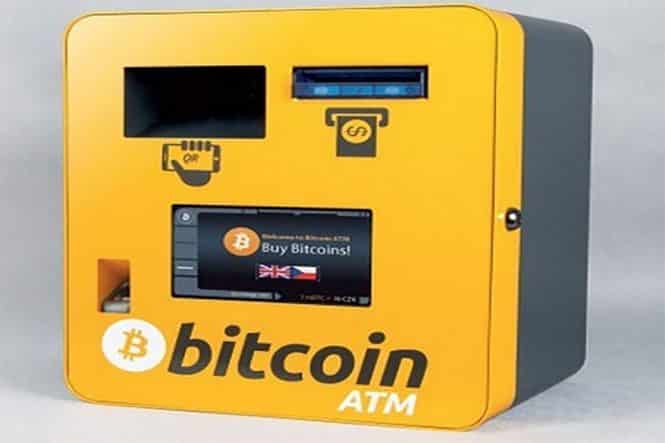


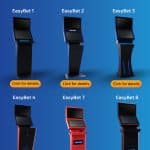
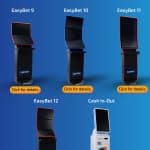

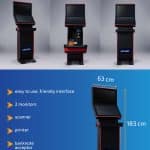
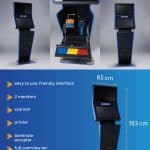
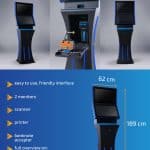
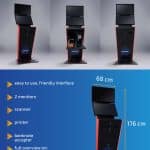
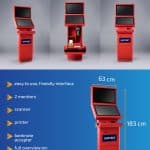
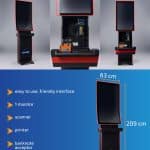
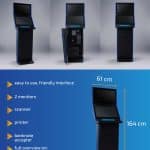
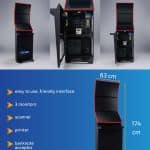
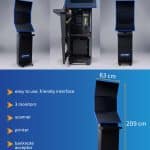
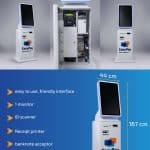
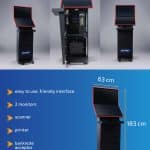



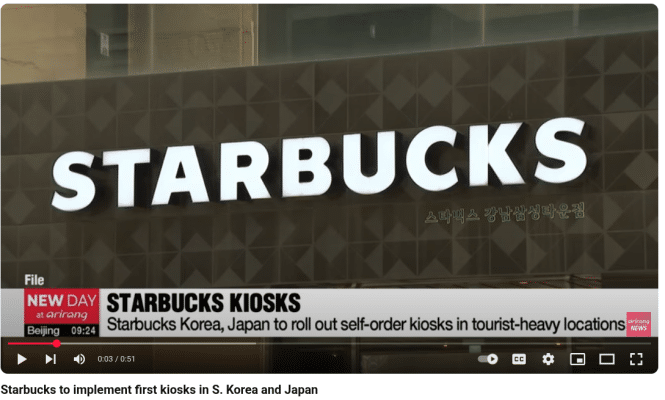


 Lightning-fast setup and content deployment
 Come see it all at InfoComm 2025
 June 11–13
 StudioDX and Wayfinding – Booth #3489 (inside the Kiosk Manufacturer Association booth)





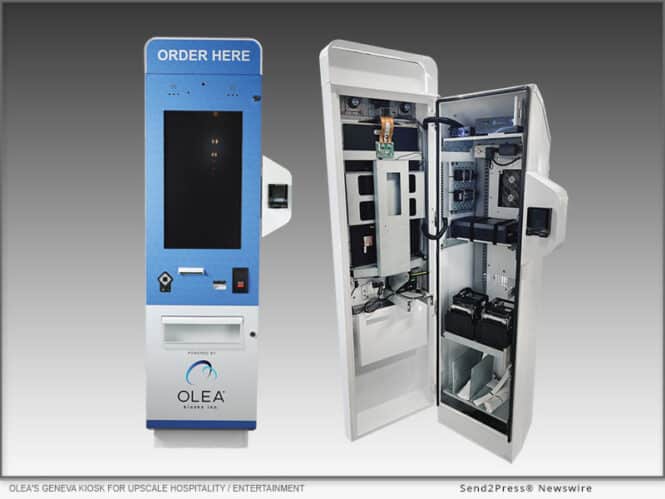





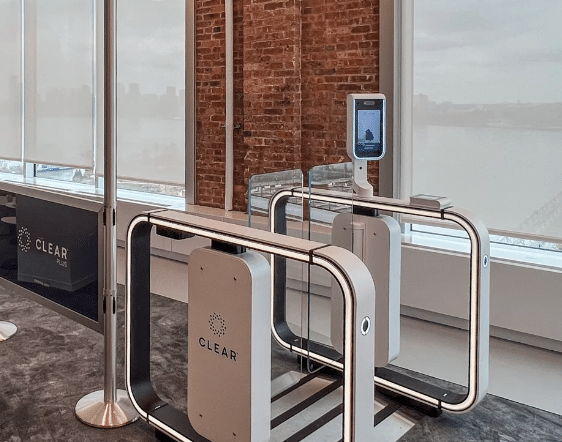

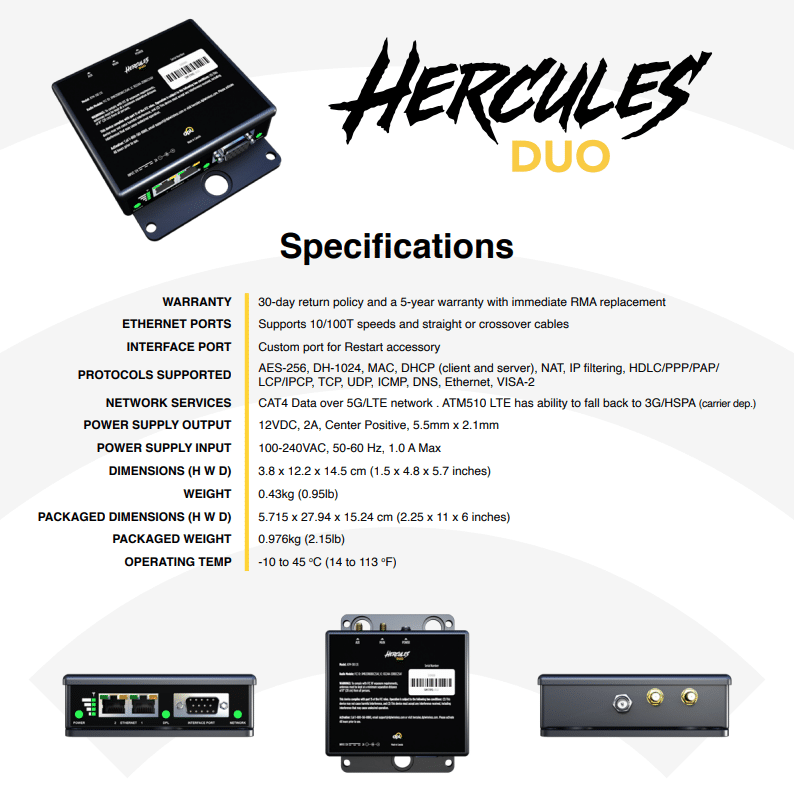



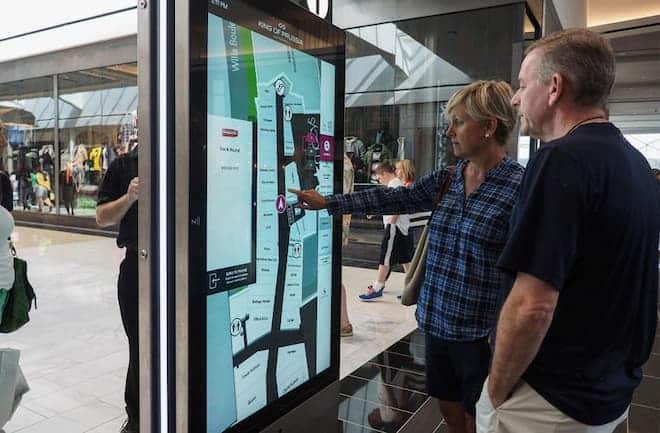
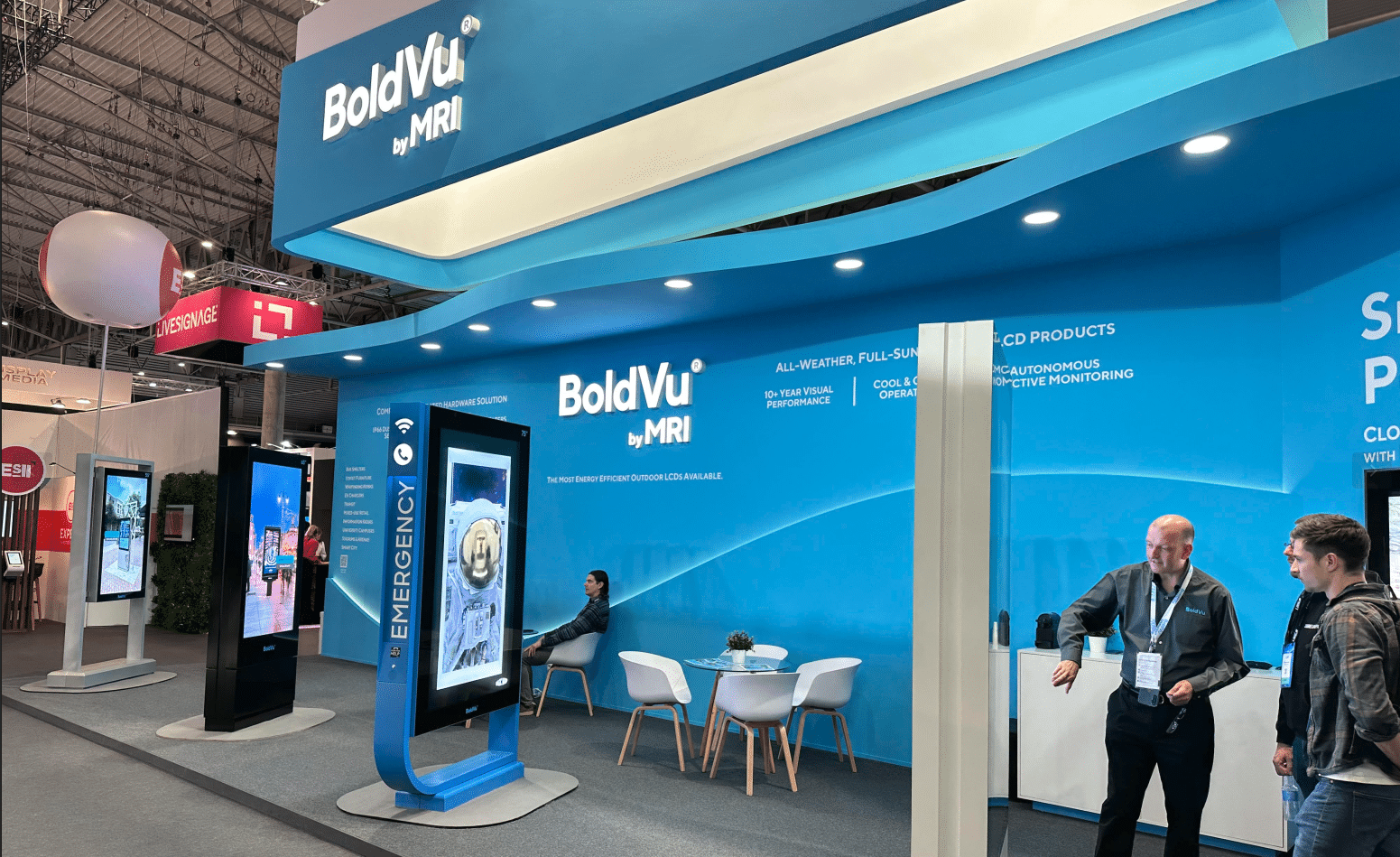

 Certified—Models are expected to work with ChromeOS Flex.